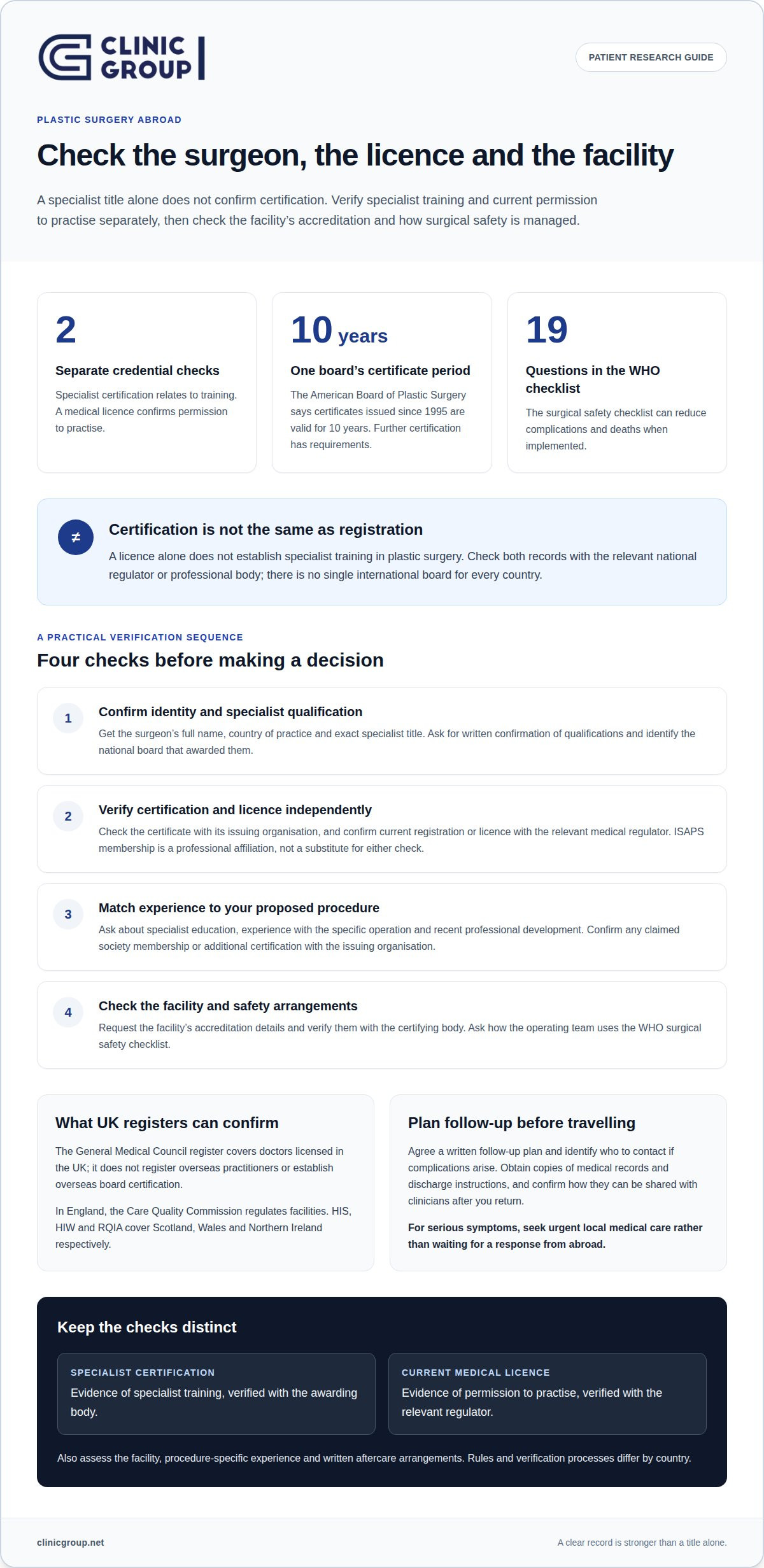
A surgeon’s title alone does not prove specialist certification. A board-certified plastic surgeon lookup abroad starts with confirming the surgeon’s specialist qualification through the relevant national or professional body, then checking their medical licence separately. Certification relates to specialist training; a licence confirms permission to practise. Also establish where the operation will take place and whether the facility is accredited.
It is reasonable to want clear evidence before deciding, especially when certification systems differ between countries. A clinic’s description is a useful starting point, but independently checking the surgeon’s credentials and experience, as well as the facility’s standards, gives you a fuller picture.
This guide explains how to check those details and assess evidence of experience with your specific procedure. You’ll learn how certification differs from licensure, how to assess facility accreditation, and which questions can help you understand a surgeon’s relevant experience before deciding on treatment abroad.
Key Takeaways
- Check specialist certification and current medical registration separately; each tells you something different about a surgeon’s credentials.
- Match the surgeon’s training and experience to the specific procedure you are considering.
- Look beyond the surgeon: assess the facility’s accreditation and ask how surgical safety is managed.
- Compare written quotes carefully, including what is covered, and understand the follow-up plan before making a decision.
- Use Clinic Group’s Plastic Surgery Provider Listings to explore verified clinics and support your research into treatment abroad.
How can you check a plastic surgeon’s credentials abroad?
A board-certified plastic surgeon lookup abroad starts with the surgeon’s full name, country of practice and exact specialist title. Request written confirmation of their qualifications, current registration and licence status, then verify these with the relevant national medical regulator. A medical licence permits practice; it does not establish specialist training in plastic surgery. The General Medical Council maintains the register of doctors licensed in the UK, but does not register overseas practitioners.
How can I verify a plastic surgeon’s board certification in another country? Identify the recognised plastic surgery board or professional society in that country, then check the surgeon’s name and certificate directly with that organisation. The American Board of Plastic Surgery is one example. Its certificates issued since 1995 are valid for 10 years, with requirements for an additional 10-year certification period.
Which official medical boards certify plastic surgeons in popular medical tourism destinations? There is no single international board covering every destination; the relevant certifying body depends on the country. Ask which national board awarded the qualification and verify it with that organisation. ISAPS membership is a separate professional affiliation, not a substitute for board certification or a current medical licence.
Check that the surgeon’s training is relevant to the operation you are considering. Ask about specialist education, experience with the specific procedure and recent professional development. A qualification in another medical specialty does not establish expertise in plastic surgery. If the surgeon claims national society membership or IBCFPRS certification, confirm the exact status and issuing organisation. Ask how their experience relates to your proposed technique.
How can I check a foreign clinic’s accreditation and patient safety standards? Request the facility’s accreditation details and the certifying body, then check them with that organisation. JCI accreditation is one example. The World Health Organization developed a 19-question surgical safety checklist that can reduce surgical complications and deaths when implemented; ask how the operating team applies it.
What rules apply to UK residents having cosmetic surgery abroad and returning for care? The surgeon and facility operate under the rules of their country; UK regulators do not certify them. In England, the Care Quality Commission regulates facilities, while HIS, HIW and RQIA cover Scotland, Wales and Northern Ireland respectively. GMC registration does not establish overseas board certification.
Before travelling, agree a written follow-up plan and identify whom to contact if complications arise. Obtain copies of your medical records, discharge instructions and relevant photographs, and establish how these can be shared with clinicians after you return. Ask the relevant regulator about complaints or restrictions, as processes differ by country. Seek urgent local medical care for serious symptoms rather than waiting for a response from abroad.
What does plastic surgery abroad cost?
The cost depends on the operation, the surgical plan and what the quoted fee includes. A facelift, rhinoplasty, breast augmentation and liposuction involve different clinical plans, so compare like with like rather than relying on a headline figure. For UK patients, ask for an itemised personal quote in pounds sterling before deciding.
| Procedure | Indicative price in GBP | What to clarify |
|---|---|---|
| Facelift | Request a personal written quote | Planned technique, anaesthesia and follow-up |
| Rhinoplasty | Request a personal written quote | Whether the plan addresses appearance, function or both |
| Breast augmentation | Request a personal written quote | Implant details, surgical fees and aftercare |
| Liposuction | Request a personal written quote | Treatment areas, facility costs and recovery arrangements |
Use these as prompts for requesting a quote, not as fixed fees. A written estimate should identify the planned procedure and explain which costs are included, so you can see what may be payable separately. The treatment scope, surgeon’s plan, anaesthesia and facility arrangements can all affect the total. Travel and accommodation are separate budget considerations unless the written quote explicitly includes them.
Before comparing providers, ask each to price the same proposed treatment. A quote for one area or technique may not be comparable with a plan that includes additional work. Check whether pre-operative assessment, tests, medicines, follow-up appointments and treatment for complications are included, excluded or charged separately. These details matter because the lowest initial figure may not represent the full cost of the planned treatment.
Ask for a written quote in GBP, with a clear breakdown of what is covered and any payment schedule. Confirm how changes to the plan would affect the amount due, and do not decide on verbal estimates alone. Your final plan should follow an in-person assessment, so the surgeon can consider your health, anatomy and goals before recommending an operation.
For an overview of planning treatment abroad, the guide to plastic surgery abroad for UK patients explains practical points to consider alongside the price. Compare the proposed care, written inclusions and aftercare arrangements as well as the quoted amount.
How do you verify a surgeon’s experience and facility?
Assess the surgeon and operating hospital as separate parts of your decision. A recognised specialist credential indicates relevant training, while experience with your specific procedure helps show whether that training fits your planned operation. Ask for the surgeon’s full name, exact procedure history and the facility’s legal name. These details let you check claims with the appropriate professional or accreditation organisation.
When assessing experience, ask how often the surgeon performs the exact procedure, not cosmetic surgery in general. Discuss the technique proposed for your anatomy and goals, and ask to see outcomes from comparable cases. Photographs can help illustrate the surgeon’s work, but they do not establish typical results. During your assessment, ask how complications are managed and who provides care after you leave hospital.
- Confirm the operating surgeon will perform the procedure and lead your care.
- Ask about experience with the specific operation and the reasons for the proposed technique.
- Discuss expected recovery, possible complications and follow-up arrangements before travelling.
Check the facility separately. Request its accreditation certificate, the name of the certifying organisation and confirmation that the certificate is current. JCI, or Joint Commission International, is a recognised accreditation for hospital quality and patient safety. Accreditation indicates that a facility has been evaluated against safety standards; it does not replace checking whether the planned operation is suitable for you.
How much do cosmetic surgery procedures cost abroad, including travel and follow-up care? There is no single total: the operation, assessment, facility arrangements, travel and duration of follow-up affect the overall budget. Ask for a written quote in GBP that itemises what the surgical fee covers, what is charged separately and how aftercare is arranged.
Ask who is responsible for each part of the journey: the surgeon, hospital team and any patient coordinator. Confirm where surgery will take place, who you can contact after discharge and how follow-up continues once you return to the UK. A clinic selection guide for treatment abroad can help you consider the facility’s standards alongside its communication and patient support. Keep the written treatment plan and contact details together before making travel arrangements.
What risks and aftercare should you consider?
Plastic surgery carries risks, including infection, bleeding, reactions to anaesthesia, poor wound healing and results that differ from your expectations. Risks depend on your health, the procedure and the care available before and after surgery. An in-person assessment is essential: the surgeon must review your health, examine the relevant area and discuss whether the operation is appropriate.
Remote photographs and video calls can support an initial discussion, but they cannot replace a physical examination. Before travelling, ensure the operating surgeon has assessed you in person and explained the proposed technique, likely recovery, possible complications and alternatives. A clear written surgical plan helps you understand what has been agreed and who is responsible at each stage.
Plan aftercare before booking. Ask who will review your recovery, how appointments are arranged and how to contact the overseas team once you are home. Confirm how your medical records, discharge instructions and prescriptions will be shared. Keep these documents accessible and make sure you understand which symptoms require prompt contact with the surgical team or urgent local medical attention.
Travel timing matters because flying soon after an operation can interfere with recovery and access to care. For major body surgery, a 7-10 day recovery and fit-to-fly window is relevant to planning a safe return flight. Your travel schedule should allow for the surgeon’s assessment of your recovery, rather than relying on a fixed departure date arranged before surgery.
- Get the surgeon’s contact details and the facility’s emergency contact process in writing.
- Confirm how scheduled reviews work after discharge and after returning to the UK.
- Ask who assesses a complication, where that assessment takes place and how records are transferred.
- Keep your written care plan and discharge information available when seeking medical help.
Plan for the possibility that a concern arises after you return. Contact the treating team using the agreed route, and seek urgent local care for a serious or rapidly worsening problem. Do not delay urgent assessment while waiting for an overseas reply. The guide to aftercare in the UK following surgery abroad can help you plan communication and follow-up before departure.
Aftercare is part of the treatment plan, not an optional extra. A sound decision weighs the operation alongside in-person assessment, recovery time, access to follow-up and a clear response plan for complications.
How can you choose a verified plastic surgery provider?
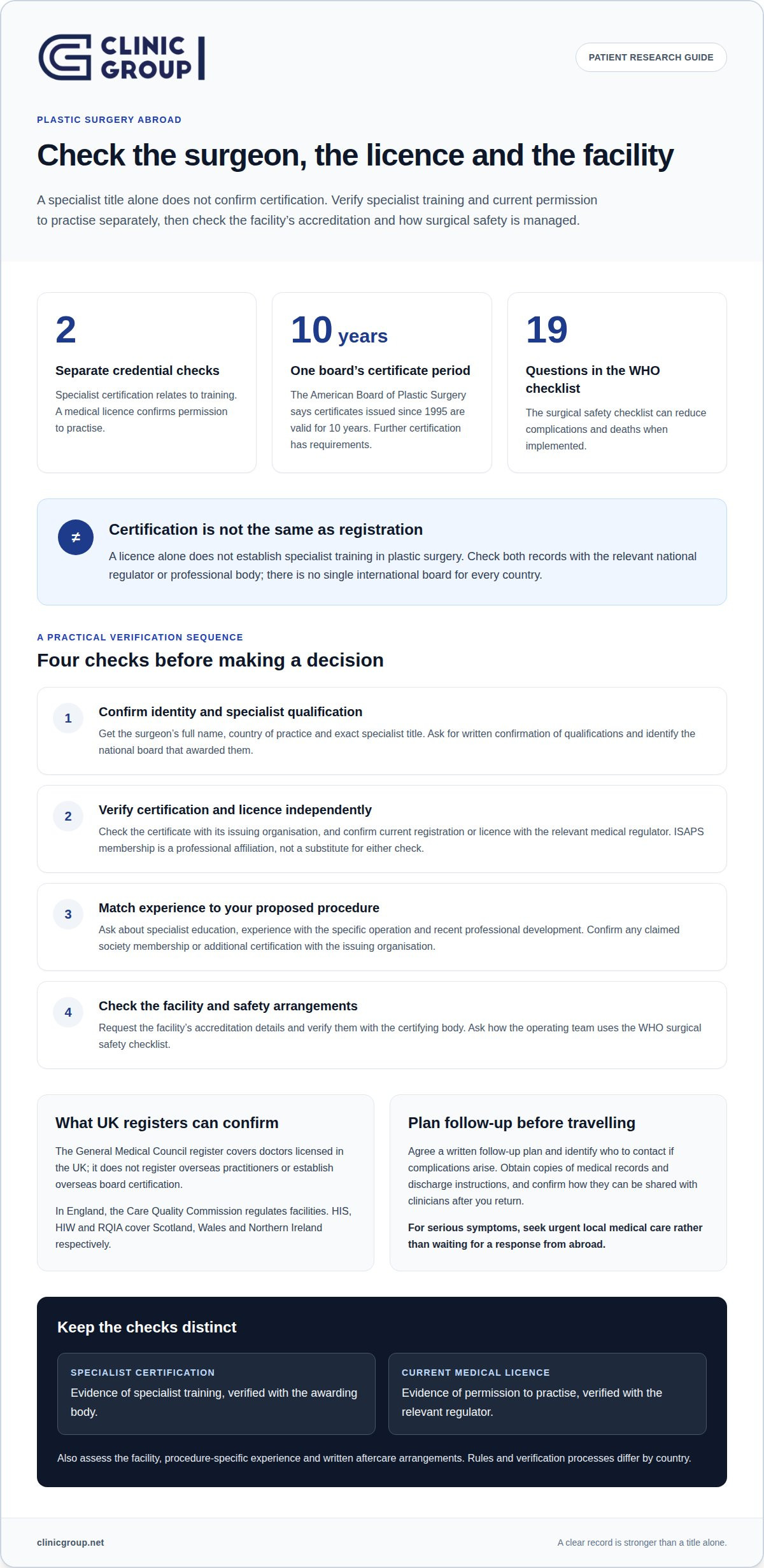
Choose a provider by considering the surgeon, operating facility and care pathway together. A verified listing is a useful starting point, but your decision should be based on clear information about who will perform the operation, where it will take place and how support continues after discharge. The clinic’s answers should be consistent across the consultation, treatment plan and written documents.
Review the surgeon’s specialist credentials alongside their experience with your planned procedure. Ask who will lead your assessment, perform the operation and manage follow-up. The consultation should cover your goals, medical history, suitable options, likely recovery and material risks. The proposed operation should be explained in terms you understand, without pressure to decide before reviewing the plan.
- Confirm the surgeon’s identity and role in your care, including who performs each part of the procedure.
- Ask for the facility’s name, accreditation details and the organisation responsible for that accreditation.
- Request a written treatment plan covering the procedure, recovery instructions and follow-up arrangements.
- Clarify how you can contact the clinical team if you have concerns after leaving the facility.
Safety arrangements should be specific, not broad assurances. Ask how the team checks your identity and planned operation, obtains consent, prepares you for anaesthesia and responds to emergencies. Find out which staff will be present and how information is handed over between the surgeon, hospital and recovery team. These details help you understand how safety protocols work in practice.
Patient support also matters when travelling internationally. Establish who coordinates appointments, explains instructions and helps resolve communication difficulties. Confirm that consultation and consent take place directly with the treating surgeon, rather than relying only on administrative or travel staff. You should have time to ask questions and receive clear answers before agreeing to surgery.
Before deciding, read reviews with care. Look for accounts that discuss the consultation, communication, aftercare and response to concerns, rather than relying on praise alone. Understanding clinic reviews before treatment abroad can help you interpret patient feedback alongside formal credentials and written care plans.
Finally, compare the whole pathway, not just the operation. A suitable provider should explain what happens before surgery, during recovery and after you return home. If details about the surgeon, facility or follow-up remain unclear, pause your decision until you understand the proposed care and responsibilities.
How can Clinic Group help you find a plastic surgery provider?
Clinic Group’s Plastic Surgery Provider Listings provide a starting point for browsing verified clinics while researching treatment abroad. A board-certified plastic surgeon lookup abroad can help you identify credentials and experience to discuss with a provider. Clinic Group is a directory and coordinator, not the treating clinic; the independent provider is responsible for assessment, clinical decisions and treatment.
The listings feature verified partner clinics almost entirely in Tirana, Albania, with a small number in Dubai, UAE. Start by identifying the procedure you are considering, such as rhinoplasty, liposuction, breast augmentation or a facelift. Review the listing, note what matters to you and prepare questions for the clinic’s clinical team before arranging a consultation.
A consultation is useful for discussing your goals and medical history with the treating surgeon. Use it to understand the proposed approach, alternatives, recovery needs and risks. You can also ask about the surgeon’s role, the clinic’s arrangements and communication during follow-up. The consultation gives you an opportunity to discuss your case with the provider; it does not guarantee that surgery will be suitable.
As you explore a listing, organise your research around practical points:
- Record the name and specialist credentials of the surgeon who would assess and treat you.
- Ask how the surgeon’s experience relates to your specific planned procedure.
- Find out which facility would be used and what accreditation applies there.
- Clarify how the provider handles follow-up and communication after you return home.
Keeping these details together makes it easier to compare the proposed care pathway with your priorities. Note which answers come directly from the treating team, and retain written information for reference. Before arranging travel, read the treatment plan carefully and make sure responsibilities for clinical care and follow-up are clear. Clinic Group’s directory supports your search, while the independent clinic remains responsible for medical care.
If you are ready to explore listed options, browse plastic surgery provider listings with Clinic Group.
Considering treatment in Albania? Request a free consultation with Clinic Group.
Frequently Asked Questions
Is the plastic surgeon certified?
You can establish certification by checking the surgeon’s exact qualification with the organisation that issued it. Ask for the full name of the board or national society, the specialty stated on the certificate and the surgeon’s registered name. Then contact the organisation or use its official register to confirm the credential. Society membership alone does not prove board certification or current permission to practise.
What are the red flags of an unsafe cosmetic surgeon?
Be cautious if the surgeon’s qualifications are described vaguely, you cannot speak directly with the treating doctor, or you are pressured to pay before your questions are answered. Promises of guaranteed results are another warning sign. Pause if the proposed operation, facility, risks or follow-up arrangements remain unclear, or if the clinic will not provide essential treatment information in writing.
What is the surgeon’s training?
A surgeon’s training record should set out their medical education, postgraduate surgical training and specialist preparation. Ask which organisation awarded each relevant qualification and whether further training focused on plastic surgery or the procedure you are considering. For example, a general surgical qualification alone does not show specialist preparation for aesthetic plastic surgery. Match documented training to the operation being discussed.
What questions should I ask a surgeon before booking?
Ask who will perform the operation, why the proposed technique suits your circumstances and what alternatives are available. Clarify the main risks, expected recovery, possible changes to the plan and how concerns are handled after discharge. Ask how to contact the surgeon, whether an interpreter will be involved and which documents you will receive. Keep the answers with your written treatment plan.
How do I check whether a foreign plastic surgeon is licensed and in good standing?
Find the medical regulator for the country where the surgeon practises and search using their full registered name. Check that the registration is current and belongs to the correct person. Ask the regulator how it handles restrictions or complaints, as records and disclosure processes vary between countries. If you cannot match a name or status, ask the surgeon to clarify it before proceeding.
What qualifications should a UK patient look for when choosing a plastic surgeon abroad?
Look for a current medical licence and a specialist qualification in plastic surgery, or the closest recognised equivalent in the surgeon’s country. Confirm which national board or professional organisation awarded it, and whether the surgeon’s training relates to your planned procedure. As a UK patient, also ensure you can understand the consultation and receive the treatment plan and follow-up information in a language you understand.
How can I verify a surgeon’s specialty training, hospital privileges, and experience?
Ask the surgeon for the awarding body’s name and details of training relevant to the planned operation. Contact the hospital to establish whether the surgeon is authorised to perform that procedure there and which facility will provide care. To assess experience, request information about comparable cases and how outcomes are evaluated. Patient photographs can inform a discussion, but cannot predict your individual result.
What are the differences between UK GMC registration and overseas board certification?
GMC registration applies to doctors practising in the UK and shows their UK registration and licence status; it is not an overseas specialist board certificate. Board certification is awarded by a specialty board within a particular system and relates to specialist standards there. For treatment abroad, check the surgeon’s local licence and relevant plastic surgery certification separately, as neither replaces the other.

Article by
Clinic Group Editorial Team
The Clinic Group editorial team publishes clear, practical guides for UK and EU patients researching medical travel — from dental implants and hair transplants to plastic surgery and eye care — with a focus on verified clinics, transparent “from” pricing, and safe planning.
Disclaimer
This article is for general information only and is not medical advice, diagnosis, or a substitute for an in-person consultation with a qualified clinician. Treatment suitability, risks, timelines, and costs vary by individual. Clinic Group connects patients with independent clinics; those clinics are responsible for clinical care. Always verify credentials, obtain a written treatment plan and itemised quote, and confirm aftercare arrangements and travel insurance cover (elective procedures are often excluded) before booking. Outcomes cannot be guaranteed.