TL;DR:
- Set clear priorities based on clinical quality, experience, accreditation, and patient support needs.
- Verify clinic credentials through independent accreditation, reviews, and before-after photos.
- Request detailed, itemized quotes and plan logistics thoroughly to ensure good value and safety.
Choosing a clinic abroad for medical or dental treatment feels straightforward until you actually start looking. Suddenly, you are faced with hundreds of options, wildly varying prices, and clinics that all claim to be the best. The stakes are real: a poor decision can mean hidden costs, substandard results, or even health complications that require costly corrective treatment back home. This guide walks you through a clear, evidence-based process for selecting the right clinic, covering everything from defining your priorities and verifying credentials to comparing costs and planning your travel, so you can make a confident decision rather than a regrettable one.
Table of Contents
- Set your priorities: what matters most in a clinic?
- Research clinic credentials and reputation
- Compare costs, inclusions and aftercare
- Plan logistics and ensure clear communication
- Why trusting your process matters more than trusting promises
- Find your clinic with Clinic Group
- Frequently asked questions
Key Takeaways
| Point | Details |
|---|---|
| Set clear priorities | Defining what matters most helps narrow your clinic options quickly and confidently. |
| Check credentials and reviews | Always verify accreditation, patient outcomes, and real reviews for each short-listed clinic. |
| Compare costs and aftercare | Ask for an itemised quote and clarify what is included to avoid surprise expenses. |
| Plan every detail | Thorough preparation and clear communication ensure a smoother, safer medical experience abroad. |
Set your priorities: what matters most in a clinic?
Before you open a single browser tab, take a moment to clarify what you genuinely need from a clinic. This single step saves hours of research and protects you from being swayed by polished marketing materials that look impressive but tell you very little about clinical quality.
Every patient’s priorities are different. For some, the most important factor is cost, particularly for larger treatments such as full dental restorations, rhinoplasty, or hair transplants, where prices in the UK or Western Europe can be prohibitively high. For others, the availability of English-speaking staff is non-negotiable, especially if they feel anxious about communicating symptoms or post-operative concerns. Some patients prioritise a clinic’s specific expertise in a particular treatment, while others want reassurance that aftercare and follow-up support are built into the package.
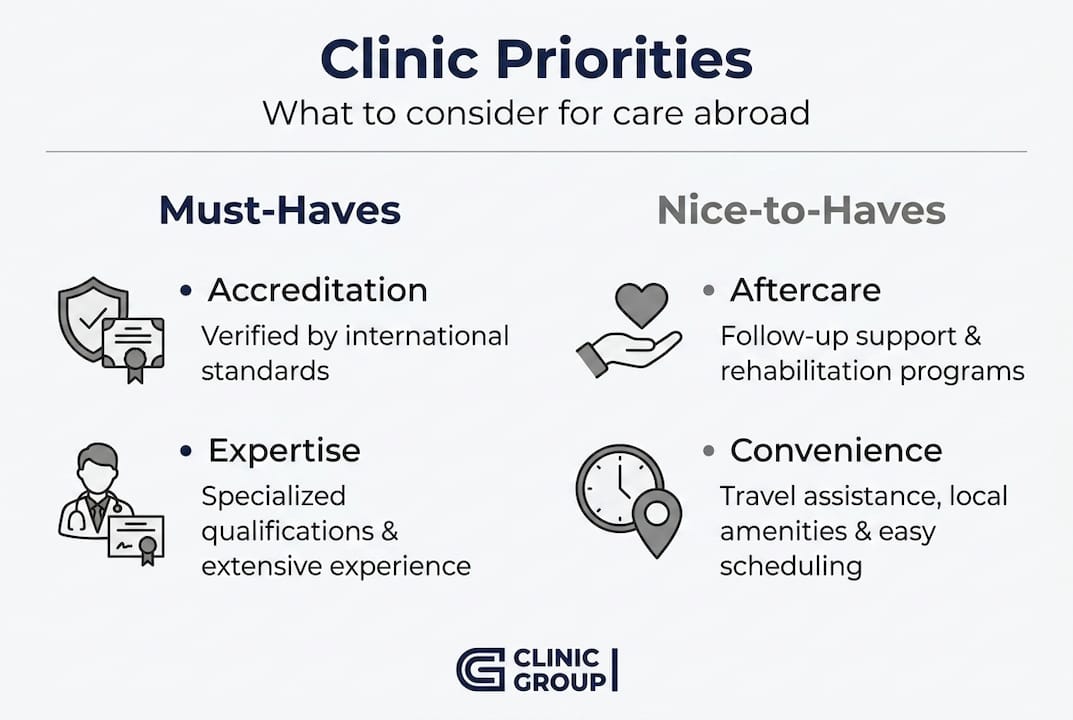
To organise your thinking, separate your criteria into two categories:
Must-haves:
- Board-certified or internationally accredited surgeons and specialists
- English-speaking staff or access to a dedicated patient coordinator
- Demonstrated experience with international patients
- Transparent pricing with a detailed written quote
- Clearly defined aftercare and follow-up protocols
- Verifiable licensing and registration with the relevant national health authority
Nice-to-haves:
- In-house accommodation assistance or partnerships with local hotels
- Airport transfers included in the package
- On-site pharmacy or prescription services
- Multilingual patient support beyond English
- Virtual consultation options before you travel
Evaluating clinics’ specialties and expertise is essential for quality care, and starting with a clear list of your own requirements makes that evaluation far more focused and effective. You can browse a structured clinic directory to filter options by location, treatment type, and accreditation status, which immediately narrows the field.
It is also worth reviewing a broad range of treatment specialties before you settle on a clinic, because some facilities excel in one area but offer only basic services in another. A clinic that ranks highly for cosmetic dentistry may not be the ideal choice for orthopaedic procedures, and vice versa.
Pro Tip: Create a simple spreadsheet with your must-haves listed as column headers, then score each clinic against them. This removes emotion from the process and keeps you objective when glossy brochures and persuasive testimonials start to blur the lines.
Research clinic credentials and reputation
Once you know your priorities, the next step is to ensure shortlisted clinics genuinely meet high standards. Reputation is not merely a collection of five-star reviews; it is a pattern of consistent, verifiable evidence that a clinic delivers safe and effective care.

1. Check international accreditations
Accreditation from bodies such as the Joint Commission International (JCI) or ISO certification signals that a clinic has been independently audited against rigorous standards for patient safety, clinical governance, and operational quality. JCI accreditation in particular is widely regarded as the gold standard for hospitals and clinics operating in the international medical tourism market. It covers everything from infection control procedures to how complaints are handled.
2. Read reviews critically
Patient reviews on independent platforms such as Google, Trustpilot, or Doctify are valuable, but you need to read them analytically. Look for patterns rather than individual comments. If multiple reviewers mention long waiting times, difficulty contacting the clinic after returning home, or unexpected extra charges, take those consistent themes seriously. Conversely, consistent praise for clear communication, professional staff, and clean facilities is a genuinely positive indicator.
3. Examine before and after photographs
For aesthetic and dental treatments, before and after photographs provide tangible evidence of clinical skill. Ask whether the photos belong to actual patients treated at that clinic, and be cautious if images look heavily edited or if the clinic cannot provide a broad range of examples across different case complexities.
4. Use comparative data where available
| Quality indicator | What to look for | Red flag |
|---|---|---|
| Accreditation status | JCI, ISO, or national health body approval | No verifiable accreditation listed |
| Surgeon qualifications | Board-certified, internationally trained | Vague credentials or no listed qualifications |
| Patient review score | Consistently 4.5 stars or above on multiple platforms | Reviews only on clinic’s own website |
| Complication disclosure | Clinic openly discusses risks and outcomes | No mention of risks or complications at all |
| Response time | Responds to enquiries within 24 hours | Slow, inconsistent, or evasive responses |
Accreditations and positive patient reviews are strong indicators of quality, and cross-referencing both gives you a much clearer picture than relying on either alone. You can find guidance on how to apply this to dental care specifically through these safe dental treatment tips, which are equally useful when assessing any specialist clinic abroad.
“A clinic that welcomes scrutiny, openly shares its credentials, and provides honest information about risks is demonstrating exactly the kind of transparency that high-quality healthcare requires.”
When you feel confident about a clinic’s credentials, browse clinics using verified directories to cross-check the information you have gathered independently. A well-structured directory that lists accreditation status, specialties, and patient feedback provides a reliable second layer of verification.
5. Watch for red flags
Avoid clinics that cannot or will not provide proof of licensing, that pressure you to commit quickly, or that offer prices dramatically lower than every comparable facility without a clear explanation. Exceptionally low prices sometimes reflect genuine cost-of-living advantages in a particular country, but they can also signal corners being cut on materials, staffing, or sterilisation standards.
Compare costs, inclusions and aftercare
After verifying quality, it is crucial to understand exactly what your money covers and, just as importantly, what it does not. Price quotes for medical treatment abroad can vary significantly not because the underlying procedure is different, but because clinics structure their packages in very different ways.
The table below illustrates how two clinics might quote differently for the same dental implant procedure:
| Item | Clinic A (package price) | Clinic B (itemised) |
|---|---|---|
| Initial consultation | Included | £80 |
| Implant procedure | Included | £900 |
| CT scan and diagnostics | Included | £150 |
| Temporary restoration | Included | £120 |
| Permanent crown | Included | £350 |
| Post-operative check-up | Included | £60 |
| Airport transfer | Included | Not included |
| Total estimated cost | £1,400 | £1,660+ |
At first glance, Clinic B’s advertised implant price may look cheaper if you only see the headline figure. The full picture tells a different story. Different clinics offer varied cost structures and inclusions for similar treatments, which is why requesting a fully itemised quote before booking is essential. You can review a range of treatment price comparisons to get a realistic benchmark for the procedure you are considering.
Key questions to ask about costs and aftercare:
- Does the quoted price include all diagnostic imaging, such as X-rays or CT scans?
- Are consultations before and after the procedure included or charged separately?
- What follow-up support is provided if you experience complications after returning home?
- Is there a dedicated aftercare coordinator you can contact directly?
- Does the clinic offer remote follow-up appointments via video call?
- Are prescription medications included in the package or billed additionally?
- What is the clinic’s policy if a procedure needs to be revised or repeated?
Aftercare is an area many patients underestimate until they need it. A dental implant, cosmetic surgery result, or hair transplant outcome depends not just on the procedure itself, but on the support and monitoring you receive in the weeks and months that follow. Clinics that offer robust aftercare, including scheduled check-in calls, access to a patient coordinator, and clear escalation pathways if something is wrong, represent genuinely better value even if their upfront price is slightly higher.
Pro Tip: Never choose a clinic on price alone. A package that costs £200 more but includes all diagnostics, transfers, and six months of follow-up aftercare will almost always deliver better overall value than a cheaper quote that leaves you paying for every additional item separately.
Plan logistics and ensure clear communication
Once you are confident in your shortlist, detailed preparation is what transforms a good choice into a smooth experience. International medical treatment involves more moving parts than a standard appointment at home, and small oversights in planning can create unnecessary stress or, in more serious cases, safety risks.
Follow these steps to prepare effectively:
-
Confirm the appointment in writing. Once you have chosen a clinic, confirm the date, time, treatment plan, and lead clinician’s name via email. This creates a clear record and gives you something to reference if any details change.
-
Sort your travel arrangements early. Book flights and accommodation as soon as your appointment is confirmed. If the clinic offers airport transfers, arrange these at the same time and confirm the pick-up point and timing. If you are arranging your own transport, research journey times carefully to avoid arriving at the clinic stressed or late.
-
Gather all necessary documents. This includes your passport or national identity card, travel insurance documents, any existing dental or medical records relevant to the treatment, a list of current medications (with generic names, not just brand names), and the clinic’s contact details including an emergency number.
-
Check your travel insurance covers medical treatment abroad. Standard travel insurance often excludes elective procedures. If you are travelling specifically for treatment, ensure your policy covers complications related to the procedure, the cost of extended stays if recovery takes longer than planned, and repatriation if necessary.
-
Prepare your questions in advance. Write down everything you want to ask the clinician before you travel, including questions about anaesthesia, recovery time, activity restrictions, and what to do if you notice unusual symptoms after returning home.
-
Confirm all details 48 hours before travel. Contact the clinic to reconfirm your appointment, check there are no changes to the schedule, and verify that all documents you were asked to bring have been received or are ready.
Proper planning ensures safety and minimises misunderstandings during international treatment, and reviewing practical consultation planning tips before you travel can help you feel genuinely prepared rather than just hopeful.
Pro Tip: Use email rather than phone calls for all key communications with the clinic. Written correspondence creates an unambiguous record of what was agreed, what was promised, and what you were told, which is invaluable if any discrepancy arises later.
Language barriers deserve particular attention. Even when clinic staff speak English, medical terminology can cause confusion. If you have any concerns about communication, ask the clinic whether a patient coordinator or interpreter will be present during your consultation and procedure. Reputable clinics that regularly treat international patients will have robust systems in place for exactly this reason.
Why trusting your process matters more than trusting promises
There is a perspective worth sharing that most articles in this space do not offer directly. The clinics that invest most heavily in glossy websites, polished testimonials, and aggressive outreach are not necessarily the best clinics. They are often simply the best marketed. This distinction matters enormously when your health is at stake.
Patients who follow a structured, evidence-based process consistently report better outcomes than those who rely on a strong gut feeling or a persuasive sales interaction. The process does not need to be complicated. It needs to be consistent: verify credentials independently, ask the same questions of every clinic you consider, compare complete costs rather than headline prices, and plan logistics with the same care you would give to any significant healthcare decision at home.
The international medical tourism sector is growing rapidly, and with that growth comes both opportunity and risk. Patients who approach this space as empowered, informed consumers, rather than passive recipients of whatever a clinic tells them, are far better positioned to access the genuine value that treatment abroad can offer. Reading resources like this dental guide perspective can help you apply the same critical thinking to specific treatments. Trust the process, and the process will protect you.
Find your clinic with Clinic Group
Having the right information and strategy makes all the difference when choosing a clinic abroad, and Clinic Group is designed to make that next step straightforward. The platform connects patients with verified, accredited clinics and specialists across Europe and the Middle East, covering a wide range of treatments directory from cosmetic dentistry and hair transplants to anti-ageing therapies and cosmetic surgery. You can search by treatment type, location, or support services, read verified patient reviews, and request a personalised consultation to discuss your specific needs. Explore our clinic network today and take the first step towards affordable, high-quality care with full confidence.
Frequently asked questions
What key qualifications should I look for in a clinic abroad?
Look for clinics with international accreditation such as JCI or ISO certification, experienced board-certified specialists, and consistent positive reviews across independent platforms. Evaluating clinics’ specialties and expertise is essential for quality care and should be your first point of verification.
How do I avoid hidden costs with international medical treatment?
Always request a fully itemised written quote that lists every component of your treatment, including diagnostics, consultations, transfers, and aftercare. Different clinics offer varied cost structures and inclusions for similar treatments, so comparing like for like is the only reliable approach.
Is aftercare typically included in treatment packages abroad?
Many clinics include some degree of aftercare within their packages, but the scope varies considerably. Always ask the clinic specifically what aftercare is provided, for how long, and how you can access support after you return home, as different clinics offer varied inclusions even for identical procedures.
What should I prepare before travelling for treatment?
Confirm all bookings in writing, arrange appropriate travel insurance that covers elective procedures and potential complications, gather all relevant medical records and documents, and prepare a written list of questions for the clinic. Proper planning ensures safety and significantly reduces the risk of misunderstandings during international treatment.