Spain is a sensible choice for most UK patients seeking elective treatment abroad, particularly for fertility, dental care, cosmetic surgery, and bariatric procedures. The country sits within easy flying distance and operates a well-regulated private healthcare sector that offers substantial savings compared with UK private rates. Two things to confirm immediately: your clinic has a dedicated international patient coordinator, and you have specialist medical tourism insurance in place before you travel. Your GHIC card will not cover elective private treatment or any complications arising from it.
- Spain performs a significant proportion of European IVF cycles, making it a leading fertility destination.
- GHIC and EHIC cover only medically necessary, state-provided emergency care during a temporary visit — not planned surgery, dental treatment, or cosmetic procedures.
- Savings compared with UK private care are realistic for many elective procedures, though Spain sits mid-range compared with Eastern Europe or Turkey.
- Complex, multi-stage care (oncology, major cardiac surgery, complex neurology) is generally better managed locally where your NHS records and specialist team are already in place.
Pro Tip: Before you travel, insist on a written, itemised factura (invoice) and a formal informe médico (medical report) from your clinic. Without these two documents, your travel insurer cannot process a claim and your UK GP cannot safely manage your post-operative care.
Table of Contents
- How Spain’s healthcare system works for medical tourists
- Which procedures draw international patients to Spain
- Where in Spain should you receive treatment?
- What does treatment in Spain actually cost?
- Quality, safety and patient protections in Spain
- Your step-by-step patient journey from enquiry to recovery
- How to choose a clinic: questions to ask and red flags to avoid
- Aftercare, complications and continuity once you’re back in the UK
- Key takeaways
- A note from Clinicgroup on booking safely
- Clinicgroup’s verified treatment network: where to start
- Useful sources and further reading
- FAQ
How Spain’s healthcare system works for medical tourists
Spain’s public health system, the Sistema Nacional de Salud (SNS), provides universal coverage to legal residents across 17 autonomous communities. Each community manages its own health planning, financing, and service delivery, which means quality, waiting times, and oversight standards can vary noticeably from region to region. For international patients, this decentralisation matters: private clinics operate within a regional licensing framework, so the regulatory environment in Andalucía differs from that in Catalonia or Madrid.
As a UK visitor, your GHIC or EHIC entitles you to medically necessary, state-provided emergency healthcare during a temporary stay. Before using any public facility, the EU advises patients to confirm the centre accepts the card and to contact the relevant autonomous community’s public health services for details. Elective private procedures, dental treatments, and cosmetic surgeries are excluded entirely. Complications arising from those procedures are also excluded.
Routine primary care presents a practical barrier. Spain’s centros de salud (primary care centres) typically require a SIP (tarjeta sanitaria individual), the Spanish health card, for registration. Short-term visitors cannot access routine public primary care without one, which means private providers are the only realistic option for most medical tourists. Major private hospitals in Madrid and Barcelona have dedicated international patient departments with English-speaking coordinators, published outcome data, and established pathways for overseas patients. That infrastructure is what makes Spain viable for planned treatment, not the public system.
Key insight: Spain’s decentralised governance means regional authorities control licensing and oversight for private clinics. Quality and patient protections can vary between autonomous communities — always verify a clinic’s regional registration, not just its national-level credentials.
Which procedures draw international patients to Spain
Spain’s private sector covers a wide range of specialities, but certain procedures attract disproportionate numbers of international patients because of price, regulatory environment, or clinical volume.
- Fertility treatment (IVF and egg donation): Spain’s legal framework permits anonymous egg donation, which addresses the donor shortages many UK patients face at home. With roughly 15% of European IVF cycles performed here and assisted reproduction accounting for around 12% of births, clinics have high volumes and experienced embryology teams. Expect multiple visits for a full cycle.
- Dental treatment: Implants, crowns, veneers, and full-arch restorations are among the most common reasons UK patients travel. Prices are substantially lower than UK private rates, and many dental clinics in resort areas are built around short-stay international patients.
For guidance on assessing dental quality before you book, check the criteria that matter most.
- Cosmetic surgery: Rhinoplasty, breast augmentation, facelifts, liposuction, and abdominoplasty are all well-supported in major Spanish cities. Surgeon volume and board certification are the key variables to verify.
- Bariatric surgery: Gastric sleeve and gastric bypass procedures attract patients who face long NHS waiting times. Spanish private hospitals offer competitive pricing and short-stay packages.
- Hair transplants: FUE and DHI procedures are available across multiple hubs, though Spain is not the lowest-cost destination for this treatment.
- Ophthalmology: LASIK, lens replacement, and cataract surgery are offered at several internationally oriented clinics, particularly in Madrid and Barcelona.
- Orthopaedics: Hip and knee replacements draw patients who face extended NHS waits, though these procedures require careful aftercare planning before you travel.
Single-visit procedures (many dental treatments, day-surgery cosmetic operations) are logistically straightforward. Multi-visit treatments such as IVF cycles or staged dental implant work require more planning, with at least two trips typically needed.
Where in Spain should you receive treatment?
Spain’s private medical sector is not evenly distributed. Madrid and Barcelona concentrate the largest internationally oriented private hospitals, with full specialist teams, English-speaking coordinators, and published outcomes. Resort areas, particularly the Costa del Sol, Balearic Islands, and Canary Islands, host a different type of clinic: smaller, often specialised in dental or cosmetic work, and built around short-stay packages that combine treatment with recuperation.

Madrid is the strongest choice for complex procedures. Hospitals such as those in the major private groups offer multi-specialty teams, on-site diagnostics, and established international patient departments. If your procedure carries meaningful surgical risk or requires specialist anaesthesia, a city hospital is the safer option.
Barcelona mirrors Madrid in terms of clinical depth and adds the advantage of strong English-language services across both public and private sectors. It is particularly well-regarded for fertility clinics and cosmetic surgery.
Costa del Sol (Málaga, Marbella) has a long-established international patient base. Clinics here are experienced with UK patients, often have English-speaking staff throughout, and offer combined treatment-and-recovery packages. For dental implants or straightforward cosmetic procedures, this region is practical and well-serviced.
Valencia and Alicante offer a growing number of internationally oriented private clinics at prices that can undercut Madrid and Barcelona, with good flight connections from the UK.
Balearic and Canary Islands suit patients who want to combine a short recovery period with a familiar holiday environment. Clinic density is lower, so verify that your specific procedure is well-supported before choosing a resort destination over a city.
Pro Tip: For any procedure requiring general anaesthesia, overnight stays, or specialist follow-up, prioritise a major city hospital with a documented international patient department. Resort clinics are well-suited to day-surgery dental and minor cosmetic work, but they are not the right setting for complex cases.
What does treatment in Spain actually cost?
Savings versus UK private care are real and consistent. For most elective procedures, patients save significant amounts compared with UK private rates, though Spain is more expensive than Albania, Turkey, or Hungary for the same treatments. The table below shows representative price bands; actual quotes will vary by clinic, city, surgeon seniority, and what is included.

| Procedure | Typical range (€) | Usually included | Often excluded |
|---|---|---|---|
| Dental implant (single) | €1,200–€3,000 | Implant, crown, fitting | Pre-op CBCT scan, bone graft if needed |
| IVF cycle (own eggs) | €4,500–€7,000 | Stimulation, retrieval, transfer | Medication, donor fees, embryo storage |
| Rhinoplasty | €4,000–€6,000 | Surgeon, anaesthesia, one night | Pre-op tests, post-op garments, follow-up |
| Breast augmentation | — | Implants, surgeon, anaesthesia | Pre-op bloods, post-op bra, follow-up |
| Gastric sleeve | €8,000–€11,000 | Surgery, 2–3 nights, dietitian | Pre-op tests, post-op supplements, follow-up |
| Private GP consultation | €60–€150 | Consultation, basic advice | Tests, prescriptions |
| Private emergency room | €200–€400 | Assessment, basic treatment | Imaging, admission, specialist referral |
Package pricing varies considerably. Some clinics quote an all-in figure covering consultation, procedure, anaesthesia, one or two nights’ accommodation, and airport transfers. Others quote the surgical fee alone and add each component separately. Always request a written breakdown before paying a deposit, and confirm in writing what happens financially if a complication requires additional treatment or an extended stay.
Quality, safety and patient protections in Spain
Spain’s private healthcare sector is regulated at both national and regional level. The national Ministry of Health sets baseline standards; autonomous communities apply and enforce them locally. For international patients, the practical question is not whether Spain has regulations, but whether the specific clinic you are considering meets them and can demonstrate it.
Verifiable trust signals to look for include:
- Regional facility registration: Every private clinic must be registered with its autonomous community’s health authority. Ask for the registration number and verify it.
- JCI accreditation: A small number of Spanish private hospitals hold Joint Commission International accreditation, the most widely recognised international standard. Its presence is a strong signal; its absence is not automatically disqualifying, but warrants closer scrutiny. For a clear explanation of what medical tourism accreditation means in practice, that guide covers the key standards.
- SEF registry (fertility): Clinics offering assisted reproduction should be registered with the Sociedad Española de Fertilidad (SEF). Confirm registration before proceeding.
- Clinician board certification: Ask for the surgeon’s número de colegiado (medical registration number) and verify it through the relevant Colegio de Médicos.
- International patient coordinator: A named, English-speaking coordinator who manages your case from enquiry to discharge is a non-negotiable standard for overseas patients.
Regarding complaints and malpractice: Spain has a formal complaints process through regional health authorities, and patients can pursue civil claims through the Spanish courts. In practice, the most effective protection is documentation. Keep every consent form, every invoice, every test result, and every written communication. If a complication arises after you return to the UK, your insurer and your GP will need this evidence to act.
Your step-by-step patient journey from enquiry to recovery
A well-managed medical trip to Spain follows a clear sequence. Rushing any stage increases risk.
- Initial enquiry and remote consultation: Contact the clinic or a facilitator such as Clinicgroup. Share your medical history, photos (for cosmetic procedures), and any relevant test results. Most clinics offer a free remote consultation before quoting.
- Quote and travel planning: Receive a written, itemised quote. Confirm what is and is not included. Book flights and accommodation only after the quote is accepted in writing.
- Secure specialist medical tourism insurance: Standard travel insurance excludes complications from planned surgery. Arrange specialist cover before any deposit is paid. Check that the policy covers repatriation and post-return complications.
- Pre-operative tests and consent: Some clinics conduct pre-op tests remotely; others require them on arrival. Confirm the timeline. Read all consent forms carefully and request English translations if needed.
- Travel and procedure: Arrive with time to settle before surgery. Keep copies of all documents in a separate bag from your main luggage.
- Immediate aftercare in Spain: Follow discharge instructions precisely. Do not fly before the clinic confirms it is safe to do so. Collect your itemised factura and informe médico at discharge.
- Return home and UK follow-up: Book a GP appointment before you travel so it is ready on return. Forward your medical report to your GP. Follow your insurer’s claims process if any complications arise.
- Remote follow-up: Many Spanish clinics offer video follow-up appointments. Confirm this is available and who to contact in an emergency.
For a broader overview of accessing international healthcare step by step, that resource covers the logistics in detail.
Entry requirements for UK citizens: you can travel to Spain visa-free for up to 90 days in any 180-day period. For a medical emergency requiring an extended stay, you must apply to the Spanish immigration authorities (Extranjería) to extend your permitted period.
How to choose a clinic: questions to ask and red flags to avoid
Choosing the right clinic is the single decision that most affects your outcome. Verification takes time, but it is not complicated.
Core verification steps:
- Confirm the surgeon’s número de colegiado and check it against the relevant Colegio de Médicos register.
- Request the clinic’s regional health authority registration number.
- Ask whether the facility holds JCI or equivalent accreditation.
- Confirm a named international patient coordinator is assigned to your case.
- Ask for outcome data or complication rates for your specific procedure if available.
Questions to ask in writing before paying:
- What exactly is included in the quoted price, and what will be charged additionally?
- What is the recommended length of stay, and what happens if I need to extend it?
- Who covers the cost of treating a complication that arises during my stay?
- Who is responsible for complications that present after I return to the UK?
- What is the follow-up timeline, and how are remote appointments conducted?
Red flags that should stop you booking:
- Refusal to provide an itemised factura or a formal medical report at discharge.
- Pressure to pay a deposit before you have received a written, itemised quote.
- Vague or verbal-only answers to questions about complication coverage.
- An all-in price significantly below the typical range with no breakdown of components.
- No named coordinator and no English-language consent documentation.
Clinicgroup supports patients through this process by matching them with verified partner clinics, coordinating travel logistics, and providing aftercare support. Before committing to any clinic independently, requesting a video call with both the coordinator and the operating clinician is a reasonable and professional step.
Pro Tip: Ask the clinic to confirm in writing the name of the surgeon who will perform your procedure. Last-minute substitutions are a known risk in some facilities; a written confirmation gives you recourse if this happens.
Aftercare, complications and continuity once you’re back in the UK
Returning home is not the end of your medical journey. Most complications from elective surgery present in the days or weeks after discharge, and managing them well depends on preparation.
- Book a GP appointment before you travel. Your GP needs your Spanish medical report to manage any post-operative issues safely. Forward the informe médico as soon as you return.
- Keep your itemised factura. Your insurer will require this document to process any claim. A clinic that will not provide one is a clinic to avoid.
- Follow your insurer’s claims process immediately if any complication arises. Specialist medical tourism insurance covers eligible complications and some post-return care windows; standard travel insurance does not.
- Maintain contact with your Spanish clinic. Most complications can be triaged remotely. Keep the clinic’s emergency contact number and your coordinator’s direct line accessible.
- GHIC/EHIC does not cover elective follow-up. If you need emergency care in Spain for a complication, the GHIC may cover state emergency treatment, but elective follow-up and private care remain your financial responsibility.
- Dental aftercare deserves particular attention for implant and crown patients. For a clear explanation of what dental aftercare involves and why it matters, that guide covers the key steps.
For complications that require treatment in the UK, your NHS GP can refer you through normal channels. If the complication is urgent, go to A&E and bring your Spanish medical report. The treating team will need to know what procedure was performed, what anaesthesia was used, and what medications were prescribed at discharge.
Key takeaways
Spain offers reliable, well-regulated private healthcare for UK patients seeking elective treatment, with savings of 30%–70% versus UK private rates and particular strength in fertility, dental care, and cosmetic surgery. Representative price bands for common procedures include dental implant (€1,200–€3,000), IVF cycle (€4,500–€7,000), rhinoplasty (€4,000–€6,000), and gastric sleeve (€8,000–€11,000), though actual quotes will vary by clinic and city. Preparation, documentation, and specialist insurance are what separate a safe trip from a costly one.
| Point | Details |
|---|---|
| Confirm your coordinator | Every clinic you consider must have a named, English-speaking international patient coordinator before you book. |
| Secure specialist insurance | Standard travel insurance excludes planned surgery complications; specialist medical tourism cover is required. |
| Insist on itemised paperwork | An itemised factura and a formal informe médico are non-negotiable for insurance claims and UK GP continuity. |
| Verify clinician credentials | Request the surgeon’s número de colegiado and check it against the relevant Colegio de Médicos register. |
| Use Clinicgroup for verified access | Clinicgroup matches UK patients with verified partner clinics, coordinates logistics, and supports aftercare. |
A note from Clinicgroup on booking safely
At Clinicgroup, we work with UK patients who want reliable access to high-quality elective treatment abroad, without the uncertainty of navigating an unfamiliar healthcare system alone. Our role is practical: we match patients with verified partner clinics, confirm that treating clinicians hold the appropriate board certifications, coordinate travel logistics and partner hotel arrangements, and stay involved through aftercare.
We do not make medical guarantees or promise specific outcomes. What we do offer is a structured process: a free initial consultation to understand your treatment needs, a transparent comparison of verified clinics, written confirmation of what each quote includes, and a named coordinator who remains your point of contact from enquiry to post-operative follow-up. Transparent pricing and European standards of care are the baseline we hold our partner clinics to, not an aspiration.
If you are considering treatment in Spain or another destination, starting with a free consultation is the most straightforward next step.
Clinicgroup’s verified treatment network: where to start
For UK patients who want the savings and quality that health tourism in Spain and other European destinations offer, without the administrative burden of vetting clinics independently, Clinicgroup provides a direct route to verified care. The practical difference is significant: instead of researching regional accreditations, requesting outcome data in a second language, and coordinating flights and hotels separately, you work with a single point of contact who handles the process.
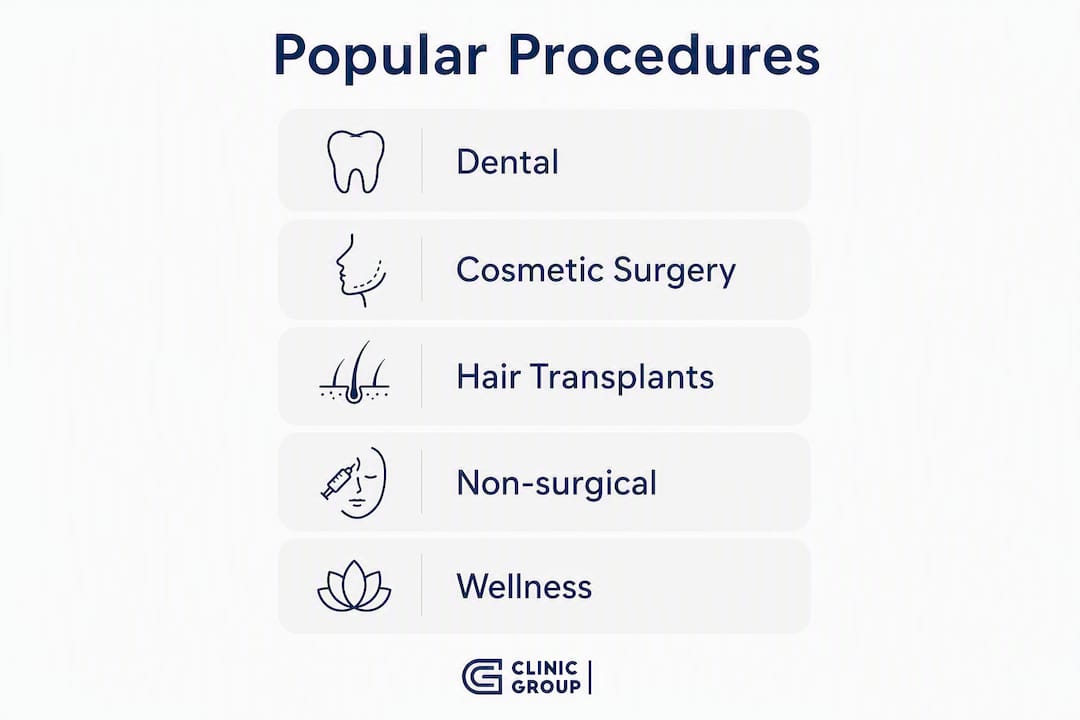
Clinicgroup’s network covers cosmetic surgery, dentistry, hair transplants, non-surgical aesthetics, and wellness programmes, with partner clinics in Albania and Dubai that meet the same verification standards described in this guide. To begin, share your treatment interest, a brief medical history, and any relevant documentation. Clinicgroup will return a shortlist of verified clinics with itemised quotes, so you can compare options and ask questions before committing to anything.
There are no upfront fees for the matching and coordination service. To request a free consultation and quote comparison, visit the Clinicgroup treatments hub and select your treatment category.
Useful sources and further reading
Before booking any elective treatment abroad, check these authoritative sources directly:
- GOV.UK Spain health and travel advice: The FCDO’s current guidance on GHIC use, emergency numbers, and a list of English-speaking medical providers in Spain. Check this page before every trip, as guidance is updated regularly.
- EU GHIC/EHIC guidance for Spain: Official EU advice on which facilities accept the card and how to confirm coverage in each autonomous community.
- Spain health system review, WHO/European Observatory (2024): The most authoritative independent overview of how Spain’s decentralised health system is structured and regulated.
- Commonwealth Fund: Spain country profile: Comparative data on Spain’s health system performance, useful for understanding where the private sector sits relative to public provision.
- Specialist medical tourism insurance providers: Search for policies that specifically cover elective procedure complications and post-return care windows. Confirm that repatriation cover is included.
- Clinicgroup contact and booking: For patients ready to enquire about verified clinics, treatment coordination, and a free quote comparison.
This article provides general information for UK patients researching medical treatment abroad. It is not a substitute for professional medical or legal advice. Confirm current regulations, insurance requirements, and clinical suitability with qualified professionals before booking any treatment.
FAQ
Does my GHIC cover treatment in Spain?
Your GHIC covers medically necessary, state-provided emergency care during a temporary visit to Spain, but it does not cover elective private procedures, dental treatment, cosmetic surgery, or complications arising from planned operations. Specialist medical tourism insurance is required for elective treatment.
How much does it cost to see a doctor in Spain as a tourist?
A private GP consultation in Spain typically costs €60–€150, while a private emergency room visit runs €200–€400 before tests or admission. Public emergency care is available with a GHIC for genuine emergencies, though non-urgent public ER waits can run 4–8 hours.
Is Spanish private healthcare safe for UK patients?
Spain’s private sector is regulated at national and regional level, and major city hospitals in Madrid and Barcelona operate to high clinical standards. Safety depends on choosing a registered clinic with a board-certified surgeon, an international patient coordinator, and clear complication policies — not on the country alone.
How do I find a reputable clinic in Spain?
Verify the surgeon’s número de colegiado through the relevant Colegio de Médicos, confirm the clinic’s regional health authority registration, and check whether the facility holds JCI or equivalent accreditation. Clinicgroup offers a verified clinic-matching service for UK patients seeking elective treatment abroad.
What insurance do I need for medical tourism in Spain?
Standard travel insurance excludes complications from planned surgery. You need a specialist medical tourism policy that covers eligible procedure complications, post-return care, and medical repatriation. Arrange this before paying any deposit to a clinic.