TL;DR:
- Verifying clinic credentials is crucial before booking treatment abroad to ensure safety and quality standards. Patients should thoroughly check registration, clinician qualifications, international accreditation, and safety protocols to avoid risks. Proper preparation includes consulting UK clinicians, gathering medical records, arranging insurance, and planning aftercare to achieve successful outcomes.
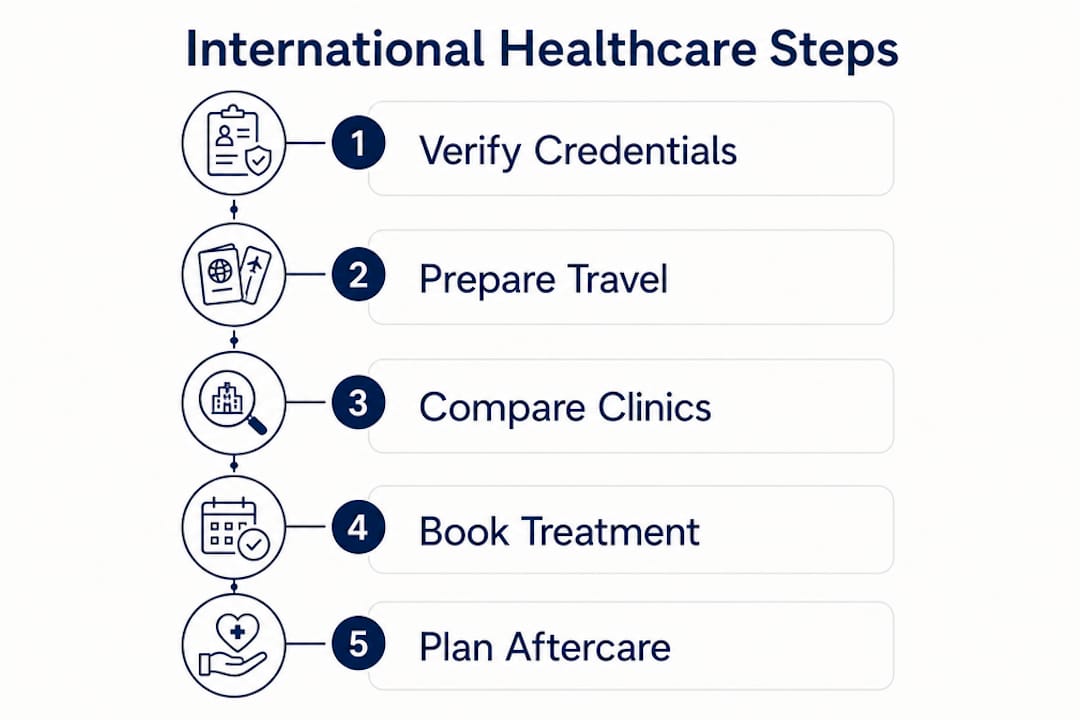
Accessing international healthcare step by step is a systematic process that covers verification, preparation, booking, treatment, and aftercare. Medical tourism is growing across the UK, driven by NHS wait times, cost barriers, and patients wanting greater control over their care. Done correctly, seeking treatment abroad delivers real benefits: access to board-certified specialists, transparent pricing, and high standards of care at significantly lower cost than private treatment at home. Done carelessly, it carries avoidable risks. This guide gives you a clear, structured path through every stage, from checking a clinic’s credentials to arranging follow-up care once you are back in the UK.
How do you verify the credentials of international clinics and clinicians?
Verifying a clinic’s credentials is the single most important step before booking any treatment abroad. Regulatory environments vary greatly between countries, and UK patients bear full responsibility for researching those differences. A clinic that looks professional online may operate under far weaker licensing rules than you would expect at home.
Start with these checks before you contact any clinic:
- Official registration: Confirm the clinic holds a valid operating licence from the relevant national health authority. Ask for the registration number and verify it independently.
- Clinician qualifications: Request the full name, medical degree, postgraduate training, and specialist certification of every clinician who will treat you. Cross-reference these details against official medical registers where possible.
- International accreditation: JCI accreditation is widely recognised among UK patients as a reliable safety standard. Clinics displaying Joint Commission International (JCI) certification have met independently audited criteria for patient safety and care quality.
- Infection control and emergency readiness: Reputable clinics provide clear information on sterilisation protocols, infection control policies, and access to emergency facilities. If a clinic cannot answer these questions directly, treat that as a warning sign.
- Written treatment plan: Any credible clinic will provide a detailed written treatment plan before you commit. This should include the proposed procedure, the clinician responsible, expected outcomes, recovery timeline, and aftercare policy.
Red flags are equally important to recognise. Industry safety guidelines caution against high-pressure sales tactics, guaranteed results, vague clinician qualifications, and refusal to provide written information. If a clinic pushes you to book quickly or cannot name the specialist who will perform your procedure, walk away.
Pro Tip: Search the clinic name alongside the country’s medical regulatory body to find independent registration records. This takes ten minutes and removes significant uncertainty.
For a thorough breakdown of what to look for, Clinicgroup’s guide on researching clinic credentials covers the full verification process in detail.
What preparatory steps should UK patients take before travelling?
Preparation before travel is where most patients cut corners, and where the most preventable problems begin. A structured approach to preparation protects both your health and your investment.
Follow these steps before you book flights or confirm a treatment date:
- Consult your UK GP or specialist. UK clinicians recommend discussing your medical history, existing conditions, and current medication with a GP before any planned treatment abroad. This consultation confirms whether the procedure is suitable for you and flags any contraindications the overseas clinic needs to know about.
- Gather and translate your medical records. Collect relevant test results, imaging, surgical history, and medication lists. Have these translated into the language of your destination country if required, and carry certified copies.
- Check travel and legal requirements. Verify visa requirements, vaccination rules, and any destination-specific health advisories. Some countries require proof of vaccination or specific documentation for medical visitors.
- Obtain medical travel complication insurance. Standard travel insurance rarely covers planned medical treatment abroad. Specialised medical travel complication insurance covers complications, emergency evacuation, extended recovery stays, and care after you return to the UK. UK-based private medical insurance typically excludes elective procedures arranged overseas, so a separate policy is not optional.
- Plan your medication logistics. Research whether your regular medications are legal to import into your destination country. Some prescription drugs are controlled substances in certain jurisdictions. Carry a letter from your GP confirming your prescriptions.
Pro Tip: Book your UK GP consultation at least four weeks before your planned travel date. This gives time to receive test results, adjust medication if needed, and obtain any referral letters the overseas clinic requires.
How to compare and book international healthcare services effectively

Choosing a clinic is a multi-stage process, not a single decision. Patients who book the first clinic they find online consistently report the most problems. A structured approach to comparison protects you from poor outcomes and wasted expenditure.
The research process works in four stages: initial awareness, shortlisting, validation, and enquiry. Most patients spend too long in the awareness stage browsing general information and too little time in the validation stage, where the real quality signals emerge.
Key factors to evaluate during shortlisting and validation:
- Itemised pricing: Transparent, itemised pricing enables you to self-qualify clinics quickly. Vague pricing or a requirement to contact the clinic for a quote before receiving any cost information is a trust signal worth noting negatively. A reliable clinic publishes clear cost breakdowns.
- Named, verifiable clinicians: Publishing named surgeon profiles with verifiable qualifications is now a baseline expectation for UK patients. If a clinic’s website lists only generic “our team” descriptions without named specialists, request specific clinician details before proceeding.
- Communication quality: The speed and quality of a clinic’s initial response to your enquiry is a reliable indicator of how they will communicate throughout your treatment. A slow, vague, or template-heavy reply suggests the same approach will apply when you have a clinical question.
- Patient testimonials and reviews: Look for detailed, treatment-specific reviews rather than generic five-star ratings. Reviews that describe the clinician by name, mention the recovery process, and reference aftercare carry more weight than brief positive comments.
- Package components: Understand exactly what a treatment package includes. Travel, accommodation, and aftercare are sometimes bundled together in ways that obscure the actual cost of the medical procedure itself. Separate each component to make a fair comparison.
The table below summarises the key evaluation criteria and what to look for at each stage.
| Evaluation criterion | What to look for |
|---|---|
| Clinic accreditation | JCI certification or equivalent national accreditation |
| Clinician credentials | Named specialist with verifiable qualifications and registration |
| Pricing transparency | Itemised written quote before booking confirmation |
| Communication responsiveness | Clear, personalised reply within 24–48 hours |
| Aftercare policy | Written aftercare plan provided before treatment date |
For further guidance on comparing clinics, Clinicgroup’s resource on choosing a clinic abroad covers pricing, reviews, and clinician verification in practical detail.
What should you expect during treatment and how do you plan for aftercare?
Treatment day abroad requires the same level of informed consent and communication clarity you would expect in the UK. The difference is that you are in an unfamiliar environment, often without a trusted support network nearby, which makes preparation more important.
Follow this sequence to manage treatment and recovery effectively:
- Confirm the final treatment plan on arrival. Before any procedure begins, review and sign a written consent form that confirms the diagnosis, the planned treatment, the clinician performing it, and the known risks. Do not proceed if any of these elements are unclear or have changed since your initial consultation.
- Confirm communication in English. Safe medical care abroad depends on clear communication at every stage, including consultations, consent forms, aftercare instructions, and emergency contacts. Confirm before treatment that all written documentation will be provided in English.
- Plan your stay for safe recovery. Doctors advise patients to remain in the destination country long enough to complete early recovery safely before flying. Premature travel increases the risk of complications including blood clots. Build sufficient recovery time into your travel plan before booking return flights.
- Obtain written discharge documentation. Before leaving the clinic, collect a full discharge summary, operative report, medication list, and emergency contact details. These documents are essential for any follow-up care in the UK.
- Arrange follow-up care before you travel. NHS clinicians often do not prioritise routine follow-up for procedures arranged privately overseas. Arrange a private follow-up consultation in the UK, or confirm that the overseas clinic offers remote post-treatment consultations, before you leave home.
- Understand the NHS’s limitations. The NHS may treat complications arising from overseas procedures in an emergency, but it is not obligated to provide routine aftercare for elective treatments arranged privately abroad. Proactive planning with a private GP or specialist at home is the reliable alternative.
Pro Tip: Ask your overseas clinic to send discharge documentation directly to your UK GP by email before you fly home. This creates a medical record trail and makes any follow-up consultation significantly more straightforward.
Clinicgroup’s detailed guide on aftercare for medical tourists explains what a written aftercare plan should contain and how to coordinate care across two countries.
Key takeaways
Accessing international healthcare safely requires verified clinics, thorough preparation, transparent pricing, and a confirmed aftercare plan before you travel.
| Point | Details |
|---|---|
| Verify credentials first | Check clinic registration, JCI accreditation, and named clinician qualifications before any booking. |
| Consult your UK GP | Discuss your medical history and medication with a UK clinician before confirming any overseas treatment. |
| Secure specialist insurance | Standard travel insurance does not cover planned treatment abroad; obtain medical travel complication cover separately. |
| Demand itemised pricing | Transparent, written cost breakdowns allow fair clinic comparison and protect against hidden charges. |
| Plan aftercare before you travel | Arrange UK follow-up care in advance, as NHS support for privately arranged overseas procedures is limited. |
What I have learned from patients who get this right
The patients who have the best experiences abroad share one characteristic: they treat the process like a project, not a purchase. They do not rush the verification stage, they read the written treatment plan carefully, and they arrange follow-up care before they book their flights. The patients who encounter problems almost always skipped one of those steps.
The most common mistake I see is underestimating aftercare complexity. Patients focus heavily on the procedure itself and assume that recovery will be straightforward. The reality is that the post-treatment period, particularly the transition back to the UK, carries its own risks and requires its own planning. Clinics that articulate clear aftercare pathways before booking are not just being thorough; they are signalling that they take patient outcomes seriously beyond the operating room.
The second most common mistake is neglecting insurance. UK-based private medical insurance excludes elective procedures arranged overseas, and standard travel policies do not fill that gap. Patients who discover this after a complication face significant financial and medical stress that a separate specialist policy would have prevented entirely.
The opportunity that international healthcare offers is genuine. Access to high-quality, board-certified specialists at a fraction of UK private costs is real and achievable. The responsibility for making it safe sits with the patient. Working with verified providers who offer transparent pricing, named clinicians, and structured aftercare removes most of the risk. The steps in this guide are not bureaucratic obstacles. They are the difference between a successful treatment and an avoidable problem.
— Clinic
How Clinicgroup supports patients seeking care abroad
Clinicgroup connects patients with verified clinics and board-certified specialists in Albania and Dubai, covering treatments from dental implants and veneers to hair transplants, plastic surgery, and anti-aging therapies. Every clinic in the network meets European standards of care, with named specialists, transparent pricing, and written aftercare plans provided before any booking is confirmed. Clinicgroup’s patient support team handles clinic matching, travel logistics, partner hotel arrangements, and post-treatment follow-up coordination, so you are not managing the process alone. For patients comparing treatment options across countries, Clinicgroup offers a structured, patient-first path to affordable, reliable care abroad.
FAQ
How do I verify that an overseas clinic is legitimate?
Check the clinic’s official registration with the national health authority, confirm the named clinician’s qualifications against a medical register, and look for Joint Commission International (JCI) accreditation as an independently audited quality standard.
Does standard travel insurance cover planned medical treatment abroad?
Standard travel insurance rarely covers planned medical procedures. You need specialised medical travel complication insurance, which covers complications, emergency evacuation, extended recovery stays, and aftercare after you return to the UK.
Should I consult my UK GP before travelling for treatment abroad?
Yes. The NHS and UK government recommend consulting a UK-based GP or specialist before any planned overseas treatment to review your medical history, existing conditions, and medication for safety.
How long should I stay abroad after treatment before flying home?
The required recovery period depends on the procedure. Doctors advise patients to remain in the destination country until early recovery is complete, as flying too soon increases the risk of complications including blood clots.
Will the NHS provide aftercare for treatment I arrange privately abroad?
The NHS may treat emergency complications, but it is not obligated to provide routine aftercare for privately arranged overseas procedures. Patients should arrange private follow-up care in the UK before travelling.