How to assess dental quality: a patient’s guide

TL;DR:
- Dental quality assessment evaluates clinics’ structure, processes, and patient outcomes to ensure safe, effective, and patient-centered care.
- Patients should verify credentials, request diagnostic imaging, and review quality assurance plans to choose high-quality providers.
Dental quality assessment is defined as the systematic evaluation of a clinic’s structure, processes, and patient outcomes to determine whether care is safe, effective, and centred on the patient. The recognised framework for this evaluation is the Donabedian model, developed by Avedis Donabedian, which organises quality into three measurable dimensions. Knowing how to assess dental quality before committing to treatment protects you from poor clinical decisions, unexpected costs, and preventable harm. This guide explains the key dental quality indicators, the formal frameworks professionals use, and the practical steps you can take right now.
What are the key clinical quality indicators in dental care?
Clinical quality indicators are the measurable signs that a dental practice meets professional standards. They cover infrastructure, personnel qualifications, and documented clinical protocols.

Infrastructure and equipment standards
A quality dental clinic operates with properly maintained equipment, sterilised instruments, and a clean clinical environment. The presence of digital diagnostic tools, such as panoramic radiographs or CBCT scanners, signals that the practice invests in accurate diagnosis rather than guesswork. Advanced diagnostics like CBCT directly improve the reliability of treatment planning for complex procedures such as implants.
Credential verification
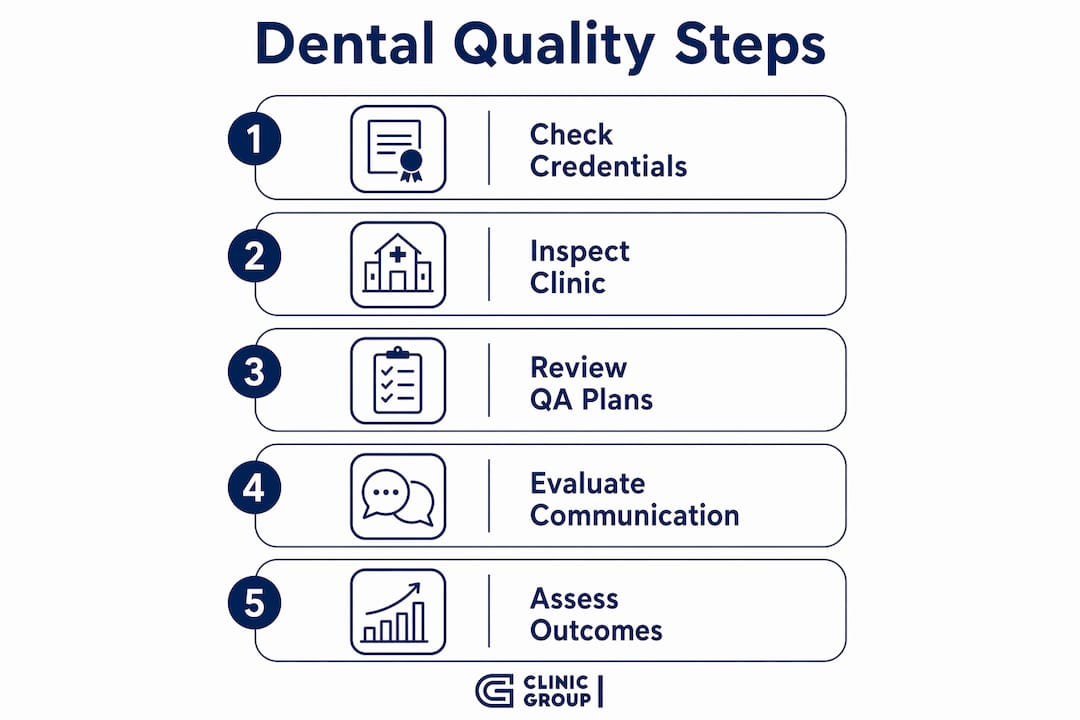
Every practising dentist holds either a DDS (Doctor of Dental Surgery) or DMD (Doctor of Dental Medicine) degree, and their licence must be current and in good standing. Patients should verify active licensure and review any disciplinary history through the relevant regulatory body before treatment. This step is one of the most reliable predictors of practitioner quality, yet it is one of the most commonly skipped.
Quality assurance plans
A formal written QA plan that systematically identifies the causes of treatment deficiencies is a hallmark of a high-quality practice. The Commission on Dental Accreditation (CODA) recommends ongoing, evidence-based quality assurance processes in both education and clinical practice. A practice without a documented QA process relies on reactive complaint handling rather than proactive improvement.
Key clinical quality indicators to check:
- Valid DDS or DMD degree and current licence
- No unresolved disciplinary actions on record
- Written quality assurance plan available on request
- Use of diagnostic imaging before complex procedures
- Documented sterilisation and infection control protocols
- Evidence of ongoing staff continuing education
Pro Tip: Ask the clinic directly whether they hold any formal accreditation and whether their QA plan is available to review. A quality practice will answer confidently and without hesitation.
How does communication and patient experience affect dental quality?
Communication is a direct measure of dental care quality, not a secondary concern. Service quality dimensions such as responsiveness, assurance, and empathy predict patient satisfaction more reliably than the physical appearance of the practice. This finding, drawn from a study of 236 patients using the SERVQUAL model, confirms that how a dentist communicates matters as much as the equipment they use.
What good communication looks like
Transparent, clear communication about diagnosis, treatment options, alternatives, and expected discomfort is a defining feature of patient-centred care. A dentist who explains findings in plain language, invites questions, and never rushes a consultation is demonstrating clinical respect. That respect shapes informed consent, patient trust, and whether patients follow through with recommended treatment.
Poor communication, by contrast, often signals deeper quality problems. A practitioner who avoids discussing alternatives, dismisses your concerns, or pressures you into same-day decisions is not operating to a patient-centred standard.
Signs of strong communication in a dental consultation:
- Findings explained clearly, without excessive jargon
- Written treatment plan provided before any procedure begins
- Time given for questions without rushing
- Alternatives discussed alongside the recommended treatment
- Expected discomfort, recovery, and costs addressed upfront
- Follow-up contact details provided
Pro Tip: Before your first appointment, send the clinic a question by email or phone. How quickly and clearly they respond tells you a great deal about how they will communicate during treatment.
Patient feedback also plays a formal role in measuring dental care quality. Practices that collect and act on patient feedback demonstrate a commitment to continuous improvement. Reviews are useful, but they carry more weight when the practice can show they have changed a process in response to patient input.
What frameworks and tools exist for systematic dental quality assessment?
Formal frameworks give patients and practitioners a shared language for evaluating dental services. The Donabedian model remains the definitive evidence-based framework for this purpose, organising quality into three distinct dimensions. The model is widely used in both NHS dental standards and private practice benchmarking.
| Framework element | Focus area | What it measures |
|---|---|---|
| Structure | Inputs and resources | Equipment, staffing, facilities, accreditation |
| Process | Clinical actions | Diagnosis, treatment planning, patient communication |
| Outcome | Results of care | Treatment success, patient satisfaction, complication rates |
| Quality Assurance Plan | Improvement systems | Identification and correction of deficiencies |
| Clinical Audit | Performance review | Comparison of practice against agreed standards |
The Structure dimension covers everything a patient can observe before treatment begins: the physical environment, the qualifications of staff, and whether the clinic holds formal accreditation. The Process dimension covers what happens during care, including how thoroughly a dentist diagnoses a problem and how well they document the treatment plan. The Outcome dimension is the hardest to assess from the outside, but asking a clinic for documented success rates on specific procedures is a reasonable and legitimate request.
Clinical audits are a formal tool within this framework. A practice that conducts regular audits compares its own performance against agreed standards and adjusts its protocols accordingly. Quality assurance plans that proactively address the causes of treatment deficiencies consistently outperform practices that only respond to complaints. The difference between the two approaches is the difference between a practice that improves and one that merely manages problems.
Individualised care planning is another quality marker. Dental care frequency and recall intervals should be based on individual patient risk assessments rather than fixed schedules. A practice that applies a one-size-fits-all recall system is not practising to the highest evidence-based standard.
How to practically evaluate and choose a high-quality dentist or clinic
Choosing a dentist is a long-term health decision. The steps below give you a reliable method for evaluating dental services before you commit to any treatment.
Start with verifiable facts. Check the dentist’s registration with the relevant regulatory body, whether that is the General Dental Council (GDC) in the UK, or an equivalent authority abroad. Confirm the degree held (DDS or DMD), the year of qualification, and any specialist registrations. Review whether any disciplinary actions appear on the public register.
Request a pre-treatment consultation. Patients can and should request consultations that include a clinic tour and a review of diagnostic protocols. Ask whether the clinic uses panoramic radiographs or CBCT imaging before complex procedures such as implants. The presence of pre-treatment imaging is direct evidence of diagnostic rigour.
For patients considering dental treatment abroad, the same evaluation criteria apply. Accreditation status, documented QA processes, and clear communication are non-negotiable regardless of geography.
Practical evaluation checklist:
- Confirm GDC registration or equivalent regulatory body listing
- Verify DDS or DMD degree and check for disciplinary history
- Ask for a written treatment plan before any procedure begins
- Request evidence of pre-treatment imaging for complex work
- Ask whether the clinic holds formal accreditation
- Check whether staff undertake continuing professional development
- Assess how clearly and promptly the clinic communicates
- Ask how the clinic handles complaints and adverse outcomes
- Review patient feedback, focusing on clinical outcomes rather than aesthetics
Red flags to watch for include aggressive upselling during a first consultation, reluctance to provide a written treatment plan, vague answers about qualifications, and pressure to proceed without adequate time to consider your options.
Key takeaways
Reliable dental quality assessment requires evaluating clinical structure, documented processes, and measurable outcomes using the Donabedian model as a consistent framework.
| Point | Details |
|---|---|
| Use the Donabedian model | Assess structure, process, and outcome as three separate quality dimensions. |
| Verify credentials first | Confirm DDS or DMD degree, active licence, and clean disciplinary record before treatment. |
| Prioritise communication | Responsiveness, empathy, and clear explanations predict satisfaction better than office appearance. |
| Request a written QA plan | A formal quality assurance plan shows the practice improves proactively, not reactively. |
| Ask for pre-treatment imaging | Panoramic radiographs or CBCT scans before complex procedures confirm diagnostic rigour. |
What patients consistently get wrong about dental quality
After years of connecting patients with verified dental clinics across Europe and the Middle East, the pattern I see most often is this: patients spend more time reading Google reviews than checking whether a dentist is actually registered.
Reviews have value, but they measure patient experience, not clinical quality. A clinic can score highly on friendliness and décor while delivering substandard treatment planning. Clinical decision-making failures cannot be compensated by good service or polished marketing. They cause automatic quality failure, regardless of how pleasant the consultation felt.
The second most common error is treating dental care as a one-off transaction rather than a long-term health relationship. A dentist who provides a thorough written treatment plan, explains every option, and documents outcomes is building a clinical record that protects you over time. That record matters if complications arise, if you move abroad, or if you seek a second opinion.
My practical advice is this: treat the evaluation process like you would any significant health decision. Ask for evidence. Request a clinic tour. Ask what happens if something goes wrong. A quality practice welcomes those questions. A poor one deflects them.
— Clinic
Clinicgroup: verified dental care with transparent standards
Clinicgroup connects patients from the UK and across Europe with verified dental clinics in Albania and Dubai, where board-certified specialists work to European standards of care. Every clinic in the network is assessed against documented quality criteria before being listed, so you are not relying on marketing alone. Patients receive personalised clinic matching, support with travel logistics and partner hotels, and structured aftercare from the point of enquiry through to recovery. For patients seeking implants, veneers, or crowns at a fraction of UK costs, dental treatment in Albania offers a reliable, transparent alternative. You can also review the full range of available treatments to find the right fit for your needs.
FAQ
What is the Donabedian model in dental care?
The Donabedian model is the leading framework for evaluating dental quality, dividing assessment into three dimensions: structure (facilities and qualifications), process (clinical actions), and outcome (treatment results and patient satisfaction).
How do I verify a dentist’s credentials?
Check the dentist’s registration with the General Dental Council (GDC) in the UK, or the equivalent regulatory body in the country where you are being treated. Confirm their degree (DDS or DMD) and review any disciplinary history on the public register.
What are the most important dental quality indicators?
The most reliable indicators are active licensure, a formal written quality assurance plan, use of pre-treatment diagnostic imaging, clear written treatment plans, and evidence of ongoing staff continuing education.
Does patient communication affect dental quality?
Yes. Research using the SERVQUAL model shows that responsiveness, assurance, and empathy predict patient satisfaction more reliably than the physical environment of the practice.
What are the red flags when choosing a dental clinic?
Key warning signs include pressure to proceed without a written treatment plan, vague answers about qualifications, no evidence of pre-treatment imaging for complex work, and reluctance to discuss treatment alternatives.