If your clinic cancels your operation for clinical or operational reasons, or you cancel within its stated refund window, you are normally entitled to a refund of unused treatment fees. The exception is when a written policy specifies a service credit or non-refundable clause you agreed to before paying. Your single most important action right now is to request the clinic’s cancellation and refund policy in writing, in English if possible, before you do anything else.
- Save every booking confirmation, invoice and payment receipt you have.
- Pause any travel spending you can still cancel without penalty.
- Ask the clinic to confirm, in writing, what portion of your payment is refundable and why.
Three reference points are worth knowing from the outset: Directive 2011/24/EU, which governs reimbursement for planned cross-border healthcare within the EU; your country’s National Contact Point (NCP), the official body for cross-border healthcare complaints; and Clinic Group’s own patient support team, who can liaise with partner clinics on your behalf when a booking made through our network needs to be cancelled.
Key Takeaways
Patients are usually entitled to a refund when the clinic cancels or when they cancel inside the clinic’s written window, provided that policy was disclosed before payment.
| Point | Details |
|---|---|
| Get the policy in writing | Request the clinic’s cancellation and refund terms before doing anything else. |
| Separate medical and travel costs | Treatment fees, flights and hotels follow different refund rules and different suppliers. |
| Document everything | Keep invoices, payment proof, consent forms and any clinical cancellation note. |
| Know your escalation order | Chargeback, consumer body complaint, National Contact Point, then small claims. |
| Clinic Group can liaise for you | Our coordinators help assemble evidence and identify the right reimbursement route. |
Where to get further help
- Directive 2011/24/EU sets the legal framework for cross-border reimbursement.
- The European Commission’s patient rights guidance explains NCP roles for country-specific complaints.
- Gov covers challenging unfair cancellation charges.
- Contact Clinic Group directly for support with a booking made through our network.
This article is general information, not a substitute for advice from a qualified lawyer. Consult a qualified legal professional about your own circumstances before acting on anything here.
Table of Contents
- How do I cancel my operation and protect my refund?
- What does a surgery refund actually cover?
- What documents do I need for a refund claim?
- Where do I send my refund claim and how long does it take?
- What if the clinic refuses to refund me?
- How Clinic Group supports patients through cancellations
- Can you negotiate a partial refund instead of a full one?
- Does travel insurance cover a cancelled operation?
- Book with a network built for clear cancellation terms
- Sources
- FAQ
How do I cancel my operation and protect my refund?
Cancelling a booked operation is stressful enough without also worrying whether you will see your money again. Follow these steps in order, and you give yourself the best possible position if the clinic disputes your claim later.
- Locate the written policy. Check your booking confirmation, quote, or consent form for the cancellation and refund terms you agreed to. If you cannot find one, ask for it immediately, because a policy that was never disclosed before payment is very hard for a clinic to enforce, according to Sprintlaw’s guidance for UK medical practices.
- Notify the clinic and the booking platform in writing. Send an email (not just a phone call) stating your full name, booking reference, the treatment booked, the scheduled date, and your reason for cancelling.
- Request written confirmation. Ask the clinic to confirm the cancellation has been received and to state clearly how much will be refunded, by what method, and by when.
- Separate medical fees from travel arrangements. Flights, hotels and transfers usually sit under different suppliers with their own cancellation rules, so deal with each one independently and keep the paperwork apart from your clinic correspondence.
- Preserve any clinical documentation. If the clinic cancelled because a clinician deemed you unsuitable for treatment, get that decision in writing. It strengthens both a clinic refund claim and, where relevant, a state reimbursement claim.
Pro Tip: Check the time zone the clinic operates in before you calculate a deadline. A “48-hour cancellation window” measured from Tirana or Dubai office hours can expire far sooner than you expect if you are working from a UK or Italian clock.
Some clinics publish tiered refund schedules, for instance a full refund beyond 72 hours before treatment, a partial refund between 48 and 72 hours, and no refund inside 48 hours, with processing taking 5 to 21 business days depending on payment method. Treat this as an illustrative example rather than a universal rule. Always confirm your own clinic’s specific windows.

What does a surgery refund actually cover?
Not every payment you made is recoverable, and knowing the difference early saves a lot of frustration.
Typically refundable:
- Treatment fees for procedures not yet performed.
- Deposits, when cancellation falls inside the clinic’s stated refund window.
- Full or partial refunds when the clinic cancels for clinical or operational reasons.
Typically non-recoverable:
- Flights and hotels booked directly with third-party suppliers under their own non-refundable fare rules.
- Bank transfer fees and currency conversion charges already incurred.
- Bespoke items already ordered on your behalf, such as a custom dental prosthesis.
It helps to think of three separate pots of money: the clinic refund, state reimbursement from your national insurer under Directive 2011/24/EU (which applies to planned cross-border treatment within the EU and caps repayment at the tariff you would have paid at home), and any travel insurance claim for cancelled flights or accommodation. A patient who cancels dental implant work, for example, may get the unused treatment fee back from the clinic directly, while their non-refundable flight has to be claimed separately through travel insurance.
What documents do I need for a refund claim?
Decision-makers, whether that is the clinic’s finance team, your insurer, or a national authority, will expect a specific paper trail. Gather these before you submit anything.
- Your written booking confirmation and an itemised invoice.
- Proof of payment: a bank transfer receipt or the relevant card statement.
- Signed consent forms and any messages exchanged with the clinic.
- Written cancellation confirmation from the clinic.
- Pre-operative assessment notes, and if applicable, a clinician’s written note explaining why the clinic cancelled.
- Flight and hotel receipts showing the fare rules that applied, plus your travel insurance policy and any claim correspondence.
Pro Tip: If you are claiming reimbursement from your national health insurer rather than a refund from the clinic, ask early whether they require certified translations. The NCP toolbox checklist for patients confirms that many national schemes do, and getting a certified translation done in advance avoids a second round trip through your documents weeks later.
Booking confirmations from a well-run platform tend to already carry most of this information in one place, which is one reason to check the documents a clinic issues at every step before you commit.
Where do I send my refund claim and how long does it take?
You generally have three or four routes, depending on how you booked and where you live.
Contact the clinic’s finance or international patient team first. If you booked through a platform, escalate there too if the clinic is unresponsive. EU residents claiming state reimbursement for planned cross-border treatment submit to their national insurer under Directive 2011/24/EU, a process the European Commission’s patient rights guidance explains in detail.
Your email or letter should include your name, booking reference, payment details, exactly what you are requesting, and copies of your supporting documents as attachments.
| Stage | Typical timeframe |
|---|---|
| Clinic acknowledges cancellation | 1–3 business days |
| Clinic confirms refund amount | 3–7 business days |
| Card refund processed | 5–10 business days |
| Bank transfer refund processed | 7–21 business days |
| State reimbursement decision (insurer) | Several weeks, varies by country |
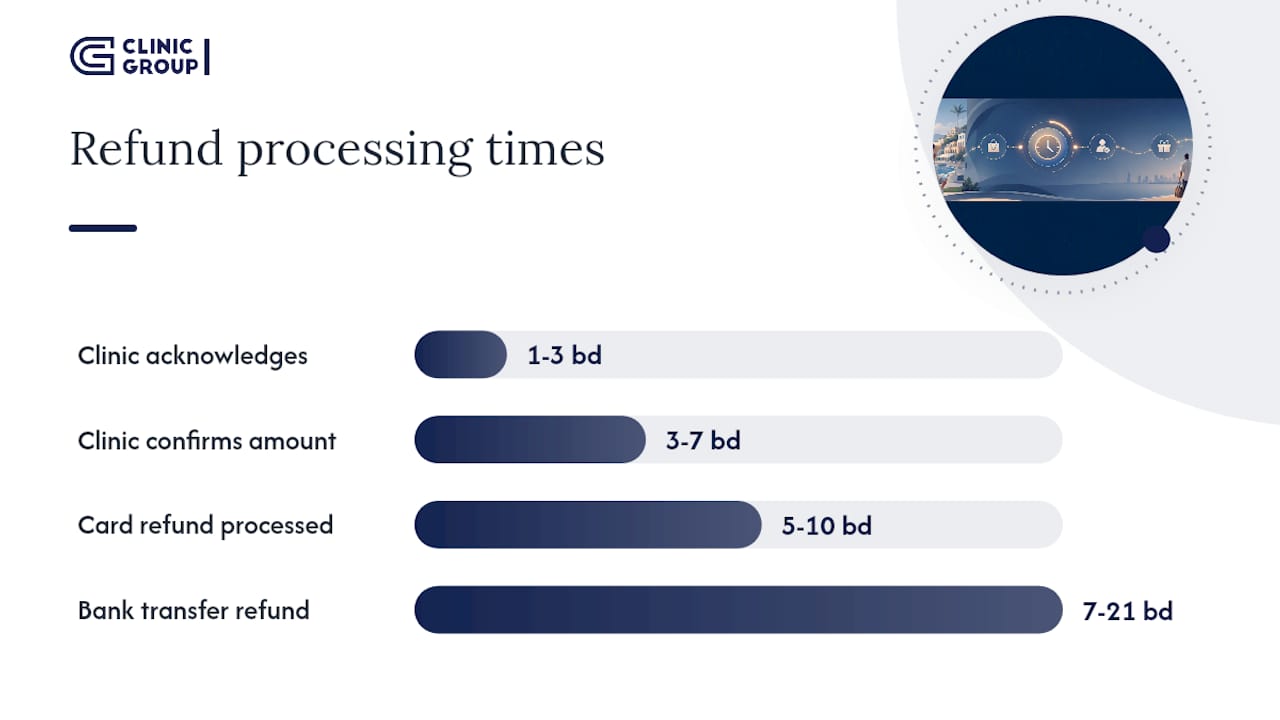
Use email as your primary channel and keep a paper trail; registered post or the platform’s own support portal is worth using if email goes unanswered for more than a week.
What if the clinic refuses to refund me?
A refusal is not the end of the road. Work through these escalation steps in order, starting with the least costly.
- Ask the clinic for a written explanation of the refusal, including exactly how any retained deposit was calculated. Which? advises that a business may only keep a deposit that fairly reflects its actual loss, not an arbitrary amount.
- If you paid by card, consider a chargeback or card dispute with your bank, which usually requires your correspondence and proof the service was not delivered as agreed.
- File a complaint with the clinic’s national health regulator or the relevant consumer protection body; UK patients can check Gov on unfair cancellation charges.
- Contact your National Contact Point for cross-border healthcare disputes, an often overlooked resource that can advise on country-specific complaint procedures.
- Consider small claims court for lower-value disputes, weighing the court fee and your time against the amount in dispute before you file.
How Clinic Group supports patients through cancellations
Clinic Group’s international patient coordinators help with exactly this kind of situation when you have booked through our network. We can liaise directly with your matched clinic, help you assemble invoices, booking confirmations and consent forms, and point you towards the correct NCP or insurer route if state reimbursement applies.
- Verified clinic matching, so your original booking always sits with an accountable, credentialed provider.
- Support gathering the evidence a refund claim needs.
- Guidance on which reimbursement channel fits your situation.
Get in touch with your Clinic Group coordinator as soon as you decide to cancel, and share your booking reference and any clinic correspondence so we can start reviewing your case straight away.
Can you negotiate a partial refund instead of a full one?
Sometimes a full refund is not on the table, but a fair partial settlement is, and that is worth exploring before you escalate. Start by asking the clinic to itemise exactly what has already been spent on your behalf, such as diagnostic scans, custom-made prosthetics, or theatre time already booked with a surgical team. A clinic that can show genuine costs incurred has a stronger case for withholding some of your deposit, and one that cannot should reduce its claim.
If a straight cash refund is being resisted, ask whether the clinic will offer a rescheduled date at no extra cost, a credit note valid for a set period, or a partial refund alongside a discount on a future treatment. These alternatives can suit patients who still want to use the same clinic once personal circumstances change, though you should never accept a credit note in place of a refund you are legally entitled to receive.
Put every offer in writing before you accept it, including the exact amount, the payment method, and the date it will arrive. Verbal assurances over the phone are far harder to enforce later. If the clinic’s opening offer feels low relative to how far in advance you cancelled, refer back to its own published policy and ask them to reconcile the figure against their stated refund schedule. A polite, specific challenge, backed by the clinic’s own written terms, resolves more disputes than an angry email ever will.
Does travel insurance cover a cancelled operation?
Standard travel insurance policies are not designed with elective medical tourism in mind, so read the policy wording carefully before you assume you are covered. Many general travel policies exclude cancellation cover for medical treatment abroad entirely, while specialist medical tourism or treatment-specific policies may cover cancellation fees, non-refundable travel costs, or even complications after surgery.
Check three things specifically: whether cancellation due to a change of mind is covered at all (it usually is not), whether cancellation due to clinical unsuitability or a medical emergency at home is covered, and what documentation the insurer requires to process a claim. Specialist travel insurance guidance on submitting claims is useful reading before you travel, not after something goes wrong, because policies often set short notification windows once an event occurs.
If you booked flights and a hotel separately from your clinic package, keep that insurance policy and its claim correspondence completely separate from your clinic refund paperwork. Insurers and clinics rarely coordinate with each other, so you are the one who has to keep both processes moving in parallel. Where a clinic package includes travel arranged through the platform, ask for an itemised breakdown showing what was booked by the clinic and what you booked independently, since that split determines which insurer or supplier you approach first.
When should you accept an offer, and when should you push further?
Accept a reasonable, well-documented partial refund that arrives quickly. Escalate if the clinic gives no written explanation, applies charges that were never disclosed at booking, or cites medical unsuitability without a clinician’s written note.
Book with a network built for clear cancellation terms
Clinic Group is the alternative to booking directly with an individual overseas clinic and hoping its cancellation terms hold up. Every clinic in our network operates under transparent, pre-booking refund policies, and our coordinators sit between you and the clinic if a cancellation ever gets complicated, rather than leaving you to chase an overseas finance department alone. That matters most for higher-value bookings such as plastic surgery or a hair transplant, where deposits are larger and the paperwork more involved.
If you are still deciding on treatment and want the reassurance of verified clinics, board-certified specialists and written terms from the outset, browse Clinic Group’s treatments and speak to a coordinator before you pay a deposit anywhere. If you have already booked elsewhere and need help reviewing a refund dispute, contact our patient support team today with your booking reference and correspondence, and we will tell you honestly what your options look like.
Sources
- Directive 2011/24/EU
- Accessing medical treatment abroad - Know your rights
- Gov
- Can I claim back a non-refundable deposit? - Which?
- Refund and Cancellation Terms for UK Medical Practices | Sprintlaw UK
FAQ
Am I entitled to a refund if I cancel my surgery?
Usually yes, if you cancel within the clinic’s stated refund window; the exception is when a written policy specifies a non-refundable deposit or service credit you agreed to before paying.
What if the clinic cancels my operation for medical reasons?
Ask for the clinician’s decision in writing, since this documentation supports both a clinic refund and any state reimbursement claim under Directive 2011/24/EU.
Can I get my flights and hotel refunded too?
Only if you booked them with a refundable fare or through travel insurance; these third-party costs sit outside the clinic’s own refund policy.
How long does a surgery refund typically take?
Card refunds often process within 5 to 10 business days, while bank transfers can take 7 to 21 business days depending on the clinic and payment method.
What should I do if Clinic Group’s partner clinic refuses my refund?
Contact your Clinic Group coordinator with your booking reference and correspondence so we can review the case and help you decide on the right escalation route.