TL;DR:
- A dental bridge is a fixed prosthetic that replaces missing teeth by anchoring artificial teeth to healthy neighboring teeth. It restores chewing, speech, and bite alignment while requiring some reshaping of abutment teeth and regular hygiene maintenance. The most common types include traditional, cantilever, Maryland, and implant-supported bridges, each suited to specific clinical situations.
A dental bridge is a fixed prosthetic restoration that replaces one or more missing teeth by anchoring artificial teeth, called pontics, to the natural teeth on either side of the gap. Those supporting natural teeth are known as abutment teeth. Dentists recommend dental bridges when missing teeth affect chewing, speech, or bite alignment, and when adjacent teeth are healthy enough to carry the restoration. Both NHS and private dental care offer bridges, though NHS dental bridges prioritise restoring function over cosmetic appearance, with limited material and design options compared to private treatment. Understanding your options fully is the first step toward making a confident, well-informed decision.
What is a dental bridge and how does it work?
A dental bridge is defined as a permanent fixed restoration that spans the gap left by one or more missing teeth. The pontic sits in the space where the natural tooth was, held firmly in place by dental crowns cemented onto the prepared abutment teeth on each side. The result is a restoration that looks, feels, and functions much like natural teeth.
Adjacent teeth must be prepared by removing a thin layer of enamel so the supporting crowns fit correctly. This preparation is permanent. Once the enamel is shaped, those teeth will always require a crown or similar protection. For patients whose neighbouring teeth already need crowns, this makes a bridge a particularly logical combined approach.

Bridges are made from several materials, including porcelain fused to metal, full ceramic, and zirconia. Zirconia and full ceramic options offer the most natural appearance and are the most common choice in private dental care. Metal-based options are more durable under heavy bite pressure and are sometimes used for back teeth.
What are the main types of dental bridges?
Four main types of dental bridges exist, each suited to different clinical situations.
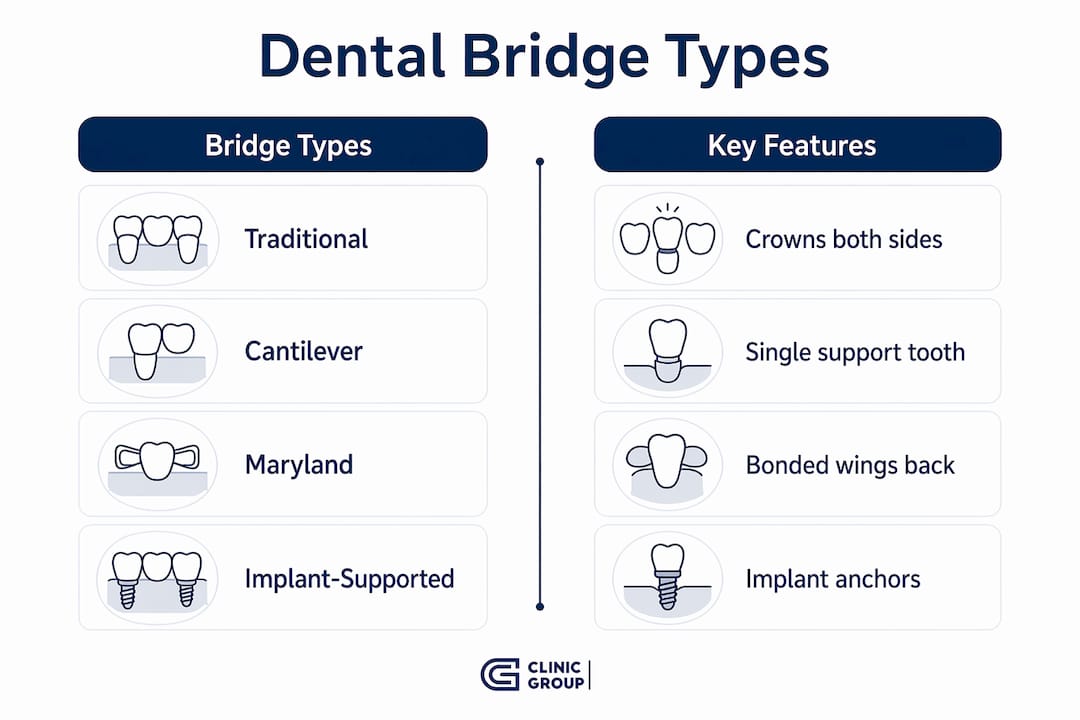
| Bridge type | How it is anchored | Best suited for | Key limitation |
|---|---|---|---|
| Traditional | Crowns on both adjacent teeth | Single or multiple missing teeth with healthy neighbours | Requires reshaping two healthy teeth |
| Cantilever | Crown on one adjacent tooth only | Areas with one neighbouring tooth | Higher stress on the single abutment tooth |
| Maryland (resin-bonded) | Metal or porcelain wings bonded to backs of adjacent teeth | Front teeth with minimal bite pressure | Less secure; not suitable for back teeth |
| Implant-supported | Titanium implants in the jawbone | Multiple missing teeth or weak adjacent teeth | Requires surgery and longer treatment time |
Traditional bridges are the most widely used type. They work well when both teeth flanking the gap are present and healthy. The trade-off is that two sound teeth must be permanently altered to support the restoration.
Cantilever bridges are less common and carry a higher risk of mechanical stress on the single supporting tooth. They are generally reserved for low-pressure areas such as the front of the mouth.
Maryland bridges avoid reshaping adjacent teeth by bonding wings to their backs instead. This makes them a conservative option for replacing front teeth, though they are not strong enough for areas that bear heavy chewing forces.
Implant-supported bridges are the most stable option and do not rely on natural teeth for support at all. They require a surgical procedure to place titanium posts in the jawbone, making them a longer and more involved treatment than conventional bridges.
Pro Tip: If you are considering a Maryland bridge for a front tooth, ask your dentist specifically about the bonding material used. Porcelain wings are less visible than metal wings and produce a more natural result.
What are the key benefits and limitations of dental bridges?
A dental bridge restores several functions that a missing tooth disrupts. The benefits are practical and well established.
- Restores chewing ability. A gap in the dental arch shifts bite pressure unevenly. A bridge redistributes force across the restored area.
- Improves speech. Missing front teeth affect pronunciation. A bridge corrects this immediately after fitting.
- Prevents teeth from shifting. Neighbouring teeth drift into an empty space over time, altering bite alignment. A fixed bridge holds the arch stable.
- No surgery required. Unlike implants, a conventional bridge does not involve cutting into the gum or placing posts in the bone. This makes it accessible to patients who cannot undergo surgery due to health conditions or personal preference.
- Faster treatment timeline. A bridge is typically completed within two to three appointments over a few weeks. Implants can take several months.
- Cost-effective tooth replacement. A well-made, cost-effective bridge provides reliable tooth replacement without the higher cost associated with implant surgery.
The limitations are equally worth understanding.
- Bone loss under the pontic. A fixed bridge does not stimulate the jawbone, so some bone resorption occurs at the site of the missing tooth over time. This is a natural and expected consequence.
- Permanent alteration of abutment teeth. Reshaping healthy enamel is irreversible. Patients with entirely healthy adjacent teeth may prefer an implant to preserve those teeth.
- Cleaning is more demanding. The pontic sits against the gum but cannot be flossed around in the usual way. Specialist floss threaders or interdental brushes are needed.
- Not permanent. Bridges typically need replacement after ten or more years, depending on wear and hygiene.
Choosing between a bridge and an implant depends on the condition of adjacent teeth, bone health, budget, and how quickly the patient needs the gap filled. Neither option is universally superior. Both serve distinct clinical situations well.
What does the dental bridge procedure involve?
The dental bridge procedure follows a clear sequence of steps. Knowing what to expect at each stage removes uncertainty and helps patients prepare.
-
Initial consultation and assessment. Your dentist examines the gap, the condition of adjacent teeth, your bite, and your gum health. X-rays confirm bone levels and root health. An NHS dentist evaluates oral health, the condition of neighbouring teeth, bite, and long-term prognosis before confirming suitability.
-
Preparation of abutment teeth. The dentist reshapes the abutment teeth by removing a thin layer of enamel from each one. This creates space for the crowns that will anchor the bridge. Local anaesthetic is used throughout, so the procedure is not painful.
-
Impressions and shade matching. The dentist takes precise impressions of your prepared teeth and the surrounding arch. These are sent to a dental laboratory where your permanent bridge is custom-made. A shade guide matches the porcelain colour to your natural teeth.
-
Fitting of a temporary bridge. A temporary acrylic bridge is placed over the prepared teeth while the laboratory fabricates the permanent restoration. This protects the shaped teeth and maintains your appearance.
-
Fitting of the permanent bridge. At the second or third appointment, the dentist removes the temporary bridge, checks the fit and bite of the permanent bridge, and cements it in place. Minor adjustments to the bite are made at this stage.
-
Aftercare guidance. Your dentist explains how to clean around the bridge, which foods to avoid initially, and when to return for a check-up.
Pro Tip: Temporary bridges are acrylic and not designed for long-term use. Avoid sticky or hard foods during the weeks between appointments, and contact your dentist immediately if the temporary bridge comes loose.
How long do dental bridges last and how should you maintain them?
Dental bridges last well over ten years with good oral hygiene and regular professional maintenance. Some bridges remain functional for fifteen years or longer when patients follow a consistent care routine. The lifespan depends on the material used, the position of the bridge in the mouth, bite forces, and the quality of daily cleaning.
Once cemented, a bridge cannot be removed without cutting the restoration. This makes ongoing hygiene around the pontic and abutment margins critical. Plaque that accumulates under the pontic or at the crown margins leads to decay in the abutment teeth, which is the most common reason bridges fail prematurely.
Effective maintenance involves the following:
- Floss threaders or superfloss. Standard floss cannot pass under the pontic. A floss threader or superfloss threads beneath the bridge to clean the gum line effectively.
- Interdental brushes. Small interdental brushes reach the margins between the crown and the natural tooth, where a standard toothbrush cannot.
- Twice-daily brushing. Use a soft-bristled toothbrush and fluoride toothpaste. Pay particular attention to the gum line around each crown.
- Regular professional cleaning. A hygienist removes calculus build-up that home cleaning misses, particularly around the abutment teeth.
- Six-monthly dental check-ups. Your dentist checks the integrity of the cement, the condition of the abutment teeth, and the fit of the bridge at each visit.
Signs that a bridge may need attention include sensitivity in the abutment teeth, visible gaps at the crown margins, a change in bite, or any looseness in the restoration. Report these to your dentist promptly rather than waiting for a scheduled appointment.
Key takeaways
A dental bridge is the most practical non-surgical option for replacing missing teeth when adjacent teeth are present, healthy, and suitable for crown preparation.
| Point | Details |
|---|---|
| Definition and function | A dental bridge uses pontics anchored to abutment teeth to replace one or more missing teeth permanently. |
| Four main types | Traditional, cantilever, Maryland, and implant-supported bridges each suit different clinical situations. |
| Key limitation | Bridges do not prevent bone loss under the pontic, and abutment teeth require permanent reshaping. |
| Procedure timeline | Treatment typically takes two to three appointments over a few weeks, with no surgery required. |
| Longevity and care | Bridges last well over ten years with consistent hygiene, floss threaders, and regular professional check-ups. |
My perspective on choosing a dental bridge
Patients often arrive at the bridge-versus-implant decision expecting a clear-cut answer. In practice, the right choice depends almost entirely on the clinical situation in front of you, not on a general preference for one technique over another.
The factor I find most decisive is the condition of the adjacent teeth. If the teeth on either side of the gap are already weakened, heavily filled, or in need of crowns, reshaping them to support a bridge is a logical combined solution. You are not sacrificing healthy tooth structure. You are restoring teeth that already need attention. When adjacent teeth are intact, however, the case for preserving them with an implant becomes much stronger.
Speed and invasiveness matter too. For patients who cannot undergo surgery, who have medical conditions affecting healing, or who simply need a gap filled quickly, a bridge is a reliable and well-tested solution. The NHS route covers bridges when there is clinical need, though NHS treatment prioritises function over aesthetics, which means material and design choices are limited. Patients who want ceramic or zirconia restorations that closely match their natural teeth typically find private care gives them far more control over the outcome.
The commitment to aftercare is the part patients most often underestimate. A bridge is not a set-and-forget restoration. It requires daily attention with the right tools and regular professional oversight. Patients who are willing to invest in that routine get excellent long-term results. Those who are not may find the bridge deteriorates faster than expected.
— Clinic
Dental bridge treatment with Clinicgroup
Clinicgroup connects patients from the UK and across Europe with verified dental clinics in Albania and Dubai, where board-certified specialists provide dental bridge treatment at transparent, significantly lower costs than UK private care. Every patient receives full support from initial consultation through to aftercare, including clinic matching, travel logistics, and partner hotel arrangements.
Clinicgroup’s partner clinics use high-quality ceramic and zirconia materials, and all treatment plans are confirmed before travel so there are no unexpected costs. For patients comparing options, the dental treatment abroad guide sets out exactly what to expect. To see available dental bridge treatments and verified clinic options, visit the Clinicgroup dentistry page.
FAQ
What is a dental bridge made of?
Dental bridges are made from porcelain fused to metal, full ceramic, or zirconia. Zirconia and full ceramic options offer the most natural appearance and are standard in private dental care.
How many teeth can a dental bridge replace?
A single dental bridge can replace one or more consecutive missing teeth, provided the abutment teeth on either side are healthy and strong enough to support the restoration.
What is the difference between a dental bridge and an implant?
A dental bridge uses adjacent natural teeth as anchors and requires no surgery, while a dental implant is placed directly into the jawbone and preserves neighbouring teeth. Implants prevent bone loss; bridges do not.
Does getting a dental bridge hurt?
The procedure is carried out under local anaesthetic, so patients do not feel pain during preparation or fitting. Some sensitivity in the abutment teeth is normal for a few days after each appointment.
Can a dental bridge be done on the NHS?
NHS dentists provide dental bridges when there is a clinical need, though material and design choices are limited to those that restore function rather than optimise appearance. Patients seeking ceramic or zirconia restorations typically choose private treatment.