A glowing testimonial is a useful clue, not proof that a clinic is right for you. You can use reviews to judge a clinic abroad, but you can’t trust them on their own: compare feedback across independent platforms and look for recurring concerns as well as positive experiences.
It’s reasonable to want reassurance before travelling for treatment, especially when reviews may be curated or hard to verify. Assess patient feedback alongside other checks, including the practitioner’s credentials, clinic registration, insurance arrangements and aftercare. This helps you distinguish persuasive marketing from information that can support a considered booking decision.
Key Takeaways
- Get a personal written quote and check which treatment, materials and follow-up costs it includes.
- Compare patient feedback across independent platforms, and look for repeated concerns rather than relying on clinic testimonials alone.
- Confirm who will perform your treatment, their qualifications and experience, and the clinic’s registration before booking.
- Read the aftercare and complication arrangements carefully, including how you’ll access your medical records after returning home.
- Use Clinic Group’s directory of verified partner clinics as a starting point for researching treatment options abroad.
What should you check when comparing clinic prices abroad?
Compare like with like: an indicative price is useful only when you know which procedure it covers. A dental implant quote, for example, may cover the implant alone or include related treatment and follow-up appointments. Ask for a personal written quote in pounds, itemised by treatment and any additional charges. A clear breakdown makes clinic prices easier to compare.
Check whether the quote includes diagnostic scans, anaesthesia or sedation, materials, accommodation and aftercare appointments. Ask about cancellation terms and whether the quoted amount could change after an in-person assessment. For example, a quote that excludes scans may not reflect the full cost of your planned treatment. The steps for comparing dental clinics can help you understand what to look for in a treatment offer.
- Treatment: Is the named procedure clearly described, with any planned stages itemised?
- Included costs: Are scans, anaesthesia or sedation, materials and follow-up appointments included?
- Travel: Are accommodation and return visits included, or charged separately?
- Changes: Do cancellation terms explain what happens if your assessment changes the treatment plan?
Give insurance separate attention. Travel insurance may not cover elective treatment, so a standard policy might not protect you against treatment-related costs. Ask the clinic for a written policy explaining who pays for emergency care or revision surgery. Also clarify who would pay for travel and accommodation if you need to return for follow-up. Keep these answers in your booking documents, not just in a conversation.
Complications can mean extra appointments, travel or corrective treatment, making an initially reasonable quote more costly. Public healthcare systems regularly treat patients for complications following elective surgery abroad. This does not mean local state services will automatically cover corrective treatment for you. Clarify the clinic’s written arrangements and the limits of your insurance before travelling.
Approximately 248,000 UK residents travelled abroad for medical treatment during 2019. That figure makes it especially important to understand what a foreign clinic’s price actually covers, rather than relying on a headline amount. Compare the itemised quote with the treatment plan, including aftercare, and keep copies of both. A national insurer’s terms and the clinic’s own policy are separate documents, so read each before you commit to treatment abroad.
How can you tell genuine patient reviews from clinic marketing?
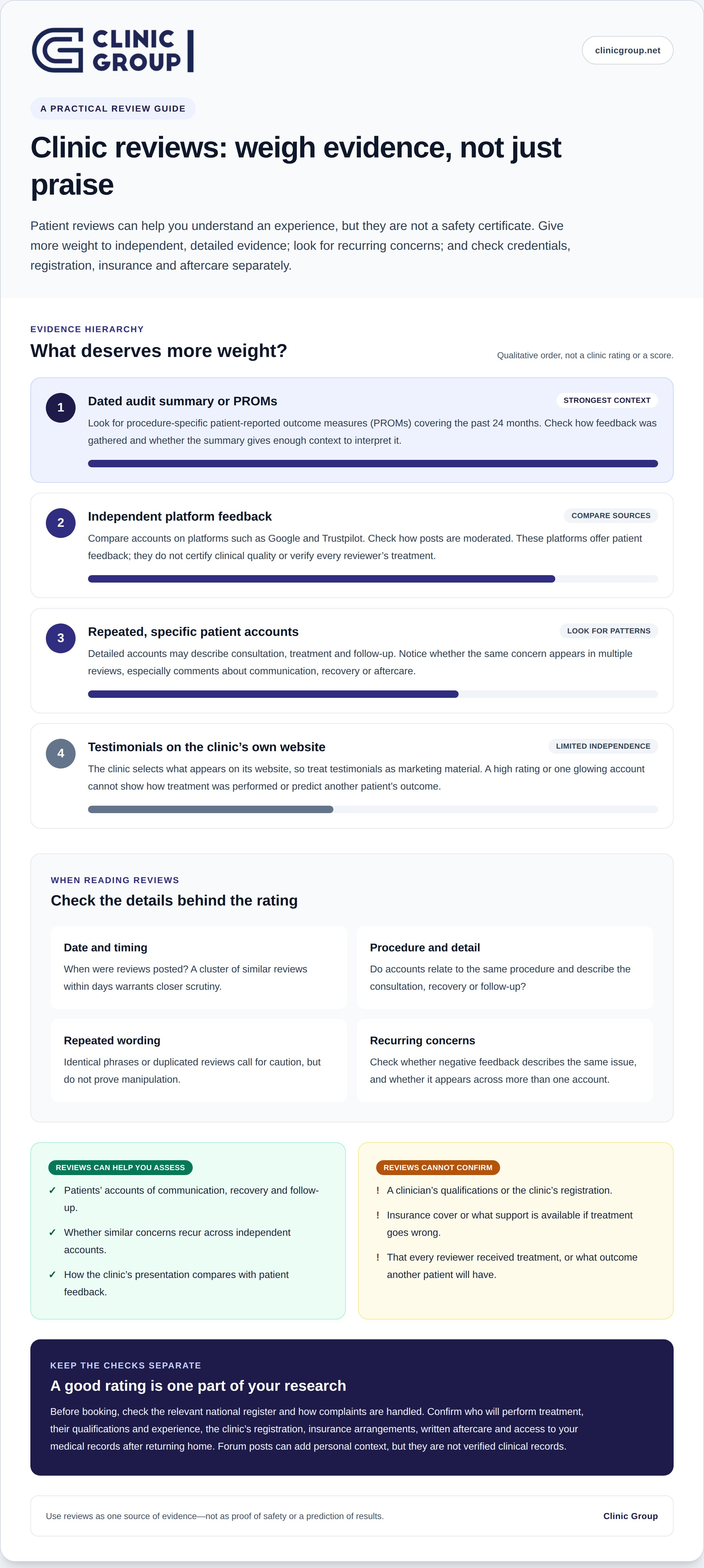
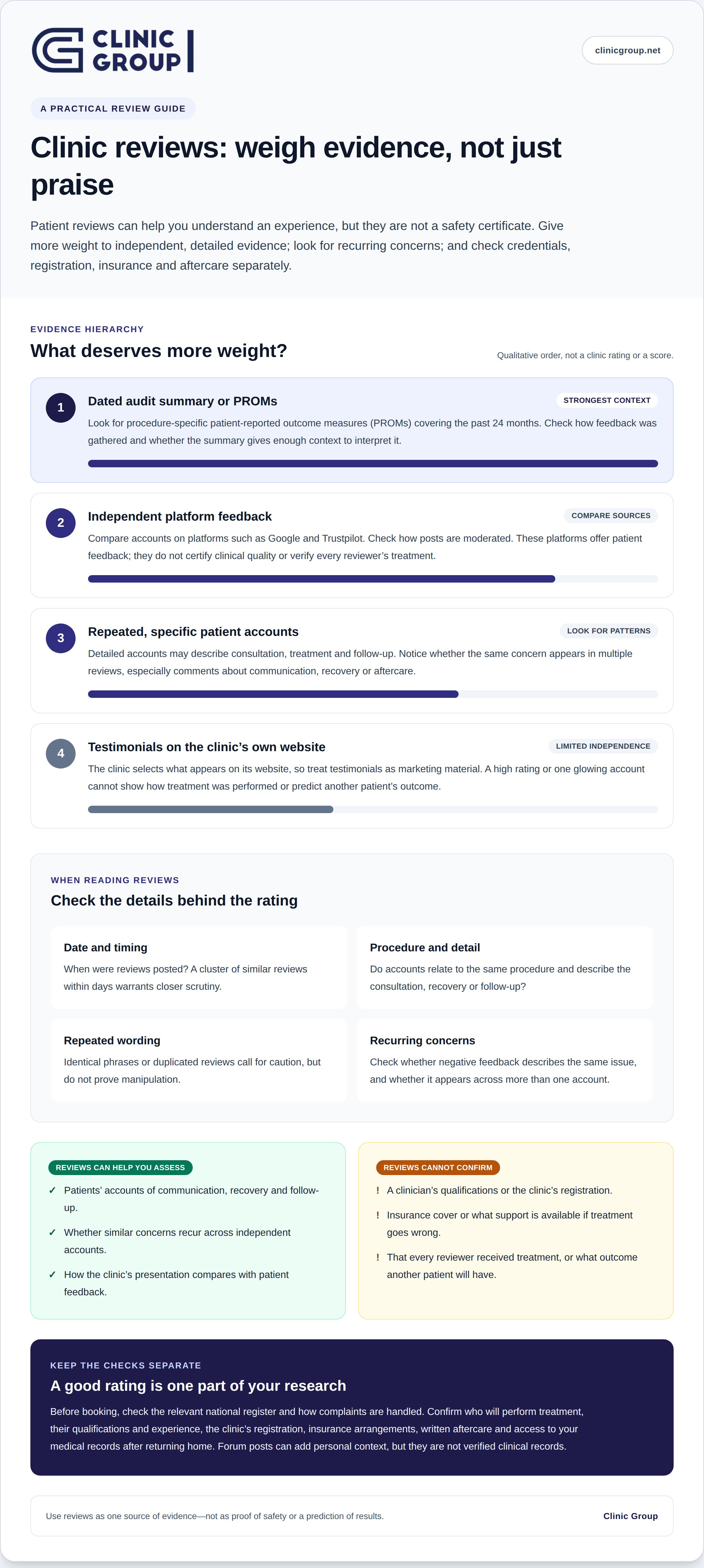
Genuine reviews often describe specific parts of a patient’s experience, such as the consultation, procedure and follow-up. Compare accounts across independent platforms, and look for consistent detail rather than relying on polished testimonials alone.
Warning signs can include identical wording across different sites, repeated phrases, or a cluster of similar reviews posted within days. These patterns don’t prove manipulation, but they warrant closer scrutiny, particularly if negative feedback describes the same unresolved issue.
Google and Trustpilot offer independent places to read reviews, but they don’t certify a clinic’s clinical quality or prove that every reviewer received treatment. Patient forums can add context about treatment abroad, but forum posts are personal accounts, not verified clinical records.
Reviews on a clinic’s own website are selected by the clinic and should be treated as marketing material. Give more weight to feedback on a platform where the clinic cannot choose which reviews appear or their order. Even then, check how the platform moderates posts and whether reviewers’ experiences are clearly described.
Read beyond the overall rating. Check when reviews were posted, whether they cover the same procedure, and what patients say about communication, recovery and aftercare. A pattern of detailed complaints about follow-up may matter more than isolated praise. A single review cannot show how treatment was performed or predict another patient’s outcome.
For a broader picture, look for a dated audit summary or anonymised patient-reported outcome measures (PROMs) dataset covering the procedure over the past 24 months. PROMs record patients’ own reports of their health or results. Check that the material identifies the procedure, explains how feedback was gathered, and gives enough context to interpret the findings. A collection of positive testimonials is not a substitute for this information.
Rules and patient protections differ by country. Before booking, find out which national body registers clinicians and regulates the clinic, then check the relevant register and understand how complaints are handled. Reviews can describe patient experiences, but they cannot confirm registration, insurance cover or what support is available if treatment goes wrong.
So, can I trust reviews for clinics abroad? Treat them as one source of evidence, not a safety certificate. A careful review check compares independent feedback with audit information and country-specific registration details, rather than treating a high rating as proof.
Treat testimonials on a clinic’s own website as promotion: the clinic selects them, so they are not independent evidence. Compare them with reviews on an independent platform where the clinic cannot selectively remove or reorder feedback. Trustpilot and Google are examples of platforms to consult, not reasons to rely on a clinic’s chosen praise.
Compare accounts across platforms, watching for repeated wording or duplicated reviews. Recurring patterns call for caution, but are not proof of manipulation. Pay particular attention to negative feedback and whether the same concern appears in multiple accounts. A cluster of favourable reviews alone offers less insight than a careful comparison of independent patient accounts with the clinic’s own presentation.
How do you verify a clinic and its clinicians before booking?
Start by asking for the practitioner’s full name, exact role and the procedure they’ll perform. Request their qualifications, specialist training and experience with that specific procedure. A general team profile isn’t enough if it doesn’t identify your treating clinician. Check that the person named during your consultation is the one expected to perform the procedure.
Then search the clinician’s name in the national medical register for the country where they practise. For UK plastic surgeons, check the General Medical Council’s specialist register. If you can’t find an overseas clinician, or the register details don’t match, pause and request clarification before booking. Keep the written response with your treatment documents.
Check the clinic separately. Ask for its legal name, registration number, licence details and the hospital address where treatment will take place. Use the country’s relevant public register or regulator to verify the clinic’s registration independently. A licence for one facility does not establish that another hospital or branch is covered.
Review accreditation claims in the same careful way. If a clinic claims JCI accreditation, check whether it appears in JCI’s public directory. ISO 9001 is another claim that can be checked through public databases. Request a copy of the relevant certificate and confirm that its name and address match the facility providing your care. Accreditation does not guarantee a satisfactory outcome.
Ask how the clinic handles online reviews, including whether it edits, removes or filters negative feedback before publication. Look for reviews on independent platforms as well as clinic pages, and note whether comments appear in a selected order. A cluster of similar posts within days, or repeated wording across platforms, merits closer scrutiny.
For outcome information, request a dated audit summary or anonymised patient-reported outcome measures for your procedure, covering the past 24 months. Ask how the results were collected and whether they include complications, revisions or readmissions. Data should relate to the procedure under consideration, not a broad clinic-wide total that combines different treatments.
To check complaints, malpractice claims or disciplinary records, search the clinician’s name and the clinic’s registration details through the relevant country’s regulator or professional register. Ask which body handles complaints and how to search its published decisions. Processes and public records vary between countries.
Use the same process for each clinician and facility rather than relying on a review score. A clinic credential check is strongest when names, registration details, certificates and procedure-specific information all refer to the same people and hospital.
What aftercare and complication arrangements should be in place before you travel?
Before booking treatment abroad, get the clinic’s aftercare and complication policy in writing. It should explain whom to contact if symptoms worsen, where urgent assessment takes place, and who pays for emergency care. Ask whether follow-up is provided by the treating clinician or another healthcare professional, and how you’ll receive advice after returning to the UK.
You can ask for procedure-specific complication, revision and readmission rates covering the past two years. Check how the clinic defines each measure and whether its figures include patients treated elsewhere after returning home. These details may help put reviews into context. A high rating cannot explain how complications are managed or what happens if recovery differs from expectations.
- Who provides urgent assessment and follow-up after you return home?
- Who pays for revision surgery, readmission or emergency treatment?
- Who covers travel and accommodation if a return visit is needed?
- How can you reach the clinic, and what response process applies?
Read the policy for its practical steps, not just broad promises of support. Confirm how to report a problem, arrange an appointment and decide whether further treatment is needed. If the answer depends on the complication, ask for examples, such as an infection or a wound that needs review. Keep the clinic’s written replies with your booking documents.
Travel can affect recovery. Many surgeons recommend waiting at least 7-14 days after surgery before flying. If you’re travelling by air after surgery, walk frequently during the flight and wear compression garments to reduce blood-clot risk. Your travel plan should allow for the clinic’s stated review appointments, rather than leaving immediately after the procedure.
Request copies of your overseas medical records before leaving, including treatment notes, X-rays and scans. Keep them accessible in the UK so a healthcare professional can understand what was done and what follow-up was advised. Ask for the records in a format you can keep and share, and check that they clearly identify the procedure and date.
Aftercare expectations can vary by procedure. BAPRAS says its members must provide adequate aftercare following treatment, including hospital stays, follow-up consultations and further treatment to resolve problems. Use this as a prompt to ask what support the clinic has arranged. In medical tourism, unclear responsibility can make it harder to act quickly if a complication arises, so resolve any gaps in the written plan before travelling.
How can Clinic Group help you find a verified clinic?
Clinic Group can help you move from general research towards a shortlist of verified partner clinics. Its directory and coordination service help you explore treatment options abroad, while the partner clinic remains responsible for clinical care. Clinic Group’s partner clinics are located almost entirely in Albania, with a small number in Dubai, UAE.
If you’re researching dental care, the Dental Treatment Directory is a starting point for exploring relevant clinics and treatment information. Hair Transplant Referrals and the Ophthalmology Clinic Directory support research in those areas. These listings help you organise your search around the care you’re considering, while the treating clinic remains responsible for clinical assessment and treatment.
A directory can help narrow your search, but it shouldn’t replace your own decision-making or a consultation with the treating clinician. Use the information to identify clinics that may be relevant to your needs, then list what you need to understand before proceeding. For example, ask who will assess you, what the proposed care involves and how follow-up is arranged.
Clinic Group connects patients with verified partner clinics and makes relevant information easier to navigate. It does not provide clinical treatment or decide whether a procedure is suitable for you. Those decisions require discussion with the treating clinician, who can assess your circumstances and explain the proposed plan.
Consider using the directory when you know which type of care you’re researching and want to focus on clinics in the partner network. Start with the relevant treatment or clinic information, then note the questions that matter to your decision. This can help you make better use of a consultation and identify what else you need to know before deciding whether to proceed.
Reviews are one part of your decision, not a substitute for direct clinical discussion. Use the directory to find relevant verified clinics, then consider their information alongside what you’ve learned about the practitioner and proposed care. An informed choice depends on understanding who is responsible for treatment and what the process involves.
If you’d like help finding relevant directory information, contact Clinic Group to discuss where to begin.
Considering treatment in Albania? Request a free consultation with Clinic Group.
Frequently Asked Questions
Are reviews on a clinic's own website worth reading?
Yes, but treat them as clinic-selected testimonials, not independent evidence. They can show which aspects of care the clinic chooses to highlight, such as communication or facilities. The question “Can I trust reviews for clinics abroad?” has no simple yes-or-no answer: compare the clinic’s testimonials with feedback hosted elsewhere and with written treatment information. Reviews describing only positive outcomes reveal little about how concerns are handled.
How do you verify the clinic and surgeon before booking?
Check that the named clinician is the person you meet in consultation and that their details match the treatment plan. Confirm their qualifications and experience relate to your procedure, then check their name in the country’s relevant professional register. Also confirm which hospital or clinic will carry out the treatment. If a name, role or facility changes between documents, request an updated written plan before arranging travel.
How long does it take to properly research a clinic abroad?
Set aside about one hour for an initial, focused review of a clinic and its clinician. Compare independent feedback, search the national register, examine the clinic’s registration details and note any unanswered questions about aftercare. Complex procedures or unclear records may need more time. Treat the hour as a starting point, not a deadline for deciding or a substitute for an in-person clinical assessment.
What aftercare and complication arrangements must be in place before you travel?
Get a written plan explaining whom to contact, how concerns are assessed and what happens if further treatment is needed. Clarify who pays for revision care, readmission or a return visit, and how you’ll receive advice after returning to the UK. Ask who provides your records and how you can access them. Keep the plan, contact details and treatment documents together.
What is the single most important question to ask a clinic abroad?
Ask: “Who is responsible for my care if I develop a complication after returning to the UK, and what does that support include?” Request a written answer explaining who assesses the problem, how to contact them and who pays for any further care. This helps establish whether the clinic has explained its aftercare arrangements clearly, rather than relying on general promises of support.
What legislation does the country have in place to protect you?
Protections depend on the country where treatment takes place, so find out which regulator oversees the clinic and clinician before booking. Ask how patients can raise a complaint and whether decisions or disciplinary findings are publicly searchable. Don’t assume UK rules apply abroad. The clinic’s explanation can help frame your questions, but the relevant national regulator’s published information is the stronger reference for local registration and complaint processes.
How can I check a foreign clinic’s registration, licence and accreditation?
Get the clinic’s full legal name, registration number and treatment-site address, then compare them with the country’s public register. Check licences against the facility where your procedure will happen, not just a group’s head office. For claimed JCI accreditation, consult JCI’s public directory; request certificates for other claims, such as ISO 9001, and check that the named organisation and site match. Check certificate dates and scope, too.

Article by
Clinic Group Editorial Team
The Clinic Group editorial team publishes clear, practical guides for UK and EU patients researching medical travel — from dental implants and hair transplants to plastic surgery and eye care — with a focus on verified clinics, transparent “from” pricing, and safe planning.
Disclaimer
This article is for general information only and is not medical advice, diagnosis, or a substitute for an in-person consultation with a qualified clinician. Treatment suitability, risks, timelines, and costs vary by individual. Clinic Group connects patients with independent clinics; those clinics are responsible for clinical care. Always verify credentials, obtain a written treatment plan and itemised quote, and confirm aftercare arrangements and travel insurance cover (elective procedures are often excluded) before booking. Outcomes cannot be guaranteed.