The headline price is only one part of planning a facelift abroad: travel, accommodation, medical assessment and aftercare also affect the decision. When comparing facelift costs, check what each quote includes and what costs extra instead of judging by the quoted figure alone.
It is understandable to focus on cost when arranging treatment outside the UK. But a suitable plan also depends on an individual medical assessment, clear information about the procedure and recovery, and enough time for follow-up before travelling home.
This guide covers the main cost and travel considerations, what to expect from a medical assessment, and how to compare verified clinics beyond price. It also outlines questions to discuss with a qualified surgeon when considering whether a facelift may suit you, so you can make an informed decision about treatment abroad.
Key Takeaways
- Compare indicative starting prices for listed plastic surgery treatments, then use a personal written quote to understand your own costs.
- Plan for an in-person assessment and a written medical evaluation before making travel and appointment arrangements.
- Discuss procedure-specific risks, recovery needs and follow-up arrangements with the treating verified clinic.
- Look beyond price when reviewing a clinic: consider its credentials, safety information, patient feedback and care arrangements.
- Clinic Group’s directory can help you explore verified providers for its listed treatments and understand the steps involved in arranging care abroad.
What do listed plastic surgery treatments cost?
Clinic Group’s treatment listings provide indicative starting prices for some plastic surgery procedures. For UK readers, the figures need to be considered in pounds when planning a budget. The approved starting prices for facelift and rhinoplasty are not provided in GBP here, so converting them without a current exchange rate would risk giving a misleading amount. A personal written quote is the appropriate basis for budgeting.
| Listed treatment | Indicative starting price in GBP |
|---|---|
| Facelift | No GBP figure available |
| Rhinoplasty | No GBP figure available |
A starting price is a reference point, not a confirmed total for an individual operation. The final amount depends on the procedure recommended after assessment and the clinical arrangements set out in the quote. Breast reduction is a distinct operation, so do not use a facelift or rhinoplasty starting price to estimate its cost.
For a useful comparison, check that each estimate covers the same treatment and cost categories. A written quote should distinguish the surgeon’s fee and clinical care from travel or accommodation costs, where relevant. It should also state what is excluded and explain how changes to the proposed treatment could affect the amount payable.
Currency is another practical consideration when budgeting in the UK. A price in another currency can change in sterling as exchange rates move, so a converted amount may differ from an earlier calculation. Check the currency and payment terms in the written quote, and use those details to plan your budget rather than treating a starting price as a fixed total.
Before deciding, review the quote alongside the proposed treatment plan. Check that the named procedure matches what was discussed during the assessment and that separate charges are clearly identified. If the package description is broad, request a clearer breakdown from the treating clinic before agreeing to proceed.
Clinic Group’s guide to comparing breast surgery quotes explains why the inclusions and exclusions matter. Use that approach to assess whether a written estimate is clear and specific to the treatment proposed. A personal written quote gives you a more dependable basis for comparing options than a headline starting price alone.
How does the treatment process work?
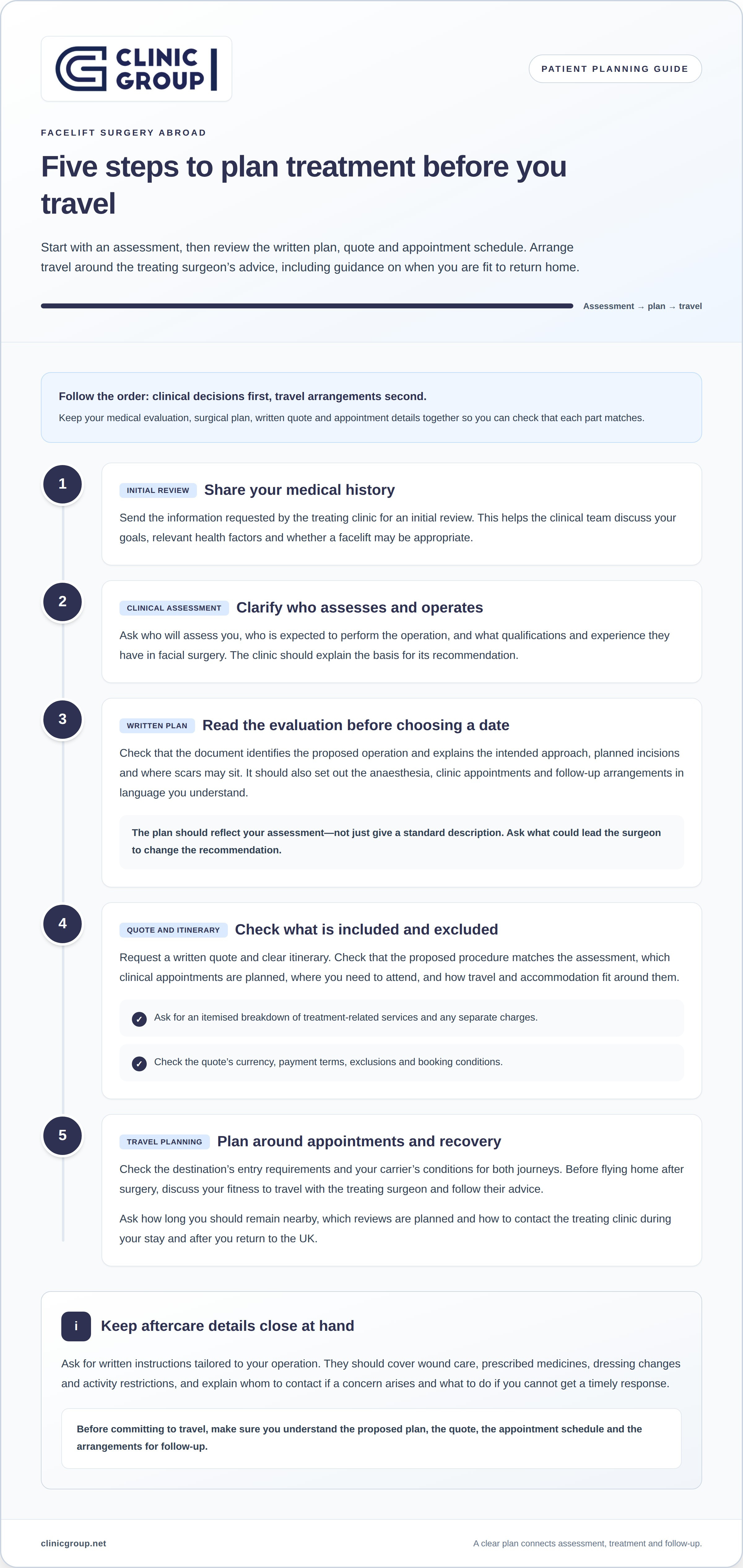
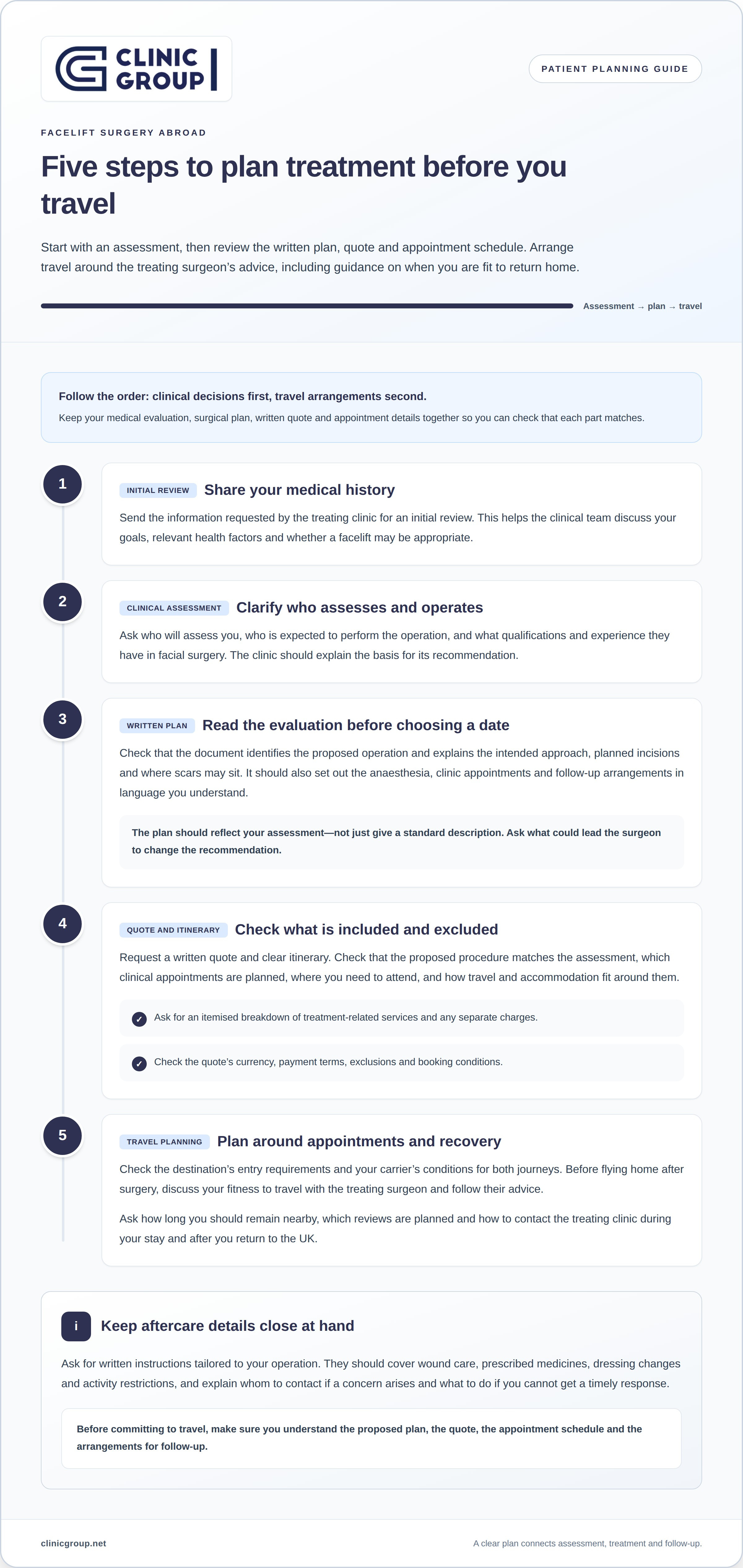
For a UK patient, arranging facelift surgery abroad begins with an assessment, followed by a written medical evaluation and a travel plan. Check the destination’s entry requirements and your carrier’s conditions for both journeys. Before flying home after surgery, discuss your fitness to travel with the treating surgeon and follow their advice.
Begin by sharing your medical history and the information requested by the treating clinic. The assessment gives the clinical team an opportunity to discuss your goals, relevant health factors and whether a facelift may be appropriate. Ask who will assess you, who is expected to perform the operation, and what qualifications and experience they have in facial surgery. The clinic should explain the basis for its recommendation.
After assessment, request a written evaluation and surgical plan before committing to a date. It should identify the proposed operation and explain the intended approach, including how facial tissues will be repositioned. Ask the surgeon to describe the planned incisions and where scars may sit. The document should also set out the anaesthesia, clinic appointments and follow-up arrangements in language you understand.
The plan should reflect your assessment, not simply give a standard description of a facelift. Ask how your health history informs the proposal and what could lead the surgeon to change it. If the recommendation is unclear, raise your questions before booking travel or making a payment.
Before confirming dates, get a written quote and clear itinerary. Check which clinical appointments are planned, where you need to attend, and how travel and accommodation fit around them. A package may combine treatment-related services with travel arrangements, but its name alone does not tell you what is included. Request an itemised breakdown and check that the appointment schedule matches the agreed plan.
Use these steps to organise the decision:
- Send the information requested for an initial review.
- Attend the assessment arranged by the treating clinic.
- Read the written evaluation and surgical plan, then ask about unclear points.
- Review the written quote, inclusions and booking conditions.
- Arrange travel around appointments and the surgeon’s advice on returning home.
Keep copies of your evaluation, plan, quote and appointment details together. The process for medical consultations abroad can help you understand what to clarify during assessment. Make sure you know how to contact the treating clinic during your stay and after you return, and who is responsible for answering clinical questions.
What risks and aftercare should patients consider?
Plan recovery as part of treatment, not as an afterthought to travel. Before booking, ask the treating clinic how long you should remain nearby, which reviews are planned and what support is available after you return to the UK. A journey home that leaves little time for recovery can make follow-up appointments and everyday tasks harder to manage.
Ask for written instructions tailored to your operation, covering wound care, prescribed medicines, dressing changes and activity restrictions. The clinic should also explain whom to contact if a concern arises, how to reach them and what to do if you cannot get a timely response. Keep these instructions and contact details accessible during your stay and after returning home.
Recovery instructions commonly include practical limits on activity and guidance about supportive clothing. Published advice includes staying at home for at least one week after surgery, avoiding strenuous chest activity for at least four weeks, and wearing a supportive, non-underwired bra 24/7 for six weeks while recovering. The treating team’s discharge instructions should guide your own routine.
Build practical support into your plan. Arrange help with shopping, childcare or household tasks if your clinic advises limiting movement. Consider who can accompany you or check in after you return, particularly while your normal routine is restricted. Discuss when you can resume work, exercise and travel, and get the clinic’s advice in writing rather than relying on another patient’s experience.
Healing also takes time. Bruising and swelling usually dissipate within 1-2 months, while scars can mature, fade and soften within 3-12 months. These changes are part of the recovery period, so ask how to care for incision sites and when the clinic wants to review progress. Follow-up can help the treating team assess healing and respond to questions about your recovery.
Before travelling home, make sure you understand what would prompt you to contact the clinic and what route to use if you need urgent clinical advice. Keep copies of your discharge summary, medication instructions and follow-up details. If care is needed after you return, knowing which team is responsible and how your records can be shared helps avoid confusion. This guide to aftercare in the UK following surgery abroad covers practical continuity-of-care considerations.
How can you choose a verified clinic?
Compare the treating surgeon, facility, written care plan and follow-up arrangements rather than relying on rankings alone. For each option, look for clear answers about credentials, safety processes and where the surgery will take place.
Clinic Accreditation and Quality Standards
Start by identifying the surgeon and facility named in your proposed plan. Review the surgeon’s qualifications and experience in breast reduction surgery, then establish which organisation issued each credential and what it covers. If a clinic cites JCI accreditation, check that the named facility and accreditation scope match the care being discussed. Ask how the clinic manages patient safety, infection prevention and concerns after surgery.
Clinic and Hospital Stay
Ask where your operation will take place and whether your stay is planned at a clinic or hospital. Request written details of admission and discharge arrangements, including who will review you before you leave. A breast reduction abroad package may list accommodation and hospital care separately, so check each item rather than assuming a hotel stay includes clinical supervision. Confirm how discomfort, wound care and urgent concerns will be handled during your stay.
Compare clinics using the same criteria. Set each written plan alongside the clinic’s information and check that the surgeon, operation, facility and follow-up route are consistent. Ask who will assess you in person, who will perform the surgery and how the clinic will share instructions after you return to the UK. A clear answer should name the responsible people and explain the practical steps.
Reviews can provide context, but they cannot establish whether a clinic is suitable for your operation. Look for specific comments about communication, assessment, hospital arrangements and aftercare. Check for recurring themes across different reviews, and note whether feedback concerns breast reduction surgery or another cosmetic procedure. Treat ratings and rankings as a starting point, not proof of surgical quality or a substitute for a written medical plan.
Destination also affects the practical comparison. Clinic Group works with verified partner facilities in established medical tourism destinations such as Tirana, Albania, and Dubai, UAE, while coordinating client services from its United Kingdom base. Compare the proposed clinic’s location, appointment schedule and recovery arrangements with your travel plan. A convenient journey does not replace an assessment of the surgeon or facility.
Before deciding, use a short review sequence: check credentials, read the clinic’s safety information, examine procedure-specific reviews, then match the written assessment and aftercare plan. Ask how follow-up works once you are back in the UK, including who handles questions about healing. These signs of a good clinic abroad can help structure your comparison when researching comprehensive breast reduction abroad packages without relying on price or promotional rankings alone.
How can Clinic Group help with your search?
Clinic Group helps patients explore overseas treatment options by connecting them with verified providers through its directory and coordinating their search. It does not provide clinical treatment: assessment, diagnosis, surgery and aftercare remain the responsibility of the treating clinic and its medical team.
If you are researching facelift treatment abroad, start by clarifying what you need to know before deciding. Clinic Group’s medical tourism treatment guides explain the steps involved in considering care abroad, while its Plastic Surgery Provider Listings help patients explore verified providers for the plastic surgery treatments represented in the directory. The treating provider must explain your individual assessment and proposed care.
This distinction matters. A directory can help you find and organise information, but it cannot determine whether an operation is clinically suitable. That decision requires an assessment by the treating medical team, including a discussion of your health history, expectations, proposed technique and recovery needs. Before you decide whether to proceed, the clinic should provide a written evaluation and explain its follow-up arrangements.
Keep your key questions together as you review options. Note what you need to understand about the assessment, the surgeon’s relevant qualifications, the facility, package inclusions and aftercare. Then compare each verified provider’s information against those points. This makes unanswered questions easier to spot and separates clinical details from travel coordination.
- Finding relevant information: use the directory and treatment guides to understand the available listed services and the general steps involved in overseas care.
- Organising your research: keep clinic details, written plans and package information together so that the proposed care and logistics are easier to review.
- Understanding roles: separate the directory’s connecting and coordination role from the treating clinic’s responsibility for medical decisions and care.
Clinic Group’s verified partner clinics are located almost entirely in Tirana, Albania, with a small number in Dubai, UAE. The directory helps you explore its listed services and provider information in those locations. For procedure-specific guidance, including whether a facelift is suitable for you, the risks to consider and the follow-up plan, speak to the treating clinic.
Use Clinic Group when you want a more organised starting point for researching verified providers and understanding how treatment arrangements fit together. Keep your decision grounded in an in-person assessment, a clear written surgical plan and direct discussion with the medical team responsible for your care. The directory supports your search, but it does not replace clinical advice or promise a particular result.
To continue your research, explore Clinic Group’s guide to plastic surgery abroad for practical information on considering treatment overseas.
Considering treatment in Albania? Request a free consultation with Clinic Group.
Frequently Asked Questions
What is included in the price of the surgery?
The written quote should specify which clinical costs it covers and which are separate. Ask whether it includes the surgeon’s fee, anaesthesia, facility care, medication, dressings and a support garment. Travel costs, such as transfers or accommodation, may be listed separately. Use an itemised breakdown to understand the total and identify possible extra charges before agreeing to treatment or making travel arrangements.
What should I consider when choosing a clinic for a facelift?
There is no single right clinic for every patient. Check whether a verified clinic can assess your needs, explain the proposed operation and set out clear follow-up arrangements. Consider the practical demands of travelling and recovering away from home alongside the clinical plan. Compare clinics on their credentials and care arrangements, rather than choosing based only on price or online rankings.
Can I pay in instalments?
Clinic Group does not provide in-house patient financing. Payment arrangements depend on the treating clinic, so ask it whether staged payments are available and what terms apply. Before paying, request written details of the deposit, payment deadlines, cancellation terms and any refund conditions. Do not assume an instalment option for overseas treatment just because one is available for other services or purchases.
How do I go about booking the surgery?
Begin by arranging an assessment with the treating clinic and sharing the information it needs to review your case. Read the written medical evaluation and proposed plan before deciding whether to proceed. Ask the clinic to explain any unfamiliar terms, then review the quote and booking conditions. Confirm the appointment and travel arrangements only once you understand the plan, payment terms and follow-up process.
How is post-operative care?
The treating clinic organises post-operative care and should explain it before surgery. Ask who will review your recovery, how to contact the clinical team after returning home and what to do if a concern arises outside a planned appointment. Keep your discharge instructions, medication details and clinic contact information together. Establish how follow-up records or advice can be shared with your usual healthcare team.
Is facelift recovery painful?
Some pain or soreness can occur, particularly during the first 1-3 days after surgery. The level of discomfort differs between patients and depends on the operation and recovery. Before discharge, ask the treating team how to take prescribed pain relief and which symptoms need prompt attention. Follow the clinic’s specific instructions rather than changing medication or activity based on another patient’s account.
What about the accommodation?
Accommodation arrangements vary. Ask whether lodging is included, where it is located and how you will travel between it and the clinic. One patient-reported package included a hotel and clinic transfers, but that example does not establish what another package covers. Consider whether the accommodation suits your recovery needs and whether a companion can stay with you. Get any agreed arrangements in writing before booking.
What is included in facelift surgery packages abroad?
Facelift abroad packages can combine clinical and travel arrangements, but inclusions vary. One patient-reported example included transfers, medication, dressings and a compression garment; do not assume these items are standard. Request a written list distinguishing surgery and clinic care from accommodation, transport and follow-up. Check who supplies each item and whether anything needed during recovery costs extra.

Article by
Clinic Group Editorial Team
The Clinic Group editorial team publishes clear, practical guides for UK and EU patients researching medical travel — from dental implants and hair transplants to plastic surgery and eye care — with a focus on verified clinics, transparent “from” pricing, and safe planning.
Disclaimer
This article is for general information only and is not medical advice, diagnosis, or a substitute for an in-person consultation with a qualified clinician. Treatment suitability, risks, timelines, and costs vary by individual. Clinic Group connects patients with independent clinics; those clinics are responsible for clinical care. Always verify credentials, obtain a written treatment plan and itemised quote, and confirm aftercare arrangements and travel insurance cover (elective procedures are often excluded) before booking. Outcomes cannot be guaranteed.