TL;DR:
- Choosing an accredited, experienced, and transparent clinic is essential for successful dental treatment abroad.
- Patient reviews and aftercare quality heavily influence satisfaction and long-term outcomes.
- Carefully compare full treatment plans, materials, costs, and communication to make a confident choice.
Choosing a dental clinic abroad is not as straightforward as picking the cheapest option or the one with the most polished website. Many patients travelling for dental care assume that clinics offering the same treatments, whether dental implants, veneers, or full mouth restorations, will deliver roughly the same results. This assumption can lead to costly mistakes, poor outcomes, and difficult follow-up situations. The clinic you choose directly shapes your experience, your safety, and the longevity of your results. Here is a thorough, step-by-step guide to making a truly informed comparison before you commit.
Table of Contents
- Understanding the landscape of dental tourism
- The essential criteria: What to compare between dental clinics
- Weighing quality, cost, and reviews: Making sense of the data
- Putting your comparison into action: Steps to a confident choice
- Why conventional clinic comparisons may miss what really matters
- Ready to compare clinics and take the next step?
- Frequently asked questions
Key Takeaways
| Point | Details |
|---|---|
| Clinic choice matters | Your clinic selection can greatly impact safety, results, patient satisfaction, and total cost. |
| Use a comparison framework | Check key criteria like accreditation, qualifications, and aftercare to avoid unpleasant surprises. |
| Balance expert and personal expectations | Combine professional criteria with your personal aims for the best outcomes. |
| Trust, communication, and aftercare | Clear communication and robust aftercare are as essential as price or medical expertise. |
Understanding the landscape of dental tourism
Dental tourism has grown substantially across Europe over the past decade. Patients from the UK, Germany, Italy, and Scandinavia regularly travel to countries such as Hungary, Poland, Turkey, and Croatia to access treatments at significantly lower prices. The savings can be considerable. A single dental implant that costs £2,500 to £3,000 in the UK may cost £700 to £1,200 in countries like Hungary or Poland, without necessarily compromising on quality.
However, the reasons people choose dental tourism go beyond cost alone. Some patients are drawn by shorter waiting times, access to newer technologies, or the opportunity to combine treatment with travel. Others simply cannot access specialist care locally at a price they can afford.
What many patients do not anticipate is that the differences between clinics abroad are just as significant, sometimes more so, than the differences between a domestic clinic and a foreign one. Reading a dental treatment abroad guide before making any decisions is a wise first step. Comparing clinics carefully matters more in a cross-border context because you have fewer safety nets. You cannot easily pop back in for a check-up. Your local dentist may not be familiar with the materials or methods used. And if something goes wrong, navigating complaints or remedial work across borders adds another layer of complexity.
Key factors driving the growth of dental tourism in Europe include:
- Rising dental costs in Western Europe and the UK
- Improved accessibility through low-cost air travel
- Higher awareness of international clinic standards and accreditations
- Easier access to online reviews and international patient forums
- Growing number of clinics that specifically cater to international patients
There is also an important professional versus patient dynamic to consider. Aesthetic outcomes evaluation and expectations differ between professionals and patients, meaning what a dentist considers an excellent result may not match what a patient envisioned. This is a critical issue in dental tourism, where pre-treatment consultations are often shorter or conducted remotely. When you skip detailed comparisons, you also skip the opportunity to assess whether a clinic understands and shares your expectations.
Learning how to handle safe medical consultations is a fundamental part of the dental tourism process, particularly when comparing what different clinics offer during their initial assessment.
The essential criteria: What to compare between dental clinics
With the dental tourism context clear, it is time to break down exactly what you should compare between clinics. Not all comparison factors carry equal weight, and knowing which ones matter most will save you both time and stress.
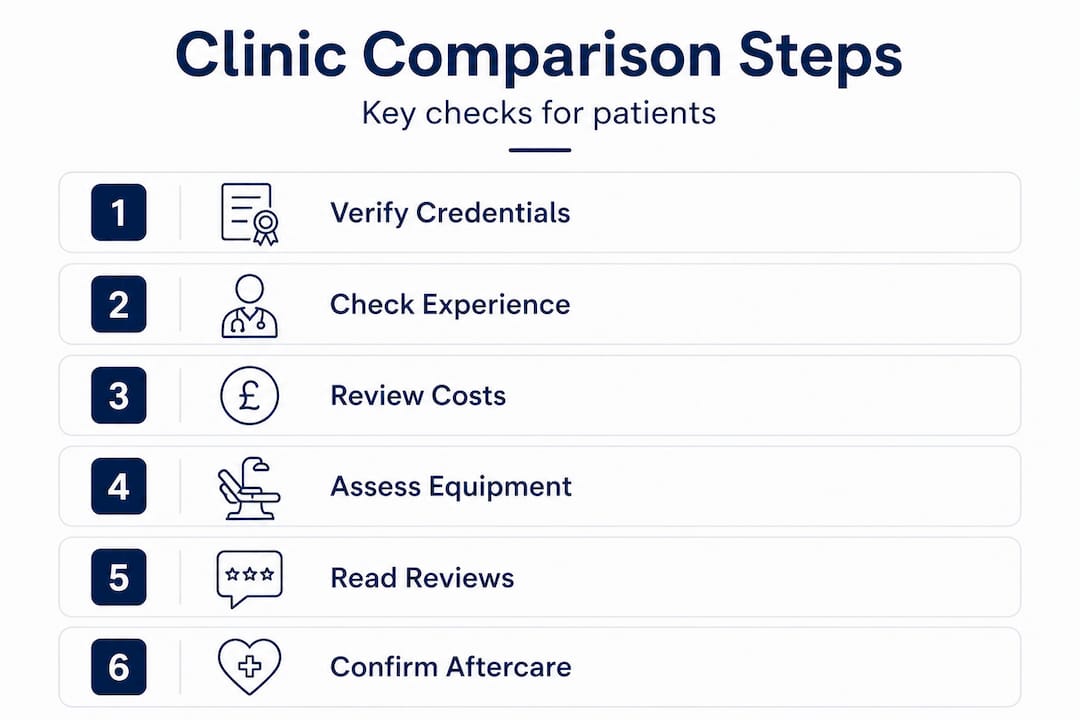
1. Accreditation and certification Reputable clinics hold internationally recognised accreditations. Look for ISO certification, membership in the European Association for Osseointegration (EAO), or recognition by national dental councils. These signal that the clinic meets established quality and safety standards.
2. Dentist qualifications and experience Check each dentist’s credentials, including their university training, specialisations, and years of experience in the specific treatment you need. A general dentist placing implants is very different from an oral surgeon who has performed hundreds of the same procedure.
3. Cost transparency Genuine clinics provide detailed, itemised treatment plans. Be cautious of any clinic that offers a single headline price without specifying what is and is not included. Ask specifically about CBCT scans, abutments, temporary crowns, and follow-up appointments.
4. Equipment and materials Ask which implant brands, composite materials, or ceramic systems the clinic uses. Recognised brands such as Straumann, Nobel Biocare, or Ivoclar Vivadent in prosthetics indicate a commitment to quality. Clinics using unbranded or low-grade materials may cut costs at your expense.
5. Patient reviews and real case outcomes Patient reviews and personal expectations should be weighed when considering clinics’ aesthetic approaches and communication. Look for reviews that describe the consultation process, the quality of communication, and how the clinic handled any issues, not just the final result.
6. Communication and aftercare provision How does the clinic communicate before and after treatment? Do they provide written aftercare instructions, emergency contact numbers, and clear guidance for patients who have returned home?
Here is a quick comparison of what to look for versus what to watch out for:
| Criteria | Green flag | Red flag |
|---|---|---|
| Accreditation | ISO or EAO certified | No verifiable credentials listed |
| Cost breakdown | Detailed itemised quote | Single “all-in” price with no detail |
| Dentist profile | Named, qualified specialist | Anonymous or vague bios |
| Patient reviews | Specific, detailed experiences | Generic or overwhelmingly perfect |
| Aftercare | Written plan, contact support | No aftercare information provided |
| Materials | Named international brands | Unlisted or unverified materials |
Browse trusted healthcare clinics using verified directories that provide this level of clinic detail upfront, rather than relying solely on a clinic’s own marketing materials.
Pro Tip: Request a written treatment plan and quote from at least three clinics before making any decision. A genuinely confident clinic will provide one without hesitation.
Weighing quality, cost, and reviews: Making sense of the data
Now that you know what to compare, let us discuss how to interpret the details and avoid misleading conclusions.
Why lower price may mean hidden compromises
A notably low quote does not automatically mean poor quality, but it does demand scrutiny. Some clinics reduce costs by using lower-grade materials, shorter consultation times, or fewer imaging procedures such as CBCT scans, which are essential for accurate implant placement. When you receive a quote that seems unusually competitive, ask the clinic to specify exactly what is included. If they cannot answer clearly, treat that as a significant warning sign.
Here is a practical framework for evaluating value across clinics:
- List the full scope of treatment for each clinic
- Confirm which materials and brands are used
- Ask whether imaging, anaesthesia, temporary restorations, and follow-up appointments are included
- Request a total cost of care, not just the headline procedure cost
- Factor in travel, accommodation, and potential remedial work into your overall budget
How to spot genuine versus misleading patient reviews
Online reviews are a valuable research tool, but they need careful interpretation. Outcome differences due to variation in communication and alignment of expectations are significant, and this shows up clearly in authentic patient feedback. Genuine reviews tend to mention specific details: the name of the treating dentist, the number of visits required, how the clinic handled an unexpected complication, or whether the aftercare instructions were clear and easy to follow.
Be cautious of:
- Reviews that are uniformly five stars with no critical feedback
- Very short, vague comments such as “Great service, would recommend”
- A large spike in positive reviews over a short time period
- Reviews that focus only on the front desk or hotel-like facilities, with nothing about the actual clinical care
The impact of aftercare and ongoing communication
One of the most overlooked elements in clinic comparisons is aftercare for medical tourists. What happens after you return home matters enormously. Strong aftercare includes written instructions, a direct contact for clinical queries, a clear protocol if something goes wrong, and ideally a relationship with a local partner clinic for urgent needs.
Pro Tip: Before booking, send the clinic a detailed question by email and assess their response time and the quality of their answer. Slow, vague, or generic responses before treatment do not bode well for communication after treatment.
Putting your comparison into action: Steps to a confident choice
You now have the knowledge and the tools, so here is how to put them into action and confidently select the best clinic for your needs.
-
Start with a shortlist of five or more clinics. Use verified platforms, patient forums, and recommendations from healthcare professionals. Avoid making decisions based on a single source.
-
Apply your essential criteria as a filter. Remove any clinic that cannot provide verifiable accreditation, named and qualified dentists, or an itemised treatment plan. This alone will narrow your list considerably.
-
Verify credentials independently. Do not rely solely on what a clinic states on its own website. Cross-reference dentist names on national dental council registers or professional association directories.
-
Make direct contact with your shortlisted clinics. Ask specific questions about your treatment, including which materials they use, how many of these procedures the treating dentist performs per year, and what the aftercare protocol is. A clinic’s responsiveness and depth of answer is itself a quality signal.
-
Weigh patient feedback against your own priorities. Reviews from patients who had the same treatment you are considering are the most relevant. Patients need to balance professional advice with their own expectations for the best outcomes. Your priorities, whether that is minimal downtime, a very specific aesthetic result, or the reassurance of a particular brand of implant, should guide how you interpret others’ experiences.
-
Seek a professional second opinion. Discuss your shortlisted clinics with your local dentist or a trusted dental professional. They may be familiar with the standards in specific countries or clinics and can review the treatment plans you have received.
-
Confirm your choice in writing. Before travelling, ensure you have a written treatment plan, a clear cost breakdown, and confirmed aftercare provisions. Explore the available dental treatments on reputable platforms to understand what is typically included in each procedure type.
Pro Tip: Ask the clinic for before-and-after photographs of real patients who have had the same treatment. Reliable clinics keep a portfolio and will share it on request, with appropriate consent in place.
Why conventional clinic comparisons may miss what really matters
Most comparison guides focus on the measurable: cost, qualifications, and star ratings. These are important, but they tell only part of the story. After years of supporting patients through international dental journeys, we believe the factors that most consistently determine satisfaction are the ones that do not fit neatly into a spreadsheet.
Laypeople and professionals often value different aspects in dental outcomes, and aligning your priorities is crucial. A dentist may be proud of achieving a technically perfect implant placement, while the patient feels dissatisfied because the shade of the crown does not match their adjacent teeth as expected. Neither party is wrong. They simply had different definitions of success, and that difference was never discussed clearly.
This is the “culture fit” question in dental tourism. Does the clinic take time to understand your specific vision? Do they ask what you dislike about your current smile, rather than immediately prescribing a solution? Do they show you digital previews or wax-ups before starting irreversible work? These are the signals that a clinic is genuinely aligned with your expectations, not just competent at performing the procedure.
Communication style matters too. Some patients feel reassured by detailed clinical explanations. Others prefer clear, simple summaries. A clinic that defaults to one mode regardless of the patient is a less reliable partner. Before booking, pay attention to how the clinic communicates with you during the enquiry stage. Are they listening to your specific concerns, or offering scripted responses?
The reassurance offered by safe dental treatment tips is valuable, but ultimately you are the final judge of success. Your satisfaction depends on how closely the outcome matches your vision, not just whether the clinical benchmarks were met. A lower-ranked clinic that listens carefully and communicates transparently may serve you far better than a highly accredited one that assumes it knows what you want.
Ready to compare clinics and take the next step?
Once you feel confident in what to look for, the next challenge is finding a reliable source to compare clinics without spending weeks on research. Clinic Group’s platform brings together verified clinics across Europe and the Middle East, with detailed profiles, patient reviews, transparent treatment information, and support throughout your journey. You can explore dental treatments by procedure type to understand what each option involves, then use the platform to compare clinics that offer the care you need. Whether you are considering implants, veneers, full-arch restorations, or a simple smile makeover, you can browse clinics worldwide and filter by location, accreditation, and patient ratings. The goal is to make your decision informed, safe, and as stress-free as possible.
Frequently asked questions
What are the most important factors when comparing dental clinics for treatment abroad?
Accreditation, dentist qualifications, transparent costs, and genuine patient reviews are especially important when comparing clinics. Patient reviews and your own expectations are both crucial factors, as satisfaction depends on how well the clinic aligns with your specific goals.
How can I tell if online reviews of a dental clinic are trustworthy?
Look for consistent themes across reviews, check for detailed personal experiences, and be cautious of generic or overwhelmingly perfect feedback. Patient reviews should be weighed against your own expectations and real outcomes, not taken at face value.
Why is aftercare important in choosing a dental clinic abroad?
Strong aftercare ensures any complications or follow-up needs are addressed promptly even after you return home. Communication and alignment between the patient and clinic are key drivers of positive outcomes, and aftercare is where that ongoing relationship proves its worth.
Should I prioritise clinic cost or dentist experience when comparing options?
Both matter, but dentist experience and clinic quality tend to have greater impact on your long-term satisfaction and safety. Laypeople and professionals often value different criteria, so aligning your own priorities clearly before comparing options will help you make the most balanced decision.