Plastic surgery in Europe requires careful research: the destination alone cannot tell you whether a procedure is right for you. The best choice depends on surgeon credentials, facility safety, suitable aftercare and arrangements for travelling home. Clinic Group’s partner clinics are in Albania and Dubai.
When considering treatment abroad, assess safety and suitability for your circumstances. This guide explains what to check about a surgeon and surgical facility, and how insurance, recovery and emergency travel arrangements may affect your decision.
You’ll learn how to assess options in Albania and Dubai, what to check about a surgeon and surgical facility, and how insurance, recovery and emergency travel arrangements may affect your decision. The aim is to help you compare options carefully and consider whether staying closer to home would better suit your needs.
Key Takeaways
- Plan recovery time, return travel and emergency arrangements together; NHS guidance identifies being over 60 as a factor that raises deep-vein-thrombosis risk.
- Assess surgeon credentials, facility standards and patient-safety arrangements, and understand why an in-person assessment matters before surgery.
- See which plastic surgery treatments and partner clinic destinations Clinic Group lists in Albania and Dubai.
- Learn how Clinic Group’s directory and coordination role can help you explore listed clinics without confusing referrals with direct clinical care.
- Use the guide’s practical considerations to make a more informed decision about treatment abroad and the support you may need.
What should patients plan before travelling for treatment?
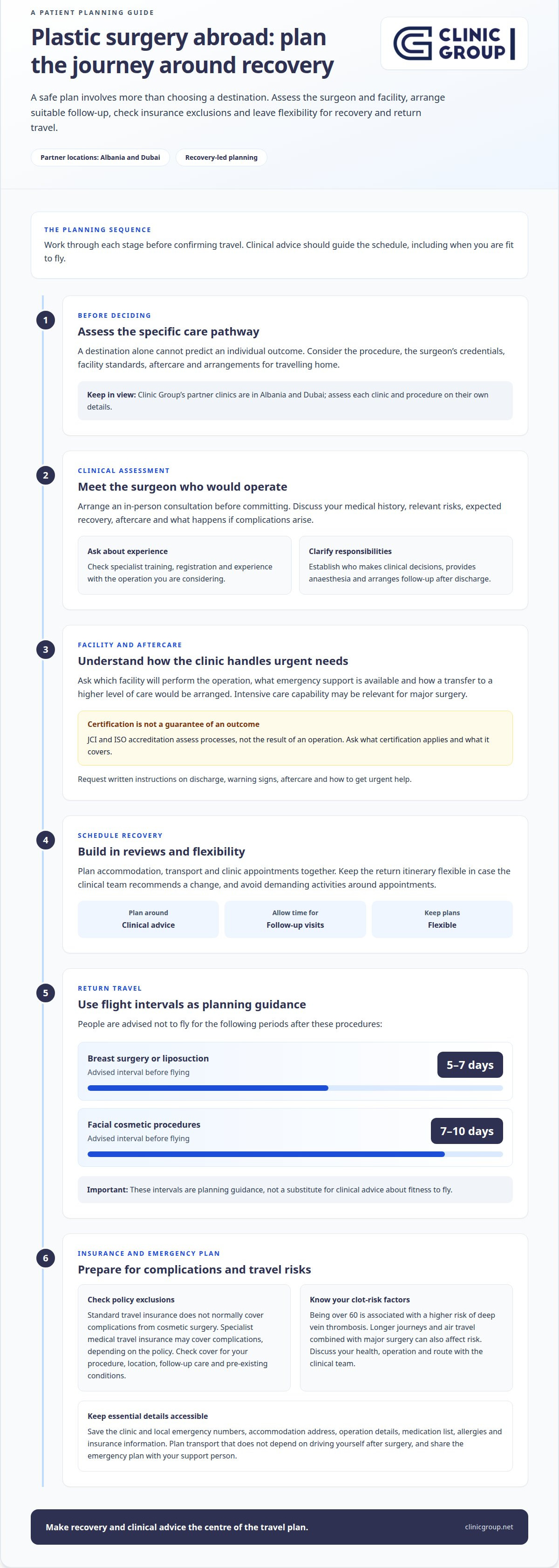
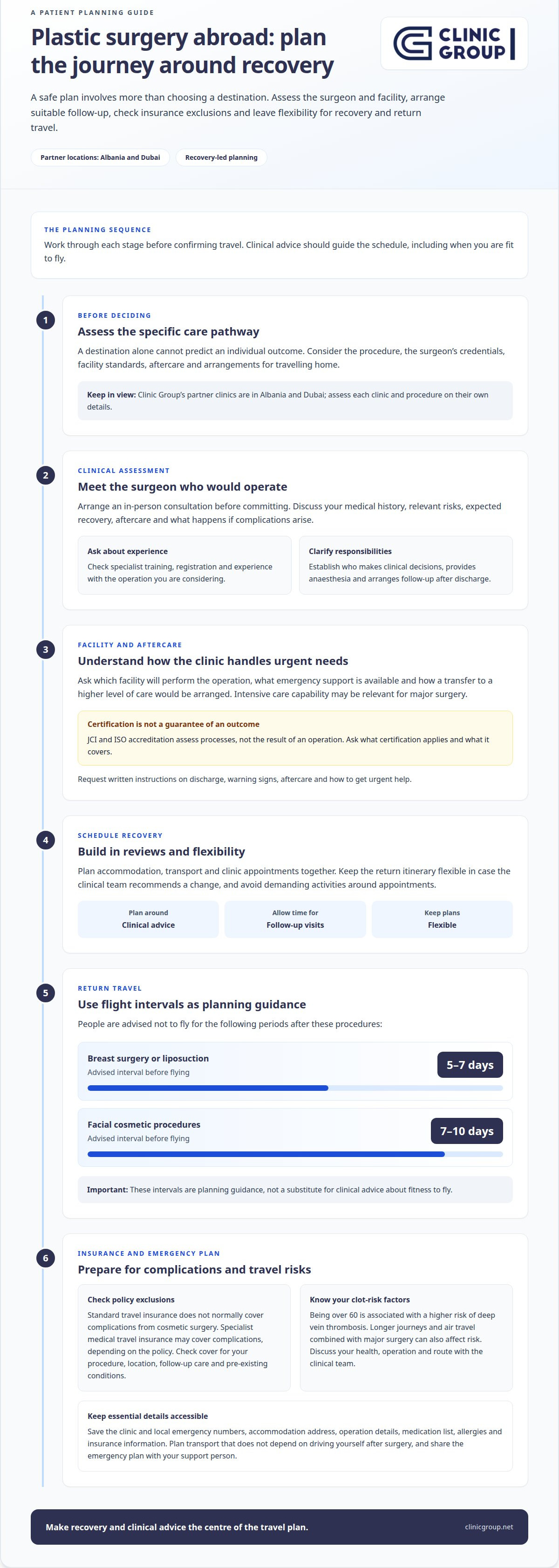
Planning travel for plastic surgery means considering recovery, insurance, accommodation and the journey home, not just the operation date. If you are considering breast augmentation, liposuction, a facelift or rhinoplasty, allow time for follow-up appointments and changes to your recovery. Set your schedule around clinical advice, not a holiday itinerary or a fixed return date.
Ask the surgeon and clinic who will perform the operation, what it involves, which risks are relevant to your health and what follow-up is arranged. Find out how urgent problems are handled, whom to contact after discharge and how your medical records will be shared. These answers clarify the care pathway before you book travel and highlight anything that needs further explanation.
Travel timing matters after surgery. People are advised not to fly for 5 to 7 days after breast surgery or liposuction, and for 7 to 10 days after facial cosmetic procedures. These intervals are planning guidance, not a substitute for clinical advice about fitness to fly. Confirm how the operation, recovery and planned review appointments affect your return journey.
Give insurance careful attention. Standard travel insurance does not normally cover complications arising from cosmetic surgery, so read the exclusions before travelling. Specialist medical travel insurance may cover complications from elective procedures abroad, but coverage depends on the policy. Check whether it applies to your procedure and treatment location, and whether it covers follow-up care and pre-existing conditions. Keep the policy details and clinic contact information accessible throughout your trip.
Consider blood-clot risk when planning the journey. Being over 60 years is a factor associated with a higher risk of deep vein thrombosis. Longer journeys can also affect risk, and air travel combined with major surgery requires careful planning. Discuss your health, the planned operation and your route with the clinical team before departure. Follow their instructions about movement during travel and any recommended preventive measures.
Plan an itinerary around clinic appointments, accommodation and transport. Confirm the clinic address and how you will get there for each review, including whether someone can accompany you. Keep the schedule flexible in case the clinical team recommends a change. Avoid planning sightseeing or other demanding activities around appointments: recovery should remain the priority.
Prepare an emergency plan before leaving. Save the clinic’s number, the local emergency number and your accommodation address. Know where to go if symptoms worsen, who can accompany you and how the clinic will communicate with local services. Keep your operation details, medication list, allergies and insurance information available on paper or on your phone. Share the plan with anyone travelling with you or supporting you at home.
For Clinic Group’s partner locations in Albania and Dubai, map the route between your accommodation and the clinic before confirming travel. Arrange transport that does not depend on driving yourself after surgery, and plan how to attend follow-up visits. The guide to planning medical treatment in Europe can help you organise the journey. Keep your return itinerary flexible so it can follow recovery needs.
How can patients assess safety before plastic surgery abroad?
There is no reliable country-wide ranking that predicts an individual’s plastic surgery outcome. Surgeon qualifications and facility standards must be assessed for the specific clinic and procedure, rather than inferred from a destination’s reputation. Choosing the best country for plastic surgery in Europe therefore starts with the care pathway, not a country label.
Arrange an in-person consultation with the surgeon who would perform the operation before committing to surgery abroad. Discuss your medical history, the procedure’s risks, expected recovery, aftercare and what happens if complications arise. The surgeon should assess your circumstances and explain the proposed plan, rather than relying only on photographs or a generic recommendation.
Ask about the surgeon’s specialist training, registration and experience with the operation you are considering. A surgeon who regularly performs rhinoplasty may have a different practice from one focused on breast augmentation or a tummy tuck. Establish who makes clinical decisions, who provides anaesthesia and who is responsible for follow-up after discharge. These details help you assess the proposed care, but cannot predict a guaranteed result.
Check the facility as carefully as the surgeon’s qualifications. Ask which institution will perform the operation, what emergency support is available on site and how the team responds if urgent treatment is needed. Intensive care capability may be relevant for major surgery. Clarify how the clinic would arrange a transfer to a higher level of care and who would coordinate it.
Facility certification can describe how an institution operates, but it does not guarantee a particular outcome. JCI and ISO accreditation assess processes, not the result of an operation. Ask which certification applies, what it covers and how it relates to your planned procedure. A logo alone cannot answer every question about staffing, emergency arrangements or aftercare.
Ask the clinic to explain its patient-safety arrangements in plain language. Discuss pre-operative assessment, infection prevention, consent, pain control, discharge criteria and access to aftercare. Request written instructions on warning signs and how to seek urgent help. The plan should identify the clinical team and the contact point for concerns after you leave the facility.
Brazilian butt lift, also called gluteal fat grafting, needs particular attention to surgical technique. BAAPS’ safety review in September 2022 concluded that injected fat should be placed only in the subcutaneous layer beneath the skin, never in the muscle. It also said the surgeon should confirm the cannula’s position using ultrasound during the operation. Ask how these safeguards apply to the planned procedure.
Compare clinics against the same practical criteria: the surgeon’s relevant qualifications, facility certification, emergency capability, consultation arrangements and written aftercare plan. Calling a clinic “modern” does not explain how it works. If you are weighing up the best country for plastic surgery in Europe, specific evidence about the clinic and operation is more useful than a broad destination ranking.
Pre-surgery consultations can help resolve questions about whether a proposed operation fits your health needs. The guide to pre-surgery consultations outlines points to discuss with the treating team. Clear information about the surgeon, facility and aftercare supports a more informed comparison across European options.
Plastic surgery outcomes cannot be reliably ranked by European country, and a destination’s reputation does not predict an individual result. Compare surgeons by their specialist training, registration and experience with the procedure you are considering, then assess the clinic and care pathway directly.
Which plastic surgery treatments and destinations are listed by Clinic Group?
Clinic Group lists partner clinics in Albania and Dubai, UAE. Its network is concentrated almost entirely in Albania, particularly Tirana, with a small number of partners in Dubai. These are the locations represented in its directory. The right choice depends on the procedure, the clinic’s arrangements and how consultation and recovery fit your needs.
The listed plastic surgery treatments include rhinoplasty, liposuction, breast augmentation and facelifts. Rhinoplasty changes the shape of the nose; liposuction removes localised fat; breast augmentation changes breast size using implants; and a facelift addresses visible facial ageing. For individuals looking to address surface texture without undergoing surgery, less invasive alternatives like an at home peel for fine lines are often considered first. Each operation has different assessment and recovery requirements, so compare the treatment and care plan as well as the location.
For example, someone considering rhinoplasty can explore listed clinics and find out how to arrange a consultation. A patient considering breast augmentation may want to understand the proposed procedure and follow-up arrangements. Liposuction and facelift surgery also require individual assessments and recovery plans; patients exploring non-surgical skin tightening and contouring alternatives might look to providers such as Vie Aesthetics. A specialist must assess whether a procedure is appropriate; the location alone cannot determine this.
Albania, particularly Tirana, is the main location represented among Clinic Group’s partner clinics. A smaller number of partners are also in Dubai. When considering these options, look at the clinic, the planned operation and how you will attend appointments. Location also affects practical arrangements such as travel and accommodation. The right choice is therefore personal, not a guarantee of quality or results.
A useful comparison focuses on the details that shape the patient journey:
- Treatment: identify whether the clinic lists rhinoplasty, liposuction, breast augmentation or facelift surgery.
- Consultation: understand how the specialist assesses your health, goals and suitability for the operation.
- Facility: establish where surgery takes place and what patient-safety arrangements apply.
- Recovery: consider follow-up and the travel arrangements needed around appointments.
This keeps the decision focused on the clinic and procedure rather than assumptions about a location. Albania may suit one patient’s preferences, while Dubai may fit another’s travel plans; neither location alone determines the quality of care or the outcome. The plastic surgery treatment guide describes the listed procedures and helps readers identify what they want to discuss. Comparing the actual clinic and care pathway is more useful than making broad assumptions about a destination.
How can Clinic Group help patients find a plastic surgery clinic?
Clinic Group helps patients move from researching plastic surgery to exploring relevant provider listings. It is a directory and coordinator that connects patients with listed clinics; it does not provide surgery or medical diagnosis. If you are considering rhinoplasty, liposuction, breast augmentation or a facelift, the directory offers a way to explore listed providers and understand the steps towards a clinical consultation.
Clinic Group’s Plastic Surgery Provider Listings feature partner clinics almost entirely in Albania, particularly Tirana, and a small number in Dubai, UAE. This defined network can help narrow your search to the locations represented in the directory. It is not a country ranking, and a directory listing does not replace an individual assessment of a clinic, surgeon or treatment plan.
Start by identifying the procedure you want to discuss. Someone considering rhinoplasty may need a different specialist and care pathway from someone considering breast augmentation. The same applies to liposuction and facelift surgery. The treating clinic’s medical team assesses suitability, explains the operation and discusses its risks. Clinic Group helps patients find listed providers and coordinate their enquiry, while clinical decisions remain with the treating professionals.
Coordination can make the early stages easier to organise. Clarify which procedure you are researching, where you would prefer to travel and what questions you want answered. The next step is a consultation with the relevant clinic, where the clinical team can review your medical history, goals and suitability. A directory can help make the connection, but it cannot determine whether surgery is appropriate or guarantee a result.
Consider practical and clinical questions together. Ask the listed clinic about consultation arrangements, the surgeon who would perform the operation, the facility, aftercare and how concerns are managed after discharge. Also consider whether the location works for travel and recovery. These details help you compare actual care pathways instead of choosing by destination name alone.
Clinic Group’s other relevant directories cover dental treatment, hair transplant referrals and ophthalmology clinics. These serve different treatment needs and are separate from the plastic surgery listings. If you are enquiring about an operation such as a facelift or breast augmentation, the plastic surgery directory is the relevant starting point. If your needs change, the other directories can help you explore their respective areas of care.
This approach is useful when you have narrowed your interest to a listed procedure but still need to find a clinic for an assessment. It can also help if you want to understand the enquiry and coordination process before discussing treatment with a medical team. A directory cannot provide a diagnosis or determine surgical suitability; that requires assessment by a qualified clinician.
Clinic Group’s role is to make the search and connection process clearer, while the partner clinic remains responsible for clinical assessment, treatment and medical aftercare. Browse the relevant listings when you are ready to explore options in Albania or Dubai, then use the consultation to discuss your individual circumstances with the treating team. To discuss your next step, contact Clinic Group.
Considering treatment in Albania? Request a free consultation with Clinic Group.
Frequently Asked Questions
Is Albania a suitable option for plastic surgery?
Albania may suit patients considering a procedure offered through a listed partner clinic, but suitability depends on the individual and the treatment plan. Use the consultation to discuss the change you hope to achieve and what the proposed procedure can reasonably address. Do not let the destination determine your decision on its own. Consider whether you are comfortable communicating with the clinic and understand its care arrangements.
Why consider surgery abroad?
Surgery abroad gives patients another set of clinics and specialists to explore. It may be worth considering if a listed treatment and clinic align with your needs and you are prepared to organise care across borders. Think about how you will communicate with the clinical team, share relevant health information and make decisions at a distance. Travel alone does not establish that a procedure or provider is right for you.
Which destinations can patients explore through Clinic Group?
Clinic Group’s listed plastic surgery partner clinics are in Albania, particularly Tirana, and Dubai, UAE. The directory does not rank countries for cosmetic surgery tourism. Instead, focus on the specific clinic and treatment available through the listed network. A useful comparison considers the consultation process, the proposed operation and whether the clinic’s communication and care arrangements suit you.
How can patients compare proposed procedure plans?
Compare the clinical plan, not just the procedure name. A written plan should explain the intended change, proposed technique, relevant alternatives and expected recovery. For example, two rhinoplasty recommendations may address different concerns about nasal shape or function. Ask the specialist to explain why the proposed approach suits your goals, and make sure the plan reflects your individual assessment rather than a standard template.
What should patients understand before giving consent?
Informed consent means understanding the proposed operation well enough to make a considered decision. The discussion should cover the purpose of treatment, relevant risks, possible alternatives and what may happen if you decide not to proceed. Ask for unfamiliar medical terms to be explained in plain English. Take time to consider the information and ensure the written consent record reflects the procedure discussed with the treating team.
Which rules apply to cosmetic surgery in Albania or Dubai?
Requirements depend on whether the operation takes place in Albania or Dubai, and on the rules governing its clinicians and healthcare facilities. The EU regulatory framework addresses healthcare quality, safety and patient rights, but it does not replace every national requirement with one identical process. Establish which country’s rules apply to your care and how the clinic handles consent, personal records and formal complaints.
What if a patient changes their mind before surgery?
Tell the clinic promptly if your goals, health information or decision changes before the operation. A new concern may affect the proposed treatment, so the clinical team needs accurate information before proceeding. Ask how a revised plan would be discussed and recorded. Do not feel obliged to continue simply because travel or appointments are arranged; communicate clearly with the treating clinic if you decide to pause.
What documents should patients keep after treatment abroad?
Keep copies of the consent form, operation summary, discharge instructions and follow-up correspondence together and somewhere accessible. These records can help another clinician understand which procedure was performed and what care was advised. Store the clinic’s contact details with them, and note the date of each appointment or communication. If documents are in another language, ask the clinic how your UK care team can understand the key clinical information.

Article by
Clinic Group Editorial Team
The Clinic Group editorial team publishes clear, practical guides for UK and EU patients researching medical travel — from dental implants and hair transplants to plastic surgery and eye care — with a focus on verified clinics, transparent “from” pricing, and safe planning.
Disclaimer
This article is for general information only and is not medical advice, diagnosis, or a substitute for an in-person consultation with a qualified clinician. Treatment suitability, risks, timelines, and costs vary by individual. Clinic Group connects patients with independent clinics; those clinics are responsible for clinical care. Always verify credentials, obtain a written treatment plan and itemised quote, and confirm aftercare arrangements and travel insurance cover (elective procedures are often excluded) before booking. Outcomes cannot be guaranteed.