TL;DR:
- Healthcare quality assurance is a prevention-based system that ensures standards of safety, clinical effectiveness, and regulatory compliance. It relies on four pillars: standard-setting, measurement, monitoring, and improvement to continuously improve patient care and safety.
Quality assurance in healthcare is defined as a systematic, prevention-focused set of activities designed to ensure that health services consistently meet established standards of safety, clinical effectiveness, and regulatory compliance. The industry term is healthcare quality management, and quality assurance (QA) sits at its core. Governed by frameworks such as the CMS Conditions of Participation under 42 CFR Part 482, QA structures itself around four functional pillars: standard-setting, measurement, monitoring, and improvement. For patients considering treatment abroad, and for healthcare professionals working to raise care standards, understanding what is quality assurance in healthcare is the first step toward making genuinely informed decisions.
What is quality assurance in healthcare and why does it matter?
Quality assurance in healthcare is the organised system that prevents errors before they reach patients. Rather than reacting to failures after they occur, QA embeds safeguards directly into clinical workflows, administrative processes, and staff behaviour. This prevention-first logic is what separates QA from other quality functions.

The importance of quality assurance extends beyond patient safety alone. Regulatory bodies, accreditation organisations, and funding bodies all require demonstrable QA compliance. Without it, a clinic risks losing accreditation, reimbursement eligibility, and patient trust simultaneously.
QA also covers clinical care quality, operational performance, and patient experience. Each of these dimensions feeds into the same goal: safe, patient-centred outcomes delivered reliably, not occasionally.
What are the core components of healthcare quality assurance?
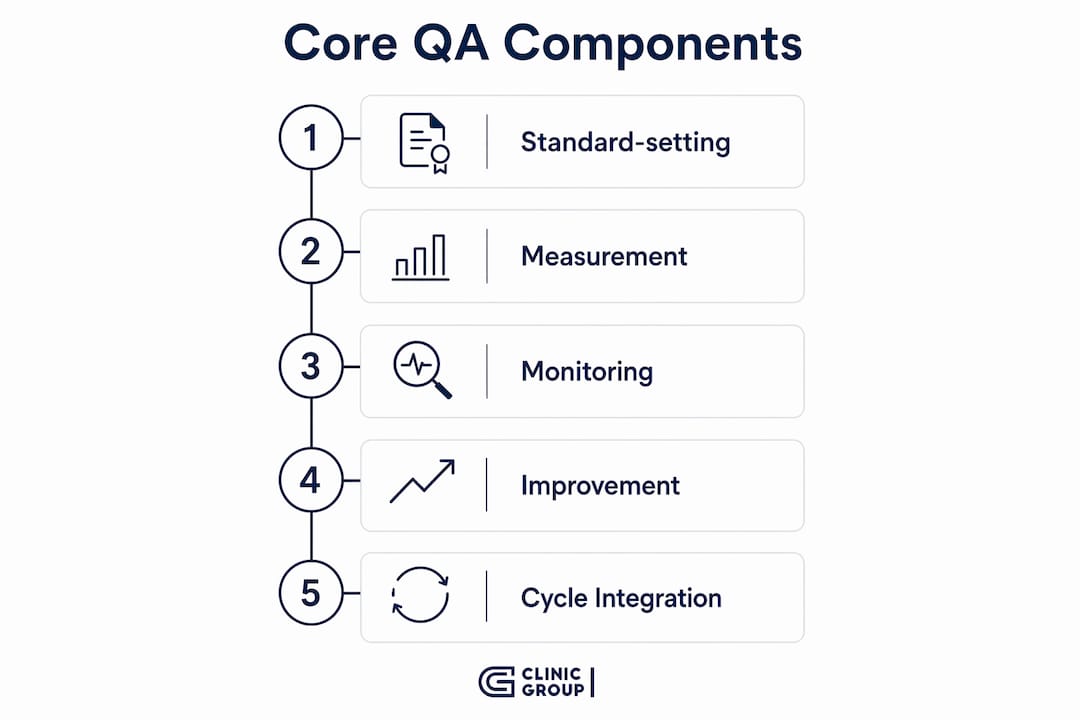
The four pillars of healthcare QA are distinct but interdependent. Each one performs a specific function within the broader quality management system.
- Standard-setting: Regulatory bodies such as the CMS, the Care Quality Commission (CQC) in the UK, and international accreditation organisations define the minimum acceptable standards for clinical care. These standards cover everything from infection control to documentation accuracy.
- Measurement: Performance indicators translate abstract standards into trackable data. Examples include surgical complication rates, medication error frequencies, and patient readmission rates. Without measurement, standards remain aspirational rather than operational.
- Monitoring: Internal audits, occurrence reporting systems, and sentinel event reviews provide ongoing visibility into whether standards are being met. Monitoring catches drift before it becomes harm.
- Improvement: When monitoring reveals a gap, the improvement pillar activates. This is the feedback and adjustment stage. It is distinct from quality improvement (QI) programmes, which operate as a continuous, data-driven discipline in their own right.
Pro Tip: Ask any clinic you are considering whether they conduct regular internal audits and how findings are acted upon. A clinic that can answer this question clearly has a functioning QA system. One that cannot is a warning sign.
The role of quality assurance in hospitals and clinics is to make these four pillars work as a cycle, not a checklist. Standard-setting without monitoring is policy on paper. Monitoring without improvement is data without purpose.
How does quality assurance differ from quality control and quality improvement?
Conflating QA, quality control (QC), and quality improvement (QI) leads to strategic oversights and diminished error reduction. Each concept has a distinct role, and healthcare organisations need all three working together.
| Function | Focus | Timing | Example |
|---|---|---|---|
| Quality assurance (QA) | Prevention | Before care delivery | Surgical checklist completed before incision |
| Quality control (QC) | Detection and correction | During or after care | Reviewing a dispensed medication before administration |
| Quality improvement (QI) | Continuous enhancement | Ongoing | Reducing average discharge time through process redesign |
QA prevents errors by embedding protocols into standard practice. QC catches defects that slip through. QI uses data over time to raise the baseline. Together, they form an integrated quality ecosystem where each function reinforces the others.
A practical example clarifies the distinction. A surgical checklist is a QA tool: it stops errors before the procedure begins. A pharmacist double-checking a prescription before handing it over is QC: it catches a potential error at the point of delivery. A hospital analysing six months of dispensing data to redesign its verification process is QI: it improves the system itself.
Pro Tip: When evaluating a clinic, ask whether they distinguish between their QA protocols and their improvement programmes. Organisations that treat these as the same thing tend to be reactive rather than preventive.
Clear terminology also matters for healthcare quality management at the organisational level. Teams that use QA, QC, and QI interchangeably cannot allocate resources or accountability correctly.
Where is quality assurance applied across healthcare organisations?
QA applies across every domain where patient safety or care quality can be affected. Its reach is broader than most patients realise.
Clinical process controls
Surgical checklists, medication verification protocols, and pre-procedure patient identification checks are all QA tools. Structured adverse event reporting and staff training programmes reinforce these controls by ensuring that human error is minimised at every clinical touchpoint. Patients undergoing procedures abroad should ask specifically whether these controls are in place and documented.
Administrative and documentation workflows
Clinical documentation is the backbone of QA. Accurate medical records enable reliable audits, support reimbursement claims, and provide the evidence base for continuous improvement. Incomplete documentation does not just create administrative problems. It creates safety gaps that audits cannot catch.
Administrative QA also covers compliance with regulations such as 42 CFR Part 482 for hospitals and 21 CFR for medical devices. These frameworks set documentation and reporting requirements that directly affect accreditation status.
Safety protocols and risk mitigation
- Adverse event reporting systems that capture near-misses, not just actual harm
- Infection control protocols verified through regular environmental audits
- Staff credentialling and ongoing competency assessments
- Patient identification procedures to prevent wrong-patient, wrong-site errors
- Medication reconciliation at every care transition point
Risk mitigation through QA reduces the frequency of preventable adverse events. For patients travelling internationally for treatment, medical tourism accreditation provides an external signal that a clinic’s QA systems meet recognised standards.
How can patients and professionals engage with quality assurance?
Both healthcare professionals and patients have a practical role in supporting and evaluating QA. Engagement is not passive.
- Review documentation practices. Professionals should verify that clinical records are complete, contemporaneous, and accessible for audit. Patients can ask to see written care plans and post-procedure instructions as a signal of documentation rigour.
- Enquire about adverse event reporting. Patients can gauge a clinic’s QA maturity by asking whether staff are trained to report near-misses without fear of blame. A non-punitive reporting culture is a hallmark of effective QA systems.
- Look beyond satisfaction scores. Patient satisfaction surveys can be misleading. High satisfaction does not equate to adherence to clinical guidelines. Objective audits and peer review are the reliable measures of care quality.
- Check accreditation status. Accreditation by a recognised body confirms that an external review has validated the clinic’s QA processes. For patients going abroad, this is one of the most reliable indicators available.
- Assess staff training transparency. Ask whether clinical staff undergo regular competency assessments and how often protocols are reviewed. Clinics with mature QA systems can answer these questions without hesitation.
Pro Tip: Before booking any treatment abroad, request a written summary of the clinic’s quality and safety protocols. A reputable clinic will provide this readily. Vague or verbal-only assurances are not sufficient.
Professionals working to improve healthcare quality should prioritise peer review over self-assessment. Internal audits are valuable, but external review catches blind spots that familiarity creates. The combination of both produces the most reliable picture of care quality.
Key takeaways
Quality assurance in healthcare is a prevention-focused system built on standard-setting, measurement, monitoring, and improvement, and it is the foundation of safe, reliable patient care.
| Point | Details |
|---|---|
| QA is preventive by design | It embeds safeguards into clinical workflows before errors can reach patients. |
| Four pillars structure QA | Standard-setting, measurement, monitoring, and improvement each serve a distinct function. |
| QA differs from QC and QI | Conflating these three functions creates accountability gaps and weakens error reduction. |
| Documentation underpins everything | Accurate clinical records are the evidence base for audits, compliance, and improvement. |
| Patients can evaluate QA directly | Asking about adverse event reporting and staff training reveals real QA maturity. |
Quality assurance as a cultural commitment, not a compliance exercise
From where I stand, the most significant shift in healthcare quality management over the past decade is not technological. It is cultural. Organisations that treat QA as a compliance checkbox produce documentation. Organisations that treat it as a cultural commitment produce safer care.
The difference shows up in how staff report errors. In a compliance-driven environment, near-misses go unreported because staff fear blame. In a psychologically safe reporting culture, near-misses are captured, analysed, and used to prevent the next incident. That cultural shift is what separates good QA on paper from effective QA in practice.
I have also seen how QA links compliance to operational excellence, reducing costs from inefficiencies while reinforcing patient and stakeholder trust. Clinics that invest in QA do not just avoid regulatory penalties. They build the kind of reputation that attracts patients who have done their research.
The future of QA in healthcare will be shaped by digital transformation and value-based care models. Data-driven audit tools, electronic adverse event reporting, and real-time performance dashboards are already changing how monitoring works. But the cultural foundation must come first. Technology amplifies what is already there. If the culture is punitive, better data just reveals more problems without solving them.
For patients, the practical implication is straightforward. Choose clinics that can speak openly about their QA processes, not just their outcomes. Outcomes are the result. QA is the system that produces them.
— Clinic
Clinicgroup and quality-assured treatment abroad
Clinicgroup connects patients from the UK and across Europe with verified clinics in Albania and Dubai, where board-certified specialists operate under European standards of care. Every clinic in the Clinicgroup network is assessed for its quality and safety protocols before patient referrals begin. That means patients benefit from clinic matching, travel logistics, partner hotel arrangements, and structured aftercare, all coordinated through a single platform. For patients who have read about dental treatment safety abroad and want to take the next step, Clinicgroup provides transparent access to verified treatment options across dentistry, hair restoration, plastic surgery, and wellness. Quality assurance is not an afterthought in how Clinicgroup operates. It is the standard.
FAQ
What is the quality assurance healthcare definition?
Quality assurance in healthcare is a systematic, prevention-focused set of activities that ensures health services meet established standards of safety, clinical effectiveness, and regulatory compliance, structured around standard-setting, measurement, monitoring, and improvement.
How does quality assurance differ from quality improvement?
Quality assurance prevents errors by embedding protocols before care is delivered, while quality improvement uses ongoing data analysis to raise the baseline performance of clinical systems over time.
Why is quality assurance important for patients going abroad?
For patients seeking treatment internationally, QA compliance signals that a clinic meets recognised safety and clinical standards, reducing the risk of adverse events and ensuring care is delivered to a consistent, verified level.
How can a patient assess a clinic’s quality assurance maturity?
Patients can ask about adverse event reporting systems, staff training protocols, and accreditation status. Clinics with genuine QA systems answer these questions clearly and in writing.
What role does documentation play in healthcare quality assurance?
Accurate clinical documentation is the foundation of QA audits. It provides the evidence base for evaluating care quality, supporting regulatory compliance, and identifying areas where processes need to improve.