TL;DR:
- Ensuring dental treatment safety abroad involves verifying infection control, sterilization, waterline testing, and emergency preparedness at clinics. Patients should ask for documentation, observe protocols, and confirm staff training and equipment standards before proceeding. Trustworthy clinics prioritize transparency and adherence to safety protocols, minimizing risks of complications.
Dental treatment safety is defined as the active minimisation of patient risk through verified infection control, sterilisation protocols, and clinical preparedness at every stage of care. For patients considering treatment abroad, knowing how to ensure dental treatment safety is not optional. It is the foundation of a successful outcome. Clinics in Albania, Dubai, and across Europe vary significantly in their standards, and the difference between a safe experience and a preventable complication often comes down to the questions you ask before you sit in the chair. This guide covers the specific measures that matter most, from infection prevention to emergency readiness.
How to ensure dental treatment safety abroad
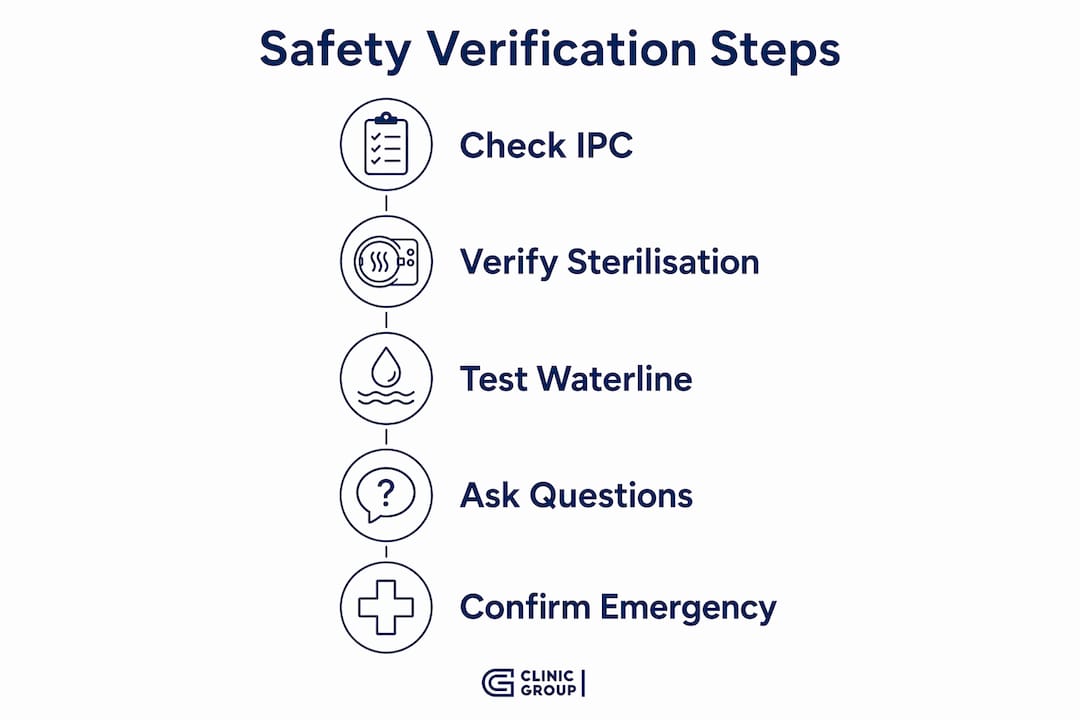
Infection prevention and control (IPC) is the first standard to verify at any international clinic. A clinic may have modern equipment and competitive pricing, but without consistent IPC compliance, patient risk remains high. The British Dental Journal defines IPC best practice as a combination of staff training, hand hygiene before and after every patient contact, proper personal protective equipment (PPE) use, and routine disinfection of all patient-contact surfaces including dental chairs, countertops, and telephones.

The critical word here is consistent. Written policies alone do not protect patients. Staff compliance with IPC workflows is the single biggest determinant of safety. A clinic with a laminated protocol on the wall but undertrained staff is more dangerous than one with fewer written policies but rigorous daily habits.
When assessing a clinic, look for the following:
- Visible hand hygiene stations at every treatment point
- Single-use PPE that is changed between patients
- Documented surface disinfection schedules using EPA-registered hospital-grade disinfectants with verified contact times
- Evidence of ongoing staff training, not just initial induction
- Clear records of IPC audits or external inspections
Pro Tip: Ask the clinic coordinator directly: “Can you share your infection control policy and confirm when staff last completed IPC training?” A clinic confident in its standards will answer without hesitation.
How can patients verify instrument sterilisation standards?
Instrument sterilisation is the process of eliminating all microbial life from reusable dental tools. It is not enough for a clinic to own an autoclave. The sterilisation process must follow a validated, documented sequence to be reliable.
A CDC-compliant sterilisation protocol follows these steps:
- Pre-cleaning: Instruments are scrubbed or ultrasonically cleaned to remove debris before sterilisation begins.
- Packaging: Instruments are wrapped or pouched with both internal and external chemical indicators on every package.
- Autoclave cycle: A validated autoclave runs at the correct temperature and pressure for the required time.
- Biological monitoring: Spore tests are run at least weekly to confirm the autoclave is killing resistant organisms.
- Documentation: Every cycle is logged, including mechanical readings, chemical indicator results, and biological test outcomes.
According to CDC-compliant guidance, clinics must use chemical indicators on every sterilisation cycle and conduct biological spore testing weekly. This two-layer approach catches failures that mechanical monitoring alone would miss.
The table below shows what adequate monitoring looks like compared to insufficient practice:
| Monitoring Type | Adequate Practice | Insufficient Practice |
|---|---|---|
| Chemical indicators | Applied to every package, every cycle | Used occasionally or only on request |
| Biological spore tests | Weekly, with documented results | Rarely performed or undocumented |
| Mechanical monitoring | Logged per load with time, temperature, pressure | Checked informally, no records kept |
| Record keeping | Full cycle logs retained and available | No documentation or verbal assurances only |
A clinic that cannot explain its sterilisation monitoring approach in specific terms is a red flag. Naming the brand of autoclave is not sufficient. Ask what types of indicators are used, how often biological tests are run, and where records are stored.
Pro Tip: Request to see a recent sterilisation log before your procedure. Reputable clinics keep these records and will share them with patients who ask. If a clinic refuses or seems confused by the request, reconsider your choice.
What is dental-unit waterline safety and why does it matter?
Dental-unit waterlines (DUWLs) are the thin tubes that deliver water to handpieces, air-water syringes, and ultrasonic scalers during treatment. Without proper maintenance, these lines develop biofilm, a layer of bacteria that can contaminate the water used directly in your mouth.
RDH Magazine recommends that clinics maintain bacterial counts at or below 500 CFU/mL (colony-forming units per millilitre) in waterline output. This is the accepted safety threshold. Clinics should test regularly, flush lines at the start and end of each day, and apply shock treatment when a test result exceeds the limit.
The table below summarises the key DUWL safety requirements:
| Safety Measure | Recommended Standard |
|---|---|
| Bacterial threshold | ≤500 CFU/mL in waterline output |
| Testing frequency | Regular scheduled testing with documented results |
| Daily flushing | At the start and end of each clinical day |
| Failed test response | Shock treatment followed by re-testing before resuming use |
| Documentation | Written records of all tests, results, and corrective actions |
Many clinics offer vague assurances about water quality without maintaining proper records. Documented testing schedules and corrective protocols are the only reliable evidence of compliance. Ask specifically for waterline test records and the clinic’s written response procedure for failed results. A general statement that “the water is fine” is not a safety standard.
What questions should you ask your dentist before treatment?
Asking the right questions before treatment is one of the most practical dental treatment safety tips available to international patients. A thorough consultation should leave you with no uncertainty about what will happen, what to expect during recovery, and who to contact if something goes wrong.
Patient guidance from Sunbit identifies the following as the most important questions to ask your dentist before any procedure:
- What are the specific steps involved in my procedure?
- What are the known risks and complications, and how would they be managed?
- What anaesthesia or pain management will be used, and what are my options?
- How long is the expected recovery, and what are the warning signs I should watch for?
- What does the cost include, and what happens if I need additional treatment after returning home?
- How do I contact the clinic outside of business hours if I have an urgent concern?
Cost transparency is particularly relevant for international patients. Understanding how dental pricing works before you travel prevents misunderstandings about what is included in a quoted price and what might be charged separately.
Pro Tip: Write your questions down before the consultation and bring them with you. Clinics that welcome detailed questions and answer them clearly are demonstrating the kind of transparency that correlates with higher safety standards overall.
How can you assess emergency preparedness at a dental clinic abroad?
Emergency preparedness is an aspect of patient safety in dentistry that patients rarely think to assess. Yet BDJ In Practice research confirms that risk assessments and structured emergency training are critical to reducing patient harm when unexpected events occur. The goal is not to prevent every possible error. It is to reduce harm when emergencies arise.
A well-prepared clinic will have the following in place:
- A documented risk assessment covering common medical emergencies in dental settings
- All clinical staff trained in Basic Life Support (BLS), not just the lead dentist
- Emergency equipment on site including oxygen, a defibrillator, and a first aid kit
- Regular drills and refresher training for the whole team
- Clear assignment of emergency response roles so every team member knows their responsibility
Whole-team emergency readiness is the standard, not individual competence. A clinic where only the principal dentist holds a BLS certificate is not adequately prepared. Ask who is responsible for emergency response and how frequently the full team re-trains. A confident, specific answer indicates a clinic that takes this seriously.
You can also review how clinic credentials and quality assurance are maintained as part of your broader research into a clinic’s safety culture.
Key takeaways
Safe dental treatment abroad requires verifying infection control, sterilisation records, waterline testing, consultation transparency, and whole-team emergency preparedness before committing to any clinic.
| Point | Details |
|---|---|
| IPC compliance is non-negotiable | Confirm staff training records and daily disinfection routines, not just written policies. |
| Sterilisation needs documented proof | Ask for cycle logs showing chemical, mechanical, and biological monitoring on every load. |
| Waterline safety requires records | Request written test results and corrective action procedures, not verbal assurances. |
| Consultation questions protect you | Ask about risks, recovery, pain management, costs, and after-hours contact before treatment. |
| Emergency readiness is a team standard | Verify that all clinical staff hold BLS certification and that drills are conducted regularly. |
What we have learned from patients who got it right
At Clinicgroup, we have supported hundreds of patients through international dental treatment journeys, and the ones who report the best experiences share a common trait. They prepared thoroughly before travelling. They did not simply compare prices. They asked the right questions, requested documentation, and chose clinics that welcomed scrutiny rather than deflecting it.
The most common misconception we encounter is that a modern-looking clinic is automatically a safe one. Polished interiors and digital X-ray equipment are reassuring, but they tell you nothing about sterilisation logs or waterline testing schedules. A clinic’s willingness to share its safety documentation is a more reliable indicator of quality than its décor.
Cost savings are a genuine and legitimate reason to seek dental treatment abroad. Patients can save substantially on procedures such as dental implants, crowns, and veneers compared to UK prices. But those savings only represent value if the treatment is delivered safely. Choosing a verified clinic through a trusted platform removes much of the guesswork. It means the safety checks have already been carried out on your behalf.
Our advice is straightforward. Use the questions in this article. Request documentation. Trust clinics that are transparent about their processes. If a clinic cannot answer your questions clearly, that is your answer.
— Clinicgroup
How Clinicgroup supports safe international dental treatment
Clinicgroup connects patients with verified dental clinics across Albania and Dubai, each assessed against European standards of care. Every clinic in the Clinicgroup network is matched to patients based on treatment needs, safety credentials, and transparent pricing. Support includes consultation coordination, travel logistics, partner hotel arrangements, and structured aftercare. Patients can browse the full range of available dental treatments including implants, crowns, and veneers, with clear cost breakdowns and no hidden charges. For patients who want to travel with confidence, Clinicgroup provides the preparation, the verification, and the ongoing support that turns a well-researched decision into a safe, successful outcome.
FAQ
What is the most important safety check before dental treatment abroad?
Verifying a clinic’s infection prevention and control compliance is the most critical step. Confirm that staff follow documented IPC workflows including hand hygiene, PPE use, and surface disinfection between every patient.
How do i know if a clinic’s sterilisation process is safe?
Ask for sterilisation cycle logs showing chemical indicators on every package, weekly biological spore test results, and mechanical monitoring records. A clinic that cannot produce these documents does not meet CDC-compliant standards.
What bacterial level is safe in dental-unit waterlines?
The accepted safety threshold is 500 CFU/mL or below in waterline output. Clinics should test regularly, flush lines daily, and apply shock treatment if results exceed this limit.
What should i ask about emergency preparedness at a foreign clinic?
Ask whether all clinical staff hold Basic Life Support certification, how frequently the team drills emergency procedures, and what emergency equipment is kept on site. Whole-team readiness is the standard, not individual certification.
Is dental treatment abroad as safe as treatment in the UK?
Treatment at a verified, accredited clinic abroad can meet or exceed UK safety standards. The key is thorough pre-treatment research, including checking clinic credentials and requesting documented safety protocols before you travel.