A medical tourism agency in the UK can help patients compare overseas clinics, understand proposed treatment plans and organise practical travel details. Its role is to make options easier to assess, while clinical suitability and treatment decisions remain with treating medical professionals. Support varies by agency, so establish which tasks it covers before proceeding.
Comparing clinics involves more than reading a treatment description. Consider facility accreditation, clinician credentials, patient support and follow-up, as well as whether travel arrangements fit the appointments and recovery plan. Dental treatment, weight-loss surgery and cosmetic procedures each raise different questions.
This guide explains how to assess these details, compare clinic options and understand the support a medical tourism agency in the UK may provide. It also covers overseas care, travel arrangements and practical next steps, helping you set clear priorities before considering treatment abroad.
Key Takeaways
- Learn which accreditation and clinician credentials can help you assess a clinic, and what those checks can and cannot tell you.
- Compare clinics by looking beyond the treatment proposal to the care setting, communication and arrangements for follow-up.
- Understand the questions to consider when weighing dental treatment abroad and ongoing care needs.
- Plan travel and accommodation around your treatment schedule, recovery and the practical details of your stay.
- Explore how Clinic Group’s treatment guides and directories can help you review partner clinic options in Albania and Dubai.
Hospital accreditation and doctor credential checks
A medical tourism agency in the UK should explain its role separately from clinical regulation. The cosmetic surgery, medical and dental tourism industry is almost entirely unregulated, so an agency’s name alone does not establish the clinical standards of a partner clinic.
Choosing Accredited Clinics and Hospitals
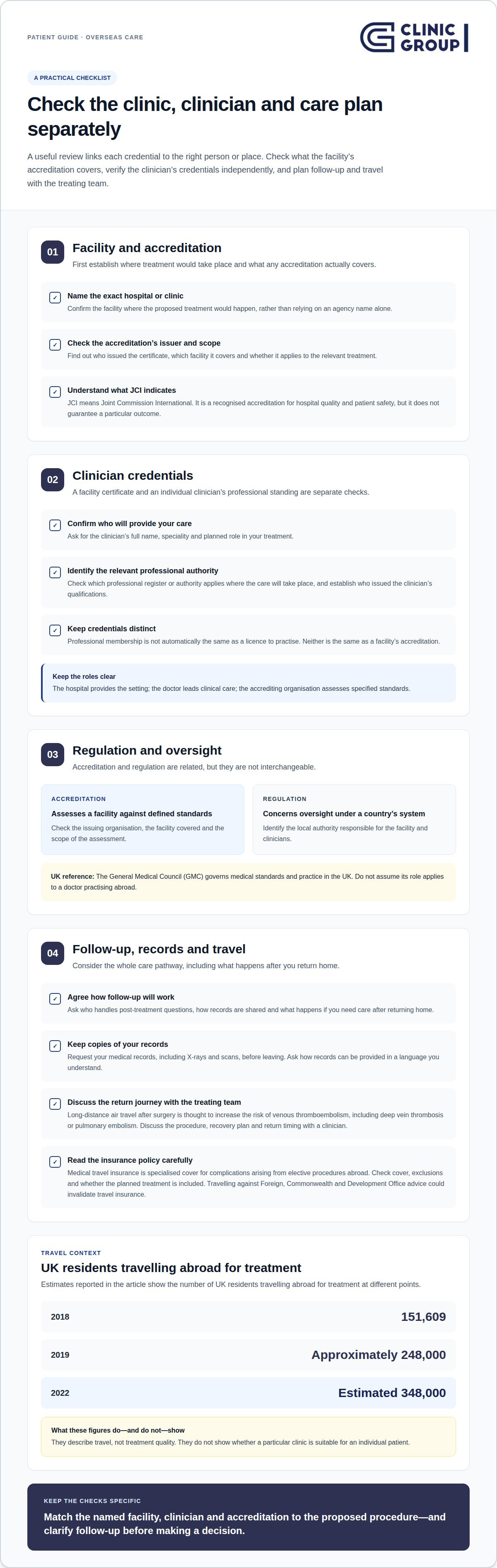
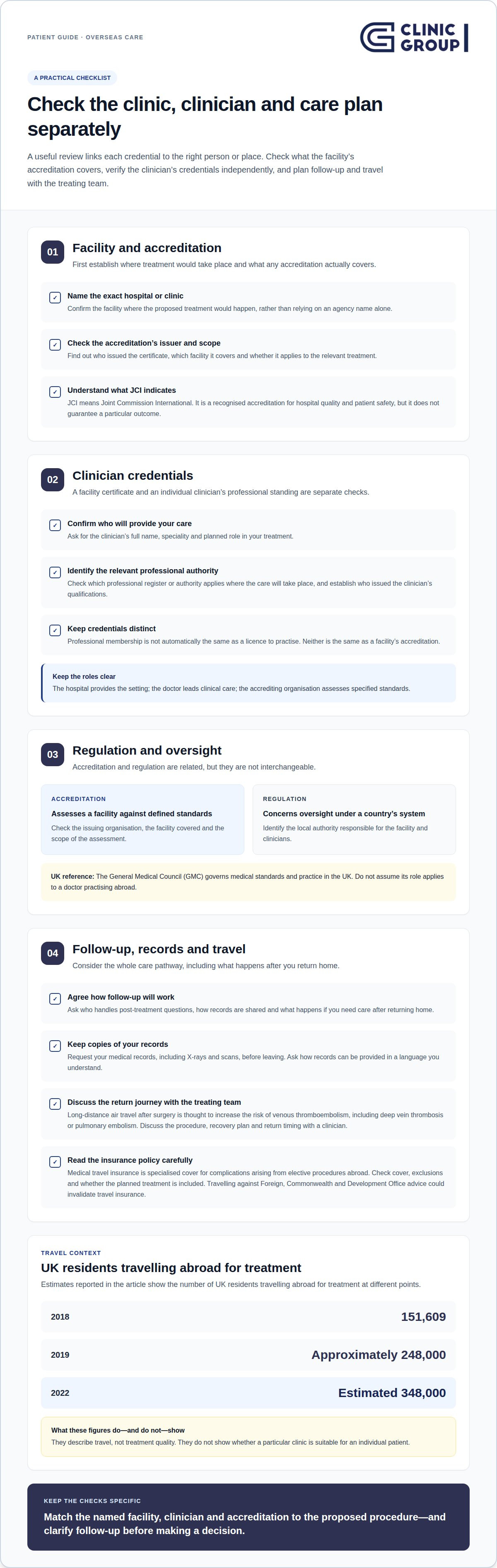
Start by identifying the hospital or clinic where treatment would take place and establishing what accreditation it holds. JCI, or Joint Commission International, is a recognised accreditation for hospital quality and patient safety. Check who issued the certificate, which facility it covers and whether it applies to the relevant treatment. Accreditation is a useful quality indicator, not a guarantee of a particular outcome.
Assess the doctor’s credentials separately from the hospital’s accreditation. Ask which professional body issued the doctor’s qualifications, what role they will have and whether the hospital’s accreditation covers the service. For plastic surgery, for example, a facility-level certificate does not by itself confirm a particular surgeon’s training. Oversight differs between countries, so establish which body issued each credential.
A practical review should connect each name to its role: the hospital provides the setting, the doctor leads clinical care, and the accrediting organisation assesses specified standards. If an agency presents a badge without naming its issuer or scope, that detail does not help you compare clinics. A useful clinic accreditation guide can help explain what accreditation represents and what it cannot establish.
Hospital Accreditation and Regulation
Accreditation and regulation are related, but they are not interchangeable. Accreditation assesses a facility against defined standards; regulation concerns oversight under the relevant country’s system. The General Medical Council (GMC) governs medical standards and practice in the UK. Its role should not be confused with oversight of a doctor practising abroad.
Accreditation arrangements for facilities may vary, so check which organisation issued any accreditation. This England-specific reference does not establish oversight arrangements for a clinic abroad. When comparing an overseas hospital, identify the local authority responsible for facilities and clinicians, and clarify which organisation issued any accreditation. Do not assume a UK body’s role applies overseas.
Make doctor checks specific. Confirm the clinician’s full name, speciality and planned role, then identify the professional register or authority that applies where care will take place. Membership of a professional college is not automatically the same as a licence to practise or facility accreditation. Keep these distinctions clear when reviewing a treatment plan.
Before deciding, match the named doctor, hospital and accreditation to the proposed procedure. A clinic’s certificate may cover a facility or service, while the doctor’s credentials relate to their own training and professional standing. These checks give you a more precise basis for comparing care, without treating one credential as proof of every aspect of quality.
Hospitals and clinics for international patients
For UK patients, compare the whole care pathway, not just the treatment appointment. A hospital’s arrangements for communication, records and follow-up affect how care continues after you return home.
UK residents travelled abroad for treatment in substantial numbers: estimates rose from 151,609 in 2018 to approximately 248,000 in 2019, then reached an estimated 348,000 in 2022. These figures describe travel, not treatment quality. Use them as context, not as proof that a particular clinic is suitable.
Do not assume UK public healthcare will provide follow-up for elective treatment abroad. Before travelling, ask the overseas clinic who handles post-treatment questions, how records are shared and what happens if you need care after returning home. Keep copies of your medical records, including X-rays and scans, before leaving. Complications can appear weeks or even months after a procedure.
Travel also affects the risk picture. Long-distance air travel after surgery is thought to increase the risk of venous thromboembolism, including deep vein thrombosis or pulmonary embolism. The procedure, recovery plan and timing of your return journey belong in the clinical discussion, not just the travel itinerary. Ask how the clinic plans follow-up and what instructions apply during your journey.
Travel insurance does not automatically include cover for medical travel. Medical travel insurance is specialised cover for complications arising from elective procedures abroad. Review what the policy covers, its exclusions and whether your planned treatment is included. The UK Government says travel insurance could be invalidated if a patient travels against Foreign, Commonwealth and Development Office advice.
Patient reviews can highlight practical themes such as communication, appointment organisation or airport support. They cannot establish clinical quality or predict an individual result. To compare value, set out the proposed treatment, inclusions, follow-up arrangements and travel requirements side by side. A lower headline figure alone does not show whether two plans offer the same care.
You retain important decisions throughout treatment abroad. Discuss consent, alternatives, expected recovery and how to obtain records in a language you understand. For privacy, ask how the clinic and agency handle personal information, who receives medical records, how they are sent and how long they are kept. Clear answers help you understand how sensitive information is managed during your care journey.
Experiences vary by procedure and clinic. A patient travelling for cosmetic surgery, for example, needs clear arrangements for assessment, recovery and contact after returning home. Explore treatment and clinic information as one starting point for understanding the options and care pathway.
Dental and weight loss surgery abroad
For dental care abroad, start with the treatment plan, not the clinic’s headline description. Implants, crowns, bridges and orthodontics address different needs, so proposals should identify the treatment and teeth involved. Note whether the plan describes one stage or several, and which parts require assessment by the treating dentist. This makes like-for-like comparisons easier.
In a dental consultation, discuss the records used to prepare the proposed plan, such as existing X-rays or scans. Ask how the clinic will explain any changes if its assessment differs from the initial proposal. For implant treatment, clarify the proposed restoration, which clinician handles each stage and what information you will receive afterwards. A dental implants abroad guide can help you prepare focused questions.
Google reviews can provide examples of patients’ reported experiences with communication, scheduling or the clinic environment. Treat them as individual accounts, not clinical evidence. If a review names a surgeon, use that name to understand who the reviewer says treated them, then discuss the proposed clinician’s role in your own consultation. A review alone cannot establish who will perform your procedure.
For plastic surgery, compare proposals by the specific operation. Rhinoplasty, liposuction, breast augmentation and facelift are distinct procedures, with different plans and recovery considerations. Ask the clinic what the consultation covers, which clinician will undertake each part and how the proposed procedure relates to your goals. Experience with one operation does not prove experience with another.
Dermatology and cosmetic procedures are not interchangeable. Clinic Group’s listed options include non-surgical aesthetics, such as Botox, fillers, PRP and lip augmentation, alongside surgical procedures. During consultation, establish whether the proposal is surgical or non-surgical, which area it addresses and what follow-up the clinic describes. Clear terminology helps distinguish a skin concern from an aesthetic procedure.
Apply the same comparison approach to hair transplantation and eye care. For FUE or DHI, clarify which technique the clinic proposes and what the consultation assesses. For LASIK, blepharoplasty or canthoplasty, compare the intended procedure and the clinician’s explanation of the plan. Each service needs its own clinical discussion, so avoid grouping them under a general promise of “medical care abroad”.
Keep a written summary for each clinic: proposed treatment, named clinician, assessment questions and follow-up details. This helps you compare actual plans rather than relying on similar procedure labels or online reviews. The treating professionals decide clinical suitability; you can compare whether each proposal is clear, specific and responsive to your consultation.
Travel planning and accommodation assistance
For UK patients, arranging treatment abroad means aligning clinic appointments with travel, accommodation and local transport.
Travel, Visa and Accommodation Assistance
Private agencies commonly refer patients to hospitals and clinics; flights and accommodation may be part of a package holiday. A medical tourism agency can explain which arrangements it coordinates and what remains for you to organise. Ask for a written itinerary linking your destination, clinic appointment and accommodation, rather than treating each booking separately.
Visa planning depends on the patient’s nationality and destination. Confirm the relevant entry requirements before committing to travel, and allow time for any required application. A UK patient travelling to Tirana or Dubai should check that travel dates, clinic appointments and accommodation details match the treatment plan. Keep booking confirmations and clinic correspondence together with medical records.
Before booking, align the schedule with the clinic’s treatment plan. For example, a dental consultation may lead to further appointments, so the itinerary should reflect the clinic’s stated sequence. Ask how appointment changes affect flights and accommodation, and establish who communicates updates. An accredited clinic’s status concerns healthcare standards; it does not itself organise your travel.
Transport Arrangements
Plan transport between the airport, accommodation and clinic. Establish which journeys are arranged, who provides the details and how you will receive updates. If you are staying in Tirana, for example, confirm the routes between the airport, accommodation and treatment location before departure. This clarifies the practical plan without assuming every package includes transfers.
Build your itinerary around clinical instructions, not just flight availability. The treating clinic’s appointment schedule and advice about travel after treatment should guide departure planning. Keep flight details, accommodation information, appointment times and emergency contact instructions together in an accessible record. If someone is travelling with you, include their arrangements so you both understand the plan.
A practical sequence is to share relevant medical records, discuss the proposed treatment and clinic appointment, then coordinate travel dates and accommodation. Next, clarify which bookings are included, who handles transport details and how itinerary changes are communicated. This helps you understand the division between clinical decisions and travel coordination.
When considering a destination, compare its clinic schedule with the time needed for travel and recovery. Albania and Dubai have different routes and travel arrangements, so avoid assuming one itinerary fits both. Keep copies of records and confirmations available during the journey. For a clearer view of treatment and clinic options, browse medical treatment information before planning your next steps.
Medical tourism clinic comparison
A useful comparison sets out the proposed treatment, clinic, clinician and follow-up plan side by side. Compare equivalent procedures first; cosmetic treatment and joint replacement, for example, involve different clinical pathways.
When choosing a medical tourism agency in the UK, look for clear explanations of its role, the clinics it connects patients with and how treatment options are presented. A useful comparison identifies the treating clinic and clinician, explains what each proposal includes and distinguishes coordination from clinical care.
A destination’s popularity cannot show whether a clinic or procedure suits you. Clinic Group’s partner clinics are almost entirely in Tirana, Albania, with a small number in Dubai, UAE. Compare the actual clinic and treatment pathway in each destination instead of assuming a country-wide label establishes quality or suitability.
Use the same questions for each proposal:
- Procedure: Is the treatment plan specific to your needs, and does it explain the proposed stages?
- Clinical team: Are the responsible clinician and their role clearly identified?
- Facility: Which hospital or clinic will provide the medical treatment, and what accreditation applies?
- Follow-up: Who explains aftercare and provides records for your continuing care?
- Practical arrangements: Do the consultation, travel dates and accommodation fit the treatment journey?
These points help distinguish proposals that use similar procedure names but involve different care pathways. For example, compare dental implant plans by their assessment, proposed stages and follow-up, rather than comparing the phrase “dental implants” alone. Assess a joint replacement by its named procedure and clinical team. Do not use a cosmetic procedure as a direct benchmark for either.
Ask how the agency presents its clinic network. A clear explanation identifies which clinic relates to each option and distinguishes the agency’s coordination role from the clinician’s responsibility for medical decisions. If a proposal changes after consultation, compare the revised plan, not an earlier summary. Keep the clinic name, clinician, procedure and follow-up details together for each option.
Choose based on the fit between your clinical needs and the specific pathway, not a destination’s reputation or a single headline claim. A useful clinic comparison makes the differences clear: who provides care, what treatment is proposed and how the journey is organised. Use those details to decide which option merits further discussion with the treating clinician.
Clinic Group: Medical Tourism Treatment Guides
Clinic Group’s Medical Tourism Treatment Guides help UK patients understand treatment options and compare the practical details of care abroad. They are useful when you have a proposed procedure but want clearer information before discussing next steps with a clinic.
Clinic Group’s Dental Treatment Directory helps you explore dental options, while Hair Transplant Referrals and the Ophthalmology Clinic Directory cover their respective treatment areas. Its partner clinics are almost entirely in Tirana, Albania, with a small number in Dubai, UAE. The guides support informed research; clinical assessment and treatment decisions remain with the treating professionals.
If you’d like support exploring the available guides and directories, contact Clinic Group to discuss your research.
Take the next step with a clear shortlist
Before deciding, turn your research into a short list of questions for the treating clinic. Note the procedure you are considering, what you still need explained and which details matter most. This gives your next conversation a clear purpose and helps you assess whether the proposed care fits your needs.
Clinic Group supports your research through its Dental Treatment Directory, Hair Transplant Referrals and Plastic Surgery Provider Listings. These resources help you explore relevant treatments and clinic options; treating clinicians remain responsible for assessment and care. If you are looking for a medical tourism agency in the UK, prioritise clear information and a process that supports informed decisions without rushing you.
Explore your options with Clinic Group and find a useful next step for your research.
A considered decision starts with clear questions and the confidence to take the next step at your own pace.
Considering treatment in Albania? Request a free consultation with Clinic Group.
Frequently Asked Questions
Does it cost anything?
Clinic Group’s consultation and coordination support is free. Independent partner clinics provide treatment, while travel or accommodation arrangements may be separate. Before proceeding, ask for a written breakdown distinguishing clinical treatment from coordination and travel arrangements. Confirm in writing what aftercare is included and who provides it, so you understand each organisation’s responsibilities throughout your planned treatment journey.
Which clinics and treatments do you cover?
Clinic Group’s directory and referrals cover dental care, hair transplants, plastic surgery and ophthalmology through partner clinics, mainly in Albania, with some partners in Dubai. Listed treatments include dental implants, crowns, bridges and orthodontics; FUE and DHI hair transplants; rhinoplasty, liposuction, breast augmentation and facelift; and eye care such as LASIK and blepharoplasty. The treating clinic assesses suitability and provides clinical care.
Will a clinic contact me?
Clinic Group’s matching and referral process can connect you with an independent clinic for clinical discussions. The clinic, not Clinic Group, assesses your needs and provides treatment. Share only the information needed to progress your enquiry, and say how you prefer to be contacted. Before a consultation, prepare a concise summary of your treatment interest and relevant medical history.
What medical procedures do UK agencies commonly arrange abroad?
Medical tourism agencies can help patients explore planned care in areas such as dentistry, hair transplantation, plastic surgery and ophthalmology. Clinic Group’s listed treatment areas include dental implants, crowns, bridges, FUE or DHI hair transplants, rhinoplasty, facelift, LASIK and blepharoplasty. Available options depend on the clinic network. An agency can connect patients with clinics, while clinicians decide what care is appropriate.
How much do medical tourism packages from the UK cost, including travel and aftercare?
Package contents vary, so compare the written treatment plan and travel arrangements rather than relying on the word “package”. Check whether accommodation, transport, clinic appointments and aftercare are included or arranged separately. Ask the clinic for an itemised treatment plan and written follow-up arrangements. Travel insurance is separate; review its terms for elective treatment and complications before making travel plans.
How can UK patients check overseas clinic credentials and surgeon qualifications?
Match the clinic’s legal name and location to its accreditation documents, then identify who issued them and which services they cover. For the surgeon, record their full name, speciality and role in your proposed procedure. Ask the clinic which professional register applies in its country and how to confirm the entry. Keep copies of these details with your treatment plan and consultation correspondence.

Article by
Clinic Group Editorial Team
The Clinic Group editorial team publishes clear, practical guides for UK and EU patients researching medical travel — from dental implants and hair transplants to plastic surgery and eye care — with a focus on verified clinics, transparent “from” pricing, and safe planning.
Disclaimer
This article is for general information only and is not medical advice, diagnosis, or a substitute for an in-person consultation with a qualified clinician. Treatment suitability, risks, timelines, and costs vary by individual. Clinic Group connects patients with independent clinics; those clinics are responsible for clinical care. Always verify credentials, obtain a written treatment plan and itemised quote, and confirm aftercare arrangements and travel insurance cover (elective procedures are often excluded) before booking. Outcomes cannot be guaranteed.