Intravenous vitamin therapy is not recommended for routine wellness use in otherwise healthy people. The Drug and Therapeutics Bulletin concluded there is a lack of high-quality evidence supporting high-dose IV vitamin infusions for general wellness, and warned of potential harms from non-physiological doses. Before booking a session, speak to your GP, request baseline blood tests (B12, iron, renal function, and G6PD where relevant), and avoid any clinic that skips pre-infusion screening.
When IV vitamin therapy may genuinely help:
- Documented deficiency with confirmed malabsorption, where oral supplementation cannot be absorbed
- Specific medical indications such as Wernicke’s encephalopathy, severe B12 deficiency with gastrointestinal disease, or inpatient repletion during critical illness
When it is unlikely to help:
- Elective “wellness” drips for fatigue, immunity, skin glow, or hangover recovery in otherwise healthy people
- Any situation where oral supplementation or dietary change has not first been tried and assessed
The single most important next step: ask your GP for targeted blood tests before spending money on a private infusion.
Key takeaways
IV vitamin therapy has a narrow evidence base for wellness claims and is primarily indicated for specific medical conditions; most healthy people gain no benefit over targeted oral supplementation.
| Point | Details |
|---|---|
| Evidence is limited | No high-quality RCTs support elective IV vitamin drips for fatigue, immunity, or skin in healthy people. |
| Medical indications exist | IV vitamins are appropriate for confirmed malabsorption, pernicious anaemia, Wernicke’s encephalopathy, and inpatient repletion. |
| UK costs range widely | Private sessions in the UK vary in cost; always compare this against the value of GP tests and oral supplementation first. |
| Safety checks are non-negotiable | Insist on pre-infusion screening, CQC-registered clinics, pharmaceutical-grade products, and on-site emergency equipment. |
| Clinicgroup connects you safely | For medically indicated or supervised wellness IV therapy abroad, Clinicgroup matches patients with verified clinics in Albania and Dubai with full travel and aftercare support. |
Table of Contents
- What is IV vitamin therapy and what formulations do clinics offer?
- What does the research actually show about IV vitamin therapy?
- What are the risks and side effects of IV vitamin therapy?
- What does UK regulation say about IV vitamin clinics?
- When are IV vitamins medically appropriate?
- What happens during a session, and what does it cost in the UK?
- How do you choose a safe clinic and what should you ask?
- Clinicgroup’s perspective on IV vitamin therapy
- Considering IV therapy abroad? Here is how Clinicgroup can help
- Sources
- FAQ
What is IV vitamin therapy and what formulations do clinics offer?
Intravenous vitamin therapy, often marketed as an “IV drip” or vitamin infusion, delivers vitamins and minerals directly into the bloodstream via a cannula. Because the gastrointestinal tract is bypassed, blood levels rise faster than with oral supplements. That pharmacokinetic fact is central to most marketing claims, yet faster absorption does not automatically translate into clinical benefit. Water-soluble vitamins such as vitamin C and the B group are rapidly excreted by the kidneys when given in excess; a brief spike in serum levels rarely produces sustained tissue benefit in someone without a genuine deficiency, as the DTB review notes. Fat-soluble vitamins (A, D, E, K) carry a different risk profile because they accumulate in tissue, raising the possibility of toxicity at high doses.
The MSD Manual summarises the most common formulations clinics and hospitals use:
- Myers’ cocktail: The most widely marketed blend, typically containing magnesium chloride, calcium gluconate, B vitamins (B1, B2, B3, B5, B6), and vitamin C in a saline or sterile water base. Originally developed by physician John Myers in the 1970s, it is now sold commercially for fatigue, fibromyalgia, and general “wellness.”
- Banana bag: A yellow-tinted hospital infusion containing thiamine (B1), folic acid, multivitamins, and magnesium in normal saline. Used clinically in alcohol withdrawal and malnourished inpatients; the name comes from its colour.
- High-dose IV vitamin C: Ascorbic acid at doses far above oral tolerance, sometimes used as an adjunct in oncology research settings. Not a standard cancer treatment.
- IV hydroxocobalamin (B12): A pharmaceutical form of vitamin B12 given by injection or infusion for confirmed deficiency, particularly where malabsorption prevents oral absorption (e.g. pernicious anaemia). This is a legitimate, NHS-prescribed treatment.
- Hydration and electrolyte bottles: Saline or Ringer’s lactate with added electrolytes, sometimes bundled with vitamins for hangover or post-exercise recovery marketing.
What does the research actually show about IV vitamin therapy?
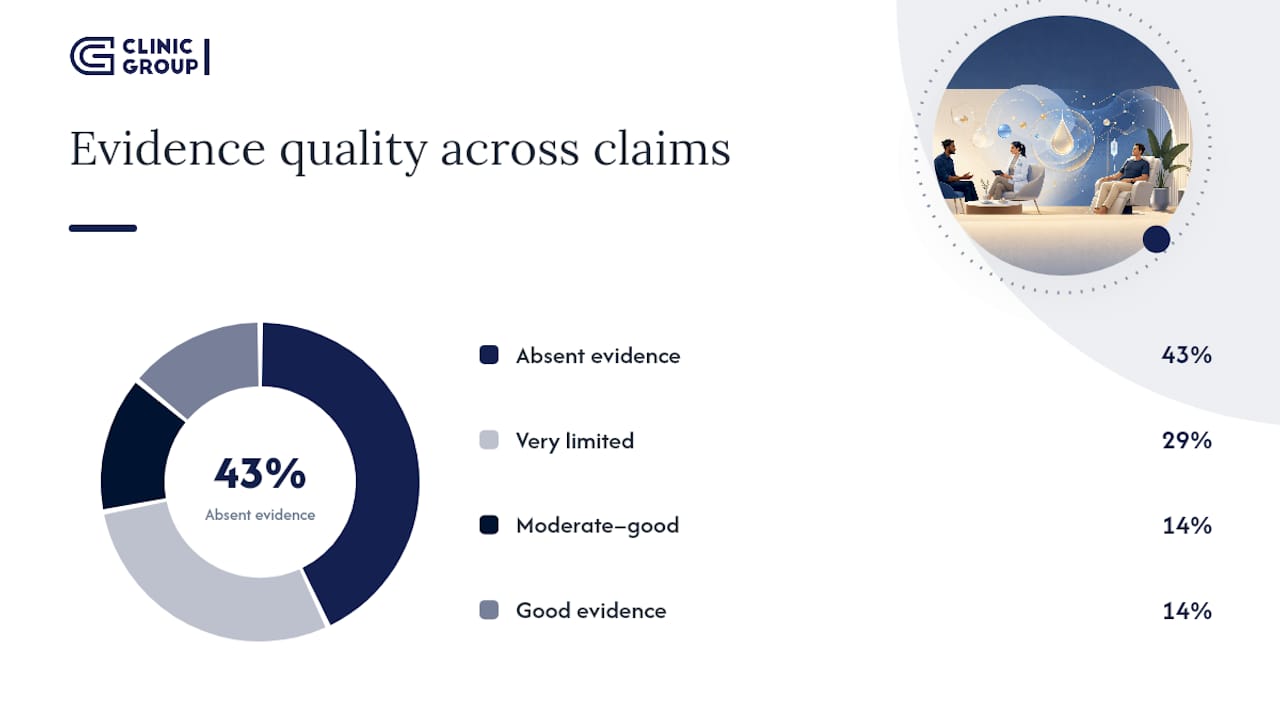
The short answer: limited high-quality evidence exists for wellness claims, and better evidence exists only for specific medical indications. Harvard Health states plainly that popular IV vitamin claims are not backed by strong evidence, and Mayo Clinic Press describes the treatment as a wellness fad with limited evidence for many claimed benefits. An open-access review published in PMC concluded that public enthusiasm for IV vitamin therapy substantially exceeds the available evidence.
The most cited clinical trial is a small placebo-controlled pilot RCT of Myers’ cocktail in fibromyalgia. Participants showed within-group improvements, but there was no statistically significant difference versus placebo, and the study’s authors themselves noted a high placebo response. That finding is instructive: it does not mean IV therapy is useless, but it does mean a well-designed trial could not separate the treatment effect from expectation and attention.
An NCBI health technology review found no evidence-based guidelines for IV multivitamin therapy in outpatient populations and noted a scarcity of primary studies examining IV multivitamin supplementation in isolation.
| Claimed benefit | Available evidence | Evidence quality | Key safety caveat |
|---|---|---|---|
| Fatigue / low energy | No RCT evidence in people without deficiency | Very limited | Electrolyte disturbance possible |
| Immune support | No controlled trial evidence for healthy adults | Absent | Infection risk at cannula site |
| Hangover recovery | Anecdotal; no published RCTs | Absent | Volume overload in cardiac patients |
| Fibromyalgia symptom relief | One pilot RCT; no significant difference vs placebo | Very limited | High placebo response confounds results |
| Skin brightness / anti-ageing | No clinical trial evidence | Absent | Hypervitaminosis risk with fat-soluble vitamins |
| Confirmed B12 deficiency (malabsorption) | Established clinical practice; NHS-prescribed | Moderate to good | Requires diagnosis and monitoring |
| Wernicke’s encephalopathy prevention | Standard of care in alcohol withdrawal | Good | Must be given before glucose in at-risk patients |
What are the risks and side effects of IV vitamin therapy?
The risks of IV vitamin therapy are real and, in some cases, serious. Because a cannula breaches the skin barrier and delivers substances directly into the circulation, the margin for error is narrower than with oral supplements.
Common and serious adverse events:
- Infusion-site reactions: bruising, pain, and phlebitis (inflammation of the vein wall)
- Infection: cellulitis, abscess, or systemic infection if sterile technique is not maintained
- Thrombophlebitis: clot formation at the cannula site
- Electrolyte disturbance: particularly with high-dose magnesium or calcium, which can affect heart rhythm
- Kidney injury: high-dose vitamin C (ascorbic acid) can precipitate oxalate nephropathy, especially in those with pre-existing renal disease
- Allergic reaction or anaphylaxis: rare but possible with any IV preparation; requires adrenaline and resuscitation equipment on site
- Air embolism: rare, but a recognised risk of any IV line if not managed correctly
Contraindications and cautions:
- Kidney disease: reduced renal clearance increases the risk of electrolyte toxicity and oxalate nephropathy from high-dose vitamin C
- Heart failure: additional fluid volume can precipitate acute decompensation
- G6PD deficiency: high-dose IV vitamin C can trigger haemolytic anaemia in people with this enzyme deficiency; G6PD testing is a standard pre-infusion screen in responsible clinics
- Pregnancy and breastfeeding: safety data for high-dose IV vitamins in these groups is insufficient; discuss with a clinician before proceeding
Drug interactions are also a practical concern. A well-documented example is the incompatibility of calcium-containing solutions with ceftriaxone (a common antibiotic), which can cause precipitate formation in the bloodstream. Bring a full current medication list to any pre-infusion consultation. Mayo Clinic Press and Harvard Health both outline these risks in their consumer guidance.
Pro Tip: Before agreeing to any infusion, ask the clinic to show you their written emergency protocol and confirm that adrenaline, resuscitation equipment, and an ACLS-trained clinician are available on site. The ACCP position statement documents adverse events from clinics that lacked these safeguards.
What does UK regulation say about IV vitamin clinics?
The regulatory picture in the UK is fragmented, and that gap is precisely what makes some wellness IV clinics risky.
- NHS guidance: NHS prescribing policy, including South West London ICB’s position statement, advises against routine prescribing of vitamins and minerals unless a specific deficiency or ACBS-approved indication exists. “Pick-me-up” prescribing is explicitly discouraged.
- MHRA: The Medicines and Healthcare products Regulatory Agency regulates products that make medicinal claims. Many wellness IV products are marketed as “nutritional” rather than medicinal, which means they can avoid full MHRA scrutiny. As Which? reports, this creates a regulatory gap on product quality and advertising accuracy.
- CQC: The Care Quality Commission requires registration for services that provide treatment by or under the supervision of a healthcare professional. A clinic administering IV infusions under a doctor’s or nurse’s supervision should be CQC-registered; always check the CQC register before booking.
- ASA: The Advertising Standards Authority has ruled against clinics making unsubstantiated health claims for IV drips. If a clinic’s website promises to “cure” fatigue, boost immunity, or treat specific conditions, that is a red flag under ASA guidelines.
- ACCP position statement: The ACCP recommends physician approval, licensed compounding, and informed consent as minimum standards for any clinic offering hydration and vitamin infusion services.
Practical implications for patients:
- Verify CQC registration on the public register before booking
- Confirm that a registered clinician (doctor or prescribing nurse) oversees every infusion
- Check that vitamins are pharmaceutical grade and prepared under sterile conditions
- Be sceptical of any clinic that advertises disease-treatment claims, as these likely breach ASA rules and may indicate poor clinical governance
When are IV vitamins medically appropriate?
IV vitamins are genuinely indicated in a narrow set of clinical circumstances, and these are quite different from elective wellness use.
- Severe malabsorption: Conditions such as Crohn’s disease, short bowel syndrome, or post-bariatric surgery can prevent adequate absorption of oral vitamins, making parenteral routes necessary.
- Confirmed B12 deficiency with malabsorption: Pernicious anaemia and other causes of intrinsic factor deficiency mean oral B12 cannot be absorbed; IV or intramuscular hydroxocobalamin is the standard NHS treatment.
- Wernicke’s encephalopathy: A neurological emergency caused by acute thiamine (B1) deficiency, most commonly in alcohol-dependent patients. High-dose IV thiamine (Pabrinex) is the standard of care and must be given before any glucose administration in at-risk patients.
- Banana bag in alcohol withdrawal: Hospital inpatient repletion of thiamine, folate, and multivitamins in malnourished patients with alcohol-related illness.
- Perioperative and critical care: Patients who cannot tolerate enteral feeding receive parenteral nutrition that includes vitamins and trace elements, as noted in the NCBI clinical review.
For most people with a confirmed deficiency who can swallow and absorb normally, oral supplementation remains the standard of care. IV administration offers no routine advantage in that group, and the DTB is explicit on this point.
What happens during a session, and what does it cost in the UK?
Understanding the practical process helps you assess whether a clinic is operating safely.
A typical private appointment:
- Pre-screening and consent: A responsible clinic takes a medical history, reviews current medications, and requests relevant blood tests (at minimum: renal function, G6PD where high-dose vitamin C is planned, and deficiency markers). A signed consent form listing risks should be provided.
- Cannulation: A clinician inserts a cannula, usually into a vein in the forearm or antecubital fossa.
- Infusion: Sessions typically last 30–60 minutes depending on the formulation and volume. You remain seated or reclined and are monitored for adverse reactions throughout.
- Immediate aftercare: Most people leave without issue. Some report a brief sensation of warmth or a metallic taste during infusion, particularly with magnesium-containing formulas. Mild bruising at the cannula site is common.
- Follow-up: A reputable clinic schedules a follow-up call or appointment, particularly if this is your first infusion.
Frequency: Private clinics typically suggest sessions every 2–4 weeks, or as single one-off treatments. There is no standardised clinical schedule for elective wellness infusions because no evidence base supports one.
Cost: Which? reports typical private UK prices in the range of £100–£700 per session, varying considerably by formulation, clinic location, and add-ons. High-dose vitamin C infusions and bespoke blends sit at the upper end of that range.
Cost context: A single session at the upper end of the UK price range (£700) could fund several months of targeted oral supplementation, a private GP consultation, and comprehensive blood tests — all of which carry a stronger evidence base for most people.
If you experience chest tightness, difficulty breathing, severe flushing, or feel unwell during or after an infusion, seek emergency medical attention immediately.
How do you choose a safe clinic and what should you ask?
Whether you are considering treatment in the UK or abroad, a structured approach to clinic vetting protects you.
Clinic verification checklist:
- CQC registration confirmed on the public register (for UK clinics)
- Visible clinician credentials (GMC or NMC registration number available on request)
- Vitamins prepared to pharmaceutical grade under sterile conditions, ideally by a licensed compounding pharmacy
- Emergency equipment (defibrillator, adrenaline) and ACLS-trained staff on site
- Written informed consent form that lists specific risks
- Pre-infusion screening tests required, not optional
Questions to ask before you book:
- What screening tests do you require before the first infusion, and who reviews the results?
- Are the vitamins pharmaceutical grade, and can you provide batch and expiry details for compounded products?
- Who administers the infusion — a doctor, registered nurse, or someone else?
- What is your emergency protocol if a patient has an adverse reaction?
- What aftercare and follow-up do you provide?
Red flags to avoid:
- No pre-infusion testing required
- Pushy upselling of additional drips or add-ons during the consultation
- No written consent form
- Claims to treat, cure, or prevent specific diseases
- No visible clinician credentials or CQC registration
For international patients, the same principles apply. Our guide to clinic safety practices for international patients covers hygiene standards, registration verification, and what to expect from a verified clinic abroad.
Pro Tip: Share your GP blood test results with the clinic before booking. A clinic that adjusts its formulation based on your actual deficiency markers is operating at a higher standard than one offering a fixed menu regardless of your results. The ACCP position statement recommends physician approval and informed consent as baseline requirements for any infusion service.

For a practical example of how a responsible clinic structures iron infusion eligibility and pre-infusion screening, the pathway illustrates the kind of clinical governance patients should expect.
Clinicgroup’s perspective on IV vitamin therapy
At Clinicgroup, we connect patients with verified clinics and board-certified specialists across Albania and Dubai, and our approach to wellness treatments is the same as our approach to every other service: patient safety and transparent information come first. We do not recommend elective IV vitamin drips to patients who have not first had a GP consultation and relevant blood tests. Where a clinically indicated treatment is appropriate, such as confirmed B12 deficiency requiring parenteral repletion or a medically supervised wellness programme at a verified partner clinic, we support patients through every step: clinic matching, travel logistics, partner accommodation, and aftercare coordination. Our view is that the evidence base for elective wellness infusions is currently too limited to justify bypassing proper clinical assessment, and we encourage every patient to prioritise that assessment before considering any IV therapy abroad.
Considering IV therapy abroad? Here is how Clinicgroup can help
For patients who have completed their GP assessment and are considering medically indicated or clinically supervised IV therapy as part of a broader wellness or anti-ageing programme, Clinicgroup offers a structured, patient-first route to verified clinics in Albania and Dubai.
- Verified clinics and board-certified specialists: every partner clinic in our network is vetted for credentials, sterile standards, and clinical governance
- Transparent pricing: no hidden costs; formulations and fees are confirmed before you travel
- Travel and aftercare coordination: we arrange logistics, partner hotels, and follow-up support so your focus stays on your health
- Consultation-first approach: we encourage patients to share GP blood test results before any booking, so the clinic can tailor treatment to documented need
Browse our full range of verified treatments and clinics or get in touch to be matched with a specialist who can review your results and recommend the appropriate pathway.
Sources
- Intravenous vitamin injections: where is the evidence? | Drug and Therapeutics Bulletin
- Why IV vitamin drips are a waste of money - Which?
- Intravenous multivitamin therapy use in hospital or outpatient settings: A review of clinical effectiveness and guidelines
- Intravenous micronutrient therapy (Myers’ Cocktail) for fibromyalgia: a placebo-controlled pilot study
- IV therapy for vitamin replenishment: Health boost or expensive placebo? - Harvard Health
- IV Vitamin therapy: Understanding the lack of proven benefit and potential risks of this health fad - Mayo Clinic Press
- ACCP Position Statement on Hydration and Vitamin Infusion Clinics
- Intravenous Vitamin Therapy (Myers’ Cocktail) - Special Subjects - MSD Manual Professional Edition
- To IV or Not to IV: The Science Behind Intravenous Vitamin Therapy
This article is general information, not a substitute for advice from a qualified doctor. Consult a qualified healthcare professional about your own circumstances before acting on anything here.
FAQ
Does IV vitamin therapy really work?
For healthy people without a documented deficiency, the evidence does not support elective IV vitamin drips. The DTB review and NCBI clinical assessment both conclude that high-quality evidence is lacking for wellness claims.
What vitamins are typically in an IV drip?
The most common formulation is the Myers’ cocktail, which contains magnesium, calcium, B vitamins (B1, B2, B3, B5, B6), and vitamin C in a saline base, as described by the MSD Manual. Hospital banana bags add thiamine and folic acid for malnourished or alcohol-dependent patients.
How often should you have IV vitamin therapy?
There is no evidence-based schedule for elective wellness infusions. Private clinics typically suggest sessions every 2–4 weeks, but this reflects commercial practice rather than clinical guidance.
How do you feel after IV vitamin therapy?
Most people report no dramatic change. Some notice mild bruising at the cannula site or a brief sensation of warmth during the infusion. Anyone experiencing chest tightness, breathing difficulty, or feeling unwell after a session should seek medical attention promptly.
Is IV vitamin therapy available through the NHS?
The NHS prescribes IV vitamins only for specific clinical indications, such as confirmed B12 deficiency with malabsorption, Wernicke’s encephalopathy, or inpatient nutritional repletion. Elective wellness drips are not available on the NHS and are not recommended by NHS prescribing guidance.