Arranging aftercare overseas comes down to three actions you must complete before paying a deposit: request a written aftercare plan from the treating clinic, arrange at least one UK follow-up review before you travel, and collect your full clinical records in English before leaving the destination. Each step closes a specific gap. A written plan fixes responsibility in writing. A pre-booked UK review means you are not searching for a clinician while recovering. English records let any UK doctor assess you safely without delays. Clinicgroup’s aftercare guidance confirms that clear post-operative instructions and a named emergency contact are the two most critical items to secure before departure. A named clinician, a written aftercare plan in English, and a 24/7 international patient contact are the most reliable trust signals to secure before paying a deposit.
Table of Contents
- What to ask the overseas clinic before you book or pay
- How to arrange a UK follow-up before you travel
- Travel logistics, fit-to-fly, and who pays for delays
- What aftercare you may need in the UK by procedure type
- Red flags that need urgent attention after you return
- If complications or disputes arise: what to do next
- Medicines, dressings, translations and travel companions
- What to confirm with the clinic before you pay a deposit
- Key takeaways
- A note from Clinicgroup on why written aftercare matters
- Clinicgroup’s aftercare coordination for UK patients
- Useful sources and Clinicgroup guides
- FAQ
What to ask the overseas clinic before you book or pay
Patients must ask the overseas clinic exactly what aftercare is included and get specific written answers before committing. Vague phrases like “full support” or “VIP aftercare” are not commitments. Here is the exact list to send by email and keep on file:
- Who will review you post-operatively, and is it the operating surgeon or a nurse?
- How many follow-up appointments are included, and on which days?
- What is the 24/7 emergency contact number for international patients?
- What is the complication and revision policy: who pays, within what timeframe, and does the clinic cover return flights if a revision is needed due to surgical error?
- How long must you stay before the clinic will clear you to fly?
- Who pays for extra hospital nights or hotel stays if discharge is delayed?
An acceptable written answer looks like this: “Three clinic reviews by operating surgeon on days 1, 3 and 7; 24/7 international patient line on +XXX; revision policy: clinic covers return flight and procedure cost within 90 days if complication is due to surgical error.” Anything shorter than that level of detail is insufficient.
Pro Tip: If a clinic’s written reply still uses phrases like “we take care of everything,” respond by asking them to specify dates, named clinicians, and cost responsibilities. A reputable clinic will answer without hesitation.
How to arrange a UK follow-up before you travel
Always try to book at least one UK review before you leave home, or identify the exact clinician you would contact on return. Continuity of care should be planned before travelling home; a local appointment scheduled in advance prevents the gap that most complications fall into.
Who to contact depends on your procedure. A GP or private GP can handle general wound checks and prescriptions. A wound clinic or practice nurse can manage dressing changes and stitch removal. For dental work, contact an implant-trained dentist. For orthopaedic procedures, a physiotherapist and a consultant. For bariatric surgery, a dietitian and your GP.

UK clinicians will typically need your operative report, implant or device details (brand, size, batch number), medication list, and any imaging. Securing detailed operative notes and a medication list, then arranging an introductory email between the overseas and local teams, materially speeds up UK handover. You can initiate that introduction yourself. Use this template:
Pro Tip: Ask the overseas clinic to send a brief clinical summary directly to your UK clinician by email before your return. Many clinics will do this at no cost, and it saves time at your first UK appointment.
Travel logistics, fit-to-fly, and who pays for delays
Confirm in writing whether the clinic provides a formal fit-to-fly clearance and the minimum stay they require before issuing it. Professional bodies recommend surgeons agree the length of local stay before travel and share records to facilitate local follow-up. Get this commitment before you pay a deposit, not after.
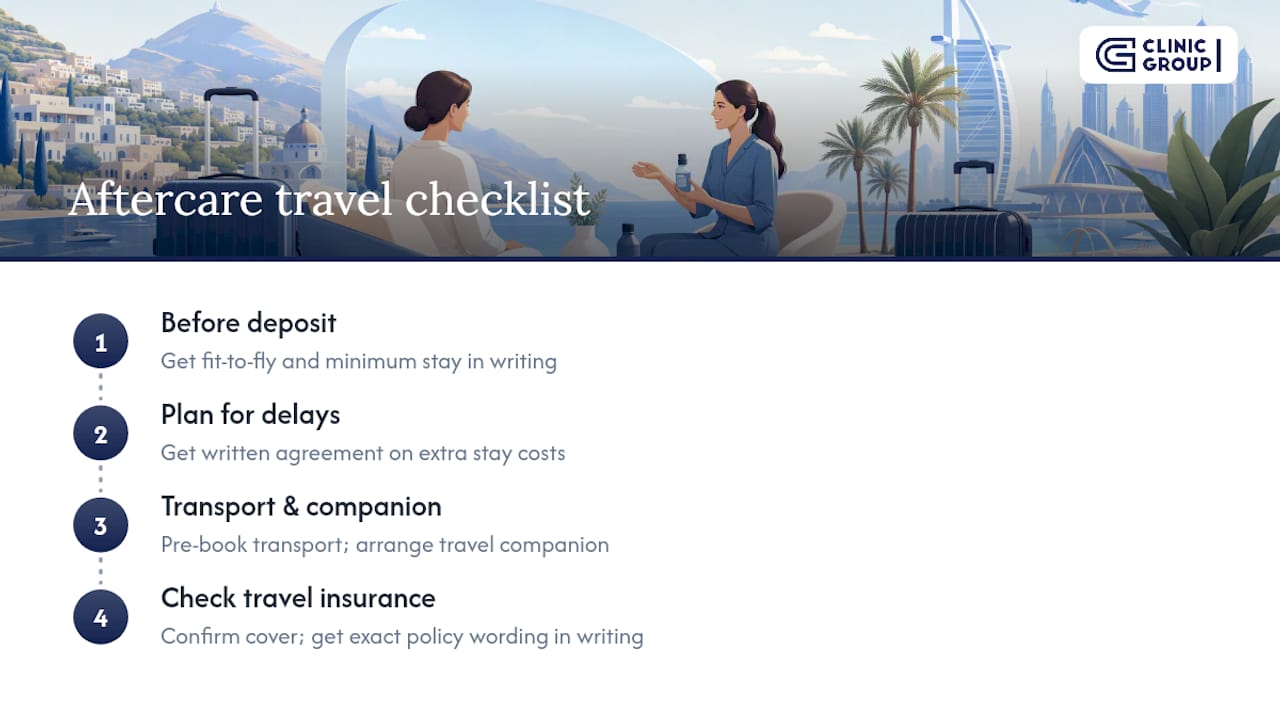
Plan for the possibility of a longer stay. Ask the clinic directly: if discharge is delayed due to a complication, who covers additional hospital nights, hotel costs and rebooking fees? The answer must be in writing. Arrange airport transport in advance, particularly if your mobility will be limited. A travel companion is advisable for any procedure requiring general anaesthetic or significant sedation.
Pro Tip: Contact your travel insurer before booking and ask specifically whether your policy covers aftercare costs, extended stays due to complications, and repatriation. Request the exact policy wording in writing. Many standard travel policies exclude elective procedures entirely.
What aftercare you may need in the UK by procedure type
Aftercare requirements vary significantly by procedure. Here is a practical guide to what to expect and who to involve:
- Cosmetic surgery — (rhinoplasty, liposuction, breast augmentation): wound checks at days 5–7 and 14, drain removal if applicable, compression garment fitting, and a consultant review at 6 weeks. Your GP or a private wound clinic can manage dressings; a consultant handles the 6-week review.
- Dental implants, crowns and veneers: X-ray review at 6–12 weeks, staged prosthetic fitting, and occlusion checks. An implant-trained dentist is required; a standard NHS dentist may not have the equipment to assess overseas implants.
- Hair transplant — (FUE or DHI): scab care for 10–14 days, prescribed medication (finasteride or minoxidil), sun avoidance for 4 weeks, and a progress review at 3 months. Your GP can manage prescriptions; the overseas clinic typically provides remote photo reviews.
Red flags that need urgent attention after you return
Seek urgent assessment for any of the following: fever above 38°C, worsening or severe pain, heavy or uncontrolled bleeding, spreading redness or discharge from a wound, breathing difficulties, chest pain, fainting, new neurological signs, or persistent vomiting. These symptoms require immediate clinical evaluation, not a wait-and-see approach.
For less urgent concerns, such as minor swelling, bruising or questions about medication, telemedicine follow-up with the overseas clinic is a practical first step. It does not replace a physical assessment but can help triage whether you need to be seen in person.
Pro Tip: When contacting any clinician about a concern, photograph the area with a timestamp, note the time symptoms started, and list any medications taken. This information speeds triage significantly and helps the clinician make a faster, safer assessment.
If complications or disputes arise: what to do next
Act quickly and document everything. The immediate steps are:
- Seek urgent care if symptoms are serious (A&E or urgent care centre).
- Contact the clinic’s international patient office and state clearly that you are reporting a complication.
- Request all clinical notes, operative photos and correspondence in writing.
- Keep every receipt: hotel, flights, pharmacy, private consultations.
- Log symptoms daily with timestamps and photographs in a single folder.
For non-emergency complications, structured remote follow-up with a contactable coordinator improves outcomes and provides early identification of problems. Ask the overseas clinic whether they offer scheduled telemedicine reviews with the treating clinician, not just a general support line.
If the clinic disputes responsibility, your written pre-deposit confirmations, signed consent forms and email correspondence become your evidence. Private UK care for complications is available but costly; this is why confirming the clinic’s revision policy in writing before booking is non-negotiable.
Pro Tip: Create a single time-stamped folder (cloud-based or on your phone) containing all clinical correspondence, receipts and photographs from the moment you book. If a dispute arises, having an organised, dated record is the single most useful thing you can present to a clinician, insurer or patient advisory service.
Medicines, dressings, translations and travel companions
Take a recovery kit and digital copies of all records. The practical essentials to pack or organise before travel include:
- Current medicines listed by generic name (not brand name, which may differ abroad)
- Spare dressings and any compression garments specified by the clinic
- Printed and digital copies of all clinical records and emergency contacts
- Phone charger and a portable battery pack for long journeys
- Waterproof dressings for wound protection during travel
Carry both a printed and digital copy of your records. If documents are not in English, arrange translation before your first UK appointment.
What to confirm with the clinic before you pay a deposit
Use this checklist before transferring any payment. Every item must be confirmed in writing, ideally in a signed PDF or a clear email thread with a date stamp:
- Written aftercare plan specifying dates, named clinician and number of follow-ups
- Named operating surgeon or clinician who will review you post-operatively
- 24/7 international patient emergency contact number
- Complication and revision policy: timeline, who pays, whether return flights are covered
- Fit-to-fly clearance policy and minimum required stay
- Commitment to provide English-language discharge summary and imaging
- Telemedicine options for remote follow-up after return
- Confirmation that records will be transferred to a UK clinician on request
Store screenshots, signed PDFs and the full email thread. A dated written reply from the clinic’s international patient office or managing clinician is the minimum standard of confirmation before any deposit is paid. Clinicgroup’s booking process guide covers these steps in detail for patients planning treatment in Albania or Dubai.
Key takeaways
Arranging aftercare overseas safely requires a written plan, named clinician contact, and English records secured before you leave the destination country.
| Point | Details |
|---|---|
| Written aftercare plan first | Request a signed, dated aftercare plan from the clinic before paying any deposit. |
| Book UK follow-up before travel | Identify and contact your UK clinician (GP, dentist, physio) before you fly, not after. |
| Collect English records on departure | Take discharge summary, operative notes, implant details and imaging before leaving the clinic. |
| Know the red flags | Fever, heavy bleeding, chest pain or breathing difficulties need urgent A&E assessment, not a clinic callback. |
| Clinicgroup coordinates the process | Clinicgroup matches patients with verified clinics and helps arrange written aftercare plans, translated records and UK handover introductions. |
A note from Clinicgroup on why written aftercare matters
At Clinicgroup, we work only with verified clinics and board-certified specialists in Albania and Dubai, and we make written aftercare commitments a standard part of every patient journey we coordinate. The gap between a successful procedure and a smooth recovery is almost always a documentation gap: a missing implant spec, an untranslated discharge note, or an emergency number that nobody answers. We help close those gaps before patients travel, by confirming aftercare plans in writing, facilitating UK handover introductions, and staying contactable throughout recovery. Patients who arrive home with a complete record folder and a pre-booked UK review consistently report a calmer, more confident recovery.
Clinicgroup’s aftercare coordination for UK patients
For UK patients planning treatment in Albania or Dubai, Clinicgroup offers a concrete alternative to navigating aftercare logistics alone. Rather than contacting clinics individually and hoping for clear answers, patients who book through Clinicgroup receive clinic matching with verified, accredited providers, written aftercare plan confirmation as part of the booking process, named clinician contact details, translated records support, travel and hotel logistics, and structured remote follow-up coordination after they return home.
Whether you are planning cosmetic surgery, dental implants, or a hair transplant, the aftercare coordination is built into the process from the start. Contact Clinicgroup for a free consultation and receive a clear picture of what aftercare is included, who your named clinician will be, and how your UK handover will be managed before you commit to anything.
Useful sources and Clinicgroup guides
- Surgery abroad aftercare in the UK — All Health and Care
- Continuity Of Care After Treatment Abroad: Follow‑Up - Acibadem Hospitals Group
- Appropriate Care of Patients Traveling for Surgery — The Aesthetic Society (ASPS) practice reference
- How to manage your post‑surgery handover to your local doctor after medical travel — TravellerMD
- Medical Tourism Checklist 2026: 47 essential steps — MAP Hospitals
- International patient after‑care & follow‑up programme — DGS Healthcare
- International treatment booking process: your 2026 guide — Clinic Group
- Aftercare services explained: what medical tourists need to know — Clinic Group
FAQ
What documents should I collect before leaving the overseas clinic?
Collect a discharge summary in English, operative notes, anaesthetic records, a medication list with generic drug names, implant or device details (brand, size, batch number), imaging on CD or USB, and the clinic’s 24/7 emergency contact number before departure.
How do I arrange a UK follow-up after treatment abroad?
Contact your GP, a private GP, or the relevant specialist (implant dentist, physiotherapist, consultant) before you travel and ask whether they can accept a post-operative handover. Bring your full records to the first appointment and ask the overseas clinic to send a brief clinical summary directly to your UK clinician.
What are the red flags that need urgent care after returning home?
Fever above 38°C, heavy bleeding, spreading redness or discharge, chest pain, breathing difficulties, fainting, or new neurological symptoms all require immediate assessment at A&E. Contact the overseas clinic’s emergency line at the same time to alert the treating team.
Can Clinicgroup help arrange aftercare and UK handover?
Yes. Clinicgroup coordinates written aftercare plan confirmations, named clinician contacts, translated records, and UK handover introductions as part of the patient journey for treatments booked through the platform in Albania and Dubai.
Does travel insurance cover aftercare costs after treatment abroad?
Standard travel insurance policies often exclude elective procedures and their aftercare. Contact your insurer before booking, ask specifically about complication cover and extended stays, and request the relevant policy wording in writing before you travel.