Choosing cosmetic surgery abroad is not simply a matter of selecting a destination. There is no country-level safety ranking, so this cosmetic surgery abroad guide focuses on what matters more: the surgeon’s qualifications, clinic oversight, recovery arrangements and plans for managing complications. UK data also show that some patients need corrective treatment after surgery overseas.
It is understandable to explore treatment beyond the UK, but travel adds practical decisions to an already significant medical choice. The operation is only one part of the experience; consultation, recovery time and access to follow-up care all deserve careful attention.
This guide explains why people travel for cosmetic surgery, what risks and UK complication data can tell you, and how to compare destinations beyond their headline appeal. It also outlines questions to consider about the surgeon, clinic, travel and aftercare, helping you make an informed decision at your own pace.
Key Takeaways
- Look beyond the destination: surgeon qualifications, clinic oversight and a clear explanation of the procedure all matter when assessing your options.
- Plan for recovery, not a holiday. Find out where follow-up appointments will take place and who will manage complications after you return to the UK.
- UK data show that complications after surgery abroad can require further treatment, so understand the aftercare arrangements before making a decision.
- Compare the full picture, including travel, recovery time and follow-up care, rather than judging a destination by its headline procedure price alone.
- Clinic Group’s Plastic Surgery Provider Listings can help you explore its partner clinics when you’re considering treatment abroad.
Post-operative aftercare and complication management
Before booking, establish how your care will continue after you leave the hospital. Ask for a written plan naming the doctor responsible for follow-up, planned review appointments and the contact route for concerns. The plan should explain where examinations will take place after you return to the UK and how clinical records can be shared if another doctor becomes involved.
What qualifications and registration should an overseas cosmetic surgeon have? Check their specialist training, qualifications, professional memberships and experience with the procedure you are considering. Verify their registration with the relevant regulator in their country, including how professional standards are enforced.
What should you check when choosing a cosmetic surgery clinic abroad? Confirm where the operation will take place, who will perform it, and how the clinic handles follow-up and complications. Meet the surgeon for a consultation rather than relying solely on discussions with sales staff.
How can you verify a clinic’s safety and accreditation? Check the clinic’s status with the relevant health authority and verify any accreditation directly with the issuing organisation. Find out which facility and services the accreditation covers; a certificate alone does not explain the aftercare arrangements.
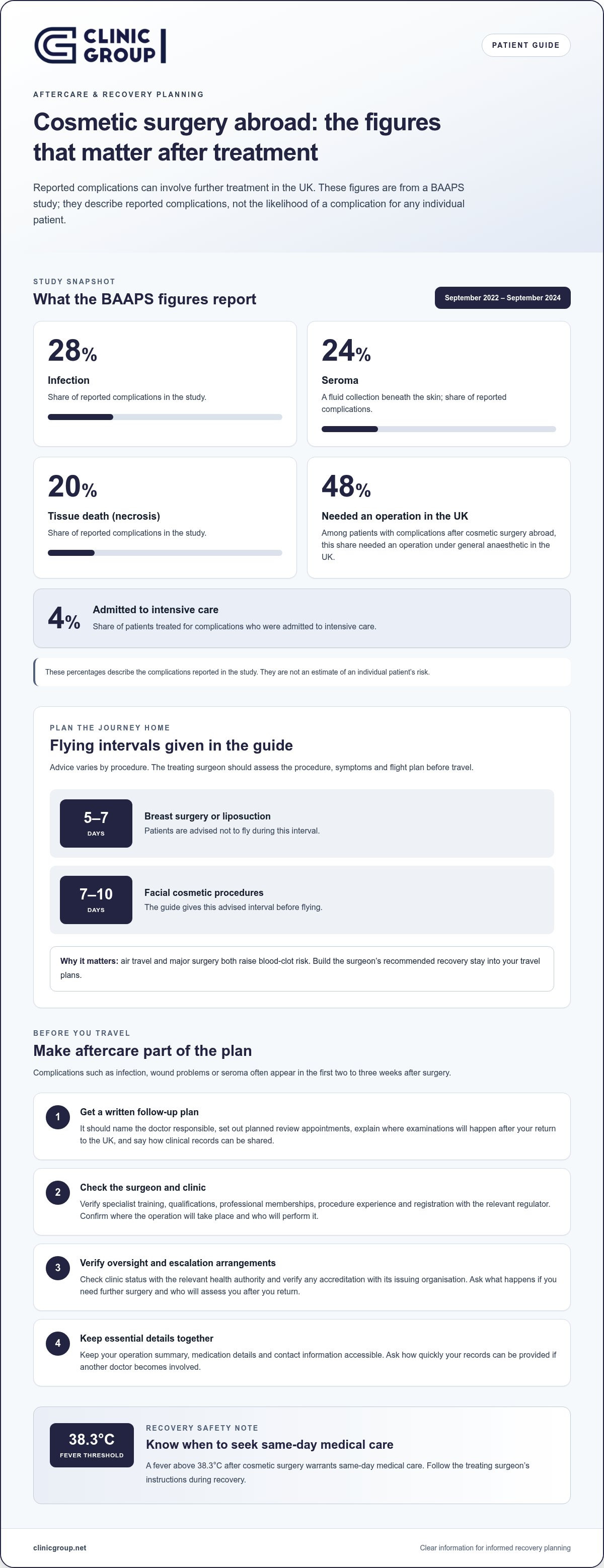
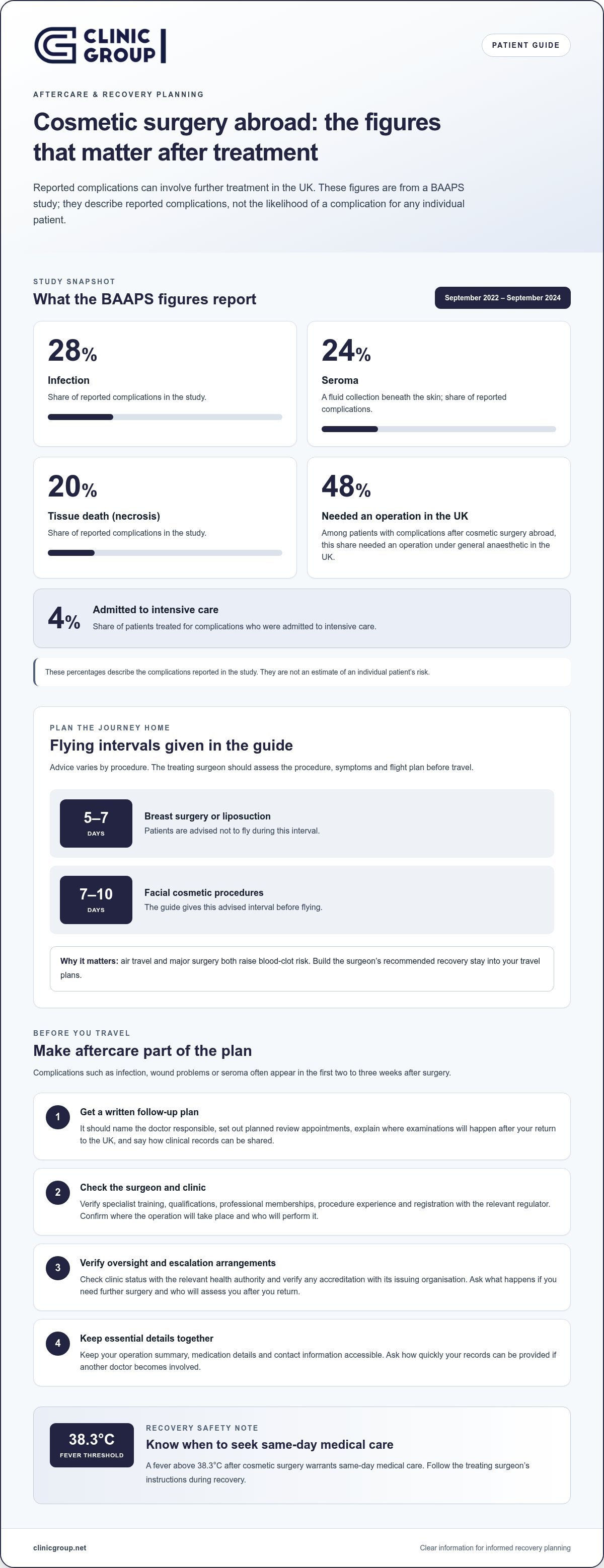
Recovery needs to be planned around the procedure, not a sightseeing itinerary. Complications such as infection, wound problems or seroma, a fluid collection beneath the skin, often appear in the first two to three weeks after surgery. In the BAAPS study covering September 2022 to September 2024, infection occurred in 28% of reported complications, seroma in 24%, and tissue death, or necrosis, in 20%.
The same BAAPS study found that 48% of patients with complications after cosmetic surgery abroad needed an operation under general anaesthetic in the UK. Four per cent of patients treated for complications were admitted to intensive care. These figures describe reported complications, not the likelihood of a problem for an individual patient, but they show why a practical escalation plan matters.
Before travelling, get the direct details of a named doctor who can address complications. Ask what happens if you need further surgery, who will assess you after you return home, and how quickly your records can be provided. A helpline alone may not connect you with the clinician familiar with your operation.
During recovery, follow the treating surgeon’s instructions and avoid alcohol, sun exposure, sightseeing and swimming. A fever above 101°F (38.3°C) after cosmetic surgery warrants same-day medical care. Keep your operation summary, medication details and contact information together, so you can act promptly if symptoms develop. For UK-focused planning, the guide to aftercare in the UK after surgery abroad covers practical considerations.
2. Reasons for travelling abroad for plastic surgery
Every year, thousands of UK patients travel abroad for cosmetic surgery. Reasons include seeking a wider choice of clinics, combining treatment with travel, or exploring options outside their local area. However, exploring UK-based cosmetic and aesthetic clinics such as enliven.skin first can provide valuable insight into non-surgical alternatives and local care standards. Your decision should still begin with the operation itself: its purpose, alternatives, recovery needs and the surgeon’s assessment. A destination’s appeal cannot replace informed consent or a clear clinical plan.
Some patients are drawn to arranging consultations and treatment in one trip. But travel and accommodation add practical commitments alongside the operation. Before booking, map out the full itinerary: consultation, procedure, recovery stay and any planned follow-up. Allow for changes if recovery takes longer than expected, and do not treat sightseeing as part of your immediate post-operative schedule.
Travel insurance does not normally cover problems arising from cosmetic surgery. Before departure, read the policy wording and ask your insurer whether the planned procedure affects cover for unrelated emergencies. Separately, clarify what insurance the clinic or surgeon holds, whether it covers your care, and what arrangements apply if emergency travel home becomes necessary. Keep the answers and relevant contacts with your consent documents.
UK travel fitness advice depends on the procedure and recovery. After breast surgery or liposuction, patients are advised not to fly for 5 to 7 days; after facial cosmetic procedures or a tummy tuck, the advised interval is 7 to 10 days. Air travel and major surgery both raise blood-clot risk, so follow the treating surgeon’s advice before travelling.
These intervals are not a substitute for a travel assessment. Commonly cited clinical guidance recommends waiting at least 7 to 10 days after most cosmetic procedures before flying; after major body-contouring or abdominal surgery, patients are commonly advised to wait two weeks or more. Ask the surgeon to assess your procedure, symptoms and flight plan, then build the recommended stay into your booking.
For UK patients, public healthcare services are unlikely to provide planned corrective treatment for complications from elective surgery abroad; emergency or life-saving care is a different situation. Make a continuity plan before leaving: know whom to contact overseas, where to seek help in the UK, and how records will be shared. Explore plastic surgery options abroad as one step in your research, while keeping recovery and follow-up central to the decision.
3. Risks of cosmetic surgery abroad
Before booking, ask the surgeon what the operation can achieve, what its limitations are, and which alternatives may be suitable. Ask about their experience with the same procedure, likely complications, emergency arrangements and who will provide follow-up care. Make sure you understand the answers before giving consent.
Plastic surgery carries the usual risks of an operation, including bleeding, infection, poor wound healing and reactions to anaesthesia. The exact risks depend on the procedure and your health. During consultation, the surgeon should explain the risks and possible complications, discuss alternatives, and show relevant before-and-after photographs. You should understand the explanation in English or another language you speak comfortably.
Blood clots are a particular concern because major surgery and air travel both increase clot risk. Deep vein thrombosis (DVT) is a clot, usually in a deep leg vein. If part of it travels to the lungs, it can cause a pulmonary embolism, which is a medical emergency. A flight of four hours or longer roughly doubles the risk of blood clots after surgery.
Flight timing depends on the procedure and recovery. Commonly cited clinical guidance recommends waiting at least 7 to 10 days after most cosmetic procedures before flying. After major body-contouring or abdominal surgery, patients are commonly advised to wait two weeks or more. People sometimes book a flight home just 72 hours after major surgery, despite the risks of flying too soon. Don’t treat a flight date as proof that you’re fit to travel.
Before surgery, ask the surgeon when flying is appropriate for your procedure and which symptoms require urgent assessment. Follow their advice about movement, hydration and any prescribed measures to reduce clot risk. New leg swelling or pain, sudden breathlessness, chest pain or coughing blood needs urgent medical attention. These symptoms may have different causes, but should not be ignored after an operation.
Plan for delays as well as the scheduled return. A complication or delayed recovery can mean remaining abroad longer, so understand how accommodation and travel changes would be handled. Check the clinic’s emergency arrangements, your insurance exclusions and the process for getting medical records. A pre-surgery consultation should give you time to raise concerns and consider the answers before consenting.
4. UK data on complications following cosmetic surgery abroad
UK evidence helps describe the complications that reach specialist care, but it cannot show the risk for every patient travelling abroad. BAAPS reported that its members treated 324 patients needing corrective surgery after cosmetic surgery abroad over four years. This records cases treated by participating surgeons, not every operation performed overseas.
A 2026 study examined 198 cases in the BAAPS national database, reported between September 2022 and September 2024. Wound breakdown, when a surgical wound separates, was recorded in 37% of cases. Abdominoplasty, or tummy tuck surgery, represented 45% of procedures in the database. These findings describe the cases collected, rather than a rate across all patients.
The patient profile offers context, not a prediction. In that BAAPS study, women accounted for 93% of patients, and the mean age was 39. Abdominoplasty made up around three-quarters of complications among UK patients requiring corrective treatment after cosmetic surgery abroad. The database therefore highlights a prominent procedure among reported cases, but cannot determine an individual’s likelihood of a complication.
The practical point is to understand how a complication would be assessed and treated. A UK specialist needs accurate details of the original operation, including the procedure performed, the date, the surgeon’s notes and any treatment already given. Keep copies of discharge documents, consent information and medication instructions together so they can be shared during an assessment.
If you notice a new or worsening problem after returning, contact the treating clinic and seek appropriate medical assessment. Give the clinician a clear timeline: when symptoms began, how they have changed, and what medication or wound care you have used. For urgent or severe symptoms, seek emergency care rather than waiting for routine correspondence from overseas.
Care in the UK depends on clinical need and available services; planned corrective surgery is not automatic after elective treatment abroad. BAAPS’s figures describe patients treated by its members, not a promise of access to a particular service. Keep communication open with the original clinic, and ask for your records to be sent promptly if another specialist becomes involved.
Case databases can help identify recurring patterns and inform discussions about patient safety. Their value lies in showing the complications that can arise in cases presenting for treatment. Their limitations matter too: reported cases do not represent every patient or establish a direct comparison between destinations. Use findings as one part of your decision, alongside the individual surgeon’s explanation and the written follow-up plan.
5. Comparative costs of surgery in different destinations
A destination comparison is more useful when it examines the treatment pathway, not just the country name. Start by defining the exact procedure you are considering and the outcome you want to discuss with a surgeon. Then compare how each clinic assesses suitability, explains alternatives and plans care. This helps distinguish genuinely similar treatment options from services that share only a broad label.
Procedure names can conceal differences in surgical scope. For example, two facelift consultations may involve different areas or techniques, depending on the patient’s features and aims. Additionally, patients weighing surgical interventions against non-invasive facial rejuvenation may benefit from consulting a Botox and dermal fillers clinic Marylebone London to understand what can be achieved without surgery. Ask each surgeon to describe the proposed operation in plain language and explain what it does not include. A written clinical plan makes those differences easier to understand than a short promotional description.
The destination also affects how practical the treatment pathway feels. Consider journey length, available transport and whether you can arrange help during recovery. Clinic Group’s partner network includes locations in Albania, including Tirana, and Dubai. Compare the actual itinerary for the clinic you are considering, rather than assuming every destination offers the same travel arrangements or appointment pattern.
Communication is another useful point of comparison. During consultation, assess whether you can explain your goals, ask follow-up questions and understand the surgeon’s answers. Check how the clinic provides written instructions and handles communication after you return home. A clear exchange helps you understand the proposed procedure and reduces the chance of relying on assumptions about what was agreed.
Compare the decision process as carefully as the proposed treatment. Does the consultation include a discussion of alternatives and limitations? Is there time to consider the plan before deciding? Can you obtain a second opinion or pause the booking process? These details help you judge whether the clinic’s approach supports an informed decision, rather than treating travel arrangements as a reason to rush.
Use a simple comparison document with one column for each clinic. Record the proposed procedure, the surgeon’s explanation, the consultation format, the named facility and the follow-up process. Note unanswered questions to discuss before making a decision. This keeps your comparison focused on clinical suitability and practical arrangements, without assuming that similarly described options are equivalent.
Explore Clinic Group’s plastic surgery listings as you compare treatment pathways.
Clinic Group: Dental Treatment Directory
Clinic Group’s Plastic Surgery Provider Listings offer a starting point for exploring partner clinics when considering cosmetic surgery abroad. Use the listings to review options in Albania, including Tirana, and a smaller number of partner clinics in Dubai. Compare them against the practical questions in this guide: surgeon qualifications, consultation arrangements, recovery planning and follow-up care.
Clinic Group is a directory, not the treating clinic; your procedure and clinical care are provided by the selected medical provider. If you are still weighing your options, browse the Plastic Surgery Provider Listings and take time to consider how each clinic’s arrangements fit your needs.
Visit Clinic Group to explore the listings.
Take your next step with confidence
Let your decision follow a careful process, not a deadline or persuasive package. Use this cosmetic surgery abroad guide as a reference while you consider what matters most, then take time to discuss your priorities with the surgeon who would perform the procedure. A clear understanding of the care pathway can help you decide whether travelling is right for you.
Clinic Group’s directory and referral options include a Dental Treatment Directory, Hair Transplant Referrals and Plastic Surgery Provider Listings. These can help you explore relevant treatment pathways and partner-clinic options. Clinic Group is a directory and coordinator, not the treating clinic; clinical decisions and treatment are the responsibility of the selected medical professionals.
If you’re ready to explore your options, contact Clinic Group without pressure and take the next step at your own pace.
A considered decision is a positive step, whether you choose treatment abroad or decide to wait.
Frequently Asked Questions
Thinking of having cosmetic surgery abroad?
Begin by identifying your goals and arranging a consultation with the surgeon who would perform the procedure. Use this cosmetic surgery abroad guide to prepare questions about suitable options, recovery and follow-up. Ask for a written treatment plan and make sure it reflects your priorities. Consider who can support you during recovery and how you would manage care once you return to the UK.
What If Something Goes Wrong?
For severe or rapidly worsening symptoms, seek urgent medical assessment and contact the clinic’s named doctor. Keep your discharge summary, operation details and medication list available for the clinician assessing you. NHS care for complications is not automatic beyond emergency or life-saving treatment. Before travelling, understand the clinic’s process for complications and how it will share your records with a UK healthcare professional if needed.
What would my aftercare package include?
Aftercare arrangements vary, so ask for a written description before booking. Clarify whether the plan includes scheduled reviews, wound checks, contact with the operating surgeon and guidance after you return home. For example, find out whether a remote appointment can assess your concern or whether you would need an in-person review. Confirm how additional appointments or treatment are arranged if recovery does not follow the expected course.
Where will the surgery happen?
Ask for the exact name and location of the hospital or clinic where your operation is planned. Your written plan should identify the facility and the surgeon responsible for the procedure. Check whether consultation, surgery and follow-up take place at the same site or different locations. Keep the address and relevant contact details with your travel documents, and share them with someone you trust at home.
Which Countries Offer the Best Cosmetic Surgery for UK Patients?
No country is the best choice for every UK patient. Compare the individual surgeon’s qualifications and relevant experience, the facility, communication and follow-up arrangements instead of relying on a destination’s reputation. Clinic Group’s partner clinics are located mainly in Albania, including Tirana, with a smaller number in Dubai. Consider how travel distance and access to care after returning to the UK fit your circumstances.
How do language barriers and medical records affect your safety?
Clear communication helps you understand consent information, recovery instructions and when to seek help. During consultation, make sure you can explain your concerns and understand the surgeon’s answers in a language you speak comfortably. Obtain copies of your consent form, operation summary, medication instructions and follow-up notes. Before leaving, check that the documents clearly identify the procedure and medicines so you can share them with a UK clinician.
How do you vet a surgeon from 5,000 miles away?
Start with the surgeon’s full name, relevant specialist qualifications, professional memberships and experience with your planned procedure. Verify their credentials through the appropriate professional or regulatory body in the country where they practise. Arrange a consultation with the surgeon who would operate, rather than relying solely on a sales representative. Request written details about who performs each part of the operation and keep those records with your treatment plan.
How long should I stay in the country after surgery abroad?
The required stay depends on the procedure, your recovery and the surgeon’s assessment of when travel is appropriate. Before booking a return flight, ask which checks need to happen in person and what circumstances could delay your departure. Allow flexibility in your travel arrangements, rather than treating a fixed flight date as a recovery milestone. Follow the treating surgeon’s advice if symptoms or examination findings affect your travel plans.

Article by
Clinic Group Editorial Team
The Clinic Group editorial team publishes clear, practical guides for UK and EU patients researching medical travel — from dental implants and hair transplants to plastic surgery and eye care — with a focus on verified clinics, transparent “from” pricing, and safe planning.
Disclaimer
This article is for general information only and is not medical advice, diagnosis, or a substitute for an in-person consultation with a qualified clinician. Treatment suitability, risks, timelines, and costs vary by individual. Clinic Group connects patients with independent clinics; those clinics are responsible for clinical care. Always verify credentials, obtain a written treatment plan and itemised quote, and confirm aftercare arrangements and travel insurance cover (elective procedures are often excluded) before booking. Outcomes cannot be guaranteed.