TL;DR:
- Turkey offers the largest patient volume and the widest price range among top dental tourism destinations in 2026.
- Choosing an accredited clinic is essential, regardless of country, to ensure quality and safety for UK patients.
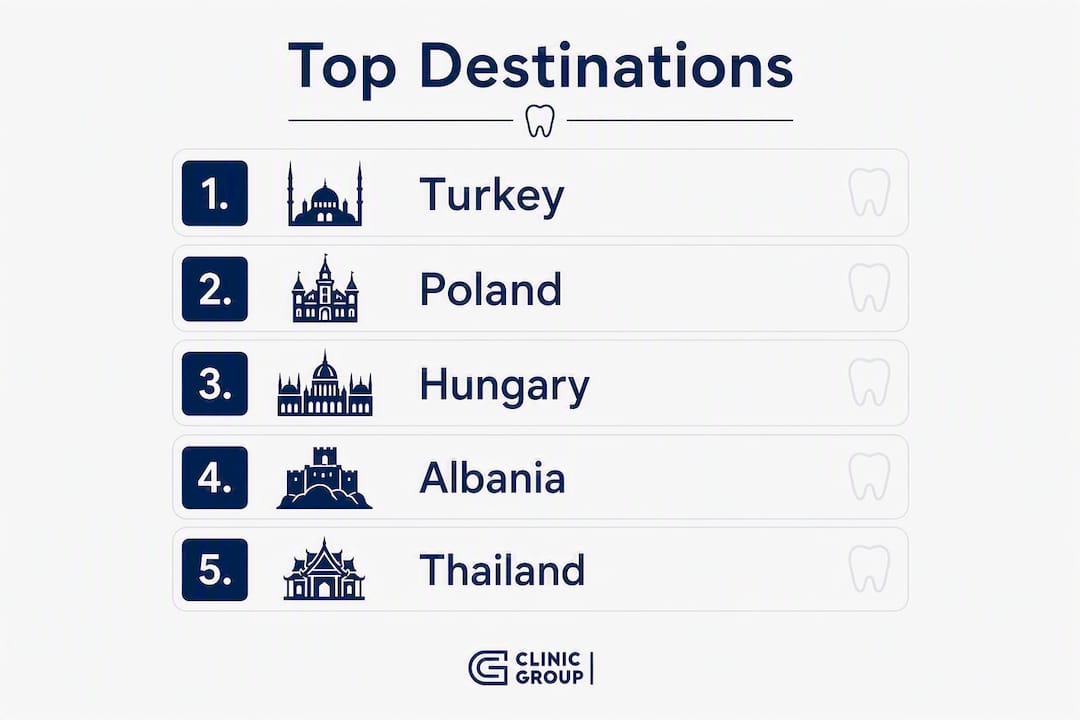
For UK patients weighing their options, the most practical dental holiday destinations in 2026 are Turkey, Poland (Kraków), Hungary, Albania, Thailand, Vietnam, Spain, Mexico, Costa Rica, and India. Each one earns its place for a different reason:
- Turkey — largest patient volume, widest price range, and the most searched European dental destination in 2026
- Poland (Kraków) — EU-standard care, short flight from the UK, and strong English-language support
- Hungary — long-established dental tourism infrastructure, particularly for complex restorative work
- Albania (Tirana) — competitive pricing, European standards, and Clinicgroup’s own verified partner Dental Med Austria Tirana for implants and cosmetic dentistry
- Thailand — multiple JCI-accredited hospital-based dental facilities
- Vietnam — lower prices and longer warranty terms at established clinics
- Spain — familiar EU regulatory environment, easy flights, and no language anxiety for many patients
- Mexico and Costa Rica — popular with patients combining treatment with a longer holiday
- India — strong value and NABH-accredited facilities in major cities
One caveat applies to every destination on this list: the country’s reputation matters far less than the specific clinic tier. Verification is not optional. Clinicgroup connects UK patients with vetted clinics across these destinations, and accreditation bodies such as Joint Commission International (JCI) provide an independent quality benchmark worth checking before you book.
Pro Tip: Before you shortlist any country, confirm whether the clinic you are considering holds a verifiable national registration number or JCI accreditation. A country’s headline reputation cannot substitute for clinic-level due diligence.
Table of Contents
- Which dental tourism destinations suit UK patients best?
- What does dental treatment abroad actually cost?
- How to choose the right destination and clinic
- Safety checks every UK patient must carry out
- Aftercare and continuity of care when you return to the UK
- Key takeaways
- Why country alone is not the whole answer
- Plan your dental treatment abroad with Clinicgroup
- FAQ
Which dental tourism destinations suit UK patients best?
1. Turkey
Turkey treats a very large number of international dental patients annually, which explains both its appeal and its wide quality variation. Budget package tiers can be significantly cheaper than Kraków on like-for-like quotes, though premium Istanbul clinics using Nobel Biocare or Straumann implants converge on EU pricing. For UK patients, Istanbul is roughly 3.5–4 hours by air. English is widely spoken in established dental practices. The risk is real: a market this large attracts low-cost operators alongside excellent ones, so accreditation verification is non-negotiable here more than anywhere.

2. Poland (Kraków)
Kraków sits about two hours from most UK airports and operates within EU regulatory standards. Clinics here commonly use recognised implant brands and offer written treatment plans in English. A single Nobel Biocare implant with a zirconia crown runs approximately EUR 1,300–1,500 at premium Kraków clinics. The shorter travel time makes it practical for two-stage implant cases where a return visit is required, and UK dentists tend to find Polish clinical documentation easier to interpret.
3. Hungary
Hungary, particularly Budapest, has been a dental tourism hub for decades. The infrastructure is mature: dedicated dental hotels, English-speaking coordinators, and clinics experienced in managing UK patients’ aftercare documentation. Hungary suits patients needing complex restorative work such as full-arch rehabilitation or All-on-4, where surgeon case volume and in-house lab control are critical quality factors.
4. Albania (Tirana)
Albania offers some of the most competitive pricing in Europe while maintaining European clinical standards. Tirana is under three hours from London. Clinicgroup lists Dental Med Austria Tirana as a verified partner specialising in implants and cosmetic dentistry, making it one of the more straightforward booking routes for UK patients who want transparent pricing and documented aftercare.

5. Thailand
Thailand’s strongest selling point is its hospital-based dental facilities, several of which hold JCI accreditation. That accreditation applies internationally recognised safety and audit protocols, making it a reliable quality proxy for UK patients unfamiliar with local regulators. The flight from London is roughly 11–12 hours, so Thailand suits patients combining treatment with an extended stay rather than a quick procedure trip.
6. Vietnam
Leading Vietnamese dental clinics advertise implant warranties of 7–10 years, which is longer than many EU clinics offer. Prices are lower than Thailand, and English is spoken at established practices in Ho Chi Minh City and Hanoi. The trade-off is fewer JCI-accredited options compared with Thailand, so national registration verification becomes more important.
7. Spain
Spain appeals to patients who want EU regulatory oversight without the uncertainty of a non-EU market. Clinics in Barcelona, Madrid, and the Costas are accustomed to UK patients and produce documentation in English. Costs are higher than Turkey or Albania but lower than UK private rates, and the short flight makes follow-up appointments feasible.
8. Mexico
Mexico is primarily popular with patients who want to combine dental work with a longer holiday or who are already travelling to North America. Clinics in Los Algodones and Cancún have extensive experience with international patients. UK patients should factor in the longer flight and the absence of EU regulatory oversight when assessing risk.
9. Costa Rica
Costa Rica attracts patients seeking high-quality care in a stable, English-friendly environment. San José clinics serving international patients often use US-standard materials and maintain English-language records. Costs are moderate compared with the UK, and the country has a well-developed private healthcare sector.
10. India
India’s NABH-accredited facilities in cities such as Delhi, Mumbai, and Chennai offer strong value for complex restorative cases. Surgeon credentials are often internationally recognised, and English is widely spoken. The 8–9 hour flight makes it less practical for short trips but viable for patients combining dental work with other treatments.
What does dental treatment abroad actually cost?
Cost ranges depend on clinic tier and the implant brand or material specified. A budget-tier clinic using a lesser-known implant system will quote significantly less than a premium clinic using Straumann or Nobel Biocare, and the long-term outcomes can differ accordingly. The figures below reflect ballpark ranges at mid-to-premium tier clinics across the recommended destinations.
| Procedure | UK private (approx.) | Turkey (budget tier) | Turkey (premium) / Kraków | Albania / Hungary |
|---|---|---|---|---|
| Single implant + zirconia crown | — | EUR 650 | EUR 1,300–1,500 | EUR 800 |
| Per-tooth porcelain veneer | — | EUR 200 | EUR 350 | EUR 250 |
| Zirconia crown (single) | — | EUR 150 | EUR 300 | EUR 200 |
Sources: SmileJet Kraków vs Turkey 2026; ballpark ranges for Albania and Hungary based on published clinic pricing. All figures in the currency the source states them; no conversion applied.
For a two-stage single implant case (implant placement, healing, crown fitting), a realistic total budget including return flights and two nights’ accommodation in Turkey or Albania might add £200–£400 to the procedure cost. Kraków or Budapest add a similar amount given short flight times and affordable accommodation.
Realistic treatment timelines:
- Single-visit procedures (veneers, crowns, composite bonding): 3–5 days including consultation, preparation, and fitting
- Single implant, immediate loading (where clinically appropriate): 5–7 days
- Two-stage implant (placement + healing + crown): two separate trips, typically 3–4 months apart; each trip 3–5 days
- All-on-4 full arch: 5–7 days for surgery and temporary prosthesis; return trip for final prosthesis after 3–6 months
- Minimum flying gap post-surgery: most clinics advise waiting 24–48 hours after implant surgery before flying; confirm with your treating dentist
For more detail on planning a dental trip, Clinicgroup’s practical guide to travelling for dental treatment covers logistics and timelines in full.
How to choose the right destination and clinic
Choosing a country is the easy part. Choosing the right clinic within that country is where most patients either protect themselves or expose themselves to risk. A clinic’s tier matters more than its country: a top-tier clinic in Turkey or Albania using Straumann implants and an in-house lab can match EU-standard outcomes; a low-cost package operator in the same city cannot.
Step-by-step vetting checklist:
- Confirm the clinic holds a verifiable national registration number or JCI accreditation; check the JCI directory directly rather than relying on the clinic’s own claims.
- Ask which implant brand and material grade will be used; request the manufacturer name and product reference in writing.
- Verify the treating dentist’s credentials: ask for their qualification certificates, specialist registration, and case volume for the procedure you need.
- Request a written treatment plan with itemised costs before paying any deposit.
- Confirm warranty terms in writing: what is covered, for how long, and what the process is if a complication arises after you return to the UK.
- Ask how the clinic handles aftercare communication with your UK dentist, and whether they will provide a full clinical record pack on discharge.
- Purchase medical travel insurance that explicitly covers surgical complications and emergency repatriation before you travel (see the safety section below).
- Check patient reviews on independent platforms rather than the clinic’s own website; look for documented outcomes from UK patients specifically.
Red flags to walk away from:
- Vague or verbal-only warranty with no written terms
- No verifiable accreditation or national registration number
- Quotes that omit the implant brand or material specification
- Pressure to pay a large deposit before receiving a written treatment plan
- No clear process for handling complications after you return home
Pro Tip: Ask the clinic to email you the implant brand, model number, and lot number before your procedure. You can then verify the product independently on the manufacturer’s website. This one step protects you if questions arise years later.
Clinicgroup’s questions to ask your dentist before travelling provides a ready-made checklist you can send directly to any clinic.
Safety checks every UK patient must carry out
JCI accreditation is the most widely recognised international benchmark for hospital-based dental services. It applies standardised safety and infection-control protocols that translate across borders. For stand-alone dental clinics, national registration is the practical alternative: NABH for India, TÜRSAB-referenced registration for Turkey, and national dental council listings for EU countries. Always verify accreditation directly through the issuing body’s directory rather than from a screenshot on the clinic’s website.
The NHS and GDC advise that patients should consult their UK dentist before booking treatment abroad, and that the NHS will not reimburse dental treatment received overseas. This is not a reason to avoid dental tourism, but it does mean you need a clear plan for follow-up care before you travel. The GDC guidance specifically flags that UK dentists may be reluctant to provide follow-up for work done abroad if documentation or clinical standards are unclear.
On insurance: standard holiday insurance does not cover surgical complications or emergency repatriation for planned medical procedures. Travel Aware is explicit on this point. You need a separate medical travel insurance policy that names surgical complications and repatriation as covered events. Confirm this in writing with your insurer before you travel, not on arrival.
For a full safety checklist, Clinicgroup’s dental treatment safety guide covers verification steps in detail.
Aftercare and continuity of care when you return to the UK
The biggest practical risk for UK patients is not the procedure itself but what happens afterwards. Complex dental work can create complications months or years later, and UK dentists often require clear, verifiable documentation before they will accept follow-up responsibility.
Documents to obtain from the overseas clinic before you leave:
- Full written treatment plan and clinical notes
- Pre- and post-treatment photographs (X-rays and CBCT scans where applicable)
- Implant brand, model, and lot number (or equivalent for other materials)
- Written warranty terms and the clinic’s emergency contact details
- A discharge summary written in English
When you return, share this documentation with your UK dentist at your next check-up. Be transparent about what was done and where. Some UK dentists will decline to treat complications from overseas work; others will accept aftercare if the documentation is clear and the materials are recognisable. Staging your treatment to allow a UK check-up between visits (for example, between implant placement and crown fitting) reduces this risk considerably.
Example aftercare plan for a single implant case:
- Week 1–2 post-surgery: soft diet, prescribed antibiotics if given, no strenuous activity
- 6–8 weeks: follow-up imaging at your UK dentist to confirm osseointegration progress; share the overseas clinic’s notes
- 3–4 months: return trip for crown fitting (or arrange with a UK dentist if the overseas clinic provides the crown components)
- 12 months: annual check-up with your UK dentist; confirm implant stability
The NHS England clinical policy confirms that patients who develop acute complications or sudden oral health issues after self-funded treatment abroad are entitled to access NHS dental care for those presentations. This does not cover routine follow-up, but it does mean emergency care is available if something goes wrong.
Clinicgroup’s UK guide to dental treatment abroad covers continuity-of-care planning in detail.
Key takeaways
Albania, Turkey, Poland, Hungary, and Thailand consistently offer the strongest combination of savings, accreditation availability, and practical logistics for UK patients seeking quality dental care abroad in 2026.
| Point | Details |
|---|---|
| Clinic tier beats country | A verified, accredited clinic in Albania or Turkey can match EU outcomes; an unaccredited package operator cannot. |
| Savings are real but variable | Turkey budget tiers run 55–70% cheaper than Kraków on like-for-like quotes; premium tiers converge. |
| Documentation is non-negotiable | Obtain implant lot numbers, X-rays, warranty terms, and a written treatment plan before leaving the clinic. |
| Insurance must be specific | Standard holiday insurance does not cover surgical complications; purchase a dedicated medical travel policy. |
| Clinicgroup simplifies verification | Clinicgroup connects UK patients with verified partners such as Dental Med Austria Tirana, handling clinic matching, logistics, and aftercare coordination. |
Why country alone is not the whole answer
The most common mistake patients make when researching dental tourism is treating destination choice as the primary decision. It is not. The destination sets the regulatory environment and the price floor; the clinic determines the actual outcome.
Turkey is a good example. It is the most searched European dental destination and treats enormous patient volumes. That scale produces genuinely excellent clinics alongside operators whose business model depends on volume and low cost. The same dynamic, at smaller scale, applies to every popular destination on this list. Patients who arrive with a country in mind but no clinic-level verification are the ones who end up with complications.
What Clinicgroup does differently is start with the clinic, not the country. Our verified-partner process checks accreditation, surgeon credentials, materials standards, and aftercare protocols before a clinic appears on our platform. Dental Med Austria Tirana is one example: a clinic we list because it meets our standards for implant and cosmetic dentistry, not simply because it is in a low-cost market. For UK patients, that distinction matters practically, because it means the documentation you receive will be legible to a UK dentist and the warranty terms will be enforceable.
Plan your dental treatment abroad with Clinicgroup
For UK patients who want the savings of dental tourism without the research burden, Clinicgroup offers a direct route to verified clinics in Albania and beyond. Rather than spending weeks comparing clinics independently, you receive a personalised clinic match based on your specific procedure, budget, and timeline, with transparent pricing and no hidden fees.
Clinicgroup handles the steps that take the most time: clinic verification, written treatment plan coordination, travel logistics, partner hotel arrangements, and post-treatment follow-up support. Every partner clinic on the platform has been assessed against documented quality criteria before being listed.
For implants, veneers, crowns, and full-arch restorations, the Clinicgroup dentistry page is the starting point. You can also explore the full range of treatments available through verified partner clinics at clinicgroup.net/en/treatments/. To request a free clinic match or an initial consultation, contact the team directly through the website.
FAQ
Where is the best place to go for dental treatment abroad?
For UK patients, Turkey, Albania, Poland, and Hungary offer the strongest combination of savings, accreditation availability, and manageable travel times. Albania is particularly practical given its proximity to the UK and the availability of verified clinics such as Dental Med Austria Tirana through Clinicgroup.
What is the cheapest country to get dental work done?
Turkey’s budget-tier clinics are among the least expensive, with single implant and crown packages starting around EUR 650, though premium Turkish clinics price similarly to Kraków. Vietnam and India also offer competitive pricing, particularly for patients willing to travel further.
Is dental tourism safe for UK patients?
Yes, when patients choose a JCI-accredited or nationally registered clinic, use implant brands such as Straumann or Nobel Biocare, and obtain full written documentation before returning home. The GDC advises consulting your UK dentist first and ensuring clear treatment records are shared for continuity of care.
How long do you need to travel for dental implants abroad?
A single-stage implant with immediate loading typically requires 5–7 days. A two-stage implant case requires two separate trips roughly 3–4 months apart, each lasting 3–5 days. Most clinics advise waiting at least 24–48 hours after surgery before flying.
What should I ask a clinic before booking dental treatment abroad?
Ask for the implant brand and model number in writing, the treating dentist’s qualifications and case volume, itemised costs in a written treatment plan, warranty terms, and the clinic’s process for handling complications after you return to the UK. Clinicgroup’s pre-travel question checklist covers all of these points.
This article provides general information for patients researching dental treatment abroad. It is not a substitute for professional dental or medical advice. Confirm current clinical guidelines, accreditation status, and treatment suitability with a qualified dental professional before booking.