By 12 months after a hair transplant, most patients see a substantial portion of their transplanted hair visible, with the hairline and mid-scalp typically reaching acceptable density first and the crown often continuing to refine beyond the one-year mark. That single fact answers the question most patients are really asking: am I on track?
For the majority of patients, the answer at 12 months is yes, even when coverage still feels uneven. Clinic-reported averages suggest that approximately half of transplanted hair is visible by six months, rising to most of the expected final density by months 10–12 in many cases. The crown is the consistent exception: it tends to mature more slowly, sometimes continuing to thicken up to 18 months post-procedure.
What to check at 12 months:
- Hairline and temples: should show clear, natural-looking density in most patients
- Mid-scalp: typically well-covered, with texture close to surrounding native hair
- Crown/vertex: may still appear thinner; this is normal and not a sign of failure
- Donor area: should have recovered fully with no visible scarring in standard FUE cases
Seek a clinical review if you have seen no new growth at all by month 12, if you have persistent scalp inflammation, pain, or any unresolved wound issues. Those are the genuine red flags, not low crown density on its own.
Key takeaways
Most patients who reach 12 months post-transplant with progressive improvement in all zones, including a still-maturing crown, are on a normal trajectory and do not require revision.
| Point | Details |
|---|---|
| 12-month coverage | Most patients see 80–100% of transplanted hair visible by 12 months, with the crown often still refining. |
| Crown timeline | The crown/vertex typically matures later than the hairline and mid-scalp, sometimes continuing to 18–20 months. |
| Slow progress | Common causes include large recipient area, shock loss of native hair, and individual growth rate variation, not necessarily graft failure. |
| When to seek review | Book a clinical review if there is no visible growth at all by 12 months, or if you have persistent inflammation, pain, or wound issues. |
| Clinicgroup support | Clinicgroup matches UK patients with verified hair transplant specialists in Albania and Dubai, covering clinic matching, travel, and aftercare. |
Table of Contents
- What does the month-by-month growth timeline look like?
- What do results typically look like by area at 12 months?
- What factors determine how your hair looks at 12 months?
- What should you do if density still looks low at 12 months?
- How do you read before-and-after galleries and verify a clinic’s images?
- How does graft count affect your 12-month timeline?
- What does a hair transplant cost in the UK, and is medical tourism worth considering?
- What questions should you ask when choosing a clinic?
- Clinicgroup’s perspective on realistic expectations and patient support
- Clinicgroup hair transplant services for UK patients
- Sources
- FAQ
What does the month-by-month growth timeline look like?
Understanding the biological stages of hair transplant recovery helps you read your own progress accurately rather than comparing yourself to someone at a different point in the cycle.
-
Weeks 0–2: healing and graft protection. The scalp is tender, scabs form around each graft site, and the priority is keeping the area clean and undisturbed. Standard recovery guidance from the American Society of Plastic Surgeons covers wound care, stitch removal where applicable, and a staged return to normal activity. Avoid direct sun, strenuous exercise, and anything that risks dislodging grafts.
-
Weeks 2–8: shock loss. Most patients experience shedding of the newly transplanted hairs during this window. This is called shock loss, and it is a normal part of the follicular cycle reset that precedes new growth, not evidence of graft failure. Shock loss affects both transplanted and nearby native hair and typically resolves as the follicles enter their active growth phase.
-
Months 2–4: the dormant phase. The scalp can look sparse and unchanged. Early, thin sprouting often begins around month 3, but growth at this stage is uneven and fine. Patience is the only clinical intervention available here.
-
Months 4–6: increasing coverage. Hair begins to thicken noticeably. Texture is still softer and finer than mature hair, and density varies across the treated area. New grafts typically start visible growth around month 3, with substantial thickening through months 6–9.
-
Months 6–9: the thickening phase. Coverage becomes more consistent. Most patients feel a meaningful cosmetic improvement during this window and can style their hair with more confidence.
-
Months 9–12: maturation. Near-final results become visible for the hairline and mid-scalp. Crown areas can continue refining past 12 months, sometimes up to 18–20 months, which is why clinicians advise against judging final density before the one-year mark.
Patient variability matters. Hair cycle synchronisation, individual healing rates, and the size of the treated area all affect how quickly results appear. Patients with larger graft counts, covering more surface area, often perceive slower progress simply because the biological timeline is the same but spread across a wider zone.
Pro Tip: Photograph your scalp under consistent lighting every four weeks from the same angle. A side-by-side comparison at months 3, 6, 9, and 12 is far more informative than a daily check in the mirror, and it gives your surgeon useful documentation if you need a review.
What do results typically look like by area at 12 months?
Hair transplant outcomes are not uniform across the scalp. Each zone has its own growth pattern, and understanding area-specific expectations prevents unnecessary concern about zones that are simply slower to mature.
Hairline and temples
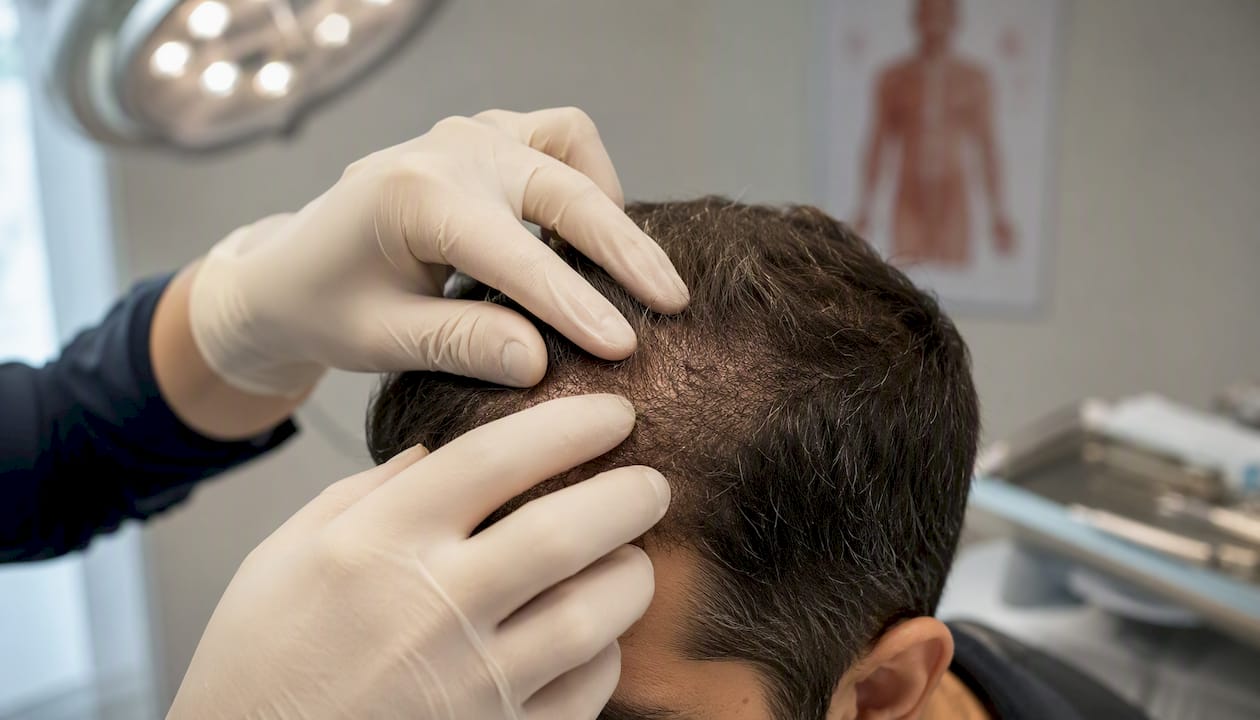
The hairline is usually the most visible and emotionally significant zone. At 12 months, most patients see a well-defined, natural-looking hairline with good density. Temples tend to respond well because the recipient area is relatively small and the grafts are placed at a consistent depth and angle by an experienced surgeon.
Mid-scalp
The mid-scalp generally reaches acceptable density by 10–12 months. Because the surface area is larger than the hairline but smaller than the crown, coverage tends to be solid and blends well with native hair on either side.
Crown and vertex
The crown is consistently the last area to reach full density. Patients commonly report that the crown can take longer than the hairline and may continue to refine after the 12-month mark, sometimes up to 18–20 months. This is partly anatomical: the crown’s circular growth pattern makes sparse areas more visible, and blood supply to the vertex can be slightly less robust than at the frontal scalp.
| Scalp zone | Typical visibility at 12 months | Notes |
|---|---|---|
| Hairline | High; natural density in most cases | Usually the first area to show clear results |
| Temples | High; good coverage in most patients | Small area; responds well to precise placement |
| Mid-scalp | High; blends well with native hair | Larger area; consistent thickening by month 10–12 |
| Crown/vertex | Moderate; may still be refining | Can continue maturing to 18–20 months |
- Density at the hairline is often judged against the finest detail: individual hair direction, angle, and spacing. A skilled surgeon plans this zone meticulously.
- Crown density is harder to assess from photos alone because the circular pattern means light hits it differently at every angle.
- Donor area recovery should be complete at 12 months with no visible scarring in standard FUE cases.
What factors determine how your hair looks at 12 months?
Results at 12 months reflect a combination of surgical decisions, biological variables, and patient behaviour. Some factors are fixed before you ever enter the clinic; others are within your control.
Non-modifiable factors:
- Donor density and quality. The number of healthy follicular units available in the donor zone sets a ceiling on what is achievable. Fine, sparse donor hair produces a different result than coarse, dense donor hair, even with identical technique.
- Norwood stage and recipient area size. Higher Norwood stages often need larger graft counts and larger treated areas, which can make perceived progress slower even when grafts follow a normal biological timetable.
- Age and hair cycle variability. Younger patients may still be experiencing active hair loss alongside transplanted growth, which can affect the overall appearance at 12 months.
Surgical factors:
- Technique: FUE versus DHI. Both are established methods, but DHI allows more precise angle and depth control during implantation, which can improve density in smaller zones. The choice depends on the area being treated and the surgeon’s assessment.
- Surgeon skill and graft handling. Graft survival rates depend heavily on how follicles are extracted, stored, and implanted. Time out of the body, temperature, and handling technique all affect viability.
Patient-modifiable factors:
- Smoking. Smoking reduces blood flow to the scalp and is consistently associated with poorer graft survival and slower healing.
- Medications. Finasteride and minoxidil are commonly recommended alongside transplantation to protect native hair; stopping them without clinical advice can affect overall density.
- Nutrition. Adequate protein, iron, zinc, and biotin support the hair growth cycle. Deficiencies can delay or reduce regrowth.
- Aftercare adherence. Following the clinic’s post-operative instructions, including sleep position, washing technique, and sun avoidance, directly affects graft survival in the first two weeks.
- Adjuvant therapies. PRP (platelet-rich plasma) treatment is used by many clinics to support graft recovery and stimulate the growth phase; evidence for its benefit as an adjunct is growing.
Finasteride is FDA-indicated for men only. Women who are or may become pregnant must not handle crushed or broken finasteride tablets, due to the risk of harm to a male fetus. It can also cause sexual side effects (reduced libido, erectile dysfunction) in a minority of men, which usually resolve after stopping treatment. Discuss these risks with a physician before starting.
Pro Tip: If you are taking any medication that affects hair growth or blood pressure, tell your surgeon before the procedure, not after. Some medications need to be paused or adjusted around surgery, and others should be continued throughout recovery.
What should you do if density still looks low at 12 months?
Low density at 12 months is not automatically a sign that something has gone wrong. Several common explanations account for slower-than-expected progress, and most do not require revision surgery.
Common reasons for lower density at 12 months:
- Slow individual hair growth rate (some patients simply take longer to reach full maturity)
- Large recipient area relative to graft count, meaning density per cm² was always going to be moderate
- Shock loss of native hair that has not yet fully recovered
- Medication effects, particularly if finasteride or minoxidil was stopped during recovery
- Crown location, which matures later than other zones in most patients
Red flags that should prompt a clinic review:
- No visible new growth at all by month 12
- Persistent scalp inflammation, redness, or tenderness
- Pain or any unresolved wound issues
- Obvious patchy areas that do not correspond to the expected crown-last pattern
Clinics commonly advise waiting a year before judging final density and offer review appointments if growth looks insufficient after that point. If you are concerned, the practical steps are straightforward:
- Self-check. Compare your monthly photographs side by side. Look for progressive improvement, even if slow, rather than a fixed end point.
- Document. Gather your pre-operative photos, your surgeon’s notes (graft count, technique, Norwood stage at baseline), and your current photos under consistent lighting.
- Book a clinic review. A review at 12 months is standard practice at reputable clinics. Bring your documentation.
- Discuss options. Depending on the assessment, options may include continued observation (if growth is still progressing), adjuvant treatments such as PRP, or planning a staged second session to increase density.
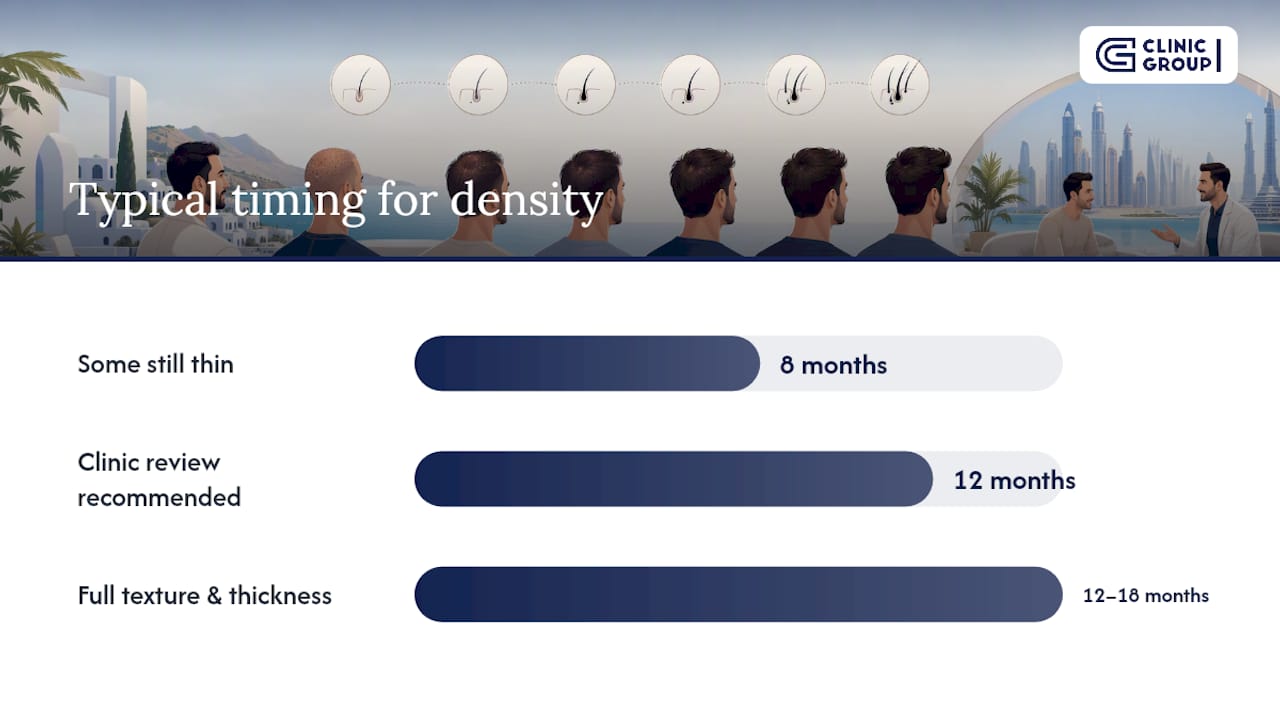
At 8 months some patients still report a thin appearance, and many do not see full texture and thickness until 12–18 months. Booking a review at 12 months rather than 8 months gives the biology time to complete its cycle before any clinical decision is made.
How do you read before-and-after galleries and verify a clinic’s images?
Before-and-after photographs are the most widely used evidence of a clinic’s results, and they are also the most easily manipulated. Knowing what to look for protects you from misleading imagery and helps you make a genuinely informed comparison.
Checklist for verifying before-and-after photos:
- Consistent lighting. Both images should be taken under the same light source and intensity. A brighter “after” photo can create the illusion of density that does not exist.
- Timestamps. Look for dated images that confirm the “after” photo was taken at 12 months or later, not at 6 months when results are still developing.
- Multiple angles. Hairline, crown, and side profiles should all be shown. A clinic that only shows the hairline front-on may be concealing crown results.
- High-resolution close-ups. Blurry or low-resolution “after” images are a warning sign.
- Donor area views. The donor zone should appear fully recovered with no visible scarring or thinning.
- Patient consent statements. Reputable clinics include a note confirming the patient consented to publication of their images.
What to look for at 12 months specifically:
- Hair texture should look similar to surrounding native hair, not uniformly fine or “pluggy”
- Hairline should appear natural, with slight irregularity rather than a perfectly straight line
- Density should blend with native hair rather than creating a visible boundary
- Crown photos should be included, not just hairline shots
When requesting images directly from a clinic, ask specifically for unedited photographs and for the clinical notes associated with each case. Any clinic confident in its results will provide both without hesitation.
How does graft count affect your 12-month timeline?
The number of grafts transplanted is one of the most discussed figures in hair restoration, but it is often misunderstood. Graft count alone does not determine how full your hair looks at 12 months; the relationship between graft count and recipient surface area is what actually matters.
A useful way to think about it: if 2,000 grafts are placed into a small hairline zone, the resulting density per cm² is high and results look full relatively quickly. Place 4,000 grafts across a large crown and mid-scalp area, and the density per cm² may be lower, even though twice as many grafts were used. The biological growth timeline for each individual graft is the same; the perceived progress is slower because the treated surface is larger.
Very large graft counts for extensive Norwood-scale cases can create the perception of slower progress for exactly this reason. The grafts are growing on schedule; the scale of the area means full coverage takes longer to become visually apparent.
| Graft count | Typical recipient area | Approximate density per cm² | Notes |
|---|---|---|---|
| 2,000 | Hairline / temples | Higher | Results often visible and satisfying by 10–12 months |
| — | Hairline + mid-scalp | Moderate | Good coverage expected by 12 months; crown may lag |
| — | Full scalp / extensive crown | Lower per zone | Staging often recommended; perceived progress slower |
Practical points about large graft counts:
- Donor management is critical. Removing too many grafts in a single session can deplete the donor zone and limit options for future sessions.
- Staged sessions, spaced 12–18 months apart, allow the first session’s results to mature before adding density in a second procedure.
- Clinics report graft numbers differently: some count individual hairs, others count follicular units (which contain 1–4 hairs each). Always confirm which unit is being quoted.
- A plan for 4,000+ grafts should include a clear staging strategy and a realistic density expectation per zone, not a promise of full coverage in a single session.
What does a hair transplant cost in the UK, and is medical tourism worth considering?
Hair transplant costs in the UK vary considerably depending on the clinic, the technique, and the graft count required. Private UK clinics typically quote between £3,000 and £15,000 for a standard FUE procedure, with larger sessions at the higher end of that range. These figures are broad estimates; actual quotes depend on individual assessment.
Albania has become a recognised European destination for hair transplantation, with board-certified surgeons, modern facilities, and European standards of care at significantly lower cost.
What is typically included in a hair transplant package:
- Pre-operative consultation (in-person or remote)
- The surgical procedure itself
- Local anaesthesia
- Basic post-operative care and medication for the immediate recovery period
- A follow-up appointment or remote review
What typically costs extra:
- Return flights and transfers
- Hotel accommodation during recovery
- Extended aftercare beyond the initial post-operative period
- Adjuvant treatments such as PRP sessions
Medical tourism checklist for UK patients:
- Verify the surgeon’s credentials and registration in their country of practice
- Confirm the clinic’s accreditation and quality standards
- Request a detailed written aftercare plan before you travel
- Arrange follow-up care with a UK-based practitioner for the recovery period at home
- Confirm what happens if complications arise after you return to the UK
- Read verified patient reviews, not just testimonials on the clinic’s own website
Pro Tip: Ask the clinic to provide a written breakdown of exactly what is and is not included in the quoted price before you commit. Unexpected costs for accommodation, transfers, or follow-up appointments can significantly change the total spend.
What questions should you ask when choosing a clinic?
Choosing the right clinic is as important as the procedure itself. A technically skilled surgeon working in a well-equipped, accredited facility produces better outcomes than the same surgeon in a poorly managed environment. These are the practical trust signals and questions that help you assess a clinic before you book.
Trust signals to verify:
- Clinician registration. In the UK, surgeons performing hair transplants should be registered with the General Medical Council (GMC). You can check any doctor’s GMC registration directly on the GMC website. For clinics abroad, verify equivalent national registration.
- Clinic accreditation. UK clinics should be registered with the Care Quality Commission (CQC). For clinics abroad, look for membership of recognised professional bodies such as the British Association of Hair Restoration Surgery (BAHRS) or equivalent European standards.
- Timestamped before-and-after galleries. Photos without dates or clinical context are not useful evidence.
- Published complication rates. Reputable clinics are transparent about their complication and revision rates.
- Verified patient reviews. Look for reviews on independent platforms rather than testimonials curated by the clinic itself.
Questions to ask at consultation:
- What is your expected graft survival rate for my case, and how do you assess donor quality?
- What technique do you recommend for my Norwood stage, and why?
- Do you offer a staged plan if my hair loss is likely to progress?
- What does your aftercare programme include, and what support is available if I have concerns after returning home?
- Who is my emergency contact if I experience complications?
How Clinicgroup supports the process:
- Clinicgroup matches patients with verified clinics in its network, including Haris Hair Medical in Tirana, where credentials, galleries, and patient reviews are published transparently.
- Travel logistics, partner hotel arrangements, and aftercare coordination are included in the support model, reducing the non-clinical risks that often concern patients considering treatment abroad.
- A medical tourism checklist is available for patients who want a structured framework for evaluating their options before booking.
Clinicgroup’s perspective on realistic expectations and patient support
At Clinicgroup, we work with patients who have often spent months researching before they contact us. The most common concern we hear is not about the surgery itself; it is about whether the results will actually look natural, and whether the clinic they choose will still be available to help them six or twelve months later.
That concern is legitimate. Hair transplantation is a long-cycle procedure. The surgery takes a day; the results take a year. A clinic that is genuinely invested in your outcome will have a structured aftercare plan, a clear review process at 12 months, and a transparent approach to discussing what happens if density is lower than expected.
What we do not do is make outcome guarantees. No reputable clinic does. What we can offer is a verified network of board-certified specialists, transparent pricing, and a support structure that covers the full patient pathway, from initial consultation through to post-operative follow-up. For UK patients considering treatment in Albania or Dubai, that means clinic matching, travel logistics, partner hotels, and a point of contact throughout recovery.
Realistic expectations, documented aftercare, and a verified surgeon are the three things that most consistently separate a positive experience from a difficult one. We build our service around all three.
Clinicgroup hair transplant services for UK patients
For UK patients weighing up hair transplant options, the cost difference between domestic private clinics and verified clinics abroad is substantial. Clinicgroup connects you with board-certified hair transplant specialists in Albania and Dubai, with packages that include clinic matching, transparent pricing, travel logistics, partner hotel arrangements, and aftercare coordination from start to finish.
There is no obligation at the enquiry stage. You receive a personalised consultation, a clear breakdown of what is included in your quote, and the time to ask every question on your list before committing to anything. Clinicgroup’s verified partner clinics publish their surgeon credentials, timestamped patient galleries, and complication rates openly, so you can assess the evidence before you travel.
To find out what a hair transplant through Clinicgroup would involve for your specific case, request a no-obligation consultation today. The process starts with a brief online enquiry, and a patient coordinator will be in touch to discuss your options and arrange a remote assessment with a specialist.
Sources
The following resources were used in preparing this article. Bringing relevant sources or your own monthly photographs to a clinic review appointment helps your surgeon assess your progress accurately.
- Hair transplant timeline (Day 1 to 12 months) - Smile Hair Clinic
- Hair transplant recovery | American Society of Plastic Surgeons
- Myhairline
This article is general information, not a substitute for advice from a qualified doctor. Consult a qualified healthcare professional about your own circumstances before acting on anything here.
FAQ
Is it normal for hair to still look thin 12 months after a transplant?
Yes, particularly in the crown. Clinics advise waiting a full year before judging final density, and the crown can continue maturing up to 18–20 months post-procedure. If there is progressive improvement across all zones, the result is likely still developing normally.
What do typical hair transplant results look like at 4 months?
At 4 months, most patients see early, fine sprouting across the transplanted area, but coverage is still sparse and uneven. New graft growth typically becomes visible around month 3, with meaningful thickening not usually apparent until months 6–9.
How long does it take for 4,000 grafts to grow?
The biological growth timeline for each graft is the same regardless of count, with near-final results typically visible by months 10–12. However, larger graft counts covering extensive areas can make perceived progress feel slower because the treated surface is larger; full coverage across all zones may take closer to 18 months.
What are the most common complications in the first 12 months?
Shock loss in weeks 2–8 is the most common concern and is a normal part of recovery. Other issues include temporary scalp sensitivity, minor swelling, and occasional folliculitis (small pimples around graft sites). Persistent inflammation, pain, or complete absence of growth by month 12 warrant a clinical review.
How do I verify that a clinic’s before-and-after photos are genuine?
Check for consistent lighting, dated timestamps, multiple angles including the crown and donor area, and high-resolution images. Ask the clinic for the graft count, technique, and baseline Norwood stage for any case shown. A clinic that cannot provide this clinical context alongside its photographs is one to approach with caution.