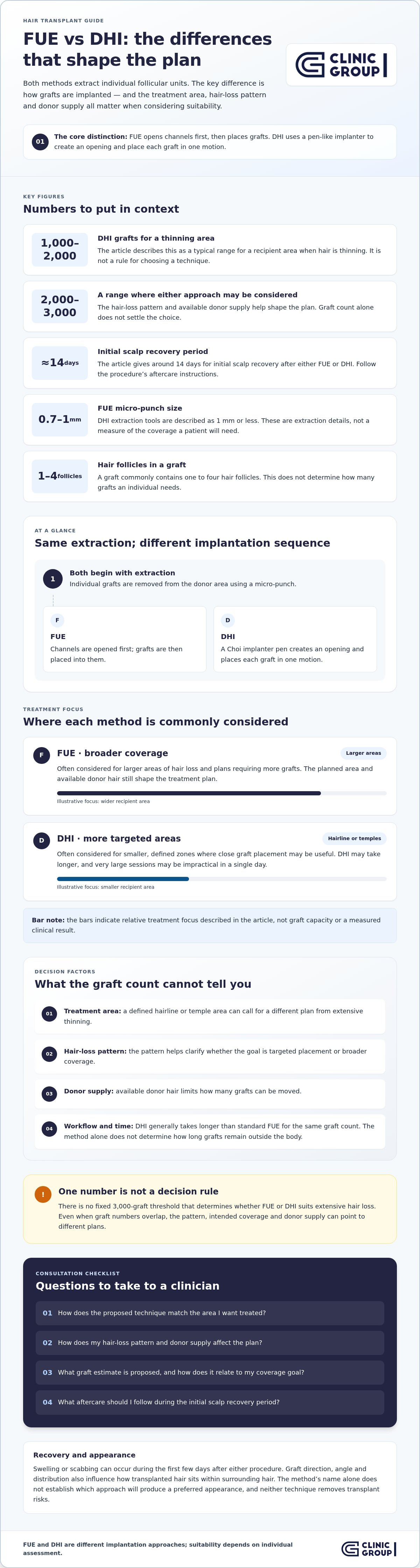
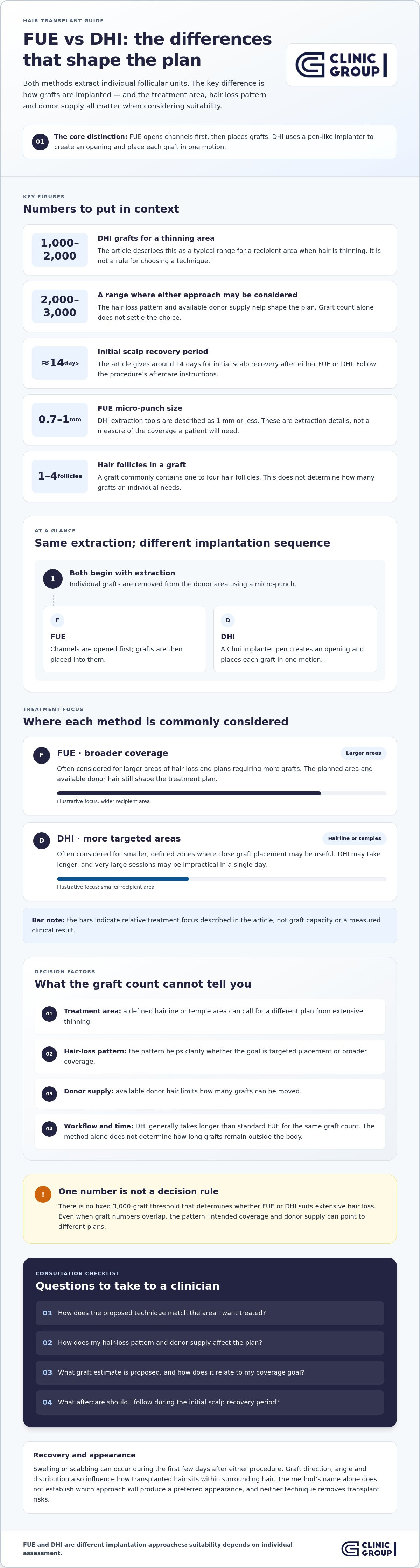
An advanced-sounding technique isn’t automatically the better choice. FUE and DHI both involve extracting individual follicular units, but differ in how grafts are implanted. With FUE, channels are opened before grafts are placed; DHI uses a pen-like implanter to create the opening and place each graft in one motion. The right choice in a DHI vs FUE comparison depends on the treatment area, hair-loss pattern and donor supply, not the method’s name alone.
It’s understandable to focus on the technique when comparing how each procedure works and what recovery involves. But the treatment area, pattern of hair loss and available donor hair also matter when weighing suitability.
This guide explains the differences in extraction and implantation, and how each approach may suit different hair-loss patterns and donor reserves. It also outlines practical points to consider before discussing a hair transplant with a qualified clinician.
Key Takeaways
- Understand how graft extraction and implantation differ before comparing the procedures.
- Relate your treatment goals to the hair-loss pattern and available donor supply.
- Consider the planned graft number alongside the time and coverage involved.
- Prepare focused questions about your treatment plan for a clinical consultation.
- Explore Clinic Group’s Hair Transplant Referrals when considering treatment options through its directory.
FUE vs DHI - What’s the Main Difference ?
In a DHI vs FUE comparison, the main difference is how grafts enter the recipient area. FUE creates small channels first, then places grafts into them. DHI, or direct hair implantation, uses a pen-like tool to make an opening and place each graft in one motion. Both methods move individual follicular units from donor areas into areas affected by hair loss.
Both procedures involve small scalp openings, and swelling or scabbing can occur during the first few days. Neither technique removes the risks associated with a hair transplant. Assessment and aftercare matter whichever method is chosen, and implantation must suit the intended treatment area.
The treatment area helps clarify suitability. DHI is often considered for smaller, targeted zones, such as a thinning hairline or temples, where close graft placement may be useful. A recipient area of 1,000-2,000 grafts is described as a typical range for DHI when hair is thinning. FUE is often considered for larger areas requiring more grafts.
| Option | Implantation method | Common treatment focus | Practical consideration |
|---|---|---|---|
| FUE | Channels are made before grafts are placed | Larger areas of hair loss | Can suit broader coverage needs |
| DHI | A pen creates an opening and places each graft | Smaller, targeted areas, including hairlines and temples | May take longer; very large sessions may be impractical in a single day |
Graft numbers are not a universal rule for choosing a method. There is no fixed 3,000-graft threshold that determines whether FUE or DHI suits extensive hair loss. Areas needing 2,000-3,000 grafts may be considered for more than one approach, depending on the pattern and donor supply. The number alone doesn’t settle the choice.
DHI may suit younger patients with less advanced hair loss, particularly when the plan focuses on a defined area rather than broad coverage. For example, someone seeking temple filling may discuss DHI, while someone with extensive thinning may need an approach suited to a wider recipient area. Age alone doesn’t determine the right technique.
The initial scalp recovery period after FUE or DHI hair transplantation is around 14 days. During this time, patients should follow the aftercare instructions for their procedure. Recovery planning should also account for early scalp changes, including swelling and scabbing during the first few days. As experienced aesthetic providers like Arden Clinic emphasise across skin and cosmetic treatments, structured aftercare is vital to protect delicate tissue during healing.
For a side-by-side overview, the FUE and DHI comparison guide can help you prepare questions for a consultation. Ask how the proposed technique relates to your coverage goal, graft estimate and donor supply.
Choose a technique by matching the planned coverage, graft requirement and available donor hair to the implantation process, rather than relying on a single graft-count cut-off. A defined hairline, temple area and extensive thinning can call for different plans, even when comparing the same techniques.
How FUE graft extraction and implantation work
Both methods begin with follicular unit extraction: individual grafts are removed from the donor area using a micro-punch. Their main procedural difference comes later, during implantation into the recipient area.
For graft numbers and treatment areas, DHI is commonly associated with targeted work and fewer grafts per session. FUE can accommodate broader coverage, although the planned area and available donor hair also shape the treatment plan.
DHI Graft Implantation
In DHI, extracted grafts are loaded into a Choi implanter pen. The clinician uses the pen to create a small opening and place each graft in one motion. This combines channel creation and implantation rather than separating them into two passes. The pen’s direction and angle help guide placement in the recipient area.
Standard FUE uses a separate implantation sequence: channels are opened first, then grafts are placed manually. Both approaches require careful positioning to follow the intended growth direction. The difference is the instrument and sequence, not the donor extraction method.
Graft Handling and Time Outside the Body
FUE and DHI both remove grafts individually, so extraction and implantation are distinct stages, even when DHI combines opening and placement. After extraction, grafts must be handled before implantation; the time between these steps is part of the procedure’s workflow.
The graft count, extraction pace and implantation method affect how the team organises the workflow. DHI generally takes longer than standard FUE for the same graft count, so session planning matters. The method alone does not determine how long each graft remains outside the body.
Graft Numbers and Treatment Areas
FUE micro-punches measure 0.7 to 1 mm, while DHI extraction tools are described as 1 mm or less. A graft commonly contains one to four hair follicles. These details describe extraction; they don’t determine how many grafts a patient needs or how much coverage those grafts can provide.
DHI can suit smaller recipient areas where close placement is planned. It tends to move fewer grafts per session, while FUE is often used for larger treatment areas. There is no universal graft-count cut-off that selects one technique for every patient.
Visible appearance depends on more than the implantation device. Graft direction, angle and distribution all influence how transplanted hair sits within the surrounding hair. Extensive clinical research establishing that DHI produces superior aesthetic results or graft survival over FUE is lacking. The technique’s name alone therefore cannot establish which method will produce the preferred appearance.
DHI’s limited graft capacity can make it less suited to severe hair loss requiring broad coverage. FUE may be considered where the recipient area is larger, but donor supply still limits how many grafts can be moved. Hair restoration planning must balance coverage against the available donor area, rather than treating graft capacity as a promise of density.
To explore treatment pathways and clinic options, browse hair transplant information and clinic options.
Choosing a technique based on hair-loss pattern and donor supply
Technique choice depends on the shape of the thinning area, the coverage sought and the available donor hair. A useful assessment considers the recipient area and donor reserve separately before comparing methods.
Technique Choice by Hair-Loss Pattern
A hair-loss pattern shows whether thinning is concentrated or spread across a wider area. A defined area can suit focused implantation, whilst broader loss requires a plan for coverage across more of the scalp. DHI allows closer graft placement in targeted areas, which may matter when the goal is density in a specific zone.
For a fue hair transplant, the number and distribution of grafts must relate to the affected area. A pattern that continues to expand also shapes the restoration plan: the clinician assesses current thinning alongside its overall distribution, rather than designing around just one visible patch.
Hair Density and Natural-Looking Results
Density describes how closely grafts are placed in the recipient area. DHI can support closer placement in targeted zones, while overall appearance also depends on graft direction and distribution. A natural-looking result is planned around how transplanted hairs sit beside existing hair, not simply the total number of grafts.
For example, a small area requiring concentrated coverage raises different planning questions from diffuse thinning across a larger area. The intended density must be considered alongside the donor reserve, so a request for more coverage does not obscure the limits of available hair.
FUE Candidacy and Donor Hair
Donor supply is the hair available for extraction, usually assessed separately from the thinning recipient area. FUE may not be suitable when donor hair is insufficient, because the method depends on removing individual follicular units from that area. The assessment therefore considers both the condition of the donor region and the coverage sought.
Patients should consider donor reserve a finite part of the treatment plan, rather than an unlimited source for adding density. A medical assessment weighs the pattern of loss, donor area and intended graft distribution together. These factors help establish whether FUE, DHI or another plan fits the treatment goals.
Regrowth takes time after either method. New hairs usually begin to appear around four months after a transplant, with visible improvement typically starting around six months. More substantial growth develops over time, and full results generally take 10 to 18 months. These stages help patients distinguish early recovery from the later appearance of transplanted hair.
When comparing methods, map the thinning area, define the desired coverage and assess donor supply before selecting a technique. This sequence keeps treatment goals and available grafts in view together.
DHI and FUE costs
In the UK, a hair-transplant quote is shaped by graft numbers, clinic location and individual treatment requirements. DHI and FUE differ in their implantation process, but the technique alone doesn’t determine the final quoted amount.
FUE, FUT and DHI Cost Comparison
FUE and DHI both use individual follicular units, while FUT removes a strip of scalp for graft preparation. The method affects the procedure’s steps: DHI uses an implanter pen and can take longer than standard FUE for the same graft count. These differences influence how a clinic plans treatment, alongside the recipient area and work required.
Graft count is a key factor in a quote, as clinics commonly base charges on the number transplanted. A hairline requiring targeted placement differs from a larger recipient area needing broader coverage. The planned extraction and implantation process also matters, so comparing techniques without comparing the proposed treatment scope can be misleading.
Costs and Financing
A written treatment plan should set out the proposed method, graft count and recipient area. These details make it easier to understand what the quote covers and how the clinician’s plan relates to the hair-loss pattern. For example, focused hairline restoration and broader crown coverage involve different treatment requirements.
Financing arrangements vary, and Clinic Group does not provide in-house patient financing. Before committing, read the written terms for any payment arrangement carefully, including its schedule and conditions. Keep the procedure plan and payment terms together so you can compare the quoted treatment accurately with the care proposed.
UK DHI and FUE Transplant Costs
UK quotes can vary with clinic location and patient-specific requirements. DHI may involve specialised tools and a longer procedure, whilst FUE charges are commonly linked to graft numbers. A larger graft count can affect the treatment plan whichever technique is used, so the proposed number should correspond to the recipient area being treated.
For a useful comparison, set out the same details for each proposed method: graft count, treatment area, extraction approach and implantation method. Then compare what each written quote includes, rather than relying on the technique label alone. This helps distinguish a change in method from a change in the amount of work planned.
FUT, FUE and DHI cannot be compared on technique names alone. Graft count, hair-loss pattern, donor supply and implantation steps all shape the proposed plan. A written quote that identifies these elements gives patients a clearer basis for reviewing treatment options, without assuming one method always costs less.
Choosing a technique based on treatment area and donor reserve
A useful starting point is the relationship between the recipient area and the donor area. A hair transplant moves finite grafts, so the technique must fit both the coverage sought and the hair available for extraction.
Use these steps to compare a proposed plan:
- Map the recipient area, such as the hairline, temples or crown.
- Estimate the grafts needed to address that area and the intended density.
- Assess the donor area and how much hair can be extracted.
- Match the planned coverage with FUE or DHI implantation.
These steps prevent a single graft number from deciding the method. There is no universal 3,000-graft threshold for choosing FUE or DHI in extensive hair loss. The distribution of thinning and the donor reserve matter alongside the planned graft count.
A smaller, defined recipient area may suit DHI when precise placement is central to the plan. DHI can place grafts closely in targeted areas, such as the hairline or temples. For example, a patient seeking focused temple filling has a different coverage goal from someone addressing thinning across a broad scalp area.
FUE may be considered for larger recipient areas, particularly where the plan involves broader coverage. Yet a wide treatment area does not mean the donor area can supply every requested graft. The available reserve sets a practical limit, and distribution must account for current thinning and the intended result.
Areas requiring 2,000-3,000 grafts may be considered for either FUE or another approach, depending on individual planning. That range should not be treated as a rule that automatically selects a technique. A hairline, crown and diffuse thinning pattern can each use grafts differently, even where the estimated count is similar.
For a larger plan, such as 4,000-5,000 grafts, donor thickness becomes especially relevant. A combination of techniques may be considered when the donor area is not very thick, but the figure alone cannot establish suitability. The essential question is whether the donor supply supports the intended recipient coverage.
Precision also means preserving a coherent distribution, rather than concentrating grafts in one visible zone without considering the wider pattern. A plan focused on the front hairline, for example, should be considered alongside thinning elsewhere. This helps patients understand how graft allocation affects coverage across the treatment area.
Compare clinics’ proposed plans by checking whether each identifies the recipient zones, estimated graft allocation and donor-area limits. The clearest hair transplant method is the one whose planned coverage and extraction strategy match those details, not simply the method with the largest stated graft count.
Clinic Group: Dental Treatment Directory
Clinic Group’s Hair Transplant Referrals can help you explore partner clinics after comparing FUE and DHI. The directory is a useful next step when you want to review treatment options in the context of your hair-loss pattern, donor supply and preferred location.
Clinic Group connects patients with partner clinics rather than carrying out hair-transplant procedures. Its clinic network includes a range of international partner locations suited to UK patients seeking treatment abroad. A consultation with a treating clinic can assess your scalp and discuss a suitable plan, including the proposed technique and graft distribution.
For broader treatment research, Clinic Group’s Medical Tourism Treatment Guides offer information to support informed decisions. Explore the directory at your own pace, then visit Clinic Group online to learn more.
Take your next step with a clear plan
Use your comparison to prepare for a focused discussion about treatment goals, rather than choosing a method by its name alone. For a DHI-versus-FUE decision, describe the areas you want treated and the outcome you hope to achieve. An in-person assessment can then consider your hair-loss pattern, donor supply and the practical demands of the proposed procedure.
Clinic Group’s Hair Transplant Referrals can help you explore partner-clinic options as you move from research towards a consultation. The treating clinician can discuss the proposed technique, graft plan and aftercare with you, helping you make an informed decision based on your circumstances.
Preparing your questions can make the next conversation more useful. Review the referral options and decide whether you’re ready to take that step.
A considered decision starts with clear information and a plan that reflects your priorities. Move forward at a pace that feels right for you. If you are also exploring broader aesthetic and wellness treatments, such as skin rejuvenation or body contouring, you might find AgeRefine Clinic a useful example of modern non-invasive care.
Frequently Asked Questions
FUE or DHI: which hair transplant method is better?
Neither method is better for every patient; the suitable choice depends on treatment goals and donor supply. Someone prioritising focused work around the temples may discuss DHI, while broader coverage may lead to a discussion of FUE. Compare the proposed graft distribution and recipient areas, not just the procedure name. A clinical assessment can also consider the pattern and progression of hair loss.
What affects the cost of DHI versus FUE?
Graft count, clinic location and the work required for treatment affect a quote. The recipient area matters too: a small hairline adjustment and wider coverage involve different plans. DHI may take longer than standard FUE for the same graft count, which can affect procedure planning. Compare written quotes that describe the same treatment area and graft plan; otherwise, they may reflect different work.
How does FUE work?
FUE removes individual follicular units from the donor area, usually at the back of the scalp, using a small punch. The grafts are then prepared for placement in the recipient area. The clinical team creates channels before inserting the grafts, controlling their position and direction. A practical question for a consultation is how the proposed graft distribution will address your specific thinning pattern.
How long is FUE recovery?
Scalp recovery develops over the days after FUE, and scabbing is part of the early healing process. Scabs may begin flaking five to seven days after the procedure and are generally gone by ten to twelve days. Plan work and social commitments around these visible changes, and follow the treating clinic’s aftercare instructions. The timing of your return to normal activities can depend on your recovery and the guidance provided.
Who may be a candidate for DHI or FUE?
Suitability relates to the hair-loss pattern, donor supply and area needing coverage. DHI is commonly considered for targeted work, such as filling the temples, while FUE may suit broader areas. DHI is also described as an option for younger people with less advanced hair loss. Age alone doesn’t determine candidacy; donor hair and treatment goals remain important parts of the assessment.
Which technique is right for you?
The suitable technique is the one that fits your recipient area and donor reserve. Before deciding, note where thinning is most visible, what coverage you want and whether hair loss affects one zone or several. Then discuss how grafts would be allocated and what the proposed plan involves. This gives a consultation a clear focus beyond choosing a procedure name.
Is DHI or FUE better for hair density?
Neither technique guarantees greater density. DHI can allow closer graft placement in targeted areas, while overall appearance also relies on how grafts are distributed. For instance, concentrating grafts at the front hairline may leave fewer available for another thinning zone. Ask how the plan balances density across the recipient area with the donor hair available and the coverage you want.
What affects thickness after a DHI or FUE transplant?
Perceived thickness reflects graft distribution, the area treated and the hair available for transplantation. A plan may prioritise a visible hairline or spread grafts across wider thinning; these choices create different coverage patterns. New hair growth takes time to develop, so early appearance isn’t the final measure. Discuss the intended distribution and expected growth stages during your clinical consultation.

Article by
Clinic Group Editorial Team
The Clinic Group editorial team publishes clear, practical guides for UK and EU patients researching medical travel — from dental implants and hair transplants to plastic surgery and eye care — with a focus on verified clinics, transparent “from” pricing, and safe planning.
Disclaimer
This article is for general information only and is not medical advice, diagnosis, or a substitute for an in-person consultation with a qualified clinician. Treatment suitability, risks, timelines, and costs vary by individual. Clinic Group connects patients with independent clinics; those clinics are responsible for clinical care. Always verify credentials, obtain a written treatment plan and itemised quote, and confirm aftercare arrangements and travel insurance cover (elective procedures are often excluded) before booking. Outcomes cannot be guaranteed.