TL;DR:
- Hospitality in healthcare emphasizes relational, patient-centered care that fosters trust and improves clinical outcomes. Implementing simple protocols like the 10-5 rule and bedside sitting enhances patient experiences and reduces readmissions. Genuine hospitality focuses on emotional safety and communication, not luxury amenities, benefiting both staff and patients across organizations.
Hospitality in healthcare is defined as a relational, place-based approach to patient care that prioritises acceptance, respect, and a welcoming attitude as core clinical values, not optional extras. Research published in Health Services Research confirms that healthcare hospitality directly correlates with patient trust and treatment adherence. Organisations including MillerKnoll, EHL (Ecole hôtelière de Lausanne), and University Hospitals in the United States have each demonstrated that when patients feel genuinely welcomed, clinical outcomes measurably improve. For healthcare professionals and policy makers, understanding what hospitality in healthcare means is the foundation for building systems where patients not only receive treatment but feel supported throughout every stage of their care.
How does hospitality improve patient trust and treatment adherence?
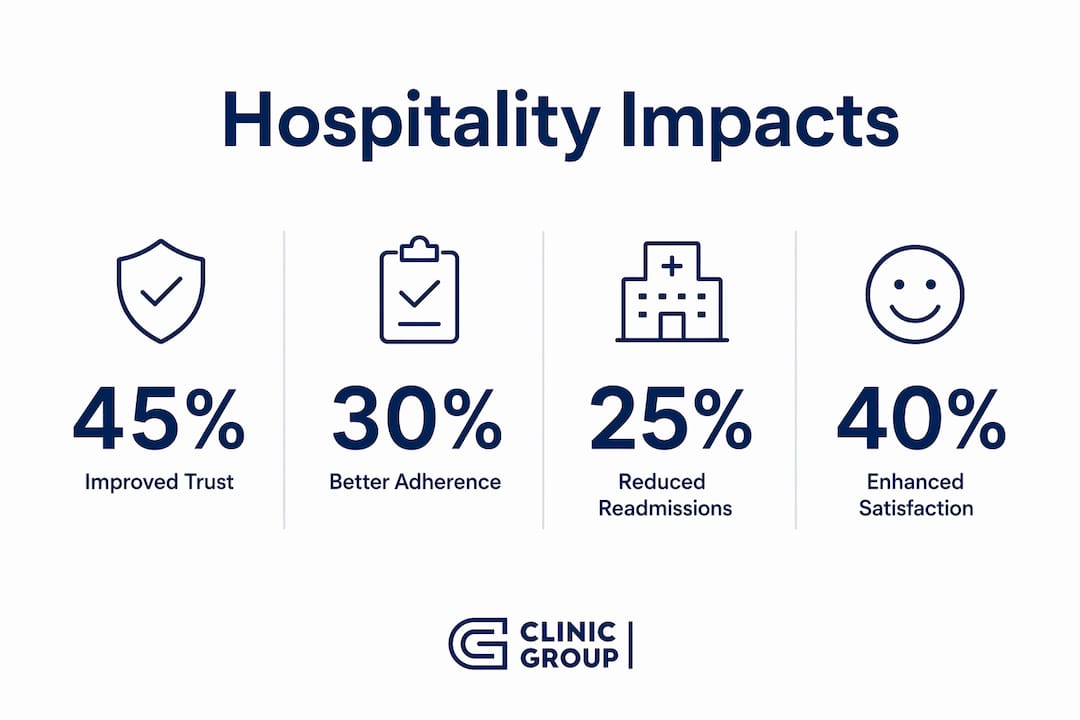
Hospitality in healthcare is not a soft concept. It produces hard clinical results. An analysis of more than 4,500 US hospitals found that institutions with higher staff responsiveness scores had significantly lower 30-day readmission rates. Lower readmission rates reduce costs, ease pressure on clinical teams, and reflect better patient outcomes across the board.
The mechanism behind this is relational. When patients feel accepted and respected, they are more likely to communicate openly with clinicians, follow prescribed treatments, and return for follow-up appointments. Research published in 2025 defines healthcare hospitality as acceptance, respect, and a welcoming attitude, each of which directly supports the trust a patient needs to engage fully with their care.
“Patients treated in environments where they feel welcomed and supported exhibit improved psychological comfort and life satisfaction.” — Cross-sector hospitality-healthcare research, 2025.
The psychological dimension matters as much as the clinical one. A patient who feels anxious, dismissed, or confused is less likely to adhere to medication schedules or attend follow-up consultations. Hospitality addresses these barriers before they become clinical problems.
The core relational benefits of hospitality in healthcare include:
- Increased patient trust, leading to more honest symptom reporting and better diagnostic accuracy
- Improved treatment adherence, reducing the risk of complications and readmission
- Greater patient autonomy, as welcomed patients feel more confident asking questions and participating in decisions
- Stronger provider-patient relationships, which support continuity of care over time
Understanding the role of quality assurance in clinics alongside hospitality principles gives healthcare teams a fuller picture of what drives positive patient outcomes.
What practical hospitality protocols enhance healthcare experiences?
Translating hospitality principles into daily clinical practice requires specific, repeatable behaviours. The most widely adopted framework is the 10-5 rule, implemented by leading US health systems including University Hospitals. The rule is straightforward: at 10 feet, make eye contact and acknowledge the patient; at 5 feet, offer a verbal greeting. This single protocol reduces patient anxiety before a word of clinical information is exchanged.

Bedside sitting is a second high-impact protocol. When physicians sit at the bedside rather than standing, patients consistently perceive the consultation as longer and more attentive, even when the actual time is identical. This perception of attentiveness improves trust and patient retention without requiring additional clinical time.
Here is a practical sequence for implementing hospitality micro-interactions across a patient visit:
- Acknowledge on arrival. Greet the patient by name within 30 seconds of their entering the clinical space.
- Apply the 10-5 rule. Train all staff, not just clinicians, to make eye contact and greet patients in corridors and waiting areas.
- Sit at the bedside. During consultations, physicians should sit at eye level to signal presence and attentiveness.
- Narrate the process. Explain each step of a procedure or assessment before it happens. Uncertainty is a primary driver of patient anxiety.
- Close with a clear next step. End every interaction by confirming what happens next, who will contact the patient, and when.
- Follow up proactively. A brief post-appointment check-in, whether by phone or message, signals that care extends beyond the clinical encounter.
These protocols are not complex. Their power lies in consistency. When every member of a clinical team applies them, the cumulative effect on patient experience is significant.
Pro Tip: Train administrative and reception staff in the same hospitality protocols as clinical staff. Patients form their first impressions at the front desk, not in the consultation room. Consistent behaviour across every touchpoint is what separates a genuinely hospitable environment from one that is merely pleasant in patches.
A well-designed aftercare checklist for patients extends these hospitality principles beyond the clinical visit, reinforcing trust and continuity at every stage of recovery.
How does healthcare hospitality differ from hotel-style luxury amenities?
The most common misconception about hospitality in healthcare is that it means premium décor, gourmet food, or concierge services. These features may improve comfort, but they are not hospitality. MillerKnoll’s research is direct on this point: true hospitality is relational and cultural, centred on meeting fundamental human needs rather than providing luxury extras.
The distinction matters for policy makers and clinical leaders because it changes where investment should go. A hospital that spends its budget on marble lobbies while neglecting staff communication training has misunderstood the concept entirely.
A more accurate model draws from hotel guest management, but applies it relationally. Successful hospitality programmes capture patient non-clinical preferences in the same way hotels store guest preferences, including preferred room temperature, dietary requirements, and communication style. The goal is personalisation that makes patients feel known, not pampered.
| Feature | Hotel-Style Luxury | Relational Healthcare Hospitality |
|---|---|---|
| Focus | Physical comfort and aesthetics | Emotional safety and trust |
| Primary tool | Upgraded facilities and amenities | Staff behaviour and communication |
| Measurement | Guest satisfaction scores | Patient trust, adherence, and readmission rates |
| Investment priority | Environment and décor | Training, protocols, and preference systems |
| Patient role | Passive recipient of comfort | Active partner in care decisions |
The risk of conflating luxury with hospitality is real. Organisations that treat hospitality as a facilities upgrade miss the relational core entirely. The result is a pleasant environment in which patients still feel unheard, uninformed, and anxious. Relational hospitality addresses the experience of being cared for, not just the setting in which care occurs.
For patients considering treatment abroad, understanding the difference between all-inclusive healthcare and genuine relational care is equally important when selecting a provider.
What organisational benefits arise from integrating hospitality principles?
Hospitality in healthcare benefits staff as directly as it benefits patients. EHL research confirms that hospitality improves employee satisfaction and creates a reinforcing cycle in which better staff morale leads to higher-quality patient care, which in turn sustains staff motivation. This is not a theoretical loop. It is a measurable operational dynamic.
The mechanism is cognitive load reduction. When clinical teams operate within clear hospitality protocols, they spend less mental energy deciding how to interact with patients in ambiguous or emotionally charged situations. MillerKnoll’s analysis found that hospitals applying hospitality behaviours reduce cognitive load on staff, freeing attention for clinical decision-making rather than interpersonal management.
The organisational benefits of embedding hospitality principles include:
- Reduced staff burnout, as structured relational protocols replace ad hoc emotional labour
- Higher employee retention, since staff in hospitable environments report greater job satisfaction and purpose
- Improved team communication, as hospitality norms create shared expectations for respectful, clear interaction
- Stronger competitive positioning, as patient satisfaction scores influence referrals, reputation, and commissioning decisions
- Lower operational costs, driven by reduced readmissions and fewer complaints requiring administrative resolution
Pro Tip: Frame hospitality training as a clinical competency, not a customer service add-on. When staff understand that relational skills directly affect patient outcomes and their own workload, adoption rates increase significantly. Linking hospitality to clinical evidence is the most effective way to secure buy-in from sceptical clinical teams.
Organisations that support staff wellbeing through structured hospitality frameworks also tend to see improvements in the quality of wellness programmes they offer, as staff model the same values they extend to patients.
How can policy makers and professionals implement hospitality effectively?
Implementing hospitality across a healthcare organisation requires deliberate leadership, not just goodwill. Dr Cliff Megerian and the University Hospitals system have demonstrated that strategic hospitality protocols increase patient engagement, compliance, and competitive advantage when applied consistently across a 21-hospital network. Scale is achievable, but it requires a structured approach.
The following priorities guide effective implementation:
- Establish leadership commitment first. Hospitality culture starts with senior clinical and administrative leaders modelling the behaviours they expect from staff.
- Standardise micro-interaction protocols. Define specific, observable behaviours such as the 10-5 rule, bedside sitting, and proactive follow-up, then train all staff regardless of role.
- Invest in preference management technology. Digital tools and standardised micro-interactions borrowed from the hospitality industry can enhance healthcare delivery without adding burden to staff.
- Measure relational outcomes alongside clinical ones. Track patient trust scores, communication ratings, and adherence rates as formal performance indicators.
- Balance clinical priorities with relational care. Hospitality protocols must be designed to fit within clinical workflows, not compete with them.
| Implementation Area | Recommended Action | Expected Outcome |
|---|---|---|
| Leadership | Model hospitality behaviours at senior level | Cultural adoption across teams |
| Staff training | Standardise micro-interaction protocols | Consistent patient experience |
| Technology | Deploy patient preference management systems | Personalised, efficient care |
| Measurement | Track trust and adherence alongside clinical KPIs | Evidence base for continued investment |
| Policy | Embed hospitality in accreditation and quality frameworks | Systemic, sustainable change |
Effective patient retention strategies, such as those outlined in proven patient retention approaches, confirm that relational consistency is the single strongest predictor of whether patients return to and recommend a provider. Policy makers who embed hospitality into quality frameworks create the conditions for this consistency to scale.
For patients navigating international care options, understanding medical tourism accreditation helps identify which providers have embedded these standards into their operational model.
Key takeaways
Hospitality in healthcare is a relational, evidence-backed approach that improves patient trust, reduces readmissions, and strengthens staff wellbeing when embedded consistently across clinical workflows and organisational culture.
| Point | Details |
|---|---|
| Hospitality is relational, not decorative | Acceptance, respect, and welcoming behaviour drive clinical outcomes, not upgraded facilities. |
| Micro-interactions produce measurable results | The 10-5 rule and bedside sitting improve trust and patient retention without adding clinical time. |
| Lower readmissions follow higher responsiveness | Analysis of 4,500+ US hospitals links staff responsiveness scores to significantly lower 30-day readmission rates. |
| Staff benefit as much as patients | Structured hospitality protocols reduce cognitive load, improve morale, and create a reinforcing cycle of better care. |
| Implementation requires leadership and systems | Sustainable hospitality culture depends on senior modelling, standardised protocols, and preference management technology. |
Why hospitality in healthcare is no longer optional
From Clinicgroup’s perspective, the shift towards relational hospitality in healthcare is one of the most significant changes in how quality care is defined and delivered. For years, the conversation focused almost entirely on clinical outcomes: survival rates, complication rates, procedure accuracy. Those metrics remain critical. What has changed is the recognition that how a patient feels during their care directly affects those clinical results.
The misconception that hospitality is a luxury concern still persists in some quarters, and it is worth addressing directly. Clinicgroup works with verified clinics across Europe and the Middle East, and the providers who consistently receive the strongest patient feedback are not necessarily those with the most impressive facilities. They are the ones where staff communicate clearly, where patients feel informed and respected, and where the experience of being cared for matches the quality of the clinical work itself.
Hospitality is now a strategic necessity for any provider operating in a competitive, consumer-aware environment. Patients have more information and more choice than at any previous point. They read reviews, compare experiences, and share their stories. A provider that delivers excellent clinical outcomes within a cold or dismissive environment will lose patients to one that delivers comparable outcomes with genuine warmth and attentiveness.
The practical implication for policy makers is clear. Embedding hospitality standards into accreditation frameworks, commissioning criteria, and staff development programmes is not a cultural aspiration. It is a clinical and commercial priority. The evidence from EHL, MillerKnoll, and University Hospitals supports this position without ambiguity.
— Clinicgroup
How Clinicgroup supports patients with hospitality-centred care
Clinicgroup connects patients from the UK, Italy, and across Europe with verified clinics in Albania and Dubai that meet European standards of care. Every treatment journey through Clinicgroup includes clinic matching, travel logistics, partner hotel arrangements, and structured aftercare, because relational care does not end when the procedure does. The clinics within the Clinicgroup network are selected not only for clinical excellence but for the quality of the patient experience they provide at every touchpoint.
If you are considering treatment abroad and want to be confident that the care you receive is both clinically sound and genuinely patient-centred, explore the full range of available treatments through Clinicgroup. Our team is available to guide you through your options, answer your questions, and match you with a verified specialist who meets your needs.
FAQ
What is hospitality in healthcare, simply defined?
Hospitality in healthcare is the relational practice of making patients feel accepted, respected, and welcomed throughout their care. It extends beyond clinical treatment to include communication, environment, and emotional support.
Why does hospitality matter in hospitals?
Hospitals with higher staff responsiveness scores record significantly lower 30-day readmission rates, according to analysis of more than 4,500 US hospitals. Relational hospitality directly improves clinical outcomes, not just patient satisfaction.
What is the 10-5 rule in healthcare?
The 10-5 rule is a micro-interaction protocol in which staff make eye contact at 10 feet and offer a verbal greeting at 5 feet. It reduces patient anxiety and has been adopted by major US health systems including University Hospitals.
How does hospitality differ from patient-centred care?
Patient-centred care is a clinical framework that places patient preferences and values at the heart of treatment decisions. Hospitality in healthcare is the relational and behavioural layer that makes patient-centred care feel genuine in practice, through consistent, respectful interaction at every touchpoint.
How can healthcare organisations improve patient experience through hospitality?
Organisations can improve patient experience by standardising micro-interaction protocols, training all staff in relational communication, capturing patient preferences digitally, and measuring trust and adherence alongside clinical outcomes.