The ultimate success of surgical hair restoration abroad is never determined by glamorous clinic marketing; it depends entirely on who actually holds the surgical punch. If you are considering a hair transplant in Dubai, you likely share a common frustration: distinguishing licensed plastic surgeons and dermatologists from unsupervised technicians. Between conflicting claims about graft survival rates, realistic density outcomes, and the anxiety of travelling home shortly after surgical extraction, planning treatment overseas can feel deeply overwhelming.
You deserve absolute clarity and reassurance before making a decision about your appearance and health. In this clinical guide, you will learn how to assess clinical standards, verify specialist qualifications through official UAE registries, and compare modern treatment techniques with confidence. We examine the practical distinctions between advanced FUE and DHI protocols, explain the regulatory frameworks that protect international patients, and provide an objective timeline for a safe, well-planned surgical journey abroad.
Key Takeaways
- Understand statutory Dubai Health Authority oversight and international benchmarks like JCI to ensure your chosen clinic adheres to rigorous patient safety protocols.
- Compare the distinct advantages of micro-FUE and Choi pen DHI protocols to determine which method aligns best with your hair transplant in Dubai.
- Learn how to use the official Sheryan portal to verify surgeon-led credentials and avoid treatment by unsupervised clinical technicians.
- Establish a realistic overseas recovery timeline covering immediate graft stabilisation, safe flight planning, and the expected shock loss phase.
- Discover how an independent directory evaluates clinic hygiene, verified licences, and patient feedback to take the uncertainty out of treatment abroad.
What clinical standards govern a hair transplant in Dubai?
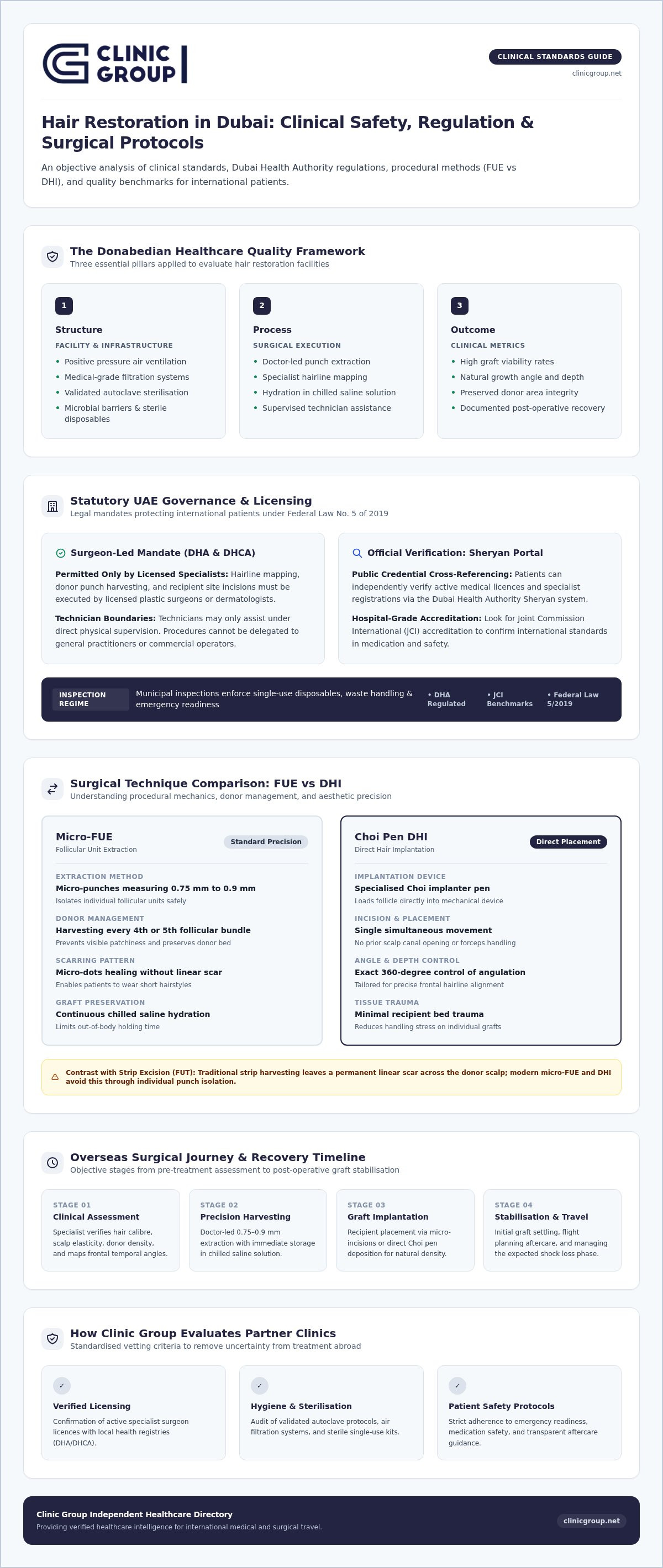
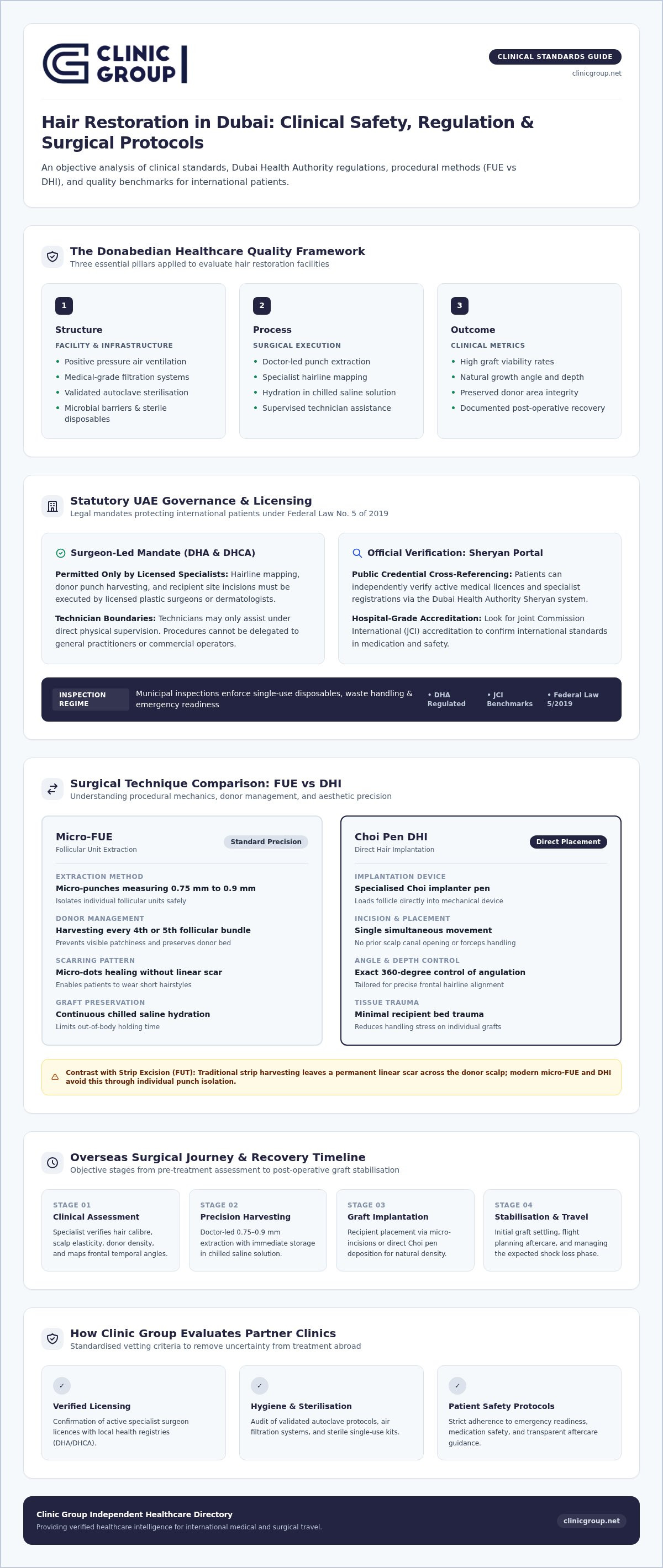
Evaluating clinical safety requires an objective framework rather than relying on promotional marketing. Healthcare quality auditors frequently apply the Donabedian model to evaluate surgical facilities across three pillars: structure (the physical operating environment and sterilisation infrastructure), process (surgical protocols and strict adherence to operative guidelines), and outcome (verified graft viability and long-term patient recovery metrics). Under this framework, high surgical standards require positive pressure ventilation systems, medical-grade air filtration, and strict microbial barriers to prevent infection during delicate graft transfer. When arranging a hair transplant in Dubai, confirming these foundational elements ensures that safety remains paramount throughout your treatment journey.
How does the Dubai Health Authority regulate hair restoration?
Clinical oversight across the emirate is strictly managed by the Dubai Health Authority (DHA) alongside the Dubai Healthcare City Authority (DHCA). Under Federal Law No. 5 of 2019 and the DHA Standards for Hair Transplant Services, surgical procedures cannot be delegated to general practitioners or unregulated commercial operators. Hairline mapping, donor punch harvesting, and recipient site incisions must be led by licensed plastic surgeons or dermatologists with documented specialty experience. Qualified technicians may assist during the procedure, but only under the direct physical supervision of the operating doctor. Regular municipal inspection regimes also enforce strict compliance regarding sterile single-use disposables, biomedical waste handling, and on-site emergency readiness.
Which international accreditations signal hospital-grade quality?
Independent accreditations provide an extra layer of reassurance alongside statutory UAE licensing. Facilities holding Joint Commission International (JCI) accreditation adhere to rigorous international benchmarks for medication handling, local anaesthetic delivery, and infection control. When clinics maintain European-standard safety protocols, procedure rooms operate with validated autoclave sterilisation and continuous air exchange. These strict clinical standards protect patients undergoing modern hair transplantation techniques from post-operative complications and microbial contamination. You can always cross-reference your operating surgeon's active credentials using Dubai's official regulatory portals before proceeding.
Which surgical technique delivers the most natural hairline?
A natural hairline relies on precise angulation, depth control, and minimal tissue trauma rather than raw graft numbers alone. During surgical planning for a hair transplant in Dubai, specialists examine whether manual or micro-motorised extraction best suits the patient's hair calibre and skin elasticity. Academic reviews of Follicular Unit Extraction demonstrate that limiting out-of-body holding time and maintaining continuous hydration in chilled saline solutions protect cellular vitality. While micro-punches safely isolate individual units, final aesthetic success depends entirely on mimicking natural growth patterns along the frontal temporal angles.
How does modern FUE differ from traditional strip surgery?
Traditional strip excision removes a section of donor tissue from the scalp, inevitably creating a permanent linear scar across the occipital region. Modern FUE replaces this invasive excision with micro-punches measuring 0.75 mm to 0.9 mm in diameter to harvest individual follicular units. These tiny punch sites heal as micro-dots rather than an elongated mark, enabling patients to wear short hairstyles with confidence. Experienced practitioners harvest every fourth or fifth follicular bundle, preventing visible patchiness and preserving the donor bed for future touch-ups.
When is direct hair implantation (DHI) the preferred option?
Direct Hair Implantation uses specialised Choi implanter pen devices to insert follicular grafts directly into the recipient skin. Instead of opening recipient channels with a scalpel beforehand and using forceps for placement, the implanter pen creates the incision and deposits the follicle in a single movement. This mechanical advantage eliminates unnecessary forceps manipulation of the delicate follicle root. Because DHI offers exacting control over exit angle and depth, surgeons frequently recommend it for reconstructing feathered hairlines or restoring density amongst native hairs without shaving the entire scalp.
What role does donor management play in long-term results?
Safe donor zones across the back and sides of the head contain a finite supply of genetically resilient hair follicles. Male pattern hair loss remains progressive, which means aggressive over-extraction during an initial procedure can leave an individual without options if thinning extends later in life. Skilled clinicians restrict harvesting to safe boundaries, occasionally integrating beard follicles beneath the jawline to boost crown density in advanced cases. If you want to review certified doctors who prioritise donor preservation, you can explore verified partner clinics through the Clinic Group platform.
How do you identify a leading hair restoration specialist?
Selecting an experienced clinician requires filtering past marketing claims to examine surgical qualifications. Across the UAE, authentic clinical excellence centres on individual surgical accountability rather than brand prestige. When evaluating specialists for a hair transplant in Dubai, verify whether the operating practitioner holds full specialist standing in plastic surgery or dermatology. Membership in recognised global authorities, such as the International Society of Hair Restoration Surgery (ISHRS), indicates that the surgeon actively engages with evidence-based research and peer-reviewed safety developments. Reliable clinics avoid high-volume commercial turnover, preferring surgeon-led sessions that allow focused attention on graft survival and patient comfort.
What questions must you ask during an initial consultation?
A direct, structured conversation helps uncover the operational reality of any clinic. Before making any clinical commitments, ask your prospective team the following direct questions:
- Which specific steps will the licensed doctor perform, and what tasks are assigned to supporting technicians?
- How many surgical procedures does your medical team schedule within the facility per day?
- What emergency protocols, resuscitation equipment, and monitoring tools are present inside the operative suite?
Clinics operating under ethical standards will clearly explain every team member's role and cap their daily patient volume to protect surgical precision.
How can international patients verify practitioner credentials?
Patients travelling from abroad should never rely solely on brochures or social media imagery, which often mask poor density using deceptive angles and lighting. Legitimate providers present unedited case histories showing macro-photographs of the hairline, clear donor recovery shots, and 12-month follow-up views under neutral clinical illumination.
You can independently verify any clinician's professional standing by entering their full name or licence number into Dubai's official Sheryan medical registry. This public system confirms whether the practitioner holds an active licence, their verified medical specialty, and any regulatory disciplinary notes. You can explore our guide to clinic accreditation and safety standards for additional detail on validating independent healthcare credentials across overseas clinics.
What travel and recovery timeline should international patients expect?
Planning travel around surgical hair restoration requires understanding the physiological timeline of graft anchoring. Newly placed follicles remain exceptionally vulnerable for the first 10 to 14 days, during which mechanical friction can easily dislodge them. For patients travelling abroad for a hair transplant in Dubai, scheduling adequate rest between the operative session and your return flight protects your cosmetic investment. Most travellers plan a four to five-day stay in the emirate, allowing sufficient time for the essential initial wash and clinical discharge before heading to the airport.
What happens before and during procedure day?
Preparation begins well before stepping into the clinic. Patients must stop taking blood-thinning medications, anti-inflammatory drugs, and alcohol at least one week prior to minimise operative bleeding. On surgery day, the clinical team performs baseline medical photography, runs routine blood screenings, and finalises hairline markings with the patient seated upright. Once local anaesthetic is administered, follicle extraction and site placement proceed across several focused hours, concluding with an antibacterial dressing placed over the donor scalp while leaving recipient grafts exposed.
How should you manage the initial 14-day healing window?
Meticulous scalp care dictates how quickly you recover once discharged. The clinical team provides specific post-operative protocols to safeguard graft survival:
- Spray the recipient zone with sterile saline solution every two to three hours to maintain tissue hydration.
- Apply a specialist foam cleanser gently without rubbing, rinsing with lukewarm water poured from a cup rather than direct shower pressure.
- Sleep with your head elevated at a 45-degree angle using a neck pillow to reduce facial oedema and prevent inadvertent pillow contact.
- Avoid intense cardiovascular workouts, heavy lifting, swimming pools, saunas, and tight-fitting headwear for at least two weeks.
Between weeks two and eight, experiencing "shock loss" is completely expected. The transplanted hair shafts will shed while the underlying roots remain dormant, with visible, permanent new growth beginning around month four.
How does travel coordination streamline the medical journey?
Navigating an overseas procedure feels far simpler when supported by an English-speaking patient coordinator who aligns airport transfers, clinic check-ins, and post-operative appointments. When travelling back home, maintain cabin hydration and request an aisle seat to avoid knocking the vulnerable recipient scalp against low aircraft lockers. Because Dubai experiences warm temperatures and intense sunlight throughout the year, protect the healing scalp with a loose, unstructured bucket hat during transfers. You should also secure specialised medical travel insurance designed specifically for overseas elective surgery before departure.
How does Clinic Group help you find verified clinics?
Choosing an overseas medical provider requires objective curation rather than promotional promises. Clinic Group functions as an independent international directory connecting patients with thoroughly vetted clinics abroad, including select partner centres in Dubai and Tirana. By acting strictly as an introductory facilitator rather than delivering surgical care directly, the platform maintains unbiased oversight. It evaluates facilities against documented safety criteria so you can arrange treatment with genuine peace of mind.
What standards must a partner clinic satisfy?
Before any surgical facility appears on our platform, our team conducts thorough compliance checks across core quality markers:
- Proof of active statutory licensing with local authorities such as the DHA or the Albanian Ministry of Health.
- Clear verification that surgical stages are led exclusively by licensed plastic surgeons or dermatologists rather than unsupervised support staff.
- Demonstrated compliance with international sterile operative conditions, hospital-grade air filtration, and verified CE-marked medical devices.
- Consistent track records of transparent patient consultations, ethical donor preservation, and validated long-term results.
If you wish to explore approved providers operating within the emirate, you can examine verified credentials through Hair Clinic Dubai on our directory.
How can patients explore alternative accredited destinations?
Every individual presents distinct hairline restoration goals, varying degrees of hair thinning, and unique travel preferences. Clinic Group allows you to compare different geographic options without compromising clinical standards. While a hair transplant in Dubai offers world-class facilities and dedicated Middle Eastern specialists, many European and UK patients also examine Tirana, Albania, which provides access to modern European medical infrastructure and seasoned surgical teams.
Through our dedicated medical concierge support, you gain access to dedicated coordinators who assist with appointments, English-language clinical communication, and second-opinion matching. You can review our full range of minimally invasive options across the hair transplant treatment directory, or consult our detailed guide on clinic accreditation and safety standards to make an informed, confident choice for your restorative journey.
Making an Informed Choice for Your Hair Restoration Journey
Achieving natural, lasting density depends on verified clinical credentials rather than commercial marketing. Prioritising doctor-led execution, verifying active DHA statutory licensing, and choosing the appropriate protocol between micro-FUE and precision DHI ensure your finite donor reserves remain protected. When planning a hair transplant in Dubai, combining objective quality vetting with structured travel precautions guarantees a safe, reassuring surgical experience.
Taking control of your appearance should be transparent and stress-free. Clinic Group simplifies this path through a curated directory of independently vetted medical clinics abroad. Each verified facility adheres to internationally recognised patient safety protocols, while dedicated patient coordinators assist with logistics to keep your medical journey organised from start to finish.
With the right clinical team by your side, restoring your hairline can be a secure and rewarding step forward.
Frequently Asked Questions
How long do I need to stay in Dubai after a hair transplant procedure?
You should plan to stay in Dubai for at least three to four days following your procedure. This allows sufficient time for immediate rest, post-operative swelling reduction, and an essential clinical wash on day two. During this appointment, the medical team inspects graft placement and cleanses donor wounds before clearing you for travel. Rushing home earlier risks dislodging fragile grafts during airport transit.
Is a hair transplant performed under general or local anaesthetic?
Hair restoration is performed almost exclusively under local anaesthetic, occasionally combined with a mild oral sedative to keep you relaxed. Local injections completely numb both donor extraction and recipient areas, meaning you stay awake and comfortable throughout the day without experiencing pain. General anaesthesia is avoided because it carries unnecessary systemic risks for an outpatient procedure that requires periodic patient movement and scalp repositioning.
What is the difference between FUE and DHI hair restoration?
The fundamental difference lies in how follicular grafts are inserted into the scalp. Standard Follicular Unit Extraction involves making incisions first before manually inserting grafts with forceps. Direct Hair Implantation utilises a specialised Choi pen device to create the incision and place the follicle simultaneously. This one-step method reduces root handling, preserves graft hydration, and offers greater control over hair angulation along delicate hairline margins.
Can I fly back to the UK immediately after hair transplant surgery?
Flying immediately after surgery is not advised; you should wait at least 48 to 72 hours before boarding a flight. Cabin pressure changes, dry air, and the physical strain of moving luggage can trigger swelling or bleeding. When undertaking a hair transplant in Dubai, staying local until your initial clinical check allows your surgeon to inspect the recipient grafts before you endure a long flight home.
How do I verify the credentials of a hair transplant surgeon in Dubai?
You can verify practitioner credentials directly through the Dubai Health Authority's online portal, known as Sheryan. By entering your surgeon's full name or licence number, you can confirm their active registration, specialist standing in plastic surgery or dermatology, and documented practice privileges. Additionally, check for international memberships in bodies like the ISHRS and request authentic photographic case studies displaying clear donor healing and realistic frontal density.
Does medical travel insurance cover elective aesthetic procedures abroad?
Standard travel insurance policies almost never cover planned elective surgery or related post-operative complications. If you travel overseas for private medical treatment, you must purchase a dedicated medical travel insurance policy. These specialised products protect against emergency hospitalisation, travel delays caused by medical advice, or specific complications arising after discharge. Always review your policy wording carefully so you understand your specific coverage limits.
What happens if my transplanted hair starts shedding after a few weeks?
Shedding transplanted hair shafts between weeks two and eight is entirely normal and expected. Known clinically as shock loss, this process occurs as hair follicles enter a temporary resting phase following surgical transplantation. The underlying roots remain firmly established below the skin's surface. Visible new growth typically emerges around month four, with final thickness and cosmetic density maturing over 12 to 18 months post-surgery.
Does the NHS correct elective surgical complications from overseas clinics?
The NHS will treat urgent medical emergencies like acute infections or heavy haemorrhage, but it does not correct unsatisfactory cosmetic results from private procedures abroad. Patients who require aesthetic revisions, scar repairs, or density corrections must pay for private care either at home or with their original clinic. This underscores why choosing vetted practitioners who follow stringent clinical standards is essential when planning a hair transplant in Dubai.

Article by
Clinic Group Editorial Team
The Clinic Group editorial team publishes clear, practical guides for UK and EU patients researching medical travel — from dental implants and hair transplants to plastic surgery and eye care — with a focus on verified clinics, transparent “from” pricing, and safe planning.
Disclaimer
This article is for general information only and is not medical advice, diagnosis, or a substitute for an in-person consultation with a qualified clinician. Treatment suitability, risks, timelines, and costs vary by individual. Clinic Group connects patients with independent clinics; those clinics are responsible for clinical care. Always verify credentials, obtain a written treatment plan and itemised quote, and confirm aftercare arrangements and travel insurance cover (elective procedures are often excluded) before booking. Outcomes cannot be guaranteed.