The true measure of successful hair restoration abroad isn't the number of grafts promised by an aggressive sales agent, but the clinical skill of the surgeon performing your procedure. If you feel overwhelmed by overseas marketing packages, anxious about unnatural hairlines, or worried about irreversible donor depletion, your caution is entirely justified. Travelling across borders for surgery can feel daunting when you're trying to verify operating theatre hygiene and doctor credentials from home.
You don't need to endure high-pressure sales pitches or guess at safety protocols to achieve natural, lasting results. This guide explains modern surgical techniques such as FUE and Direct Hair Implantation (DHI), outlines how to objectively assess clinics against European regulatory frameworks, and shows you how to select verified medical providers. You'll also discover how to arrange post-operative aftercare and travel logistics, helping you plan every step safely and with complete clarity.
Key Takeaways
- Understand the clinical differences between modern micro-surgical methods like FUE and DHI to protect donor follicles and avoid a visible linear scar.
- Discover how to assess clinical credentials for hair restoration abroad against recognised European regulatory frameworks rather than relying on promotional sales pitches.
- Learn the critical warning signs of commercial hair mills to ensure qualified medical doctors plan and execute every delicate surgical stage.
- See how a dedicated patient coordinator simplifies your medical journey, coordinating travel logistics, clinic appointments, and translation support.
- Follow the realistic 12-month biological growth timeline, navigating temporary shock loss to achieve long-term density through structured scalp care.
What is hair restoration abroad and how does it work?
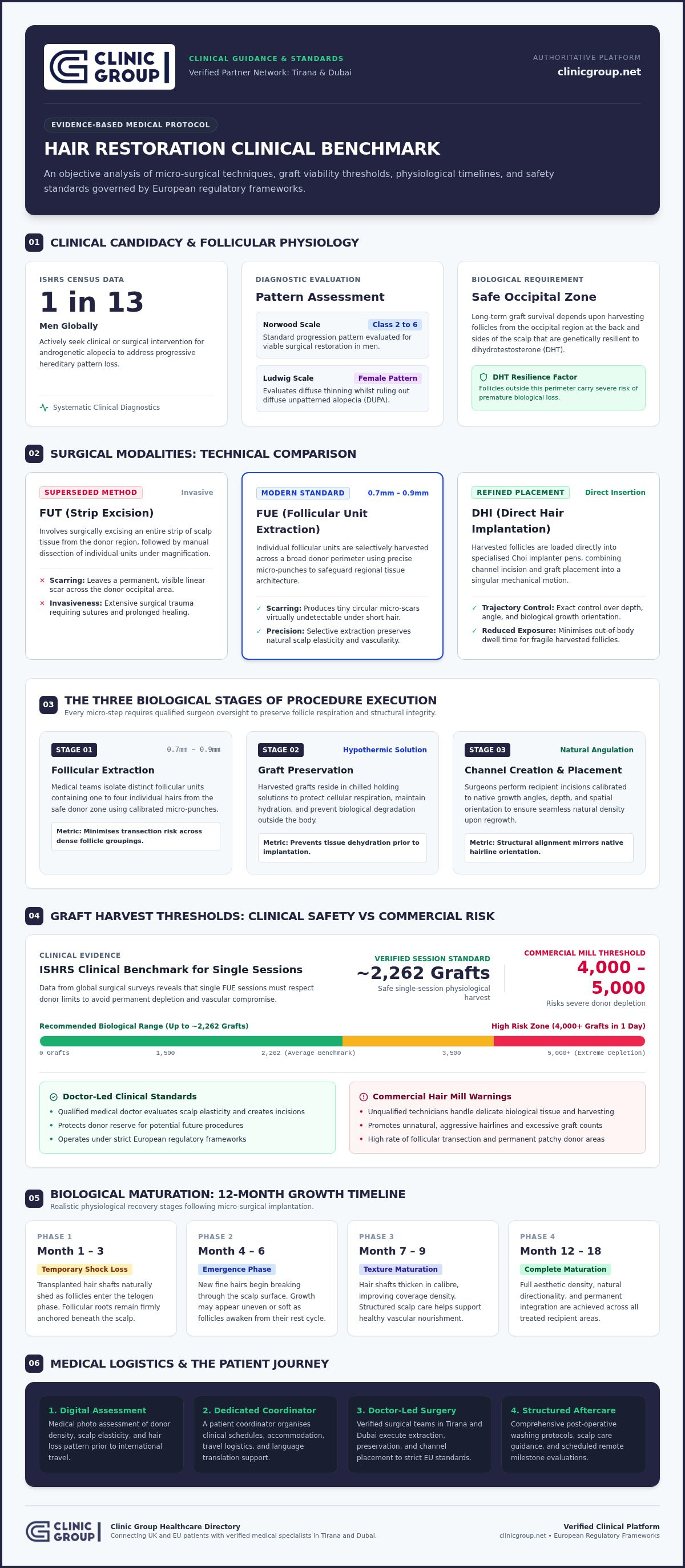
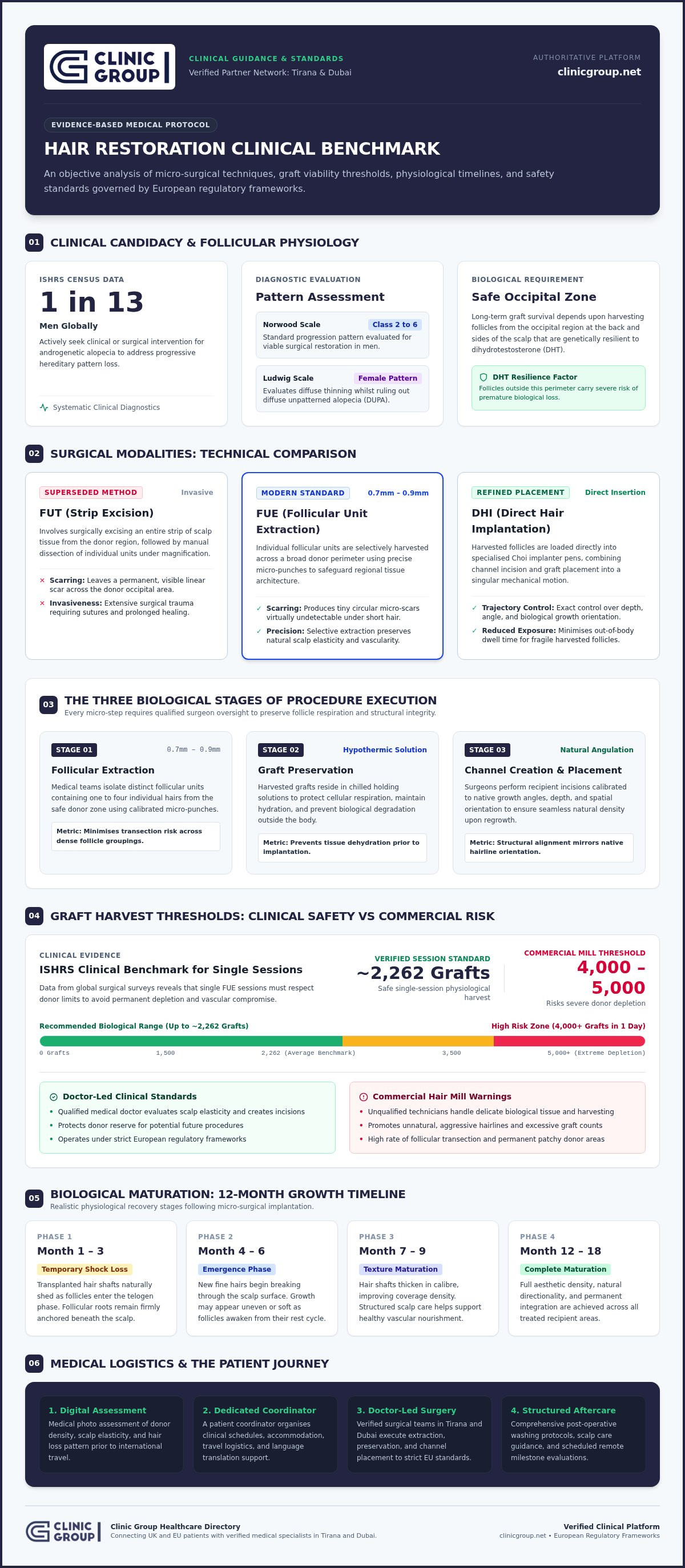
Surgical hair restoration is the medical process of transferring healthy, genetically resilient hair follicles from a dense donor zone into areas experiencing thinning or balding. When researching hair restoration abroad, UK patients often look beyond local options to access experienced surgical teams and modern clinical facilities in destinations such as Tirana and Dubai. According to census data from the International Society of Hair Restoration Surgery (ISHRS), approximately 1 in 13 men globally seeks medical or surgical intervention for androgenetic alopecia.
However, successful treatment requires distinguishing between doctor-led clinical practices and commercial technician-run facilities. A qualified surgeon assesses scalp elasticity, designs an age-appropriate hairline, and oversees every extraction step. In contrast, unvetted facilities often deploy non-medical staff to perform delicate tissue handling, increasing the risk of follicular transection and patchy results. From your initial digital assessment to final visual density, the biological journey typically requires 12 to 18 months for complete maturation.
Which hair loss conditions can surgical restoration treat?
Surgical procedures primarily address androgenetic alopecia across Norwood scale classifications 2 to 6, where hair loss follows a predictable pattern. For women, clinical teams evaluate Ludwig scale thinning while ruling out diffuse unpatterned alopecia (DUPA), which affects systemic hair stability. A successful procedure requires healthy, stable donor follicles situated in the safe occipital zone at the back and sides of the scalp. If these donor hairs are genetically vulnerable to dihydrotestosterone (DHT), long-term graft survival drops significantly.
How does the hair transplant process function?
The surgical sequence follows three precise biological stages to ensure optimal follicle survival:
- Follicular extraction: Medical teams isolate individual follicular units containing one to four hairs from the donor area using micro-punches measuring 0.7mm to 0.9mm.
- Graft preservation: Harvested follicles reside in chilled, hypothermic holding solutions to preserve cellular respiration and prevent dehydration outside the body.
- Channel creation and placement: Doctors use specialized instruments to create recipient incisions that mirror the natural growth angles, depth, and spatial orientation of native hair. Clinical definitions of modern hair restoration techniques demonstrate how this structural alignment ensures seamless aesthetic integration once natural growth resumes.
Before planning your itinerary, reviewing a trusted guide on pre-surgery consultations will help you identify the necessary medical documentation and questions to raise with your surgical team.
Which modern hair restoration techniques are available overseas?
Traditional follicular unit transplantation (FUT) involved excising a strip of scalp skin, leaving a visible linear scar across the donor region. Modern clinical practice has largely superseded this invasive method in favour of advanced micro-surgical solutions that prioritise rapid tissue recovery and aesthetic precision. Reputable clinics offering hair restoration abroad now specialise in minimally invasive techniques such as Follicular Unit Extraction (FUE) and Direct Hair Implantation (DHI), often complemented by regenerative therapies to support long-term scalp care.
What is FUE hair restoration?
Follicular Unit Extraction isolates individual follicular groupings from the permanent donor zone using micro-punches measuring between 0.7mm and 0.9mm. Because individual follicles are harvested selectively across a wide area, healing results in tiny circular micro-scars that remain virtually undetectable under short haircuts. ISHRS clinical survey data shows the average single FUE session involves roughly 2,262 grafts. Unregulated clinics advertising 4,000 to 5,000 grafts in a single day often risk permanent donor depletion. Patients can explore clinical standards across vetted partners through the Clinic Group overview of hair transplant treatments.
How does DHI differ from standard FUE?
Direct Hair Implantation refines the placement phase by combining channel creation and follicle insertion into a single mechanical step. Surgeons place harvested follicles into specialised Choi implanter pens, allowing precise control over depth, angle, and directional alignment without needing pre-cut recipient slits. This approach proves particularly effective for refining hairlines, restoring eyebrows, or operating around existing native hair without fully shaving the head. To evaluate whether this method matches your personal restoration goals, consult the detailed guide to the DHI hair transplant technique.
Who represents an ideal candidate for surgical restoration?
Candidate suitability depends on donor density, hair shaft diameter, and underlying biological stability. Patients with active alopecia areata or unmanaged inflammatory conditions aren't suitable candidates until hair loss is stabilised medically. Consulting established medical resources, such as the CDC guidelines on medical tourism, helps patients understand pre-travel clinical checks and post-operative infection risks before booking overseas travel. If you're considering hair restoration abroad and want an objective clinical evaluation, you can request an initial consultation through the Clinic Group directory.
How can UK patients choose a safe and verified clinic abroad?
Choosing an international provider requires looking past polished social media marketing and evaluating measurable clinical standards. Evaluating hair restoration abroad works best when applying structured healthcare frameworks such as the Donabedian model, which assesses quality across physical structure, clinical process, and observed outcomes. Unregulated commercial facilities often cut operational costs by substituting fully qualified doctors with unlicensed technicians during surgical stages. This practice significantly increases your risk of asymmetrical hairline design, graft transection, and permanent donor-area scarring.
Safe medical travel starts with clear, objective due diligence. Official UK government advice on surgery abroad advises patients to verify surgeon registrations, independently audit clinic safety protocols, and secure specialised medical travel insurance before confirming overseas appointments. You should always obtain an itemised, written treatment plan that outlines medical steps, surgical personnel, and follow-up provisions prior to committing to travel.
Which clinical accreditations and surgeon credentials matter?
Start by confirming that your treating doctor holds active licensure with their national medical chamber and maintains active membership in reputable clinical organisations like the ISHRS. The physical facility must align with rigorous hygiene benchmarks, such as JCI accreditation standards or the local equivalent of the EU regulatory framework. These guidelines require verified autoclaving records, sterile positive-pressure air filtration, and immediate emergency transfer protocols. For a structured evaluation template, refer to the patient guide on clinic accreditation standards.
What questions should you ask during your virtual consultation?
During your initial video assessment, ask direct procedural questions to confirm medical governance:
- Surgeon participation: Which specific procedural steps does the doctor perform personally, and what role do assistants play?
- Daily patient capacity: How many operations does the clinical team handle each day? High-volume centres running dozens of simultaneous procedures cannot guarantee adequate surgeon supervision.
- Clinical accountability: Can the clinic supply written documentation of sterilisation standards and official emergency transfer pathways?
Why consider emerging medical destinations like Albania?
Tirana has rapidly become a respected hub for UK patients seeking European medical standards without factory-style throughput. Leading partner clinics in Albania, such as Spitali Italian Salus, frequently employ surgical teams trained across Italy and Western Europe who operate under strict EU-aligned sanitary protocols. Direct flights from London to Tirana take between 2.5 and 3 hours, and British passport holders can stay visa-free for up to 90 days, making pre-operative travel and timely post-operative recovery simple to coordinate.
What does the patient journey involve when travelling overseas?
Organising hair restoration abroad requires systematic coordination between clinical teams and travel services. When arranging care through an integrated model, patients receive end-to-end guidance from an assigned patient coordinator. This dedicated point of contact manages clinical scheduling, arranges private airport transfers, coordinates hotel stays, and provides translation assistance throughout your hospital visits. Managing logistics alongside medical planning ensures your time overseas remains focused entirely on treatment and initial healing.
NHS guidance explicitly establishes that state healthcare in the UK is under no obligation to repair elective cosmetic work carried out privately overseas. As a result, travelling patients must purchase specialised medical travel insurance before departure. Unlike standard holiday cover, these policies specifically cover unexpected medical complications, surgical revisions, or extended accommodation needs abroad.
How should you prepare before travelling for treatment?
Preparation begins at home at least two weeks before your flight. You'll need to follow specific pre-operative guidelines to optimise scalp conditions:
- Cease blood-thinners: Stop taking aspirin, anti-inflammatory medications, and herbal supplements like ginkgo biloba or vitamin E, following your doctor's explicit instructions.
- Limit nicotine and alcohol: Abstain from smoking and alcohol for at least seven days before surgery, as both constrict blood vessels and compromise graft perfusion.
- Pack suitable clothing: Bring loose-fitting, front-buttoning shirts or zip hoodies. Pulling tight crew-neck jumpers over newly implanted grafts can instantly dislodge them.
What happens during surgery day at an international clinic?
Your procedure morning starts with an in-person surgical evaluation. The doctor draws the agreed hairline onto your scalp, confirming symmetry and graft density zones. Once you approve the layout, the team administers local anaesthesia to numb the donor region completely. Meticulous graft harvesting follows, during which technicians count and sort extracted follicular units. After a structured lunch break designed to let you rest and hydrate, your surgeon creates recipient channels and places the grafts carefully. The entire process takes between six and eight hours, depending on total follicle volume.
How should you handle post-operative flight travel?
Flying home requires careful physical precautions to safeguard fresh recipient sites. Cabin air dries out healing skin quickly, so spray your scalp with sterile saline mist every 30 to 45 minutes as instructed by your clinical team. Wear an inflatable horseshoe travel pillow around your neck to support your head against the aircraft seat without letting the recipient area touch fabric. Stay well hydrated, avoid lifting heavy cabin bags into overhead lockers, and keep your head slightly elevated to prevent facial swelling during descent.
How do you ensure proper aftercare and long-term results?
Diligent aftercare is just as essential as surgical execution for securing optimal graft survival and natural follicle density. While clinical teams complete the physical placement, long-term success with hair restoration abroad depends heavily on how you manage your scalp once you return home. UK health authorities make clear that the NHS does not manage routine elective follow-ups or corrective care for private procedures completed overseas. Establishing a disciplined, remote aftercare protocol with your overseas provider ensures emerging follicles receive the protection they need during each biological healing phase.
What does the first fourteen days of recovery require?
The initial two weeks determine whether newly placed grafts take root successfully. You will need to maintain a strict scalp care routine to prevent trauma:
- Hydration and gentle cleansing: Apply prescribed sterile saline spray frequently for the first three days. From day four, gently dab the recipient area using diluted baby shampoo foam, allowing crusts to soften without rubbing or scratching.
- Activity restrictions: Avoid vigorous cardiovascular exercise, heavy lifting, saunas, and excessive sweating, all of which elevate cranial blood pressure and risk dislodging fragile grafts.
- Physical protection: By day ten, follicular units are securely anchored beneath the dermis. However, you must still shield your scalp from direct sun exposure and friction for at least four weeks.
What is shock loss and when does new growth begin?
Patients often worry when transplanted hair shafts begin shedding between weeks two and eight. This temporary reaction, known as shock loss, is a standard physiological response to surgical relocation. While the external hair shaft sheds, the vital follicle bulb remains firmly intact beneath the skin. Early, fine regrowth typically emerges around months three to four. Between months eight and twelve, hairs thicken considerably, with final structural coverage and natural maturation completing around month eighteen.
How does remote aftercare coordination work with Clinic Group?
Organising hair restoration abroad through the Clinic Group directory ensures continuous medical oversight after your flight lands. Patients submit clear, high-resolution photographs at one, three, six, and twelve months so treating surgeons can review biological progress and graft integration. If unexpected redness, irritation, or swelling occurs, your assigned patient coordinator communicates directly with the surgical clinic on your behalf to obtain prompt, doctor-verified advice. To begin your journey and review suitability with a vetted specialist, you can submit your details to request a consultation today.
Taking control of your hair restoration journey
Securing natural, lifelong hairline density comes down to medical expertise rather than aggressive sales tactics. A successful experience with hair restoration abroad depends entirely on selecting doctor-led surgical teams, verifying operating theatre hygiene, and following a methodical aftercare schedule. Rather than navigating unvetted providers on your own, you can take control of your aesthetic health through objective clinical standards.
Clinic Group connects you directly to a network of 10+ verified clinics operating under strict safety protocols in destinations like Tirana and Dubai. With dedicated patient coordinators managing your logistical planning and an established 5 / 5 patient rating display, you receive structured, dependable assistance at every stage of your travel.
Taking an informed, step-by-step approach ensures you protect your donor reserves and restore your hair with lasting confidence.
Frequently Asked Questions
Is hair restoration abroad safe for UK patients?
Yes, hair restoration abroad is safe provided you select a vetted, doctor-led clinical facility adhering to strict international hospital standards. Safety depends on clinician qualifications, operating theatre sterility, and thorough pre-operative planning rather than geographical location. UK patients should ensure licensed surgeons manage all graft incisions and avoid unaccredited centres. Always confirm emergency transfer protocols and secure medical travel insurance covering overseas elective procedures before booking.
What is the difference between FUE and DHI techniques overseas?
Follicular Unit Extraction (FUE) involves extracting individual follicular grafts with micro-punches and inserting them into separately prepared recipient incisions. Direct Hair Implantation (DHI) uses specialised Choi implanter pens that combine incision and graft placement into a single fluid step. This gives surgeons greater control over hair depth, angle, and density without always requiring full head shaving, making DHI especially useful for hairline refinement.
Will the NHS provide aftercare if I experience issues abroad?
No, the NHS does not provide routine follow-up examinations, cosmetic revisions, or corrective treatments for elective procedures undertaken privately overseas. UK health guidelines state that state care treats only acute, life-threatening post-operative emergencies. Patients must arrange formal aftercare protocols directly with their overseas clinic and purchase dedicated medical travel insurance that covers emergency medical complications and extended overseas accommodation needs.
How long do I need to stay abroad for a hair transplant?
Most patients should plan a clinical trip lasting three to four days. Day one involves arrival, settling into accommodation, and in-person consultations. Day two is dedicated to the surgical procedure itself. Day three includes an essential follow-up visit for bandage removal, scalp inspection, and first clinical washing instruction. Remaining in the destination for this initial period ensures treating doctors can verify that healing is progressing smoothly before your flight.
Can surgical hair restoration permanently resolve genetic baldness?
Surgical transplantation permanently relocates follicles resistant to dihydrotestosterone (DHT) from the donor zone to thinning areas. These transplanted hairs generally retain their genetic resistance for life. However, surgery cannot stop future loss of native, untreated hairs surrounding the treated zones. Doctors often recommend medical stabilisation therapies alongside surgery to maintain long-term density across the rest of your scalp.
How soon after my procedure overseas can I fly back to the UK?
Patients can generally fly back to the UK within 24 to 48 hours following their final post-operative wash. Short direct flights, such as a two-and-a-half-hour trip from Tirana, cause minimal disruption. During the flight, keep your head elevated, spray the graft site with saline solution every 30 to 45 minutes, and wear an inflatable neck pillow to prevent recipient follicles rubbing against plane seats.
What should I do if my international clinic uses technicians instead of doctors?
You should reconsider proceeding with any facility where unlicensed technicians perform surgical incisions or graft extractions. High-standard clinical governance mandates that certified medical doctors lead procedural planning, hairline creation, and surgical incisions. If a clinic refuses to guarantee doctor-led surgery in writing, decline the booking and seek a verified clinical provider who provides transparent surgeon credentials and strict medical oversight.
Are surgical outcomes guaranteed when booking hair restoration abroad?
No reputable medical provider guarantees surgical outcomes. Biological tissue integration varies between individuals depending on scalp healing, underlying medical health, and adherence to aftercare guidelines. When arranging hair restoration abroad, trustworthy clinics offer detailed biological consultations, realistic density expectations, and formal aftercare support rather than unrealistic commercial promises. Always obtain written treatment documentation detailing expectations before travelling.

Article by
Clinic Group Editorial Team
The Clinic Group editorial team publishes clear, practical guides for UK and EU patients researching medical travel — from dental implants and hair transplants to plastic surgery and eye care — with a focus on verified clinics, transparent “from” pricing, and safe planning.
Disclaimer
This article is for general information only and is not medical advice, diagnosis, or a substitute for an in-person consultation with a qualified clinician. Treatment suitability, risks, timelines, and costs vary by individual. Clinic Group connects patients with independent clinics; those clinics are responsible for clinical care. Always verify credentials, obtain a written treatment plan and itemised quote, and confirm aftercare arrangements and travel insurance cover (elective procedures are often excluded) before booking. Outcomes cannot be guaranteed.