For UK patients in 2026, Albania and Dubai stand out as the leading destinations for high-quality, affordable dental care abroad, with Albania offering some of the most competitive prices in Europe and Dubai providing internationally accredited care for those combining treatment with travel to the Gulf. Turkey, Hungary, Poland, and Spain round out the shortlist for patients weighing travel time, cost, and clinical standards.
The recommended booking route is through a verified facilitator such as Clinicgroup, which connects UK patients with vetted clinics, handles travel logistics, and coordinates aftercare. Before you book anything, two steps matter above all others:
- Speak to your UK dentist first. A pre-travel consultation identifies contraindications, sets realistic expectations, and may prevent unnecessary travel altogether.
- Request a Clinicgroup consultation to receive a matched clinic shortlist, a written treatment plan, and a full cost breakdown before committing to any deposit.
The NHS advises patients to independently verify overseas credentials, secure appropriate insurance, and obtain a written treatment plan with a full cost breakdown before booking. That advice is the foundation of everything in this guide.
Key takeaways
Albania and Dubai are the most reliable destinations for UK patients seeking verified, affordable dental care abroad in 2026. Gross savings for implants and veneers in Albania are typically 50–70% below UK private rates for comparable procedures, though actual net savings depend on the specifics of your treatment plan and travel costs.
| Point | Details |
|---|---|
| Top destinations in 2026 | Albania and Dubai offer the strongest combination of verified clinical standards and savings for UK patients. |
| Gross savings possible | Implants and veneers in Albania are typically 50–70% below UK private rates for comparable procedures. |
| Remedial cost risk | A survey found that many UK dentists had treated patients with complications after dental tourism; remedial costs can erase savings. |
| Verification essentials | Confirm clinician credentials, written warranty terms, and implant brand in writing before paying any deposit. |
| Clinicgroup’s role | Clinicgroup matches UK patients with vetted clinics in Albania and Dubai, coordinating travel, aftercare, and transparent pricing. |
Table of Contents
- Which countries offer the best dental treatment abroad in 2026?
- What do dental procedures cost abroad, and how many trips will you need?
- How do you check a clinic and dentist before you book?
- What UK patients need to know about safety, regulation, and continuity of care
- How to plan your trip: a step-by-step checklist
- How Clinicgroup selects and vets clinics for 2026
- Clinicgroup’s perspective on what patients actually need
- Clinicgroup: verified dental care in Albania and Dubai
- Sources
- FAQ
Which countries offer the best dental treatment abroad in 2026?
Country choice shapes your experience more than almost any other decision. Clinical quality, travel time, language access, and aftercare realities vary considerably across popular destinations for UK patients.
Albania
Albania has become one of the most sought-after destinations for affordable dental care abroad, particularly for implants, veneers, and full-mouth restorations. Tirana’s leading clinics operate to European clinical standards, use recognised implant systems such as Straumann and Nobel Biocare, and employ English-speaking staff as standard. Flight time from London is roughly two hours, and return visits for staged implant procedures are straightforward to plan.
- Typical savings vs UK private: substantial savings on most restorative procedures
- Accreditation: Leading clinics hold ISO certifications and operate under Albanian Ministry of Health registration; Clinicgroup partner clinics undergo additional vetting
- Aftercare: Written warranties are available at reputable clinics; remote follow-up via digital records is increasingly standard
- Caveat: Standards vary significantly between clinics; independent verification remains essential
Dubai
Dubai suits patients who want internationally accredited care, often combining treatment with a longer stay. The Dubai Health Authority (DHA) regulates all dental practitioners, and many clinics hold Joint Commission International (JCI) accreditation. Costs are higher than Albania but typically 30–50% below UK private rates for comparable procedures. English is the working language across all major clinics.
- Typical savings vs UK private: significant savings
- Accreditation: DHA-licensed practitioners; JCI accreditation available at leading facilities
- Travel: Approximately six to seven hours from London; visa on arrival for UK passport holders
- Aftercare: Strong continuity-of-care infrastructure; remote consultation options well established
Turkey
Turkey remains one of the most popular dental tourism destinations for UK patients, particularly for veneers and smile makeovers. Istanbul and Antalya host large dental facilities with high patient volumes and competitive pricing. Substantial savings against UK private rates are achievable, though the British Dental Association warns that high volumes and aggressive marketing have been associated with variable quality and complications requiring remedial work on return.
Hungary
Budapest has a long-established reputation for dental tourism, with clinics catering specifically to UK and German patients. Standards at accredited Budapest clinics are generally high, and many dentists hold postgraduate qualifications from Western European universities. Savings are typical. Flight time is around two and a half hours from London.

Poland and Spain
Poland offers strong clinical standards in cities such as Kraków and Warsaw, with notable savings and easy access from most UK airports. Spain is a practical option for patients already spending time there or living part of the year in popular coastal areas; savings are more modest at 20–40%, but continuity of care is easier to manage given the proximity and established expat infrastructure.
Savings illustration: A single dental implant with crown at a UK private clinic typically costs several thousand pounds. At a Clinicgroup-vetted clinic in Albania, the equivalent procedure costs notably less, representing substantial gross savings before travel costs. Actual net savings depend on flights, accommodation, and the number of visits required.
What do dental procedures cost abroad, and how many trips will you need?
Understanding realistic costs and timelines prevents the most common planning mistake: underestimating total expenditure and the number of return visits required.
Typical price ranges by procedure
Ranges are illustrative. Actual quotes depend on clinical complexity, materials specified, and individual clinic pricing. Always request a written itemised treatment plan.
How many visits does each procedure require?
- Crowns and veneers: Often completable in a single visit of five to seven days, covering preparation, temporaries, and fitting of the final restorations.
- Root canal treatment: Typically a single visit, though complex multi-canal cases may require a short follow-up.
- Dental implants: The standard staged protocol requires at minimum two visits separated by a healing window of three to six months. The first visit covers extraction (if needed) and implant placement; the second covers the abutment and crown fitting. Some clinics offer same-day or immediate-loading protocols for suitable patients, but these carry specific clinical criteria.
- Full-mouth rehabilitation: Plan for two to three visits over six to twelve months.
Remedial work is the hidden cost most patients overlook. The Dental Defence Society notes that managing complications after overseas treatment can be complex because of unfamiliar techniques, unavailable components, and difficulties accessing foreign clinical records. Factor in the possibility of at least one unplanned return visit or UK remedial appointment when calculating net savings.
Pro Tip: Ask your overseas clinic to specify the exact implant brand and component reference numbers in writing before treatment. If a crown or abutment needs replacing later, your UK dentist will need this information to source compatible parts.
How do you check a clinic and dentist before you book?
Verification is not optional. The GDC recommends checking practitioner qualifications, specialist memberships, and complaints-handling procedures rather than relying solely on general reviews. Here is a practical checklist.
Credentials and registration
- Confirm the clinic is registered with the relevant national health authority (e.g., Albanian Ministry of Health, Dubai Health Authority).
- Check whether the clinic holds international accreditation such as JCI or ISQua recognition.
- Verify the treating dentist’s qualifications, postgraduate training, and any specialist memberships. Ask for copies of diplomas if necessary.
- Confirm the clinic carries professional indemnity insurance and ask who is responsible for remedial costs if treatment fails.
Clinical standards
- Ask specifically about sterilisation protocols and infection-control procedures. Waterline management is a frequently overlooked risk; dental unit waterlines can harbour Legionella and other pathogens if not properly maintained, so it is reasonable to ask what decontamination regime the clinic follows.
- Request the implant brand and material specifications for any prosthetic work.
- Ask whether CBCT scanning is available for implant planning.
Treatment plan and contract
- Insist on a written, itemised treatment plan with a full cost breakdown before paying any deposit.
- Confirm who will perform each stage of treatment. Package-only offers that do not name the treating clinician are a significant red flag.
- Request written warranty terms: what is covered, for how long, and what the process is if remedial work is needed.
- Ask about the refund policy if treatment cannot proceed as planned.
Patient reviews and trust signals
- Look for reviews on independent platforms rather than testimonials hosted on the clinic’s own website. Patterns across multiple independent sources are more reliable than a handful of five-star ratings. The Dental Health Foundation advises researching clinics carefully, including examples of work and independent reviews, before committing.
- Check how the clinic responds to negative reviews. A clinic that engages constructively with complaints is a more reliable partner than one that ignores or disputes them. Patient reviews for overseas clinics carry more weight when they are recent, specific, and verified.
Red flags to walk away from
- No direct clinical consultation with the treating dentist before treatment begins.
- Pressure to pay a large non-refundable deposit before a written treatment plan is issued.
- Vague or verbal-only warranty commitments.
- Inability to name the specific implant system or materials to be used.
Pro Tip: Insist on a direct video or in-person consultation with the dentist who will actually perform your treatment, not just a patient coordinator. Ask them to walk you through the treatment plan and confirm it in writing. A signed contract that specifies who bears the cost of remedial work is the single most important document you can have.
What UK patients need to know about safety, regulation, and continuity of care
This is where dental tourism planning most often falls short. Understanding the regulatory limits before you travel is not pessimistic; it is the most practical thing you can do.
What the GDC and NHS can and cannot do
The GDC has no jurisdiction over overseas dental providers. If something goes wrong with treatment carried out abroad, you cannot raise a formal complaint with the GDC against the overseas dentist. The Royal College of Surgeons has noted that UK patients may lack the consumer protections they would have at home and can face hidden costs for follow-up care. Civil redress through overseas courts is possible in principle but rarely practical.
The NHS will treat acute complications arising from privately funded overseas treatment, but it will not reimburse the cost of private treatment failures. NHS England’s clinical policy makes clear that access to remedial NHS care follows existing acceptance criteria and capacity constraints. In practice, this means you may wait for NHS treatment while managing a complication, or pay privately for urgent remedial work in the UK.
Key figure: A BDA survey reported that many UK dentists have treated patients with complications after dental treatment abroad, and remedial costs can potentially erode or eliminate initial savings.
Travel health precautions
TravelHealthPro advises that invasive dental procedures carry additional risks, including exposure to blood-borne viruses, and recommends reviewing routine vaccinations and planning continuity of care between the overseas clinic and your home country before travel. Check your vaccination status with your GP or a travel health pharmacy, and confirm you are fit to fly after any surgical procedure. Most clinicians advise waiting at least 24–48 hours after implant surgery before flying, though individual clinical advice takes precedence.
Continuity-of-care steps
- Obtain copies of all clinical records, X-rays, and CBCT scans in digital format before you leave the overseas clinic.
- Agree an aftercare plan in writing with the overseas clinic, including a named contact for remote follow-up queries.
- Inform your UK dentist of the treatment carried out and share the clinical records on your return.
- Arrange dental travel insurance that specifically covers complications arising from overseas dental procedures. Standard travel insurance policies often exclude elective dental treatment.
Pro Tip: Before you travel, ask the overseas clinic to send your treatment plan and X-rays to your UK dentist. This creates a baseline record and means your UK dentist can manage any complication with full clinical context rather than starting from scratch.
How to plan your trip: a step-by-step checklist
A well-planned dental trip reduces risk and makes the experience far less stressful. Work through these steps in order.
- Consult your UK dentist. Confirm the proposed treatment is appropriate, identify any contraindications, and ask for a written summary of your current dental status to share with the overseas clinic.
- Obtain a second opinion if needed. For complex or high-cost treatment plans, an independent UK opinion is worth the cost.
- Request written quotes from at least two verified clinics. Use Clinicgroup to receive matched clinic options with itemised quotes. Compare materials, warranty terms, and clinician credentials, not just price.
- Confirm fitness to fly. Discuss post-surgical flying restrictions with the treating dentist and your GP, particularly for implant surgery or extractions.
- Arrange specialist dental travel insurance. Confirm the policy covers complications arising from elective overseas dental procedures, emergency dental treatment abroad, and repatriation if needed.
- Book accommodation near the clinic. Clinicgroup coordinates partner hotel options close to its verified clinics in Tirana and Dubai, reducing travel stress during recovery.
- Plan your recovery window. Allow at least two to three days of rest after surgical procedures before sightseeing or onward travel. For implant placement, a longer recovery buffer is advisable.
- Check visa and entry requirements. UK passport holders do not require a visa for Albania or Dubai for short stays, but confirm current entry requirements before booking flights.
- Prepare your documentation. Carry copies of your treatment plan, insurance documents, and emergency contact details for both the overseas clinic and Clinicgroup’s patient support team.
- Arrange a follow-up appointment with your UK dentist for within four to six weeks of returning, to review the completed treatment and address any early concerns.
For a more detailed pre-travel preparation list, the Clinicgroup pre-travel guide covers practical logistics specific to UK patients travelling for dental care.
How Clinicgroup selects and vets clinics for 2026
Not all dental clinics abroad meet the same standard, and the vetting process behind a recommendation matters as much as the recommendation itself. Here is what Clinicgroup requires before listing a clinic as a verified partner.
- Clinical accreditation: Partner clinics must hold registration with the relevant national health authority and, where applicable, international accreditation such as JCI or ISO certification.
- Clinician credentials: Treating dentists’ qualifications, postgraduate training, and specialist memberships are verified independently. Clinicgroup does not list clinics where the treating clinician cannot be named in advance.
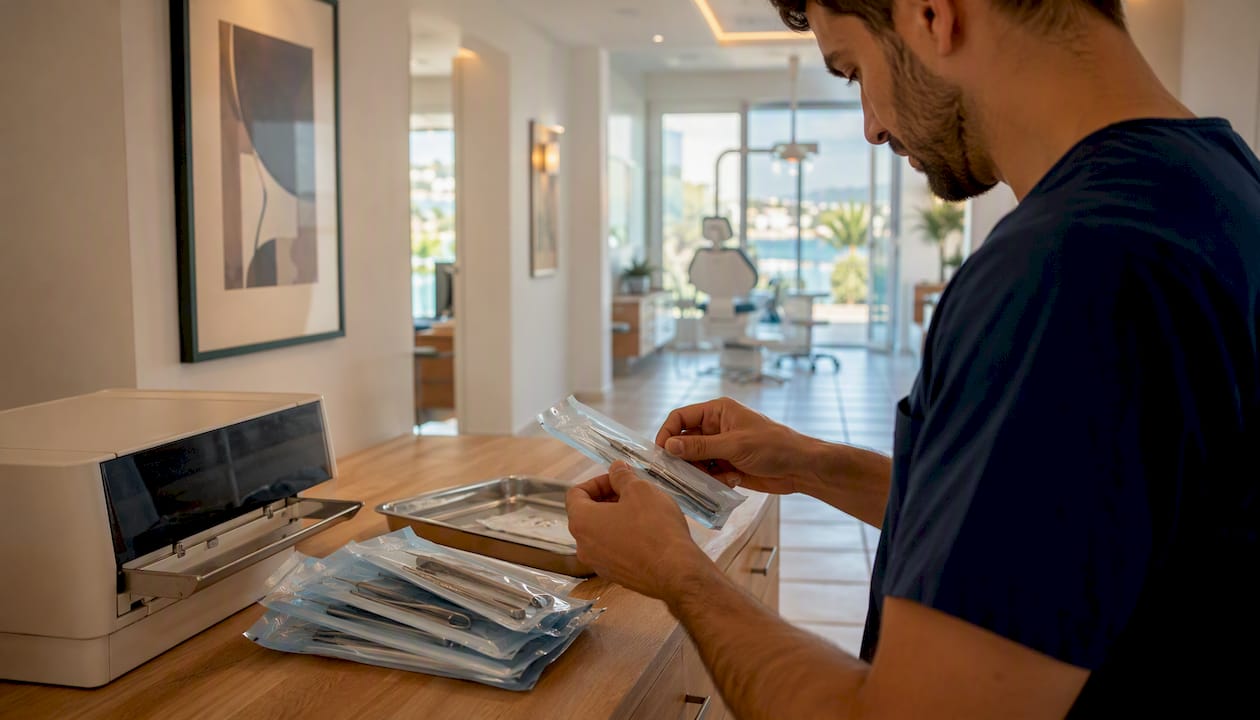
- Infection control standards: Sterilisation protocols, waterline management, and decontamination procedures are reviewed as part of the partner verification process.
- Patient review patterns: Review histories across independent platforms are assessed for consistency, recency, and the clinic’s responsiveness to complaints. A single spike of positive reviews is treated as a flag, not a signal of quality.
- Written aftercare agreements: Partner clinics are required to offer written warranty terms and a named aftercare contact for remote follow-up.
- On-site verification: Where possible, Clinicgroup conducts or commissions on-site audits of partner facilities before listing them.
- 2026 data currency: Clinic status, accreditation, and pricing are reviewed on a rolling basis. Clinics that do not maintain standards are removed from the platform.
Using a verified facilitator reduces booking risk in a practical way. Clinicgroup provides a single point of contact for clinic matching, travel logistics, and local aftercare coordination, which means patients are not navigating unfamiliar systems alone if a problem arises.
Clinicgroup’s perspective on what patients actually need
At Clinicgroup, we see the full picture of what dental treatment abroad involves, and we are direct about both the opportunity and the responsibility it carries.
The savings available through verified clinics in Albania and Dubai are real and substantial. A patient travelling to Tirana for a full set of porcelain veneers or a staged implant treatment can achieve savings that genuinely change what is financially possible for them. That matters, particularly given the cost of UK private dentistry and the limited availability of NHS complex restorative work.
What we are equally clear about is that those savings are only meaningful if the treatment is done well and followed up properly. Transparent pricing, written treatment plans, named treating clinicians, and documented aftercare agreements are not optional extras at Clinicgroup partner clinics; they are conditions of listing. We coordinate partner hotels, airport transfers, and local English-speaking assistance precisely because a patient who is well supported throughout their stay is far more likely to have a positive clinical outcome and a stress-free experience.
Speak to your own UK dentist first. That is not a disclaimer; it is the most useful thing you can do before any overseas dental consultation. Your UK dentist knows your dental history, can identify contraindications, and can help you evaluate whether the proposed treatment plan from an overseas clinic is clinically sound.
Clinicgroup: verified dental care in Albania and Dubai
For UK patients who have done their research and are ready to take the next step, Clinicgroup offers a patient-first route to dentistry in Albania and Dubai that removes the guesswork from clinic selection and travel planning.
What the Clinicgroup service includes:
- Clinic matching: Shortlisted, verified clinics aligned to your specific treatment needs and budget.
- Verified clinician profiles: Named dentists with confirmed qualifications and experience, available for direct pre-treatment consultation.
- Travel and hotel coordination: Partner hotel options close to clinics in Tirana and Dubai, plus airport transfer arrangements.
- English-speaking local assistance: On-the-ground support throughout your stay.
- Aftercare planning: Written aftercare agreements and a named contact for remote follow-up queries after you return home.
- Transparent pricing: Itemised written quotes before any commitment is made.
Clinicgroup facilitates bookings and coordinates the patient experience; it does not make medical guarantees or clinical promises about outcomes. Treatment decisions remain between you and the treating clinician.
To receive a no-obligation clinic match and written quote for your dental treatment, contact Clinicgroup or visit the dentistry treatments page to request a consultation.
Sources
The following authoritative sources informed this guide and are worth consulting directly for deeper information.
- Treatment abroad checklist - NHS
- General Dental Council — standards and guidance
- British Dental Association — dental tourism
- NaTHNaC / TravelHealthPro — travelling abroad for treatment
- Dental Defence Society — managing follow-up care after treatment abroad
- Dental Health Foundation — going abroad for dental treatment
- NHS England — clinical policy for self-funded dental treatment requiring NHS intervention
This article is general information, not a substitute for advice from a qualified doctor. Consult a qualified healthcare professional about your own circumstances before acting on anything here.
FAQ
Which country is best for dental work abroad for UK patients?
Albania is currently the strongest option for most UK patients, combining European clinical standards, English-speaking staff, short flight times of around two hours from London, and gross savings for implants and veneers that are typically 50–70% below UK private rates for comparable procedures. Dubai is the preferred choice for patients seeking JCI-accredited facilities or combining treatment with a longer stay.
Where in Europe offers the best dental treatment for UK patients?
Albania and Hungary consistently rank among the best European destinations for UK dental patients, with Albania offering the most competitive pricing and Hungary providing a long-established track record with clinics experienced in treating UK and German patients. Poland is a strong third option for those prioritising clinical standards at moderate savings.
What is the risk of getting dental work done abroad?
The main risks are variable clinical quality, limited regulatory recourse if treatment fails, and remedial costs on return. The BDA reports that 86% of UK dentists surveyed had treated patients with complications after overseas dental treatment. Choosing a verified clinic through a facilitator such as Clinicgroup, securing written warranty terms, and arranging specialist dental travel insurance significantly reduces these risks.
How many trips will I need for dental implants abroad?
A standard implant protocol requires at minimum two trips: one for implant placement and one for the crown fitting after a healing window of three to six months. Some clinics offer immediate-loading protocols for suitable patients that can reduce this to a single extended visit, but clinical eligibility criteria apply.
Does the NHS cover complications from dental treatment abroad?
The NHS will treat acute complications arising from overseas dental treatment, but it will not reimburse the cost of private treatment failures. NHS England’s policy confirms that access to remedial NHS care follows existing acceptance criteria, meaning there is no guarantee of prompt NHS treatment for complications from elective overseas procedures.