TL;DR:
- Booking a verified clinic and consulting your UK GP before travel significantly reduces risks for UK medical tourists seeking regenerative therapies abroad. Regenerative treatments stimulate the body’s repair mechanisms gradually, unlike traditional fillers that provide instant volume, with safety depending on clinic standards and proper planning. Proper pre-travel coordination, verification, and comprehensive aftercare plans are essential for safe, effective treatment outcomes.
For UK medical tourists, the clearest first step is to book a video consultation with a named treating clinician through a verified platform such as Clinicgroup before you commit to any travel. Choosing a verified clinic abroad for regenerative therapies means you benefit from pre-screened facility standards, board-certified specialists, transparent pricing, and a structured aftercare plan from day one.
- Choose a clinic verified for facility standards, clinician credentials, and published protocols.
- Arrange a video consultation with the treating clinician (not a sales agent) before booking flights.
- Confirm a written aftercare plan that covers your return to the UK.
- Budget for treatment, travel, at least one contingency visit, and emergency cover.
Pro Tip: Book your GP appointment before you enquire with any clinic abroad. Having a GP-reviewed medical summary ready speeds up the consultation process and signals to the clinic that you are a prepared, safety-conscious patient.
Table of Contents
- What are regenerative therapies, and how do they differ from traditional fillers?
- Safety, regulation and the UK patient context: what to check before you book
- How to choose a safe, credible clinic abroad for regenerative therapies
- How Clinicgroup verifies clinics and supports UK patients
- Typical regenerative treatments: what recovery and timelines look like
- What to budget: treatment, travel, aftercare and contingency
- How to prepare for the trip and manage aftercare on your return
- Key takeaways
- Clinicgroup’s perspective on regenerative medicine abroad
- Clinicgroup connects you to verified regenerative therapy clinics
- FAQ
- Useful sources and further reading
What are regenerative therapies, and how do they differ from traditional fillers?
Regenerative therapies stimulate the body’s own repair mechanisms, specifically neocollagenesis and fibroblast activation to improve tissue quality from within. Traditional fillers replace lost volume instantly; regenerative treatments build structural improvement progressively over weeks and months.
Common modalities you will encounter in clinic literature:
- PRP (Platelet-Rich Plasma): Your own blood is processed to concentrate growth factors, then injected or applied topically to stimulate collagen production in the face, scalp, or joints.
- PRF (Platelet-Rich Fibrin): A second-generation autologous biologic with a slower growth-factor release, often preferred for facial skin quality and hair restoration.
- Microneedling with biologics: Controlled micro-injuries combined with PRP or other topical biologics to accelerate skin remodelling.
- Bio-remodelling injectables: High-concentration hyaluronic acid formulations (such as Profhilo) that remodel the skin matrix rather than simply adding volume.
- Dental regenerative grafts: Bone and soft-tissue grafting protocols used ahead of implant placement to restore lost structure.
The clinical intent is progressive tissue quality improvement, not an instant transformation. Expert practitioners are moving away from corrective, volume-based approaches toward biological renewal that retrains tissue to age differently.
Statistic callout: According to the American Society of Plastic Surgeons, patient demand for regenerative aesthetic procedures including PRP and PRF has grown consistently as patients seek subtle, cumulative results rather than dramatic change.
Pro Tip: Always ask whether the PRP or PRF used is autologous (drawn from your own blood that day) or a commercially prepared product. Some clinics market treatments as “stem cell” therapies when the actual material is a standard biologic. Ask for the product name and batch documentation.
Safety, regulation and the UK patient context: what to check before you book
The single most important step before booking any treatment abroad is to discuss your plan with your GP or a UK specialist. This allows pre-existing conditions to be reviewed, medications to be assessed, and an aftercare route to be agreed before you travel.

Regulatory differences matter. A clinic verified under Albanian or UAE standards does not automatically meet MHRA or HTA equivalence. The MHRA Innovation Office is the UK’s single point of contact for regulatory queries on regenerative medicines, and UK regulators have no jurisdiction over clinics operating outside the UK.
Specific risks to be aware of:
- Infection at injection or incision sites
- Deep vein thrombosis (DVT), particularly after long-haul flights post-procedure
- Bleeding or haematoma
- Nerve injury with certain injectable protocols
- Delayed complications that present only after you return home
“Decisions about treatment abroad should be made on clinical quality, not holiday appeal. Thorough research and careful planning are non-negotiable.” — Travel Aware, UK Government
Pro Tip: Before you travel, insist on a written, itemised quote and a documented emergency and complication plan. If a clinic cannot provide both in English, treat that as a serious warning sign.
How to choose a safe, credible clinic abroad for regenerative therapies
Verification, published protocols, and a named treating clinician are the three non-negotiable criteria. Use this checklist in order when evaluating any clinic.
- Accreditation and facility standards — confirm the clinic holds recognised accreditation (JCI, ISO, or equivalent national standards) and operates in a licensed medical facility.
- Clinician credentials — verify the treating clinician’s board certification, specialty training, and registration number. Ask for their name before you book.
- Published protocols and evidence — request written treatment protocols. Some commercial regenerative protocols lack peer-reviewed support; a credible clinic will be honest about evidence levels.
- Itemised pricing — every cost should be listed: consultation, consumables, anaesthetist (where applicable), follow-up visits, and complication management.
- Aftercare and complication plan — written, in English, covering both in-country and post-return care.
- Patient reviews and documentation — verified reviews on independent platforms, plus published case documentation where available.
- Travel and recovery logistics — confirm recommended in-country stay, fitness-to-fly guidance, and partner accommodation.
Questions to ask in your pre-travel video consultation:
- What is your specific qualification and registration number?
- Which exact product or biologic will be used, and can I see the documentation?
- What is the complication rate for this procedure at your clinic?
- Who do I contact if I experience a problem after returning to the UK?
Red flags: hard-sell pressure, evasiveness about clinician identity, inability to provide written aftercare, and any clinic that refuses a direct video call with the treating clinician.
Pro Tip: A safe booking process always starts with the clinician, not the price. If the first conversation is about cost rather than your medical history, reconsider.
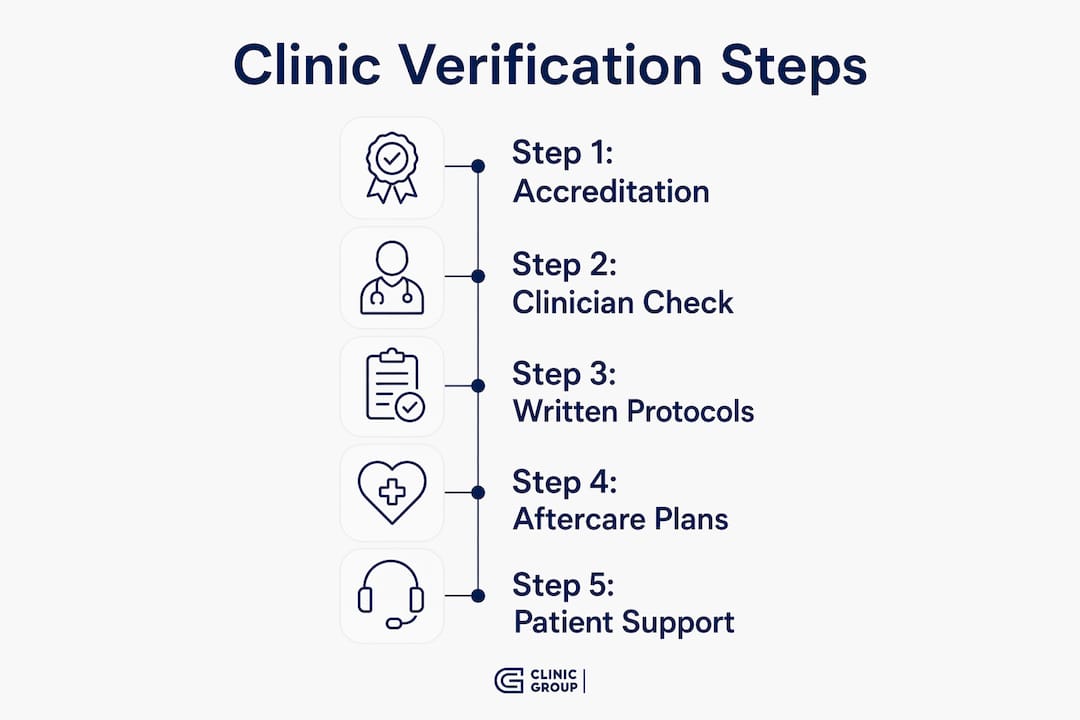
How Clinicgroup verifies clinics and supports UK patients
Clinicgroup matches patients to verified clinics in Albania and Dubai and manages logistics and aftercare coordination throughout the treatment process.
Verification criteria Clinicgroup applies to partner clinics:
- Facility licensing and accreditation standards
- Board-certified specialists with confirmed credentials
- Published treatment protocols and evidence standards
- Transparent, itemised pricing with written consent documentation
- Verified patient feedback and case documentation
The patient journey Clinicgroup supports includes clinic matching based on treatment type and budget, video consultations with the treating clinician, travel planning, partner hotel arrangements, in-country coordination, and post-return aftercare support.
Pro Tip: Clinicgroup can help you arrange GP liaison documentation and request written discharge and aftercare notes from the treating clinic in English, so your UK GP has everything needed to manage your follow-up care.
Typical regenerative treatments: what recovery and timelines look like
Different procedures carry different recovery windows and fitness-to-fly considerations. Planning your in-country stay around these is not optional.
| Procedure | Immediate recovery | Recommended in-country stay | Common post-procedure checks |
|---|---|---|---|
| PRP facial/scalp | Mild redness, 24–48 hrs | 1–2 days | Injection site review |
| PRF facial | Mild swelling, 24 hrs | 2–3 days | Skin response assessment |
| Microneedling with biologics | Redness, 48 hrs | 2–3 days | Healing and infection check |
| Bio-remodelling injectables | Minor swelling, 24–48 hrs | 1–2 days | Nodule/distribution review |
| Dental regenerative graft | Swelling, 3–5 days | 5–7 days | Wound integrity, infection |
Air travel soon after procedures increases DVT risk and can compromise wound healing. Brief returns are risky when:
- Swelling or wound sites have not stabilised
- Anticoagulation or anti-inflammatory medication is still active
- The clinician has not confirmed fitness to fly in writing
Staged protocols such as serial PRP or combined biologic programmes require multiple visits. Plan for this from the outset, whether that means repeat travel or arranging local follow-up with a UK practitioner.
What to budget: treatment, travel, aftercare and contingency
Always budget for treatment plus travel plus at least one contingency visit plus emergency funds. Underestimating the total cost is one of the most common mistakes UK medical tourists make.
Cost components to confirm with every clinic:
- Consultation fee (initial and follow-up)
- Consumables and biologics (PRP kits, grafting materials, injectables)
- Anaesthetist or sedation fees where applicable
- Diagnostic scans or blood tests
- Medications and post-procedure dressings
- Follow-up visits included in the package
- Complication management: what is covered and for how long
Typical price ranges vary significantly by destination and procedure complexity. Albania generally offers significant savings compared to equivalent UK private clinic prices for procedures such as PRP, PRF, and dental regenerative grafts. Dubai pricing is comparatively higher but remains competitive for complex anti-ageing and hair restoration protocols. Always verify that a quote is itemised and contractual, not an estimate.
Pro Tip: Check cancellation, complication, and repatriation policies before you pay any deposit. Confirm that English-language documentation and GP discharge notes are included in the quoted price, not charged as extras.
How to prepare for the trip and manage aftercare on your return
Arrange a GP consultation and obtain a written aftercare plan before you travel. This is the step most patients skip and most frequently regret.
Pre-travel checklist:
- Book a GP appointment; share your treatment plan and get a written medical summary.
- Review all current medications with your GP for interactions or pre-procedure adjustments.
- Purchase travel insurance that explicitly covers the planned medical procedure and potential complications.
- Book your recovery accommodation for the full recommended in-country period.
- Obtain a written, itemised quote and signed consent documentation from the clinic.
- Complete a video consultation with the treating clinician to confirm all details.
On return, hand your GP the written discharge and aftercare notes from the clinic. Schedule a follow-up appointment within two weeks. Know in advance who to contact for an emergency: the clinic’s international patient coordinator and your GP or nearest A&E.
Pro Tip: Plan your flight home for at least 24–48 hours after minor regenerative procedures and 5–7 days after dental grafting or combined protocols. Sitting immobile in a pressurised cabin too soon after treatment raises DVT risk. Confirm fitness to fly in writing with your clinician before you book the return flight.
Key takeaways
Choosing a verified clinic through Clinicgroup, consulting your UK GP before travel, and securing a written aftercare plan are the three steps that most reduce risk for UK medical tourists seeking regenerative therapies abroad.
| Point | Details |
|---|---|
| Verify the clinic first | Confirm accreditation, named clinician credentials, and published protocols before any payment. |
| Consult your UK GP | Discuss your treatment plan with your GP and agree an aftercare route before you travel. |
| Budget for the full trip | Include treatment, travel, contingency visits, and emergency funds in your total budget. |
| Plan your recovery window | Stay in destination for the clinician-recommended period; confirm fitness to fly in writing. |
| Book via Clinicgroup | Clinicgroup matches you to verified clinics in Albania and Dubai with full logistics and aftercare support. |
Clinicgroup’s perspective on regenerative medicine abroad
The most consistent pattern we see among patients who have a positive experience abroad is preparation. Those who arrive with a GP-reviewed medical summary, a written quote, and a named clinician they have already spoken to on video are far better placed to manage any unexpected development. Regenerative therapies, done well, deliver progressive and genuine improvement. But “done well” depends entirely on the clinic’s standards, the clinician’s credentials, and the aftercare structure around the treatment. Clinicgroup exists to make those three things verifiable before a patient boards a flight. Transparent pricing, board-certified specialists, and coordinated aftercare are not optional extras; they are the baseline every patient deserves.
Clinicgroup connects you to verified regenerative therapy clinics
Clinicgroup takes the uncertainty out of finding a credible clinic abroad. Rather than researching dozens of providers independently, you are matched to a verified clinic in Albania or Dubai that fits your specific treatment needs, whether that is anti-ageing skin rejuvenation, hair restoration with PRP adjuncts, or dental regenerative grafting. Every clinic in the Clinicgroup network has been assessed for facility standards, clinician credentials, and transparent pricing. Video consultations with the treating clinician are arranged before you travel, and aftercare coordination continues after you return home. To take the first step, contact Clinicgroup and request a matched consultation for your chosen treatment.
FAQ
What are regenerative therapies in aesthetics?
Regenerative therapies such as PRP, PRF, and bio-remodelling injectables stimulate the body’s own repair mechanisms to improve tissue quality progressively, rather than replacing volume instantly as traditional fillers do.
Is it safe to have regenerative treatments abroad?
It can be safe when the clinic is properly verified, the treating clinician is board-certified, and a written aftercare plan is in place before you travel. The NHS advises discussing any planned treatment abroad with your GP first.
How do I verify a clinic for regenerative therapies?
Confirm accreditation, request the treating clinician’s name and registration number, ask for written protocols, and insist on a video consultation with the clinician directly. Evasiveness on any of these points is a red flag.
How long should I stay after a regenerative procedure abroad?
Minor procedures such as PRP or bio-remodelling typically require 1–3 days in destination; dental regenerative grafts need 5–7 days. Always confirm fitness to fly in writing with your clinician before booking your return flight.
Can Clinicgroup help arrange aftercare for UK patients?
Yes. Clinicgroup coordinates written discharge and aftercare notes in English, supports GP liaison, and provides post-return follow-up coordination for all patients treated through its verified clinic network.
Useful sources and further reading
“UK health bodies consistently advise that clinic choice should be driven by safety, standards and clear aftercare plans, not marketing or holiday appeal.” — NHS Treatment Abroad Guidance
- NHS: Treatment abroad checklist for UK patients — primary reference for GP consultation, aftercare planning, and risk awareness.
- Travel Aware: Surgery abroad, cut out the risk — UK Government guidance on verifying clinics and avoiding decisions based on cost or holiday appeal.
- TravelHealthPro: Medical tourism, travelling for treatment — practical guidance on recovery windows, DVT risk, and fitness to fly.
- ASPS: Regenerative aesthetics, PRP, PRF and beyond — clinical overview of regenerative modalities and patient expectations.
- LSRI: Stem cell therapy truth and patient guide — honest assessment of evidence levels for commercial regenerative protocols.
- GOV.UK: Advanced therapy medicinal products regulation and licensing in the UK — MHRA regulatory framework for regenerative medicines in the UK.
- Clinicgroup: Aftercare checklist for patients — practical pre- and post-travel aftercare guidance for Clinicgroup patients.