A UK GHIC can help with medically necessary state healthcare in the EEA and certain other countries, on the same basis as residents, but excludes private treatment and repatriation. Options for UK travellers include an eligible GHIC or EHIC, travel insurance, international private medical insurance and self-pay care. The right arrangement depends on why and how long you travel.
It’s understandable to expect a health card or insurance policy to cover more than it does. In practice, cover depends on the type of care, the country and the terms of the policy. Travel insurance is designed for trips, while international health insurance can provide cover for healthcare over a longer period; exclusions may apply, including to pre-existing conditions and cosmetic treatment.
This guide explains how healthcare options outside the UK differ, what you may pay for NHS services at home, and how private or self-pay treatment fits in. It also sets out what a GHIC does and does not cover, helping you compare care at home with care abroad.
Key Takeaways
- Separate routine NHS charges from private and self-pay care to understand what may come out of your own pocket.
- Match private medical insurance to the care you need, including whether outpatient treatment and existing conditions are covered.
- A UK GHIC can help with medically necessary state healthcare in eligible destinations, but it does not cover private treatment or repatriation.
- For a longer stay abroad, consider how residency status, visa arrangements and local registration affect access to healthcare.
- Before arranging treatment overseas, understand how to find a suitable clinic and what information may be needed to register for care.
Health care spending and out-of-pocket costs
In England, patients may pay directly for some NHS services, including prescriptions and dental treatment. Prescription charges apply to each item, not to the prescription as a whole. Before collecting medication, check whether you qualify for an exemption or another arrangement that affects the amount you pay.
Private healthcare involves a separate financial arrangement. With self-pay care, you pay the provider directly for treatment. With private medical insurance, the insurer contributes towards eligible treatment under the policy terms. For example, if you see a specialist privately, the consultation, tests and follow-up may be charged separately, particularly if the policy excludes any of them.
Insurance does not mean one payment covers every type of care. The premium pays for the policy, while an excess is the amount you contribute towards eligible claims. Some international private medical insurance plans settle inpatient bills directly with a hospital or clinic. This can avoid waiting for reimbursement, but outpatient care is not included in every plan.
- Age and medical history: insurers may use these details when assessing the premium and deciding how pre-existing conditions are treated.
- Destination and geographical area: cover for selected countries affects the policy’s scope and price. A plan covering Europe differs from one that includes wider international destinations.
- Level of cover: inpatient treatment, outpatient consultations, routine care and check-ups can be included or excluded according to the plan.
- Excess and optional benefits: choosing a higher excess or adding benefits changes the balance between the premium and what the patient may pay when claiming.
These differences matter whether you are making a short visit or spending longer abroad. Travel insurance is designed for trips, while international health insurance can cover ongoing healthcare needs. Read the exclusions carefully: cosmetic treatment, care that is not medically necessary and treatment outside the policy’s geographical area may not be covered. If you are arranging planned treatment, check whether the policy covers elective care, rather than only ordinary illness.
To compare what you could pay, separate the premium, excess, excluded services and any direct-payment arrangements. Then match each item to the treatment and country you have in mind. A clinic comparison checklist for international healthcare can help you consider practical details alongside the financial terms, rather than comparing the premium alone.
Private healthcare and self-pay treatment
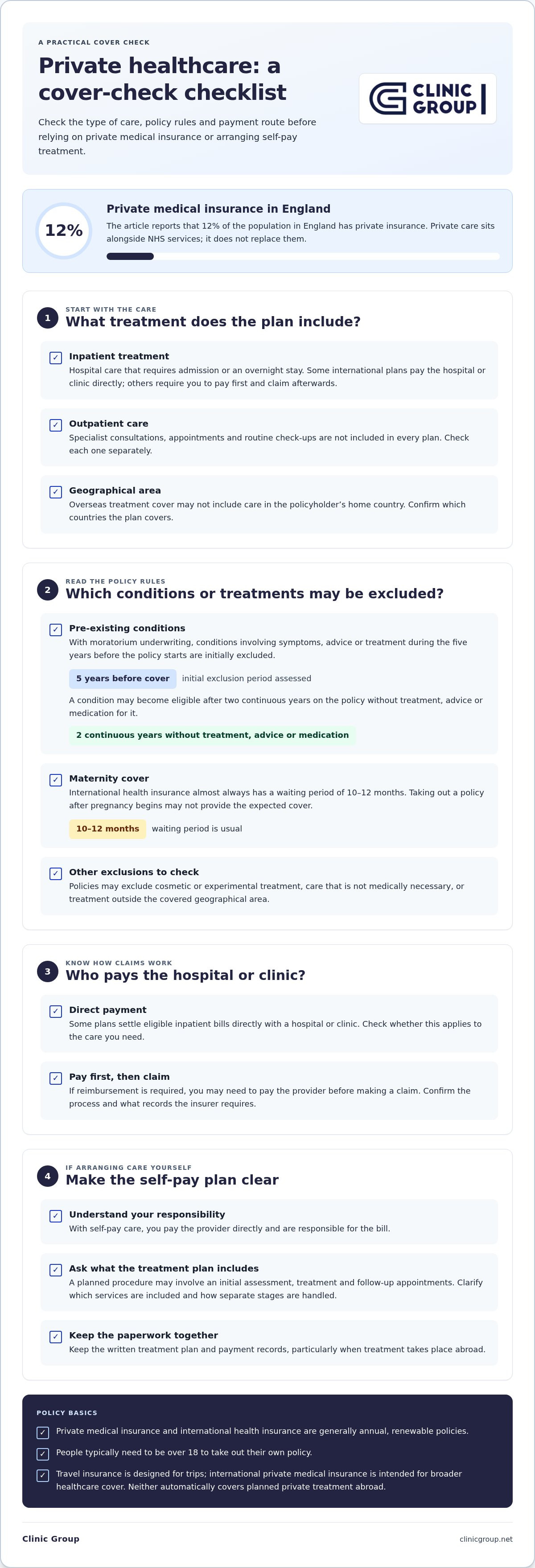
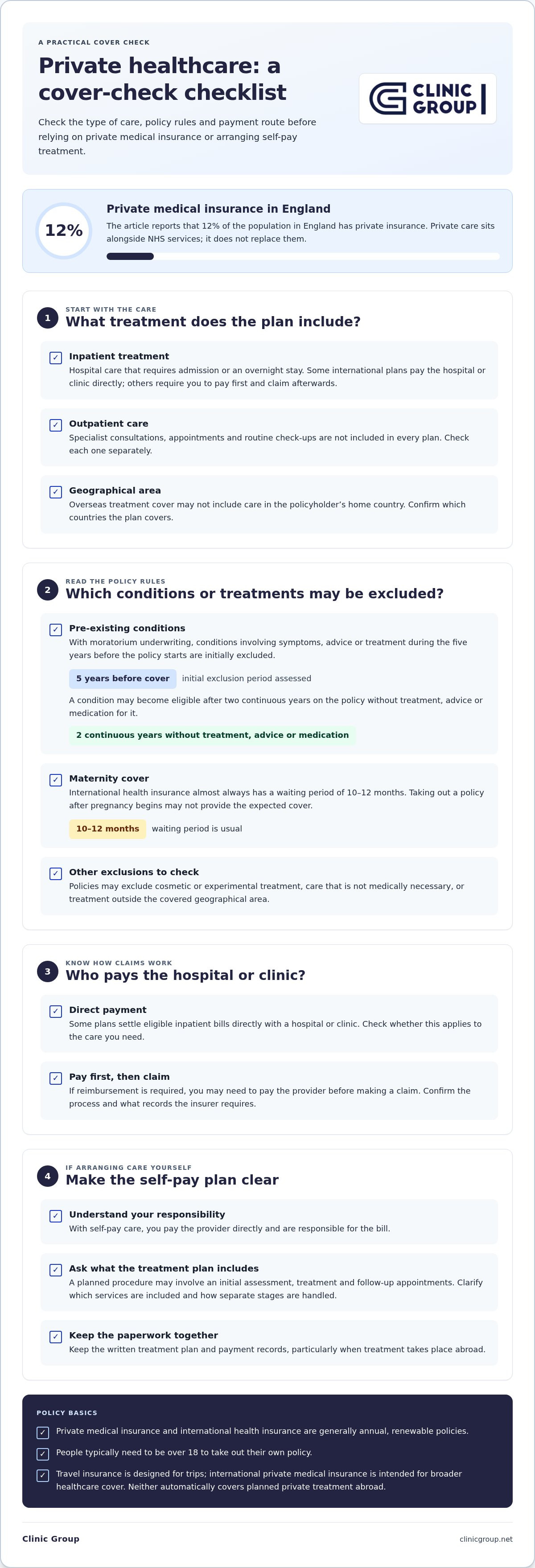
Private care in England sits alongside the NHS, rather than replacing its public services. Private insurance covers 12% of the population in England. Patients can also arrange treatment themselves and pay the hospital or clinic directly. This self-pay route may suit someone seeking a particular appointment or planned procedure, but it places responsibility for the bill on the patient.
Private medical insurance and international health insurance are generally annual, renewable policies. People typically need to be over 18 to take out their own policy. Cover depends on the selected plan, and a health insurance card does not automatically mean every treatment is included. A global policy’s geographical area matters: cover for overseas treatment may not include care in the policyholder’s home country.
Before choosing a policy, compare its cover with the care you expect to need. Inpatient treatment involves hospital care requiring admission or an overnight stay. Some international plans pay hospitals or clinics directly for inpatient care; others may require you to pay first and claim later. Outpatient consultations, specialist appointments and routine check-ups are not covered by every plan.
- Existing conditions: moratorium underwriting initially excludes conditions with symptoms, advice or treatment during the five years before the policy starts. A condition may become eligible after two continuous years on the policy without treatment, advice or medication for it.
- Maternity: maternity cover on international health insurance almost always has a waiting period of 10-12 months. A policy taken out after pregnancy begins may therefore not provide the expected cover.
- Exclusions: policies may exclude cosmetic or experimental treatment, care that is not medically necessary, or treatment outside the covered geographical area.
- Payment route: check whether the insurer pays the hospital directly or reimburses the patient after a claim. This affects how much money the patient needs available at the time of treatment.
Self-pay care avoids insurance eligibility rules, but you need to understand exactly what the provider’s treatment plan includes. A planned procedure, for example, may involve an initial assessment, treatment and follow-up appointments. Clarify which services are included and how separate stages are billed. Keep the written plan and payment records together, particularly when treatment takes place abroad.
Travel insurance and global health insurance serve different purposes. Travel insurance is designed for a trip, while international private medical insurance is intended for broader healthcare cover. Neither automatically covers planned private treatment abroad. For a procedure, review the policy wording for elective care and exclusions before relying on insurance. Patients exploring planned care can browse Clinic Group’s international healthcare directory to understand the available treatment pathways.
What healthcare options are available to UK citizens travelling abroad?
For temporary trips, UK travellers can use a UK GHIC or eligible UK EHIC to access medically necessary state healthcare in the European Economic Area and certain other countries. Treatment is provided on the same basis as it is for residents of the country visited, so local charges may still apply. A card does not make every service free.
A UK GHIC is valid for up to five years. Each family member needs their own card, including children. Some UK EHIC eligibility routes require residence in the EEA or Switzerland before 1 January 2021. An EHIC issued under Withdrawal Agreement rights is free and lasts for up to five years. The card type and eligibility route depend on the traveller’s circumstances.
- Use the GHIC or EHIC for eligible state care: it covers medically necessary treatment during a visit, where the destination participates in the scheme. It does not cover treatment that local residents must pay for.
- Arrange travel insurance before departure: a GHIC or EHIC does not cover private medical facilities, medical repatriation to the UK, or ski and mountain rescue.
- Disclose health conditions: tell the insurer about existing conditions, including conditions under investigation. Serious medical conditions may require a specialist insurance policy.
- Review trip duration: travel insurance is typically designed for trips of up to 90 days. Moving abroad to live, work or study calls for different healthcare and insurance arrangements.
Travel insurance and a GHIC have different purposes. A traveller who needs medically necessary care at a participating state hospital may use the card. It does not cover a private clinic visit or a return journey to the UK. Travel insurance may help with eligible emergency treatment and related evacuation or repatriation, subject to the policy terms.
International private medical insurance may suit people who need cover beyond a short trip. Its geographical area determines where care is covered, and policies vary in how they treat existing conditions. Some cover hospital stays, specialist consultations or routine check-ups, while others exclude outpatient care. If you need cover in the UK, choose a plan that includes the UK.
Before leaving, confirm that every traveller has the appropriate card and insurance documents. Read the policy’s exclusions and assistance instructions, and keep the insurer’s contact details accessible. Travel insurance providers should offer 24-hour assistance helplines for advice about appropriate treatment. These arrangements help clarify which route applies if illness or injury occurs overseas.
What visas or residency rules affect access to healthcare overseas?
A visa gives permission to enter or remain in a country; it does not, by itself, establish entitlement to healthcare. Access depends on the destination’s rules, your residency status and any healthcare agreement that applies. A short visit, study placement and move for work may each involve different arrangements. Keep immigration documents separate from health cover documents.
For UK residents studying in the EEA or Switzerland, the start date of study matters. People who began studying there after 1 January 2021 need to apply for a UK Student GHIC. A student card is specific to that route, rather than a general replacement for checking local eligibility. Each person should keep their card and travel documents accessible during their stay.
Residency also affects access when someone moves to the UK. Expatriates living and working in the UK can apply to register with an NHS GP practice using a GMS1 form. Registration provides a route to primary care, but a GP referral does not necessarily mean the patient is entitled to free NHS hospital treatment. These are separate questions: GP registration and hospital charging status.
- For a temporary visit: check whether a healthcare agreement or card applies to the destination and the traveller’s status. A visa alone does not show that planned or private care is covered.
- For study abroad: establish whether the UK Student GHIC route applies. The relevant date is when study began, not simply the date of travel.
- For a move overseas: distinguish travel insurance from arrangements intended for living abroad. Travel insurance is not intended for permanent residence.
- For a move to the UK: use the GMS1 process to apply for GP registration, then consider hospital entitlement separately.
UK immigration permission has its own health-related requirement. Most adults applying for UK immigration permission pay an immigration health surcharge. Students, Youth Mobility Scheme applicants and children under 18 pay a different surcharge. This relates to immigration permission in the UK, not automatic access to healthcare in another country. A UK visa or residence document should not be treated as overseas health insurance.
Before travelling for study, work or a longer stay, identify the purpose and length of the visit, the visa category and the applicable healthcare route. Then keep proof of residency, immigration status and insurance together. For instance, a student starting an EEA course after 1 January 2021 should consider the Student GHIC route, while someone relocating for work needs arrangements suited to residence rather than a short trip.
How can UK residents find and register with a doctor or hospital abroad?
First decide whether you need routine care during a stay, ongoing care after relocating, or planned treatment. Each need can involve a different type of provider and registration process. For example, a visitor who needs a prescription may contact a local doctor, while someone moving for work may need to join a local primary-care system. Those seeking specialised nutritional or lifestyle support might also turn to private allied health services, such as Wise Eats Registered Dietitians, to maintain personal wellbeing abroad. The destination’s rules determine how registration works.
For planned care, start by identifying the relevant specialty; for instance, international directories like Upper Cervical Care help patients locate specialist clinicians in specific fields. Look for a provider that offers the service you need and ask whether it can assess your concern. Check that the provider handles the treatment you need, and find out whether the first appointment involves an assessment, tests or a treatment plan. A clear summary of your medical history helps the provider understand your needs.
Use these steps to prepare for an appointment:
- Define the care needed: describe the symptoms, diagnosis or procedure in plain language. Note when the issue began and any treatment already received.
- Contact the provider: ask how appointments are booked and whether registration forms are required. Establish whether the first visit is for assessment or treatment.
- Prepare records: gather relevant medical history, current medication details, test results and referral documents. Keep copies available in a format the clinic can review.
- Clarify communication: establish the language used for consultations and written instructions. Make sure you understand how to discuss symptoms, treatment choices and follow-up.
- Plan continuity: ask how the provider shares records and care plans with your existing clinicians. This helps keep information consistent when you return to the UK.
If you are staying longer, ask the local health authority or practice how to register. Documents and eligibility criteria vary by country and residency status, so find the process that applies to your circumstances. Keep evidence of your address and residency available if requested. Do not assume a UK GP referral automatically registers you with an overseas practice.
Hospital care follows a different route from routine GP-style care. In an emergency, use the destination’s emergency service. For planned hospital treatment, find out whether you need a specialist referral or an initial consultation. Ask how the hospital will receive your medical records and who will explain the proposed care. This helps distinguish an assessment appointment from admission for treatment.
Before travelling, save the provider’s appointment details, address and instructions somewhere accessible. Share your itinerary with someone at home and keep your UK GP’s contact details. If you are arranging planned treatment abroad, clear communication about your records, assessment and follow-up helps you understand each stage of care.
Clinic Group: Dental Treatment Directory
Clinic Group’s Dental Treatment Directory helps patients explore dental care through its verified partner clinics, mainly in Tirana, Albania, with a small number in Dubai. It can be a useful next step if you are considering treatment abroad and want to compare clinic options alongside the practical arrangements discussed above.
Clinic Group also offers Hair Transplant Referrals, an Ophthalmology Clinic Directory and Medical Tourism Treatment Guides. The platform connects patients with listed clinics; the clinics themselves provide clinical assessment and treatment. This distinction makes clear who will discuss your care and where treatment takes place.
To explore the directory or ask Clinic Group about its listings, visit clinicgroup.net.
Make your next healthcare decision with clarity
Choosing healthcare options outside the UK starts with matching the care you need to the right route. For planned treatment, consider what assessment involves, how follow-up will be arranged and how your records can support continuity when you return home.
Clinic Group offers a Dental Treatment Directory, Hair Transplant Referrals and Plastic Surgery Provider Listings to help patients explore relevant clinic options. The listings help you research and connect with providers; clinical assessment and treatment are provided by the clinics.
Take the next step at your own pace: explore the information, identify the treatment area that fits your needs and decide how you would like to proceed.
A considered decision starts with clear information. Use it to approach your next step with greater confidence.
Frequently Asked Questions
What healthcare options are available outside the UK?
Options include state healthcare available through a reciprocal arrangement, private medical insurance, travel insurance and self-pay treatment. The suitable route depends on whether you need urgent care during a visit, routine care during a longer stay or planned treatment. These arrangements are distinct: a card for state healthcare does not automatically cover private clinics, and insurance cover depends on the policy terms.
How does healthcare work for UK residents living abroad?
Access depends on the destination’s rules and your residency status. If you are staying longer, find out how to register with local primary care and which documents the practice requires. Keep an up-to-date list of medicines, allergies and relevant diagnoses, and arrange to share it with a new doctor. This helps the clinician understand your care history without relying on memory alone.
What are the costs of paying for healthcare out of pocket in popular destinations?
There is no single out-of-pocket charge that applies across destinations or types of care. The amount depends on the treatment, provider, local charging arrangements and whether consultations, tests or follow-up are billed separately. For planned care, request an itemised written estimate before agreeing to treatment. For unexpected care, ask the provider to explain the proposed services and charges before non-urgent treatment begins.
Will travel insurance cover planned treatment abroad?
Travel insurance is designed for trips, not as general cover for planned elective treatment. The policy wording determines what is covered, and exclusions may apply to care that is not medically necessary or falls outside the policy’s geographical area. Before travelling for planned care, read the relevant exclusions and ask your insurer about the specific treatment. Clarify whether complications arising from elective care are covered.
What documents should I prepare for an overseas medical appointment?
Prepare a concise medical history, an up-to-date medication list, details of allergies and any relevant test results or referral letters. Include the reason for the appointment and details of treatment already received. Keep copies accessible while travelling, organised so the clinician can quickly find important information. If a document uses unfamiliar terminology, ask your usual clinician to explain key diagnoses before departure.
How can I arrange continuity of care after treatment abroad?
Before travelling, find out how you will receive your treatment summary, test results and follow-up instructions. Ask how these records can be shared with your UK GP or another clinician involved in your care. Keep copies of correspondence and note whom to contact with post-treatment questions. A clear handover helps your clinician at home understand what care took place and what follow-up was recommended.

Article by
Clinic Group Editorial Team
The Clinic Group editorial team publishes clear, practical guides for UK and EU patients researching medical travel — from dental implants and hair transplants to plastic surgery and eye care — with a focus on verified clinics, transparent “from” pricing, and safe planning.
Disclaimer
This article is for general information only and is not medical advice, diagnosis, or a substitute for an in-person consultation with a qualified clinician. Treatment suitability, risks, timelines, and costs vary by individual. Clinic Group connects patients with independent clinics; those clinics are responsible for clinical care. Always verify credentials, obtain a written treatment plan and itemised quote, and confirm aftercare arrangements and travel insurance cover (elective procedures are often excluded) before booking. Outcomes cannot be guaranteed.