TL;DR:
- Dental warranties are voluntary agreements where dentists promise support for specific treatments over a set period. They do not guarantee outcomes and can be voided by patient behaviors like smoking or poor oral hygiene. Warranties often do not transfer if the dentist leaves or the patient moves, emphasizing the importance of written terms and proper maintenance.
What is a dental warranty, and do UK dentists offer them?
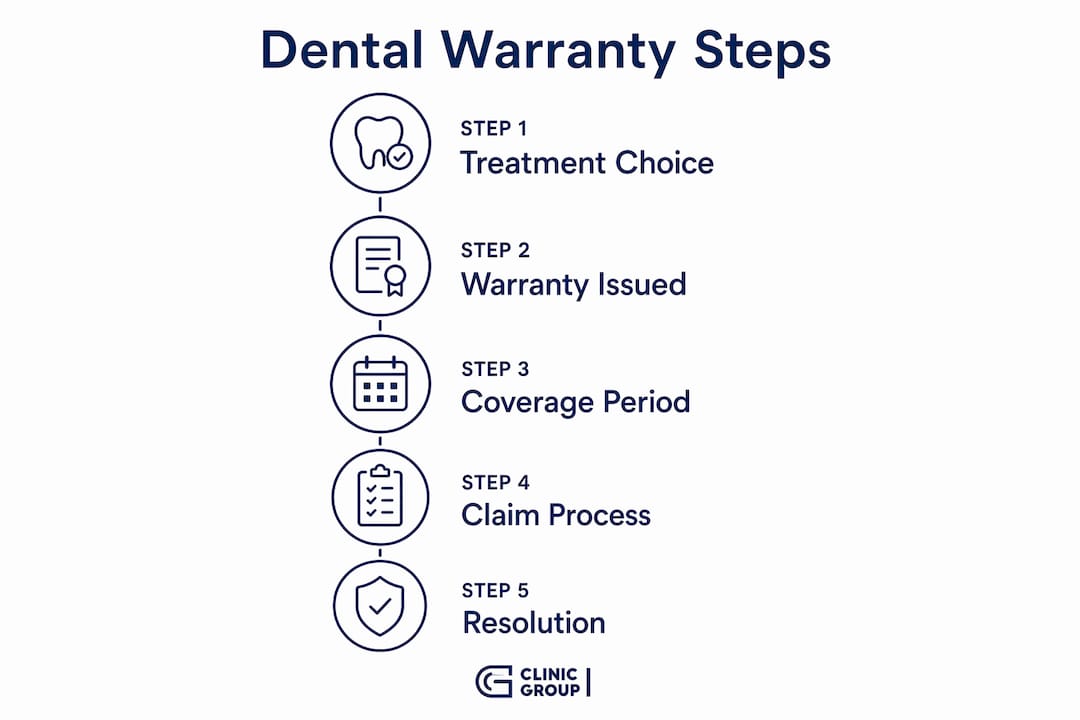
A dental warranty is a contractual promise from a dental provider that a specific treatment will be supported for a defined period. If the work fails within that time, the dentist agrees to repair or replace it, usually at no additional charge. Understanding how dental warranties work helps you ask the right questions before treatment begins, not after something goes wrong.
In the UK, dental warranties are voluntary. The General Dental Council does not require dentists to offer them, but it does require clear disclosure when they are offered. That means if your dentist provides a warranty, they must tell you exactly what it covers, how long it lasts, and what would void it.
The NHS operates differently. Certain NHS restorations in England carry a 12-month guarantee as a built-in feature of the treatment contract, not as an optional extra. Private dental warranties, by contrast, are negotiated terms between clinic and patient, with no standardised format across the industry.
Key distinctions to understand before signing anything:
- A warranty is a contractual assurance, separate from the dentist’s general duty of care
- Warranties do not guarantee clinical outcomes, only repair or replacement within set conditions
- NHS guarantees apply only to certain restorations at the original practice
- Private warranties vary significantly between providers in scope, duration, and exclusions
Which treatments are typically covered, and for how long?
Coverage depends heavily on whether your treatment is NHS or private, and on the specific material and procedure involved.
NHS dental warranties in England cover a defined list of restorations for 12 months from completion:
- Fillings
- Root fillings
- Inlays and onlays
- Porcelain veneers
- Crowns
Repair or replacement within that window carries no charge to the patient, provided the failure was not caused by trauma or subsequent private treatment on the same tooth. In Wales, the NHS warranty period extends to 24 months for routine treatment, with bridges and dentures also included.
Private dental warranties are far less uniform. Dental implant fixtures often carry extended coverage for mechanical or integration failure, while crowns and bridges usually have shorter durations. Veneers and composite bonding tend to attract shorter terms, reflecting their material sensitivity. Manufacturer warranties on implant components can extend coverage further, though these operate separately from the clinical warranty your dentist provides.

Pro Tip: Ask your dentist whether the warranty covers the implant fixture, the crown placed on top, or both. These are often separate agreements with different durations.
One important nuance: implant warranties generally exclude biological complications such as peri-implantitis unless the problem is traced to faulty materials. The distinction between a mechanical failure and a biological one matters considerably when making a claim.
What can void your dental warranty coverage?
Most warranty disputes arise not from poor dentistry, but from patient behaviour after treatment. Patient-controlled factors are the most frequent void triggers for dental warranties, and providers are entitled to decline claims when these apply.
Common reasons a warranty may no longer apply:
- Smoking accelerates gum recession and implant failure, and many providers exclude smokers from warranty coverage entirely
- Bruxism (teeth grinding) without a fitted night guard places excessive force on restorations and is a standard exclusion
- Poor oral hygiene, evidenced by gum disease or decay around the treated tooth, typically voids coverage
- Missing scheduled check-ups is one of the most overlooked void conditions; most warranties require attendance at specified intervals
- Subsequent private treatment on the same tooth after NHS work automatically removes the NHS guarantee
- Trauma, such as a sports injury or accident, is excluded from both NHS and most private warranties
Beyond patient behaviour, structural factors also affect validity. Warranties may lapse if the original provider leaves the practice or if clinic ownership changes. Most warranties do not transfer to a new dentist, which means patients who relocate may find their coverage unenforceable.
Pro Tip: Before treatment, ask in writing whether your warranty transfers if you move or if the dentist departs. Get the answer documented alongside your warranty certificate.
What does UK law and professional guidance say about dental warranties?
The GDC’s Standards for the Dental Team make the position clear: warranties are not mandatory, but transparency about them is. Standard 1.8 requires dentists to have appropriate indemnity arrangements so patients can seek compensation for harm. A warranty sits alongside this framework, not in place of it.
From a legal perspective, warranties are contractual promises that simplify repair recourse but differ from the dentist’s duty of care. Once a warranty expires, patients revert to standard negligence law if they wish to pursue a claim. The warranty period therefore sets a clear temporal boundary on the easier contractual route.
There is a subtlety here that patients often miss. Issuing a broad warranty can actually create obligations for a dentist that go beyond what negligence law would require. A treatment that was carried out competently and met all professional standards could still trigger a warranty claim if it fails within the covered period, even without any fault. This is why some providers offer limited, carefully worded warranties rather than open-ended guarantees.
Consumer protection legislation in the UK, including the Consumer Rights Act 2015, also applies to dental services. If a service is not carried out with reasonable care and skill, patients have statutory remedies regardless of whether a warranty was offered. A warranty does not remove these rights; it adds a parallel contractual layer.
Practical advice for patients: getting the most from your warranty
The most reliable way to protect yourself is to treat the warranty as a document, not a verbal assurance. Before any procedure begins, request the terms in writing. A reputable practice will provide this without hesitation.
Once treatment is complete, your responsibilities include:
- Following the aftercare instructions provided by your dentist
- Attending all scheduled maintenance appointments, typically every six months
- Maintaining a consistent oral care routine that supports the longevity of your restoration
- Keeping your warranty certificate alongside your treatment records
Dental warranties versus dental insurance serve different purposes. A warranty is a provider commitment covering the specific treatment they performed. Dental insurance is a financial product you purchase separately, covering a broader range of future dental costs. The two can coexist, but a warranty claim goes to your dentist, while an insurance claim goes to your insurer.
If you financed your dental treatment, be aware that financing contracts may remain payable regardless of warranty claims unless a dispute is formally resolved. Raising a warranty claim does not automatically pause your repayment obligations.
For patients considering treatment options, understanding why dental costs differ helps contextualise how warranty terms affect overall value, not just the upfront price.
How dental warranties work when you treat abroad with Clinicgroup
Receiving dental treatment outside the UK raises specific questions about warranty enforcement. If something needs attention after you return home, who do you contact, and how does the process work?
Clinicgroup addresses this directly by connecting patients with verified dental clinics in Albania that operate to European standards of care and provide transparent, written warranty terms before treatment begins. Partner clinics such as Dental Med Austria Tirana and Initio Dental Clinic offer structured warranty documentation as part of the treatment package.
Key considerations for patients receiving dental care abroad:
- Request written warranty terms in English before travelling, covering duration, covered procedures, and exclusions
- Understand the claims process: most warranties require you to return to the original clinic for assessment, so factor potential return travel into your planning
- Aftercare continuity matters: Clinicgroup arranges follow-up support and can facilitate second opinions, which is particularly valuable for implant patients
- Language and jurisdiction: warranty terms should specify which country’s law governs the agreement and how disputes are handled
- Partner hotel and logistics support: Clinicgroup’s treatment journeys include accommodation and travel coordination, reducing the practical barriers to returning for warranty-related appointments if needed
The savings available through dental treatment abroad can be considerable, but only when warranty terms are as clear as the pricing. Clinicgroup’s clinic-matching process includes reviewing warranty policies alongside clinical credentials, so patients are not comparing costs in isolation.
Consumer rights and dispute resolution for dental warranties in the UK
When a warranty claim is disputed, patients in the UK have several routes available. The first step is always to raise the issue directly with the practice in writing, clearly referencing the warranty terms and the nature of the failure.
If the practice does not resolve the matter, the next step is the Dental Complaints Service, which handles complaints about private dental treatment in England, Wales, and Northern Ireland. For NHS treatment, the NHS complaints procedure applies, and unresolved cases can be escalated to the Parliamentary and Health Service Ombudsman.
The GDC can investigate concerns about a dentist’s fitness to practise, though this route addresses professional conduct rather than contractual warranty disputes. For financial claims, the small claims court is available for amounts up to £10,000 in England and Wales, and the process is designed to be accessible without legal representation.
Patients should keep all written communications, warranty certificates, treatment records, and receipts. This documentation is the foundation of any successful dispute, whether through the practice, a complaints body, or the courts.
Key takeaways
Dental warranties in the UK are voluntary contractual assurances, not regulated entitlements, and their value depends entirely on the clarity of their terms and the patient’s commitment to maintaining the treated work.
| Point | Details |
|---|---|
| NHS guarantee scope | NHS restorations in England carry a 12-month guarantee; Wales extends this to 24 months for routine treatment. |
| Private warranty variation | Implant fixtures typically carry 5–10 year coverage; crowns and bridges usually 1–5 years. |
| Common void triggers | Smoking, bruxism without a night guard, missed check-ups, and subsequent private treatment on the same tooth all void coverage. |
| GDC transparency requirement | The GDC does not mandate warranties but requires dentists to disclose all terms, durations, and exclusions when one is offered. |
| Dispute resolution options | Unresolved warranty disputes can be escalated to the Dental Complaints Service, NHS complaints procedure, or small claims court. |
FAQ
Do dentists in the UK have to warranty their work?
No. The GDC does not require dentists to offer warranties, but if one is provided, the dentist must clearly disclose what it covers, how long it lasts, and any exclusions that apply.
Who is responsible if a dental implant fails?
Responsibility depends on the cause. If the failure is mechanical or linked to faulty materials within the warranty period, the providing clinic is typically liable for repair or replacement. Biological complications such as peri-implantitis are usually excluded unless caused by a material defect.
What is the 12-month rule for NHS dental treatment?
Certain NHS restorations in England, including fillings, crowns, root fillings, inlays, onlays, and porcelain veneers, are guaranteed for 12 months from the date of fitting. Repair or replacement within that period carries no charge, provided the failure was not caused by trauma or subsequent private treatment on the same tooth.
Does a dental warranty transfer if I change dentist?
Most dental warranties do not transfer to a new provider. Claims generally require returning to the original practice, and coverage may lapse entirely if the treating dentist leaves or the clinic changes ownership. Always confirm transferability in writing before treatment.
Is a dental warranty the same as dental insurance?
No. A warranty is a commitment from your dentist covering the specific treatment they performed. Dental insurance is a separate financial product covering a broader range of future dental costs. The two serve different purposes and operate independently.