What is a UK medical visa and who needs one?
A UK medical visa is not a separate visa category. It is a specific type of Standard Visitor visa issued to people who need private medical treatment in the United Kingdom. Understanding this distinction matters, because the rules, fees, and permitted activities all sit within the Standard Visitor framework.
Most visitors can stay in the UK for up to six months on a standard visit. For medical treatment that is expected to last longer, a dedicated medical Standard Visitor visa allows a stay of up to 11 months, at a cost of £234. This is the core of explaining medical visas for a UK context: the permission is time-limited, privately funded, and tied directly to a specific course of treatment.
Who needs to apply?
- Patients from visa-national countries who want private medical treatment in the UK, regardless of the duration of their stay.
- Any visitor, regardless of nationality, whose treatment is expected to last longer than six months. All visits exceeding six months require a Standard Visitor visa.
- Organ donors travelling to the UK to donate to a family member or close friend.
- Patients attending private consultations or diagnostic appointments that form part of a longer treatment plan.
Who does not need a full visa?
- Visitors from non-visa-national countries whose treatment will be completed within six months may be eligible to travel without a visa, though they must still meet Standard Visitor eligibility requirements.
- Some nationalities can instead apply for an Electronic Travel Authorisation (ETA), which costs £20 and permits stays of up to six months. If treatment is likely to exceed six months, a Standard Visitor visa is the appropriate route.
Key principles to understand from the outset:
- Treatment must be privately funded. Patients cannot access NHS-funded care under this visa, except in very limited circumstances involving reciprocal healthcare arrangements between the UK and another government.
- The treatment must be of finite duration. Open-ended or indefinite treatment plans will not satisfy Home Office requirements.
- Patients must intend to leave the UK once treatment is complete or when their visa expires.
- Dependants cannot be granted leave as dependants of a visitor. Any accompanying family member must qualify in their own right as a general or child visitor.
UK medical visa requirements and documentation you need to prepare
The documentation requirements for a UK medical visa are specific, and gaps in any one area are a common reason for refusal. Preparing a complete, well-organised application file before you submit is the single most reliable way to avoid delays.

The medical letter: the foundation of your application
The most critical document is a letter from a UK-registered doctor or consultant. Under Immigration Rules Appendix V, this letter must confirm:
- The medical condition requiring consultation or treatment.
- The estimated cost and likely duration of treatment, which must be finite.
- Where the consultation or treatment will take place.
For an 11-month visa, the letter must also confirm that treatment is likely to exceed six months. The doctor or consultant must be registered with the General Medical Council (GMC) or hold an NHS consultant post. You can verify a doctor’s registration on the GMC’s List of Registered Medical Practitioners.
Financial evidence
Patients must demonstrate they have sufficient funds to cover treatment costs, accommodation, and travel without accessing public funds. If a sponsor is funding the visit, they must provide:
- Bank statements covering 3–6 months.
- A letter of support confirming they will fund the trip.
- Evidence that funds are liquid and transferable, particularly important for applicants from countries with currency controls.
Health screening
- Patients with a communicable disease must satisfy a medical inspector that they pose no danger to public health.
- For stays exceeding six months, a tuberculosis (TB) certificate is required, confirming the applicant has been screened for active pulmonary TB and that it is not present.
Visa fees in 2026
- Standard Visitor visa (up to 6 months): £135
- Standard Visitor visa for medical treatment (up to 11 months): £234
- Extension of stay: £1,172 per application
Other conditions to confirm in your application:
- A clear intention to leave the UK after treatment is completed.
- Evidence that arrangements for treatment have been made at the applicant’s own expense.
- No intention to seek employment, study, or access public funds during the visit.
Pro Tip: Include a payment confirmation or deposit receipt from your UK clinic alongside the medical letter. A documented financial commitment to treatment substantially strengthens the application and gives the Entry Clearance Officer (ECO) concrete evidence that arrangements are genuine.
How to apply for a UK medical visa: a step-by-step process
The medical visa application process follows a defined sequence. Working through each stage carefully, and in order, reduces the risk of errors that delay or derail an application.
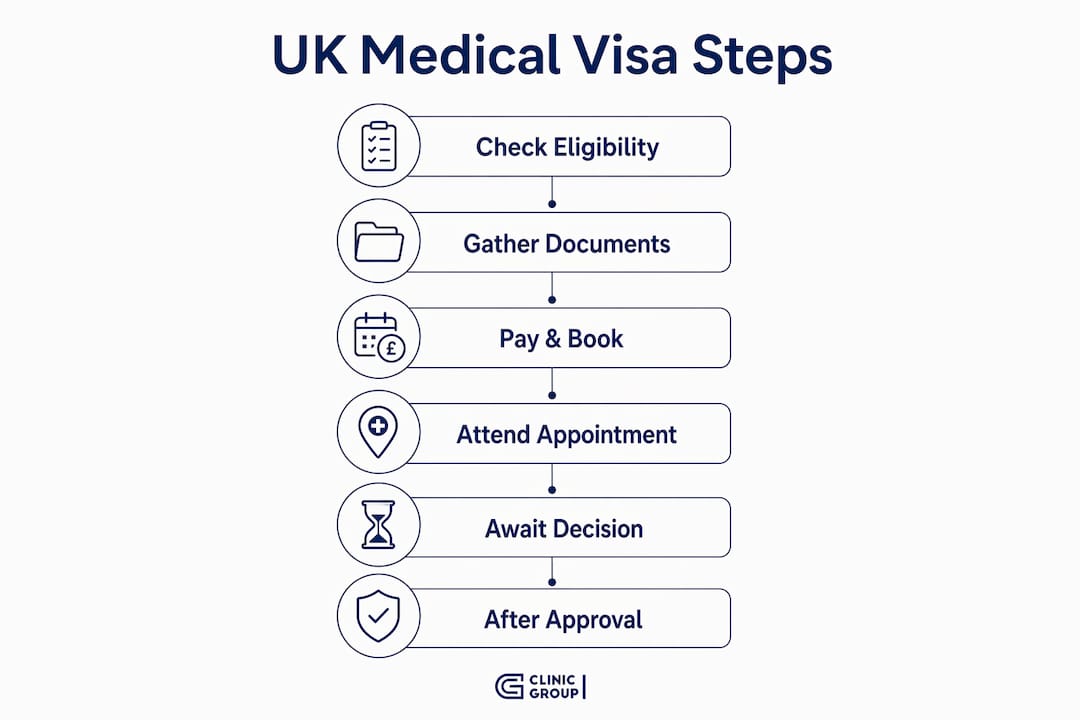
Step 1: Check eligibility and gather documents
Before starting the online form, confirm you meet Standard Visitor eligibility requirements and the additional requirements for medical visitors. Collect your medical letter, financial evidence, TB certificate if applicable, and your valid passport. Check whether your nationality requires a visa or whether an ETA is sufficient for your treatment duration.
Step 2: Complete the online application
Apply online using the “Apply for a UK visit visa” form on GOV.UK. You will need:
- Details of your travel history for the past 10 years.
- Your employer’s address and contact details.
- The name and address of anyone paying for your trip.
- Details of any family members in the UK.
- Your TB test certificate if you are applying for an 11-month visa.
Step 3: Pay the visa fee and book your biometrics appointment
Pay the relevant fee (£135 for six months, £234 for 11 months) and book an appointment at a visa application centre. All visa nationals must submit biometric information, including fingerprints and a photograph, as part of the entry clearance process.

Step 4: Attend your appointment and submit supporting documents
Bring your passport, application reference, and all supporting documents to your appointment. Upload or submit additional evidence as instructed. The ECO may contact your UK consultant or hospital directly if they have questions about costs or treatment arrangements.
Step 5: Await a decision
Processing times vary depending on the application centre and time of year. The earliest you can apply is three months before your intended travel date. You will be notified of the decision through the visa application centre or by post, depending on your location.
Step 6: After approval or refusal
If approved, check the visa vignette carefully to confirm the permitted duration and any conditions. If refused, the refusal letter will state the reasons. You may reapply, addressing the specific grounds for refusal, though there is no automatic right of appeal for visitor visas.
For treatment lasting longer than six months:
Patients who are already in the UK and need to extend their stay can apply for a further six months at a cost of £1,172. There is no limit on the number of times an extension can be granted, provided the patient continues to meet all requirements and can show they have met the costs of treatment already received.
Common reasons for UK medical visa refusal and how to avoid them
Refusal is rarely arbitrary. The Home Office follows clear criteria, and most refusals trace back to one of a small number of recurring issues.
-
Vague or incomplete medical letters. The most frequent cause of refusal is a letter that fails to specify the estimated cost, the likely duration of treatment, or the treatment location. Incomplete documentation of treatment details is cited consistently in refusal decisions. The letter must be comprehensive and specific.
-
Insufficient or unverifiable proof of funds. Showing a current bank balance is not always enough. The ECO needs to see that funds are stable over time, liquid, and transferable. Applicants from countries with currency controls face additional scrutiny, and sponsors must provide detailed financial documentation rather than a simple letter.
-
Failure to declare intent to avoid NHS care. Patients must explicitly confirm they will not seek NHS-funded treatment. Any intent to access free NHS care can result in immediate refusal and may affect future entry applications.
-
Missing health screenings. Applicants with communicable diseases who have not obtained medical clearance, or those applying for an 11-month visa without a TB certificate, will not meet the eligibility requirements.
-
Ambiguous departure intentions. The Home Office maintains a strict position on applicants demonstrating a clear intention to leave the UK after treatment. Vague or contradictory statements about future plans raise doubts about whether the visit is genuinely temporary.
-
Submission of false or misleading information. Any inaccuracy, whether deliberate or accidental, can result in refusal and a potential entry ban. Double-check every document and declaration before submission.
-
Open-ended treatment plans. Treatment described as ongoing, indefinite, or subject to repeated renewal without a clear endpoint will not satisfy the requirement for finite duration. Fertility treatment is a specific example the Home Office has flagged: where success is uncertain over a prolonged period, the ECO may contact the consultant directly to assess the likelihood of completion.
Travel and entry guidance for medical visitors to the UK
Arriving in the UK as a medical visitor requires preparation beyond the visa itself. Border officers can ask detailed questions, and having the right documents to hand at the point of entry avoids unnecessary delays.
Entry clearance and border checks
Visa nationals must have their entry clearance in place before travelling. At the UK border, officers may ask about your treatment arrangements, your consultant’s details, and your plans to leave after treatment. Carry printed copies of your medical letter, proof of accommodation, and your return travel booking.
Arranging travel and accommodation
Book accommodation close to your treatment facility where possible, and confirm your appointment dates before finalising travel. If treatment involves multiple stages over several weeks, plan for realistic recovery periods between appointments. Patients travelling for procedures such as dental treatment abroad or surgical interventions should factor in post-procedure rest time when booking return flights.
Restrictions during your stay
While in the UK on a medical visitor visa, you must not:
- Take employment of any kind.
- Access public funds or benefits.
- Undertake a course of study (beyond incidental learning).
- Engage in business activities.
- Marry or form a civil partnership without the appropriate permission.
Documents to have ready at all times
- Your passport with the visa vignette.
- Your medical letter from the UK consultant.
- Proof of accommodation bookings.
- Evidence of funds or sponsor’s financial support.
- Your return or onward travel booking.
- Your TB certificate, if applicable.
Public health protocols
Patients with infectious or communicable conditions must have satisfied a medical inspector before travel. If your condition changes between application and travel, notify the relevant authorities and seek updated medical clearance. Check current UK Government guidance on any public health entry requirements before departure, as these can change.
Switching visa types
Switching from a medical visitor visa to another category, such as a work or settlement visa, is not permitted during the stay. The medical visitor route is a temporary permission tied to a specific treatment purpose, and the Home Office does not allow mid-visit changes to the visa category.
Expert insights and practical tips for securing your UK medical visa
Clear clinical evidence and confirmed payment arrangements are the two factors that most reliably determine whether a medical visa application succeeds. This is consistent with Home Office guidance and with the experience of medical travel specialists who support patients through the process.
Documentation quality is everything
The ECO’s decision rests almost entirely on the paperwork. A letter that covers the condition, the cost, the duration, and the location leaves little room for doubt. A letter that is vague on any one of these points invites follow-up questions or outright refusal. Thorough preparation of accurate documents leads to faster decisions.
Financial evidence: go beyond the minimum
Showing a current balance is a starting point, not a complete answer. The ECO wants to see that funds have been consistently available, that they can be transferred to the UK, and that the applicant or sponsor has genuinely committed to meeting all costs. Bank statements covering 3–6 months, alongside a sponsor’s letter and evidence of any payment already made to the clinic, build a credible financial picture.
Demonstrate a clear intention to leave
The Home Office is particularly focused on whether the visit is genuinely temporary. Applicants should be prepared to show ties to their home country, such as employment, property, or family commitments, that make return after treatment a natural and expected outcome.
Start early
Applications can be submitted up to three months before travel. Given that gathering a complete medical letter, financial documents, and a TB certificate (where required) takes time, starting the process as early as possible avoids last-minute gaps. If your UK consultant needs to provide additional verification, allow time for that correspondence.
Pro Tip: Ask your UK clinic to include a payment plan or deposit confirmation with the medical letter. The Home Office guidance explicitly notes that evidence of financial commitment to treatment, not just available funds, strengthens the application considerably.
Clinicgroup works with patients at every stage of their treatment journey, from initial clinic matching and documentation support through to travel logistics, partner hotel arrangements, and aftercare coordination. Patients considering international healthcare options benefit from having a structured support network in place before they apply for any travel permission.
Insurance and healthcare coverage for medical visa holders
Travel insurance is not a formal requirement for a UK medical visa, but the Home Office strongly recommends it, and in practical terms, travelling without it is a significant financial risk.
Why insurance matters for medical visitors
Private medical treatment in the UK is expensive. If your condition changes, your treatment is extended unexpectedly, or you need emergency care unrelated to your planned procedure, the costs fall entirely on you. Overseas nationals are not eligible for free NHS treatment except in genuine emergencies. Even emergency NHS care may be charged to overseas visitors depending on the circumstances, so having comprehensive cover in place from the moment you travel is advisable.
What to look for in a policy
A policy for a medical visitor should cover:
- The specific medical condition you are travelling to treat, including any complications arising from that treatment.
- Emergency medical expenses unrelated to your planned procedure.
- Repatriation costs if you need to return home for medical reasons.
- Trip cancellation or curtailment if treatment dates change.
- Accommodation and travel costs if your stay is extended due to medical necessity.
Standard travel insurance policies often exclude pre-existing conditions or planned medical procedures. You will need a specialist policy that explicitly covers the treatment you are travelling for. Check the policy wording carefully, particularly around exclusions for elective or cosmetic procedures.
Checking your health screening requirements
For patients applying for an 11-month visa, the TB certificate requirement is part of the health screening process. Some insurers also require evidence of health screening before they will issue a policy for certain destinations or treatment types. A useful dental care checklist for travellers outlines the kind of pre-travel health documentation that supports both visa and insurance applications.
Sponsor liability
If a sponsor is funding the visit, their financial commitment typically covers treatment costs but not necessarily ancillary medical expenses. Clarify with your sponsor whether their support extends to emergency cover, and take out a personal policy to fill any gaps.
Planning your treatment abroad with Clinicgroup
If you are considering treatment outside the UK rather than travelling to the UK for care, Clinicgroup connects patients with verified clinics across Albania and Dubai, covering dentistry, hair transplants, plastic surgery, non-surgical aesthetics, and wellness programmes. All partner clinics meet European standards of care, with board-certified specialists and transparent pricing that typically represents a significant saving compared with UK private rates.
Every treatment journey through Clinicgroup includes clinic matching, travel logistics, partner hotel arrangements, and structured aftercare. Explore the full range of available treatments and speak with the patient support team to find the right option for your needs.
Key takeaways
A UK medical visa is a Standard Visitor visa for private treatment, valid for up to 11 months, with strict requirements around funding, documentation, and departure intention.
| Point | Details |
|---|---|
| Visa type and cost | The Standard Visitor visa for medical treatment costs £234 and permits a stay of up to 11 months. |
| Medical letter is mandatory | The letter from your UK consultant must confirm the condition, estimated cost, treatment location, and finite duration. |
| Financial proof must be thorough | Bank statements covering 3–6 months, plus evidence of liquidity and transferability, are required from applicants or sponsors. |
| NHS access is prohibited | Patients must explicitly declare they will not seek NHS-funded care; any intent to do so leads to refusal. |
| Extensions are available | Patients can extend their stay by a further six months at a cost of £1,172 per application, with no limit on the number of extensions. |
FAQ
How does a UK medical visa work?
A UK medical visa is a Standard Visitor visa that permits private medical treatment for up to 11 months. It requires a letter from a UK-registered consultant, proof of private funding, and a clear intention to leave the UK after treatment is complete.
What do border officers check for a medical visa?
Officers verify your medical letter, proof of accommodation, evidence of funds, and your return travel arrangements. They may also ask about your treatment plan and your ties to your home country.
What medical conditions can lead to visa refusal?
Having a communicable disease does not automatically result in refusal, but applicants must satisfy a medical inspector that they pose no danger to public health. Failure to obtain the required medical clearance, or to provide a TB certificate for an 11-month application, will result in refusal.
What counts as compassionate reasons for a medical visit?
Compassionate circumstances typically refer to visits involving serious illness, end-of-life care, or organ donation to a close family member or friend. The Home Office considers these on a case-by-case basis within the Standard Visitor framework, and the same documentation requirements apply.
Can I switch to a different visa while in the UK for medical treatment?
No. The medical visitor route does not permit switching to a work, study, or settlement visa during the stay. If your circumstances change, you would need to leave the UK and apply for the appropriate visa from outside the country.