TL;DR:
- A dental itinerary is a carefully planned schedule that covers all phases of treatment abroad from assessment to recovery. It ensures clinical timelines, travel, and recovery periods are coordinated for safety and success. Proper planning with detailed, written treatment plans reduces risks and enhances the overall dental travel experience.
A dental itinerary is a structured, multi-phase plan that organises every stage of your dental treatment abroad, from the first remote consultation through to final recovery at home. Unlike a standard travel itinerary, it coordinates clinical timelines, lab fabrication windows, healing periods, and travel logistics into a single, coherent schedule. The industry term for this document is a dental treatment itinerary, and it functions as both a clinical roadmap and a patient protection tool. The process typically spans 6–10 weeks from initial inquiry to full recovery. Getting this plan right before you book a single flight is the single most important step in dental travel planning.
What are the key components of a dental itinerary?
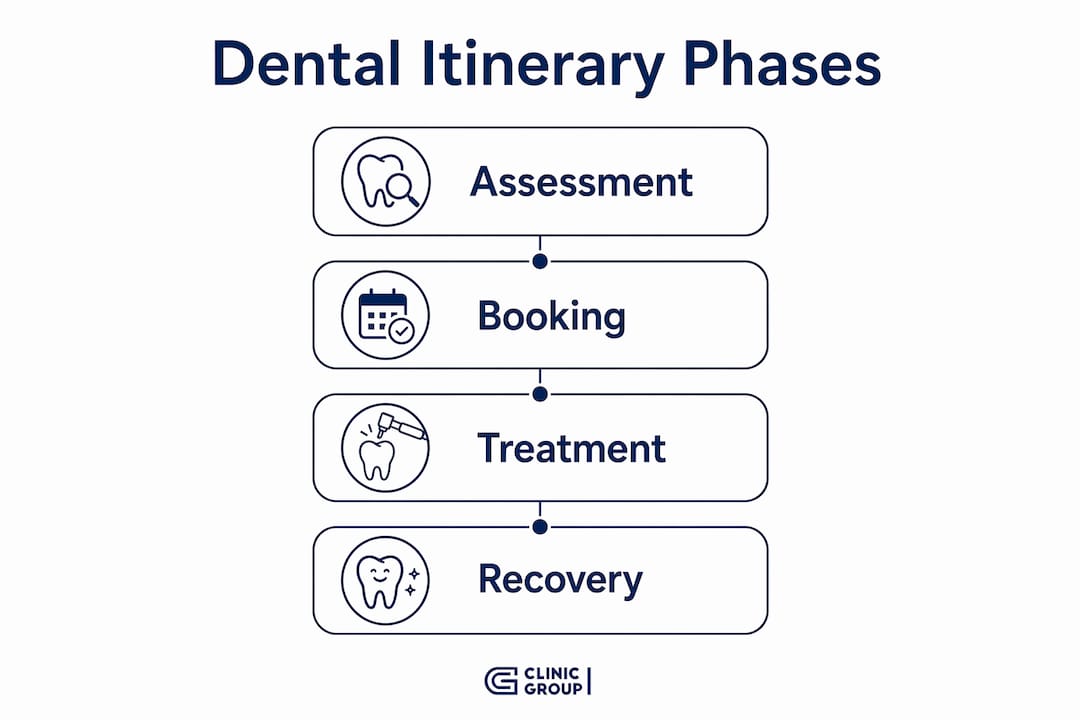
A dental treatment itinerary is built from four distinct phases: assessment, booking, clinical treatment, and recovery. Each phase has its own requirements, and missing any one of them creates gaps that can compromise your results or your safety.

Assessment and diagnosis
The assessment phase begins before you leave the UK. You will need to gather recent dental X-rays, a written summary from your local dentist, and a full medical history including any medications. Sharing this pre-travel packet with your chosen clinic early prevents surprise treatment plan changes after you arrive. Some evaluations, such as CBCT scans, require in-person confirmation upon arrival, so your itinerary must allow flexibility for diagnostic adjustments on day one.
Clinic selection and treatment contracts
Choosing the right clinic is not simply about price. You need to confirm the materials being used, the qualifications of the treating dentist, and the clinic’s guarantee policy. Treatment plans should function as binding contracts with explicit details on procedure steps, material brands, timelines, and costs. A clinic that cannot provide this level of documentation is a clinic worth avoiding. Reading verified clinic reviews before committing to any booking is a practical first filter.
Booking and logistics
Once the clinical calendar is set, you book flights and accommodation around it. Not the other way around. Your itinerary should include flight times, hotel proximity to the clinic, deposit payment records, and travel insurance details. A well-structured dental tourism guide will always place clinical scheduling first and travel arrangements second.
Recovery and follow-up
The recovery phase is the most underestimated component of any dental itinerary. Post-operative care instructions, prescribed medications, dietary restrictions, and the date of your follow-up appointment all belong in this section. Patients who skip this phase in their planning are the ones who end up flying home too early.
Pro Tip: Request a written, itemised treatment plan from your clinic before paying any deposit. If the clinic cannot provide one, treat that as a warning sign.
How does the type of treatment affect your dental itinerary?
The procedure you are having is the single biggest factor in determining how long your dental itinerary needs to be and how many trips it requires.
Single dental implants require two trips spaced 3–6 months apart to allow for osseointegration, the biological process by which the implant fuses with the jawbone. The first trip typically lasts 4–7 days and covers placement; the second trip runs 3–5 days and covers the crown fitting. Lab fabrication and biological healing phases are fixed timelines. They cannot be compressed to suit a patient’s preferred travel dates, and any clinic that suggests otherwise should be questioned carefully.
Full-arch solutions such as All-on-4 or All-on-6 can sometimes be completed in a single longer trip of 10–14 days using immediate load protocols, where a temporary prosthesis is fitted on the same day as implant placement. Veneers and crowns generally require one trip of 5–7 days, with lab work completed during the visit.
| Procedure | Trips required | Typical duration | Recovery buffer needed |
|---|---|---|---|
| Single dental implant | 2 trips | Trip 1: 4–7 days; Trip 2: 3–5 days | 2–3 days before flying |
| All-on-4 / All-on-6 | 1 trip (immediate load) | 10–14 days | 3–5 days before flying |
| Dental veneers | 1 trip | 5–7 days | 1–2 days before flying |
| Dental crowns | 1 trip | 5–7 days | 1–2 days before flying |
| Full smile makeover | 1–2 trips | 7–14 days per trip | 3–5 days before flying |
For patients considering implant procedures abroad, understanding these timelines before booking is not optional. It is the foundation of a safe and successful outcome.
Pro Tip: Ask your clinic to confirm in writing which phases of your treatment require in-person attendance and which can be managed remotely. This shapes your entire travel calendar.
What practical steps should patients take to finalise their dental itinerary?
Preparation is where most dental tourism plans succeed or fail. Patients who arrive with complete documentation and a confirmed treatment plan have far smoother experiences than those who leave details to chance.
-
Send your dental records early. Share recent X-rays, a written dentist summary, and your full medication list with the clinic at least four weeks before your planned departure. This gives the clinical team time to prepare a realistic treatment plan and flag any concerns before you travel.
-
Secure a written treatment contract. Before paying any deposit, obtain a document that specifies every procedure, the materials to be used, the cost breakdown, the guarantee policy, and the clinical schedule. This document is your primary protection if anything changes during treatment.
-
Book flights after the clinical calendar is confirmed. Flight availability must not dictate treatment timing. Your dental team sets the clinical schedule; you then find flights that fit it. Reversing this order is the most common and most costly mistake in dental travel planning.
-
Prepare a pre-travel pack. This should include any prescribed medications, a list of soft foods for the recovery period, your travel insurance documents, the clinic’s emergency contact details, and a copy of your treatment contract.
-
Schedule a pre-departure check with your local dentist. A brief appointment at home before you fly confirms your baseline oral health and gives you a written record that may be useful if complications arise abroad.
-
Build buffer days into your return. Do not book a return flight for the morning after your final procedure. Allow at least 2–3 days between your last clinical appointment and your flight home.
For a broader checklist on preparing dental records and what to bring, a structured oral care checklist can help you avoid common oversights.
How do you balance travel and treatment in your dental itinerary?
The most important mindset shift for dental tourists is this: you are not going on a dental holiday. You are undergoing medical treatment in a location that happens to require travel. That distinction changes how you plan every element of your trip.
Biological healing does not pause for sightseeing. After major oral surgery, swelling, sensitivity, and fatigue are normal for several days. Flying is medically discouraged for 1–2 weeks after major oral surgery because cabin pressure changes can aggravate swelling and increase bleeding risk. A minimum 2–3 day recovery buffer before your return flight is not a suggestion. It is a clinical requirement.
Practical considerations for balancing travel and treatment include:
- Book accommodation close to the clinic. A short transfer after a procedure matters more than a scenic hotel location.
- Plan rest days into the itinerary. Do not schedule tourist activities on procedure days or the day immediately after.
- Confirm clinic opening hours against your travel dates. Public holidays in Albania or Dubai may affect appointment availability.
- Keep your return flight flexible where possible. If your treatment runs longer than expected, a rigid return ticket creates pressure to leave before you are ready.
- Communicate with your clinic throughout. If swelling or discomfort is greater than expected, contact the clinic before deciding to travel.
For UK patients travelling to Albania, a typical itinerary for veneers might look like this: arrive on a sunday, attend a diagnostic appointment on monday, begin preparation on tuesday, attend a fitting on thursday, and fly home on saturday after a rest day on friday. For implant patients, the same structure applies to trip one, with trip two scheduled 3–6 months later. Patients travelling to Dubai follow similar clinical timelines, with the added benefit of a warmer climate during winter months. Detailed dental travel tips for coordinating these logistics are available for patients planning their first trip abroad.
Key takeaways
A well-constructed dental itinerary is the difference between a safe, successful treatment abroad and a costly, stressful experience that requires remedial work at home.
| Point | Details |
|---|---|
| Define the itinerary early | A dental treatment itinerary should be finalised 4–8 weeks before departure to allow for bookings and travel. |
| Let clinical needs lead | Book flights only after the clinical calendar is confirmed; never let travel dates dictate treatment timing. |
| Know your procedure’s timeline | Single implants require two trips spaced 3–6 months apart; veneers and crowns typically complete in one trip of 5–7 days. |
| Build in recovery time | Allow a minimum 2–3 day buffer between your final procedure and your return flight to reduce health risks. |
| Treat the treatment plan as a contract | Obtain a written, itemised plan before paying any deposit; it is your primary protection throughout the process. |
Clinicgroup’s perspective on dental itinerary planning
Having supported patients from the UK and across Europe through dental treatment in Albania and Dubai, we have seen the same pattern repeat itself. The patients who have the smoothest experiences are not necessarily the ones who chose the cheapest clinic or the most convenient flight. They are the ones who arrived with a complete, confirmed treatment plan and realistic expectations about recovery.
The most common oversight we see is patients underestimating how much the recovery phase shapes the entire trip. A veneer fitting feels straightforward, but sensitivity and adjustment time are real. An implant placement is a surgical procedure, and treating it as anything less leads to rushed decisions about return flights.
We have also seen a growing demand for verified clinics with transparent pricing and written guarantees. Patients are more informed than they were five years ago, and rightly so. The question is no longer simply “can I save money abroad?” It is “can I trust this clinic to deliver what it has promised, and does my itinerary give me the time and space to recover properly?” Those two questions, answered honestly before you book, are the foundation of a successful dental tourism experience. For patients who want to understand dental safety standards abroad before committing, that research is time well spent.
— Clinicgroup
Planning your dental treatment abroad with Clinicgroup
Clinicgroup connects patients from the UK and Europe with verified partner clinics in Albania and Dubai, covering treatments from dental implants and veneers to full smile makeovers. Every clinic in the network meets European standards of care, with board-certified specialists and transparent, itemised pricing. Clinicgroup’s patient coordination team supports you from the first inquiry through to aftercare, helping you build a realistic treatment itinerary, match with the right clinic, and arrange travel logistics without the guesswork. To see the full range of dental treatments available through the network and request a personalised consultation, visit the treatments page and take the first step towards a confirmed, safe dental plan abroad.
FAQ
What is a dental itinerary?
A dental itinerary is a structured plan that organises every phase of dental treatment abroad, including assessment, clinical procedures, and recovery, typically spanning 6–10 weeks from first inquiry to final healing.
How many trips does dental tourism usually require?
Single implants require two trips spaced 3–6 months apart, while veneers, crowns, and full-arch solutions can often be completed in one trip of 5–14 days depending on the protocol used.
When should I finalise my dental itinerary before travelling?
A dental treatment itinerary should be confirmed 4–8 weeks before departure to allow sufficient time for clinic coordination, flight booking, and accommodation arrangements.
Is it safe to fly after dental surgery?
Flying is medically discouraged for 1–2 weeks after major oral surgery. A minimum 2–3 day recovery buffer before your return flight reduces the risk of swelling and pressure-related complications.
What should a dental treatment plan include?
A treatment plan should specify every procedure, the materials to be used, the full cost breakdown, the guarantee policy, and the clinical schedule. It functions as a binding contract between you and the clinic.