Gentle walking should start on day one for most cosmetic procedures, but everything more demanding waits for staged clearance. High-intensity exercise, heavy lifting and contact sports stay off the table until your surgeon says otherwise, and the timeline for that clearance depends entirely on what was operated on.
Procedure-specific rules matter more than generic fitness advice here. Breast surgery typically restricts upper-body lifting and resistance work for 4 to 12 weeks depending on implant placement, while abdominoplasty protects the core for 8 to 12 weeks. Rhinoplasty and facial procedures need you to avoid anything that raises blood pressure in the head for at least 2 to 6 weeks.
- Day 1 onwards: short, gentle walks unless your surgeon advises bed rest.
- Weeks 1 to 6: stationary cycling, light range-of-motion work, no heavy lifting.
- Week 8 onwards: gradual return to resistance training, only with clearance.
- Any time: stop and call your surgical team for fever above 38°C, sudden swelling, worsening pain, or calf tenderness.
Pro Tip: Even 10 minutes of walking twice a day does more for your recovery than one long, ambitious session that leaves you sore and swollen.
Key Takeaways
Safe recovery depends on staged, procedure-specific progression: walking from day one, resistance work delayed by weeks, and clearance sought at every phase change.
| Point | Details |
|---|---|
| Start walking immediately | Gentle walking from day 1 reduces DVT risk and supports lymphatic drainage for most procedures. |
| Follow procedure-specific limits | Breast surgery restricts lifting for 4 to 6 weeks; abdominoplasty delays core work for 8 to 12 weeks. |
| Use the 50% rule | Halve your usual weight and reps when reintroducing resistance training, increasing load by no more than 10% weekly. |
| Watch for red flags | Fever above 38°C, calf swelling, or sudden bleeding need urgent contact with your surgical team. |
| Arrange aftercare in advance | Clinic Group helps coordinate physiotherapy referrals and aftercare for patients treated at verified partner clinics abroad. |
Table of Contents
- Why ushtrime pas kirurgjisë estetike require a staged approach
- How long until you can exercise after each procedure?
- What does a week-by-week return-to-exercise plan look like?
- Which exercises should you avoid and what are the red flags?
- What should you check before every exercise session?
- How do nutrition and hydration affect your recovery?
- How do you stay motivated during physical recovery?
- What are realistic long-term fitness goals after surgery?
- Clinic Group’s perspective on aftercare and physiotherapy support
- Get aftercare and physiotherapy support arranged before you travel
- Sources
- FAQ
Why ushtrime pas kirurgjisë estetike require a staged approach
Post-surgery exercises, or ushtrime pas kirurgjisë estetike, follow a different logic to normal fitness training. Your body isn’t just tired after cosmetic surgery, it’s actively rebuilding tissue, and every incision is weaker in its first few weeks than it will ever be again. Push too hard too soon and you risk wound separation, seroma, or a scar that heals wider than it should.
Early ambulation is the exception to the “rest and recover” instinct most patients have. Gentle walking from day one after most cosmetic procedures reduces the risk of deep vein thrombosis and helps bowel recovery and lymphatic drainage. Lying still for days does the opposite: blood pools, swelling builds, and healing slows.
Once walking is established, progression should follow a clear structure rather than how you feel on a given morning:
- Apply the 50% rule. When you reintroduce any resistance work, use half the weight and half the reps you managed before surgery, and move with deliberate control.
- Cap weekly increases at 10%. This protects the tensile strength of your incisions while they remodel, rather than testing them against a sudden jump in load.
- Avoid Valsalva-type effort. Holding your breath while straining, common in heavy lifting, spikes internal pressure against fresh incisions.
- Wear prescribed compression or support garments during activity if your clinic has advised them.
- Ask for physiotherapy input if your procedure was complex or you’re returning to competitive sport, since physiotherapist-led programmes help prevent compensatory movement patterns and secondary injuries.
Pro Tip: Think of the 50% rule as training with intention rather than ego. Halving your usual weight isn’t a step backwards, it’s what lets you get back to full capacity without a setback.
Clearance should be sought at every phase change, not just at the six-week mark. A surgeon or nurse checking your wound at week 3 might approve cycling but still ask you to hold off on upper-body work, and that granularity matters more than a single blanket “you’re cleared” conversation.
How long until you can exercise after each procedure?
Timelines vary sharply by procedure, and lumping them together is where most generic recovery advice goes wrong. Here’s what the evidence and clinical guidance suggest for the most common cosmetic surgeries.
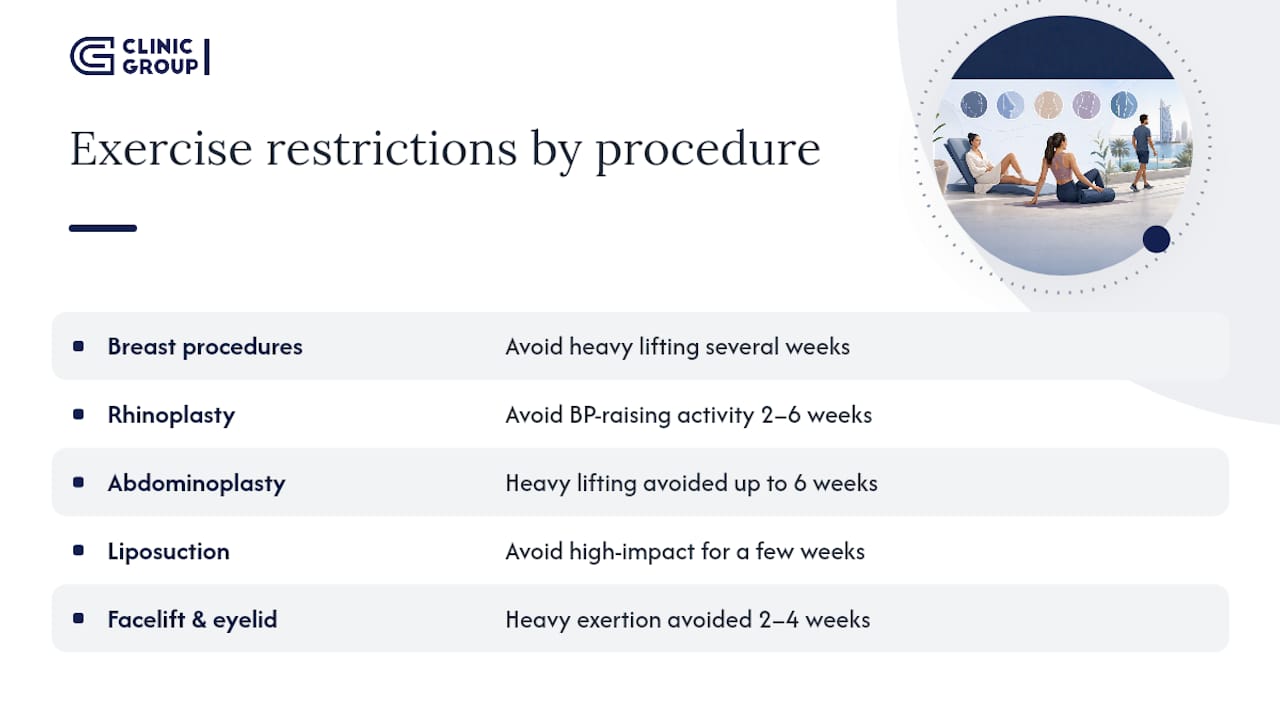
Breast augmentation, reduction or reconstruction. For implant-based reconstruction, avoid heavy lifting for a minimum of several weeks, longer if the implant is placed underneath the muscle. A supportive bra is typically worn for multiple weeks, and upper-body resistance training stays off-limits until your surgeon confirms the implant pocket has settled.
Rhinoplasty and facial procedures. Anything that raises blood pressure in the head, bending forward sharply, straining, or vigorous cardio, should wait at least 2 to 6 weeks. Contact sports need considerably longer, since a knock to the nose during early healing can shift cartilage that hasn’t fully set.
Abdominoplasty. Mobility starts on day one, but in a flexed posture that avoids tension on the abdominal wall. Heavy lifting is avoided for up to six weeks, and core-specific exercises are typically delayed 8 to 12 weeks. Drain care and garment instructions from your surgical team take priority over any generic fitness timeline.
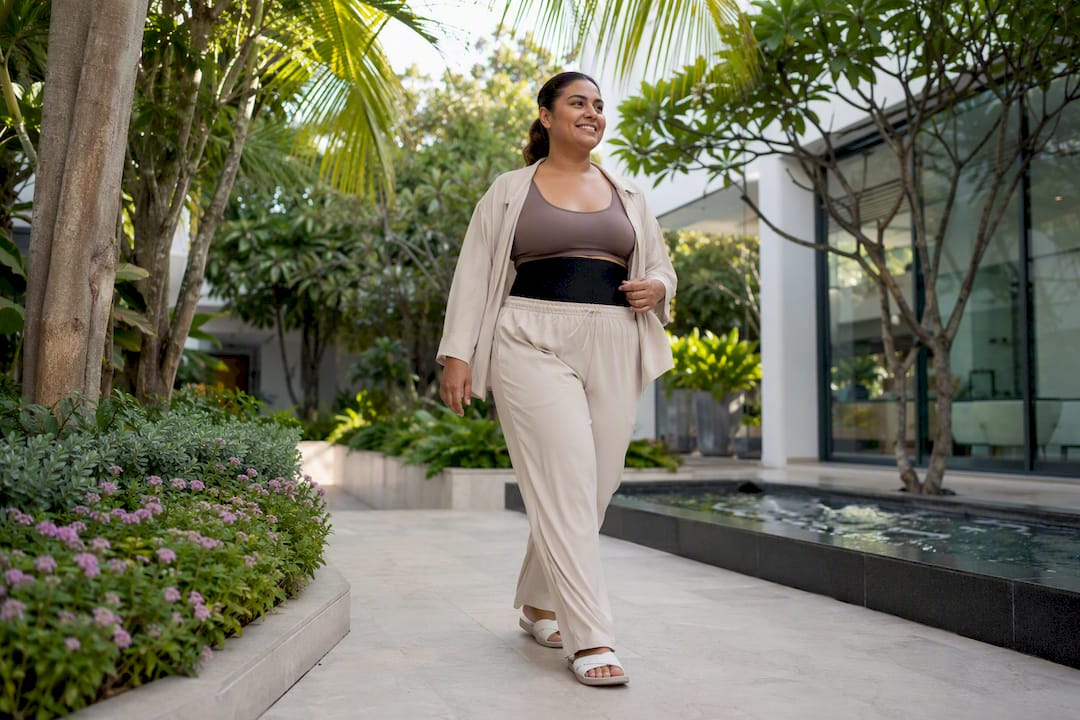
Liposuction. High-impact activity is avoided for a few weeks, and compression garments are usually worn during exercise to limit fluid accumulation and support tissue adherence as swelling subsides. Progress in small increments rather than jumping straight back into running.
Facelift and eyelid surgery. Light activity, short walks and daily tasks, can resume within days, but heavy exertion, bending, and anything that increases facial blood flow waits 2 to 4 weeks. Swelling around the eyes and jawline is a useful guide: if it’s still prominent, you’re not ready for cardio.
Across every category, high-intensity workouts and contact sports are typically avoided for at least 6 to 8 weeks, sometimes considerably longer for procedures with deeper tissue disruption. If you’ve had rhinoplasty and want a fuller week-by-week breakdown, our rhinoplasty recovery guide covers it in more depth.
What does a week-by-week return-to-exercise plan look like?
A staged plan works better than vague “take it easy” advice because it gives you concrete markers to check yourself against. The following adapts to most cosmetic procedures, but always defer to your surgeon’s specific instructions where they differ.
Days 0 to 3. Short, frequent walks around your home, five to ten minutes, several times a day. Focus on hydration and deep breathing exercises to support lung function and circulation. Avoid any lifting, twisting, or straining.
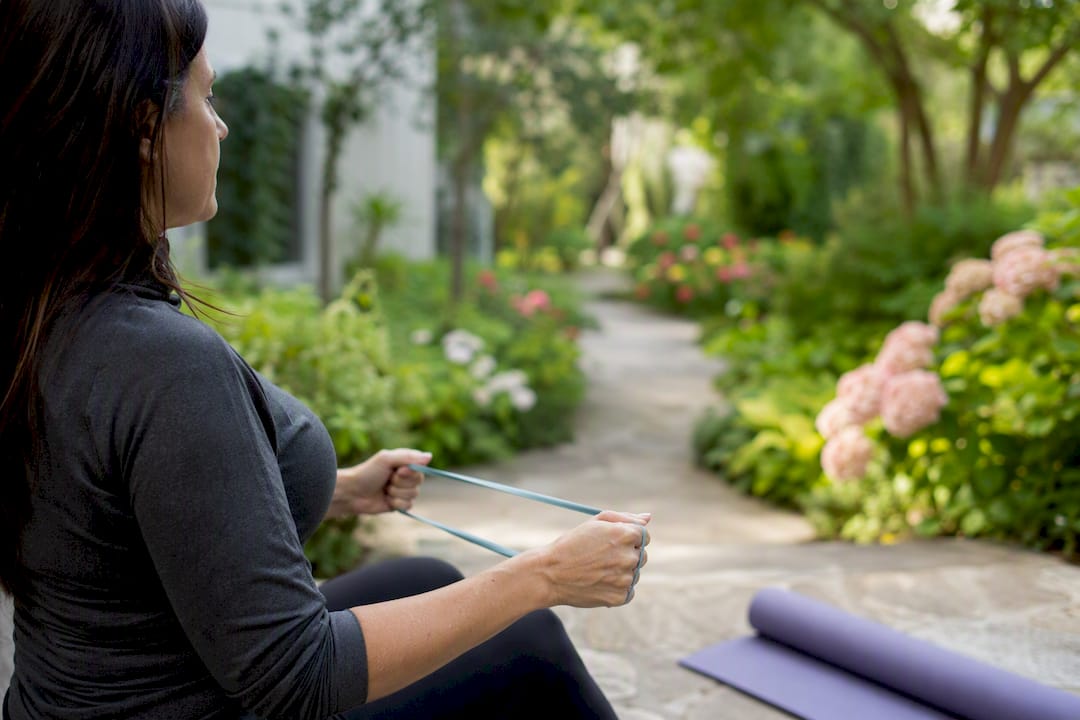
Weeks 1 to 3. Extend walking duration gradually, aiming for 20 to 30 minutes if your procedure allows it. Gentle range-of-motion exercises for unaffected joints and stationary cycling on a low resistance setting are usually appropriate once your surgeon confirms it.
- Walk first, before anything else.
- Add low-impact cardio, such as stationary cycling, once walking feels easy.
- Introduce resistance training only after cardio tolerance is established, starting with the lower body before the upper body if you’ve had chest surgery.
- Save high-impact and contact activities for last.
This order isn’t arbitrary. It reflects how the body should be reintroduced to load and impact, building tolerance in the least demanding categories before testing more forceful ones.
Weeks 4 to 6. Light resistance training can often begin for non-operated areas, using the 50% rule outlined earlier. If you’ve had abdominoplasty, core work stays off the plan entirely during this window.
Week 8 onwards. Gradual return to heavier resistance and higher-intensity training, but only once your surgeon has given explicit clearance. Increase intensity by no more than 10% per week, and treat any new soreness or swelling as a signal to slow down rather than push through.
Pro Tip: Keep a simple log, date, activity, how you felt afterwards. Patterns show up faster on paper than in memory, and it makes your next follow-up appointment far more useful.
Which exercises should you avoid and what are the red flags?
Certain movements consistently cause setbacks in recovery, regardless of which cosmetic procedure you’ve had. Knowing what to avoid is as important as knowing what’s safe.
- Heavy lifting, maximal-effort lifts, and any exercise that requires holding your breath under strain.
- Contact sports, competitive running, and explosive plyometric movements (box jumps, burpees, sprinting).
- Prolonged inverted yoga poses, such as headstands or downward dog held for extended periods.
- Heavy abdominal strain, including sit-ups, planks, or twisting movements after core-adjacent surgery.
- Bending, twisting, or reaching household activities that your surgeon has flagged as off-limits.
Some symptoms during recovery are normal. Others need urgent attention.
If you notice sudden bleeding, wound drainage with an unusual odour, a fever above 38°C, sudden or sharply worsening pain, swelling or tenderness in one calf, or shortness of breath, stop all activity and contact your surgical team immediately. Calf swelling combined with breathlessness can indicate a blood clot and needs urgent medical review, not a wait-and-see approach.
None of this is meant to make you fearful of movement. It’s meant to help you tell the difference between the expected discomfort of healing and a signal that something has gone wrong.
What should you check before every exercise session?
A short pre-exercise routine keeps recovery on track without turning every walk into a stressful checklist. Run through these points before you move:
- Confirm your surgeon or nurse has cleared the specific activity level you’re planning, not just “exercise” in general.
- Wear any prescribed support garments and keep dressings dry if you’ve been told to.
- Start with 5 to 10 minute walks, note how your body responds, and increase duration or intensity by no more than 10% per week.
- Stop immediately for any warning signs covered above, rather than pushing through to finish a session.
- Keep your clinic’s contact details accessible, and book physiotherapy input if you’re working towards a demanding sport.
Clinical signs that you’re ready to progress include minimal pain without needing medication, incisions that are healed without drainage or inflammation, restored range of motion, and the ability to manage daily tasks without excessive fatigue.
Pro Tip: Bring this checklist, physically or as a note on your phone, to your follow-up appointments. It turns a vague “how are you feeling?” into a specific conversation about what you’re ready for next.
How do nutrition and hydration affect your recovery?
Tissue repair is metabolically demanding, and what you eat directly affects how well incisions heal and how much energy you have for gentle movement. Protein intake matters more than usual during recovery, since collagen synthesis and wound repair both depend on adequate amino acid supply. Lean meat, fish, eggs, and legumes should feature more heavily on your plate than they might normally.
Hydration supports circulation, which in turn supports the lymphatic drainage that early walking is meant to encourage. Dehydration thickens blood slightly and can worsen swelling, working against exactly the outcomes staged exercise is trying to achieve. Aim for steady water intake throughout the day rather than large amounts in one sitting, particularly if you’re also managing prescribed pain medication that can affect appetite and thirst cues.
Vitamin C and zinc are commonly recommended around the recovery period because both play roles in collagen formation and immune function, though a balanced diet usually covers these needs without supplementation. Avoid excessive salt intake in the first few weeks, since it can exacerbate fluid retention and swelling around surgical sites.
Alcohol is worth cutting back significantly, not just because it interacts with pain medication, but because it dehydrates tissue and can interfere with sleep quality at exactly the point your body needs restorative rest most.
How do you stay motivated during physical recovery?
Recovery rarely feels linear, and that catches a lot of patients off guard. You might feel strong on day 10 and then unexpectedly fatigued on day 14, and that fluctuation is normal rather than a sign you’re doing something wrong.
Frustration tends to peak around the two to three week mark, when initial swelling has reduced enough that you feel “back to normal” but your surgeon’s timeline says otherwise. This gap between how you feel and what’s actually safe is where most premature return-to-activity mistakes happen. Trusting the timeline over the mirror is genuinely difficult, particularly for people used to an active lifestyle before surgery.
Small, visible progress markers help more than waiting for a single “recovered” milestone. Tracking walking duration, noting reduced swelling, or simply logging pain-free days gives you something concrete to point to on the harder days. Connecting with your clinic between major follow-ups, even a quick message about how you’re progressing, can also ease the isolation some patients feel once the initial flurry of post-operative attention settles down.
It helps to remember that the restrictions aren’t arbitrary obstacles. Every week of patience is protecting the result you had surgery for in the first place.
What are realistic long-term fitness goals after surgery?
Full recovery isn’t really the finish line, it’s closer to a reset point from which your ongoing fitness resumes. Most patients reach a stage, typically somewhere between three and six months depending on procedure, where their surgeon confirms there are no remaining exercise restrictions specific to the surgery itself.
From that point, the goal shifts from “recovering safely” to “maintaining and building on” whatever fitness level you return to. This is a good moment to reassess your routine rather than simply resuming exactly what you did before surgery. Many patients find their pre-surgery training had imbalances, overreliance on certain muscle groups, neglect of mobility work, that a structured return actually helps correct.
Long-term maintenance of results from body-contouring procedures like liposuction or abdominoplasty also depends on sustained activity and stable weight, since significant weight fluctuation after surgery can affect contouring outcomes over time. Building a routine you can realistically sustain matters more than an intense short-term programme you abandon after a few months.
Clinic Group’s perspective on aftercare and physiotherapy support
Patients travelling abroad for cosmetic surgery often worry most about what happens after they fly home, not the procedure itself. That’s a fair concern, and it’s one we take seriously.
Clinic Group works only with verified clinics across our partner network, and we help coordinate aftercare, including physiotherapy referrals, so your exercise progression doesn’t stall simply because you’re no longer in the same country as your surgeon. If you’re booking treatment with us, ask your patient coordinator directly about rehabilitation support and follow-up options during your consultation.
We don’t guarantee outcomes, and clinician clearance always takes priority over any general timeline. If you experience red-flag symptoms while abroad, use local emergency services first and inform your clinic immediately afterwards.
Get aftercare and physiotherapy support arranged before you travel
Once you know what recovery involves, the harder question is who’s coordinating it, especially if your surgery happens abroad and your usual GP or physio isn’t involved. Clinic Group exists to close that gap: we connect UK and Italian patients with verified clinics and help arrange the aftercare and physiotherapy referrals this article has walked through, so your return to exercise isn’t left to guesswork once you’re home.
Our plastic surgery treatment page outlines the procedures we support, alongside clinic verification and travel coordination. If your recovery plan includes physiotherapy referrals or aftercare check-ins, our aftercare services for medical tourists explains what that support typically looks like.
Bring the checklist from this article to your consultation, and ask directly what rehabilitation support is included. You can start that conversation through our contact page whenever you’re ready.
Sources
- Road to recovery: Get moving again with post-surgery workouts | ASPS
- Post op advice for implant based reconstruction — Royal Devon
- Abdominoplasty Surgery — Chelsea and Westminster Hospital NHS Foundation Trust
- Top 5 Tips For Resuming Exercise After Cosmetic Surgery | Centre for Surgery
This article is general information, not a substitute for advice from a qualified doctor. Consult a qualified healthcare professional about your own circumstances before acting on anything here.
FAQ
When can I go swimming after cosmetic surgery?
Swimming usually waits until wounds are fully healed and any drains have been removed, typically around 4 to 6 weeks, though your surgeon will confirm timing based on your specific procedure.
When can I start running again?
Running falls into the high-impact category, generally avoided for at least 6 to 8 weeks, and longer after abdominoplasty or breast surgery until your surgeon confirms your tissues can handle repeated impact.
When should I start scar massage?
Scar massage typically begins once wounds are fully healed, commonly around four to six weeks after surgery, using a non-perfumed cream.
When can I return to heavy lifting at the gym?
Heavy lifting is usually delayed until at least 6 to 8 weeks post-surgery, and often longer for abdominal or chest procedures, with clearance needed from your surgeon before resuming pre-surgery weights.
Can Clinic Group help arrange physiotherapy after surgery abroad?
Yes, Clinic Group coordinates aftercare and physiotherapy referrals for patients treated at verified partner clinics, and you can request this support directly through your patient coordinator during booking.