Tirana is the main hub for medical treatment in Albania, and private clinics are licensed by the Ministry of Health and Social Protection. For UK passport holders, short stays do not require a visa, and flights from the UK take about three hours. These practical details are a starting point, not a substitute for understanding the clinic, treatment plan and follow-up arrangements.
It’s understandable to weigh convenience and choice against questions about standards and safety when considering treatment abroad. This guide explains how clinics and private hospitals in Albania are regulated, which treatment options are available through Clinic Group’s partner network, and what to plan for travel, insurance and aftercare.
You’ll also learn why standard travel insurance may not cover planned treatment abroad or related complications, and why follow-up arrangements matter before you travel. These practical checks can help you assess whether treatment in Albania suits your needs and plan with a clearer understanding of what to expect.
Key Takeaways
- Private clinics in Albania are licensed by the Ministry of Health and Social Protection; doctors and dentists must also be registered with their national professional orders.
- Albania is an EU candidate country, not an EU member, so EU-wide healthcare and consumer frameworks do not automatically apply.
- Standard travel insurance generally excludes planned treatment abroad and may exclude related complications; plan insurance and accessible funds for unexpected care and repatriation.
- UK passport holders do not need a visa for short stays, and flights from the UK take about three hours. Check how the legal status of your medicines may differ abroad.
- Tirana is the main hub for treatment. Dental implants usually require two trips around three months apart, so include follow-up and travel in your planning.
Clinic regulation and professional registration
Yes, UK patients can travel to Albania for medical or dental treatment. Before booking, verify that the private clinic is licensed by Albania’s Ministry of Health and Social Protection and that the treating doctor or dentist is registered with the relevant national professional order.
These are separate checks: a clinic’s licence relates to the facility, while professional registration relates to the practitioner. Confirm the treating clinician’s name, specialty and role, then compare those details with the written treatment plan. Albania is an EU candidate country, not an EU member, so EU-wide healthcare and consumer frameworks do not automatically apply.
For dental treatment, compare written plans by the care proposed and the sequence of appointments. Check whether diagnostic work, materials, temporary restorations and planned follow-up are included. Ask for each treatment stage, along with any care needed after returning to the UK, to be clearly set out.
A clinic profile can help identify the facility and services described, but it does not replace checking licensing and practitioner registration. For example, review the Haris Hair Medical clinic profile as one part of your research, then assess the clinical details relevant to your own proposed care.
Use this checklist to organise your comparison:
- Record the clinic’s full legal name and its Ministry of Health and Social Protection licence details.
- Identify the clinician responsible for consultation, treatment and follow-up; confirm their professional registration and specialty.
- Compare written plans for the same procedure, including materials, treatment stages and aftercare arrangements.
- Check how the clinic communicates in English, including how consent and clinical instructions will be explained.
- Keep copies of your treatment plan, consent documents and clinical records for your UK healthcare team.
Medical education is useful context, but it does not replace checking an individual clinician’s registration. Medical programmes in Albania follow a six-year curriculum combining theoretical learning with early clinical experience. Albanian graduates may pursue postgraduate training or professional registration in the EU and EEA, subject to local language and licensing requirements.
When comparing a hospital with a clinic, focus on the setting required by the procedure and the care plan. A dental appointment and a procedure requiring hospital facilities may involve different teams and arrangements. Compare the named facility, responsible practitioner, proposed treatment, follow-up and contact process side by side. These details help you judge whether the care plan fits your needs.
Insurance, follow-up and complication planning
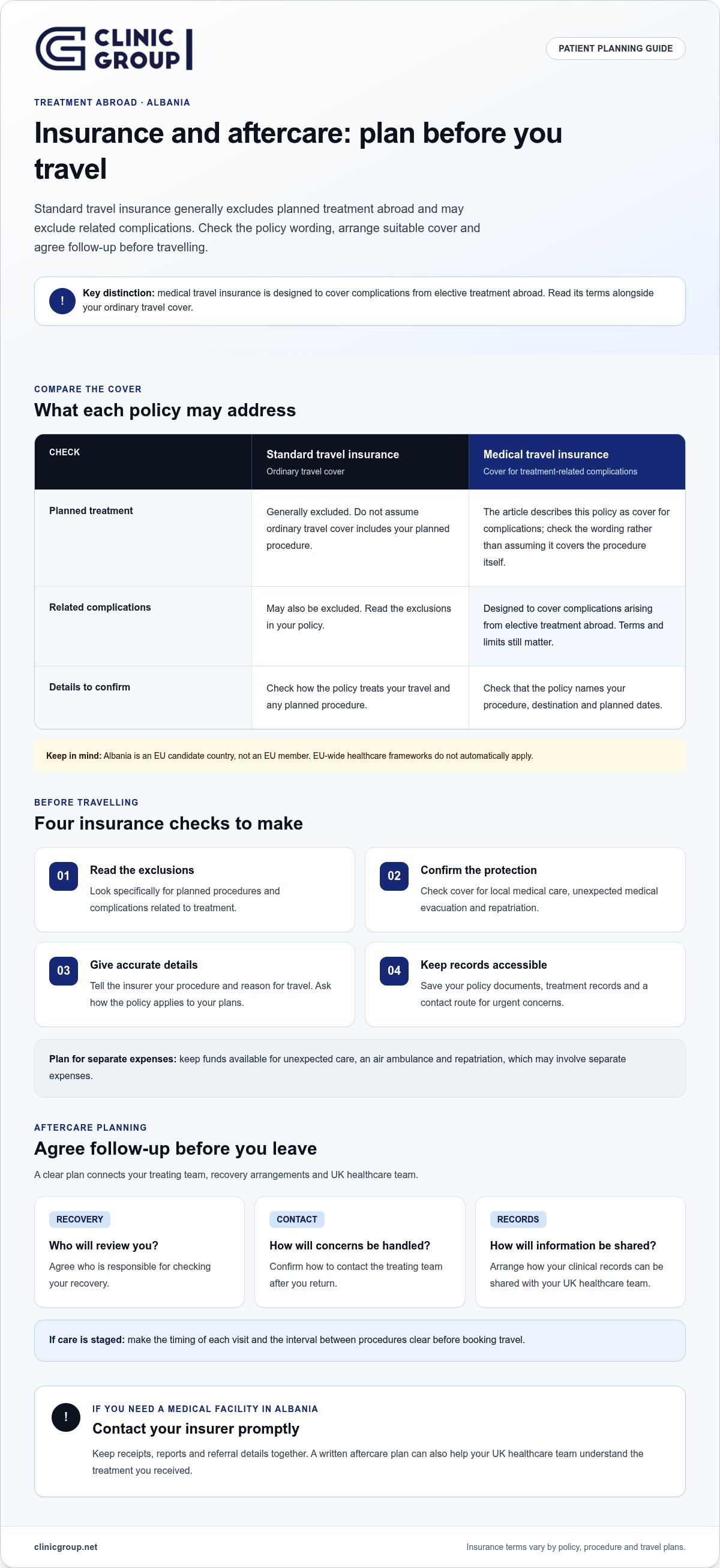
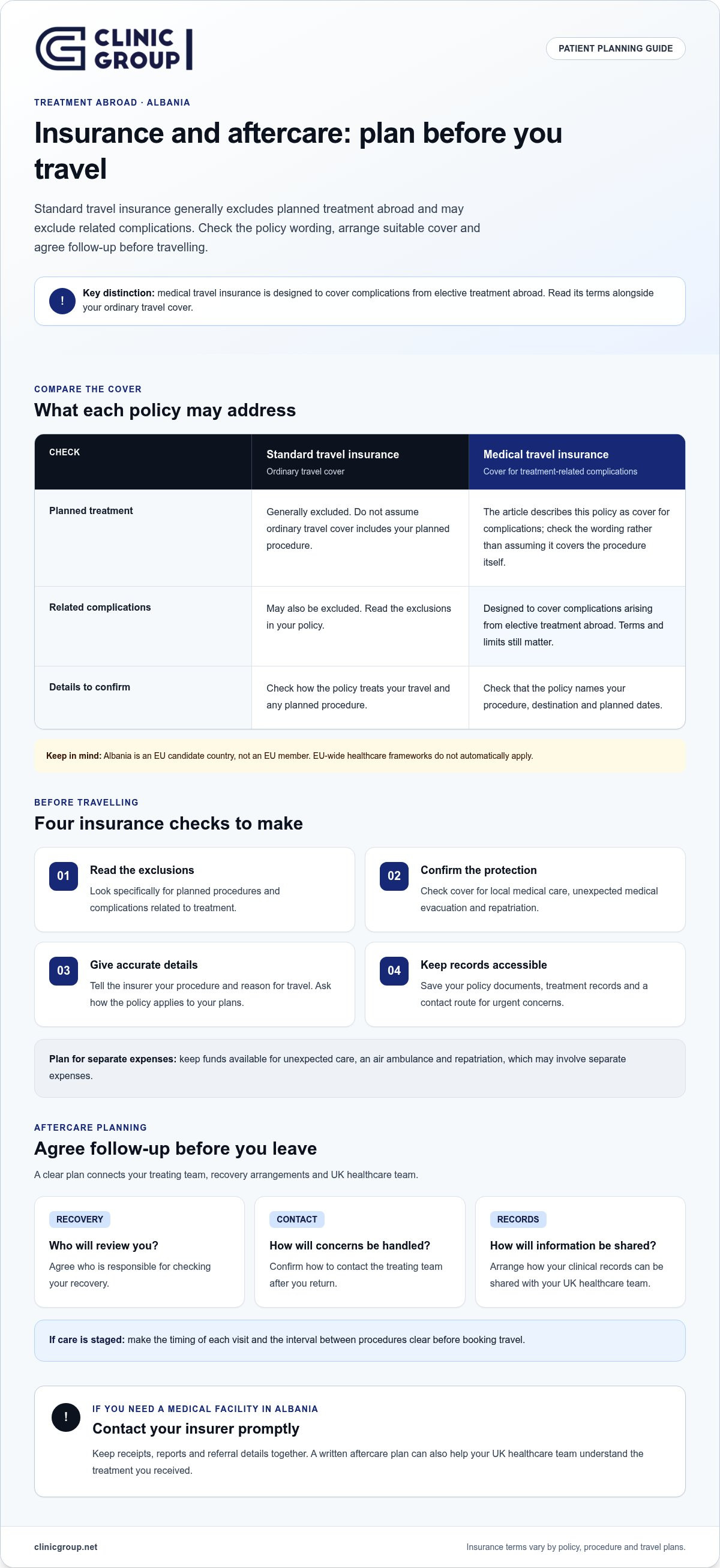
Standard travel insurance generally excludes planned treatment abroad and may also exclude complications arising from it. A medical travel insurance policy is designed to cover complications from elective treatment abroad, so read its terms alongside your ordinary travel cover. Check whether the policy names your procedure, destination and planned dates.
Albania is an EU candidate country, not an EU member, so EU-wide healthcare frameworks do not automatically apply. Arrange cover that addresses local medical care and unexpected medical evacuation. Keep funds available for treatment abroad, an air ambulance and repatriation, as these may involve separate expenses.
For volunteering, internships or study, tell the insurer the purpose and duration of your stay. A standard holiday policy may not cover an extended placement or organised activity. Ask how it treats illness, accidents, medical evacuation and any planned procedure. Keep the written response with your policy documents.
Albania’s Health Insurance Institute is primarily funded by a charge of 3.4% on gross salaries. That national funding arrangement is distinct from cover for a UK visitor’s planned treatment, travel risks or complications. Do not assume a contribution to Albania’s system provides cover for your own medical care.
Before travelling, organise follow-up around the treatment plan. Agree who will review your recovery, how clinical concerns will be handled after you return, and how your records will be shared. For staged care, make sure each visit’s timing and the interval between procedures are clear before booking travel.
- Read exclusions for elective procedures and treatment-related complications.
- Confirm cover for care in Albania, medical evacuation and repatriation.
- Give the insurer accurate details about your procedure and reason for travel.
- Save policy documents, treatment records and a contact route for urgent concerns.
- Arrange follow-up communication with the treating team before leaving Albania.
If a doctor refers you to a medical facility while you’re in Albania, contact your insurer promptly. Keep receipts, reports and referral details together; they can help the insurer assess what happened and explain the next steps. A written aftercare plan can also help your UK healthcare team understand the treatment you received.
For a broader planning overview, explore medical travel guidance alongside your policy documents. Insurance terms vary by activity and procedure, so the wording that applies to your volunteering, internship, studies or treatment matters most.
Albania’s healthcare system and private hospitals
Albania’s public healthcare system has three tiers: primary, secondary and tertiary care. Primary care is the first point of contact; secondary and tertiary services provide more specialised assessment and hospital care. For international patients, this structure offers context, but it does not mean every service is accessible through the public system.
In 2022, Albania had 43 public hospitals and 18 private hospitals. The country also has approximately 413 public healthcare clinics providing primary and secondary services. These figures describe different parts of the system: a clinic may provide local or outpatient care, while a hospital can provide inpatient treatment. The facility type alone does not establish whether it has the specialist team or setting required for a particular procedure.
Hospital capacity includes 8,885 beds, of which 8,169 were in public hospitals. Albania’s current health expenditure was estimated at 6-7% of GDP in 2018, and almost 60% of that expenditure was paid privately. These figures show the role of private funding, but they do not establish the quality, availability or patient experience of an individual hospital. Compare the specific service and care pathway, rather than treating national totals as a guide to one clinic.
Public-private partnerships describe arrangements in which public and private organisations may have roles in providing or supporting services. The label alone does not explain who employs the treating specialist, manages the facility or arranges follow-up. Clarify which organisation is responsible for each part of the care pathway, including admission, records and post-treatment contact. This matters especially when a plan involves more than one facility.
Tirana is the country’s main medical tourism hub. Medical and dental facilities can be very poor, particularly outside Tirana, so location matters when considering access to specialist care. Some staff at medical providers in Albania speak English, but language support can differ by team and appointment. Clear communication about consent, instructions and records is essential to understanding a treatment plan.
When comparing a public hospital, private hospital or clinic, organise the information around the care required:
- Match the facility type to the planned procedure and level of specialist care.
- Identify who is responsible for treatment, records and follow-up.
- Check how language support applies to consultations and clinical instructions.
- Consider the location, particularly if care outside Tirana would require access to additional services.
These distinctions help you understand Albania’s healthcare structure without assuming that public capacity, private provision or a partnership label guarantees a particular service. For medical tourism, focus on how the named facility, clinical team and follow-up arrangements fit together for the treatment you’re considering.
Travel requirements and flight times from the UK
UK passport holders do not need a visa for short stays in Albania, and flights from the UK take about three hours. Plan travel around the treatment schedule, recovery arrangements and any return visits, rather than choosing flights before the clinical plan is clear.
In an emergency in Albania, call 127 to request an ambulance. Keep the number accessible with your travel documents, and contact your insurer promptly if you’re referred to a medical facility.
Check the latest vaccine recommendations at least 8 weeks before travelling to Albania. Drink bottled water rather than tap water, and choose UHT or pasteurised milk; some areas have altitude-sickness risk, and air pollution can be high.
Entry arrangements depend on your nationality and length of stay. UK passport holders can visit for short stays without a visa; an Albanian type C visa permits a stay of up to 90 days within a 180-day period. Keep your passport, booking details, clinic correspondence and insurance information together, so you can access them during travel.
Plan the journey from arrival to your accommodation and clinical facility before departure. Confirm the arrival airport, appointment address, transfer arrangements and who is handling each leg. Save your accommodation address and clinic contact details offline in case mobile data is unavailable. Allow enough time to travel between the airport, accommodation and appointments.
Prepare your medicines before travelling. The legal status of some medicines prescribed or bought in the UK can differ abroad. Carry medicines in their original packaging with the prescription or a letter explaining their use, and check the rules for each medicine before packing it. Keep essential medication in your hand luggage where permitted.
A medical trip can also bring stress from treatment, unfamiliar surroundings and time away from home. Before departure, share your itinerary with someone you trust, agree how you’ll keep in touch and plan quiet time around appointments. If you already receive mental health support, arrange how it will continue while you’re abroad.
Use this travel checklist to keep the practical details together:
- Save your passport details, insurance documents and clinic appointment information.
- Confirm transfers, addresses and travel times for each appointment.
- Check medicine restrictions and carry relevant prescription information.
- Review vaccine advice at least 8 weeks before departure.
- Keep emergency number 127 accessible during your stay.
Preparation matters because entry rules, medicines and care arrangements differ between countries. A clear plan helps you manage documents, travel and appointments without assuming that UK arrangements apply in Albania.
Albania’s medical tourism market and treatment options
Tirana is Albania’s main hub for medical tourism, bringing international patients to the country’s largest city for planned care. Options include dental treatment, hair transplants, plastic surgery, eye care and wellness check-ups. They differ in the number of visits, assessment needs and follow-up arrangements, so compare the entire treatment pathway, not just the procedure.
Dental care illustrates why travel planning must follow the clinical plan. Dental implant treatment usually requires two trips around three months apart. That interval affects flights, time away from home and arrangements for care between visits. Ask for a written outline of both stages, the purpose of each appointment and how the clinic will communicate with you while you are back in the UK.
Other procedures bring different practical considerations. A hair transplant or plastic surgery requires recovery planning, while eye care calls for clear discussion of assessment and follow-up. A wellness check-up may involve a different appointment structure from an operation. Identify the specific procedure, then map consultations, treatment, recovery and follow-up against your travel plans.
Language is another part of the patient journey. Some staff at medical providers in Albania speak English, but patients should understand who will explain the treatment, consent documents and recovery instructions. Ask for key clinical information in writing, including how to contact the team after returning abroad. Clear instructions are particularly useful if a concern arises after travel.
Before choosing a treatment pathway, compare these practical points:
- Visits: establish how many journeys the plan involves, especially for staged dental implants.
- Assessment: understand which checks and consultations happen before treatment and in person.
- Recovery: match the expected care plan to your return travel and time away from work.
- Communication: clarify how English-language discussions and written instructions are handled.
- Aftercare: agree how follow-up works across Albania and the UK, and who receives clinical records.
Medical treatment in Albania can involve multiple appointments and journeys; the treatment plan determines the travel pattern. Consider insurance and emergency arrangements before departure, particularly for planned procedures abroad. Read policy exclusions and make sure you understand how to seek help during your stay. A low number of visits should not be your only measure of convenience.
For UK patients, the clearest comparison is between complete care pathways: treatment stages, time between appointments, recovery arrangements, language support and follow-up. This makes the differences between dental, hair, surgical, eye-care and wellness options easier to understand before you commit to travel.
Clinic Group: Dental Treatment Directory
Clinic Group’s Dental Treatment Directory helps patients explore dental care options in Albania and compare treatment plans. It’s a useful next step once you know which procedure you’re considering and have questions about visits, recovery or follow-up. Clinic Group also offers Hair Transplant Referrals, an Ophthalmology Clinic Directory and Medical Tourism Treatment Guides.
Use these resources to narrow your research and organise the questions you want answered before making travel arrangements. Clinic Group lists partner clinics almost entirely in Tirana, Albania, with a small number in Dubai. The directory helps you explore options; clinical assessment and treatment are provided by the treating clinic.
For more information, visit clinicgroup.net.
Take your next step with confidence
Before choosing medical treatment in Albania, turn your research into a clear set of priorities. Decide what matters most to you, then note any unanswered questions about your care and the decision ahead.
A focused discussion can help you understand how a proposed care pathway fits your circumstances. Take time to consider the information, compare it with your priorities and decide at a pace that feels right.
A considered approach can help you move forward feeling informed and prepared.
Frequently Asked Questions
What medical treatments and healthcare services are available in Albania for visitors and residents?
Residents may be eligible for family doctor visits, reimbursable medicines and medical check-ups, while visitors often arrange planned care privately. Albania’s medical sector includes general and specialist services, but the suitable route depends on individual circumstances and treatment needs. For a check-up, clarify its purpose and which records or test results could help the clinician understand your health history.
How does Albania’s public healthcare system work, and who is eligible for treatment?
Eligibility for public services depends on the person and the type of care. Since January 2016, around 600,000 uninsured people have been eligible annually for free family doctor visits and reimbursable medicines. Nearly one million people aged 35-70 are entitled to free medical check-ups, whether insured or uninsured. These entitlements describe specific groups and services; they don’t establish a visitor’s eligibility for publicly funded treatment.
What should I compare in a private clinic’s written treatment plan?
Compare clinical details, not just procedure names. Check the proposed treatment stages, diagnostic work, materials, temporary restorations where relevant, recovery instructions and follow-up arrangements. For example, dental implant plans may set out different stages or restoration materials. Ask for unfamiliar terms to be explained in plain English, and keep the final plan with your consent documents and medical records.
How can I arrange communication with doctors if I need care in Albania?
Some staff at medical providers in Albania speak English, but communication arrangements depend on the team and appointment. State your preferred language and ask how clinical discussions will be handled. Prepare a concise summary of your symptoms, medical history and regular medicines. This helps keep the consultation focused and gives the clinician relevant context without relying on memory during an unfamiliar appointment.
What standards and risks should I consider before medical or dental treatment in Albania?
Albania’s medical device law requires CE marking for medical equipment entering the country. This concerns equipment and does not guarantee a particular treatment result. Albania is an EU candidate country, so EU-wide healthcare and consumer frameworks do not automatically apply. For an informed decision, understand the proposed procedure, its material risks, consent information and how concerns will be addressed after treatment.
What emergency number should I save before travelling in Albania?
Save 127, the number to request an ambulance in Albania, in your phone before departure. Keep it accessible alongside your accommodation address and relevant medical information. If an insurer refers you to a medical facility, contact the insurer promptly and retain referral details and clinical paperwork. Having these details together can help you communicate clearly during an unexpected event and manage the next practical steps.
What are the costs of private doctors, hospital care, dental treatment and prescriptions in Albania?
How do you find English-speaking doctors and hospitals in Tirana and other Albanian cities?
Tirana is Albania’s main medical treatment hub, and some provider staff speak English. Before booking, ask how English-language support will cover consultations, consent, clinical instructions and follow-up.

Article by
Clinic Group Editorial Team
The Clinic Group editorial team publishes clear, practical guides for UK and EU patients researching medical travel — from dental implants and hair transplants to plastic surgery and eye care — with a focus on verified clinics, transparent “from” pricing, and safe planning.
Disclaimer
This article is for general information only and is not medical advice, diagnosis, or a substitute for an in-person consultation with a qualified clinician. Treatment suitability, risks, timelines, and costs vary by individual. Clinic Group connects patients with independent clinics; those clinics are responsible for clinical care. Always verify credentials, obtain a written treatment plan and itemised quote, and confirm aftercare arrangements and travel insurance cover (elective procedures are often excluded) before booking. Outcomes cannot be guaranteed.