TL;DR:
- The safest way to find reliable medical specialists abroad is to verify the surgeon’s credentials directly with national regulators and obtain a written aftercare plan. Patients should consult their UK clinician first, confirm the clinician’s registration, and scrutinize clinic licensing and patient feedback before paying any deposit. Clinicgroup’s verified directory offers pre-checked clinics and named specialists in Albania and Dubai, ensuring documented safety standards and continuity of care.
The safest route to finding reliable medical specialists abroad is straightforward: speak to your UK clinician first, verify the named surgeon directly with the destination country’s medical regulator, and insist on a written aftercare plan before paying any deposit. Within the next 24–48 hours, contact your GP to discuss fitness to travel, request the full name and registration number of the clinician who will perform your procedure, and cross-check those details with the relevant national regulator. Clinicgroup’s verified directory offers a practical starting point, with pre-checked clinics and named specialists across Albania and Dubai, all held to documented European-standard protocols.
Table of Contents
- How to find trusted specialists: your step-by-step checklist
- What to verify: credentials, registrations, and red flags
- Vital questions to ask the clinic and surgeon before you pay
- Aftercare, complications, and continuity of care when you return to the UK
- Budgeting and timeline: what to plan for
- How Clinicgroup helps UK patients find verified specialists
- Key takeaways
- The patient-first principle matters more than the price
- Clinicgroup’s verified directory: your next step
- Useful sources
- FAQ
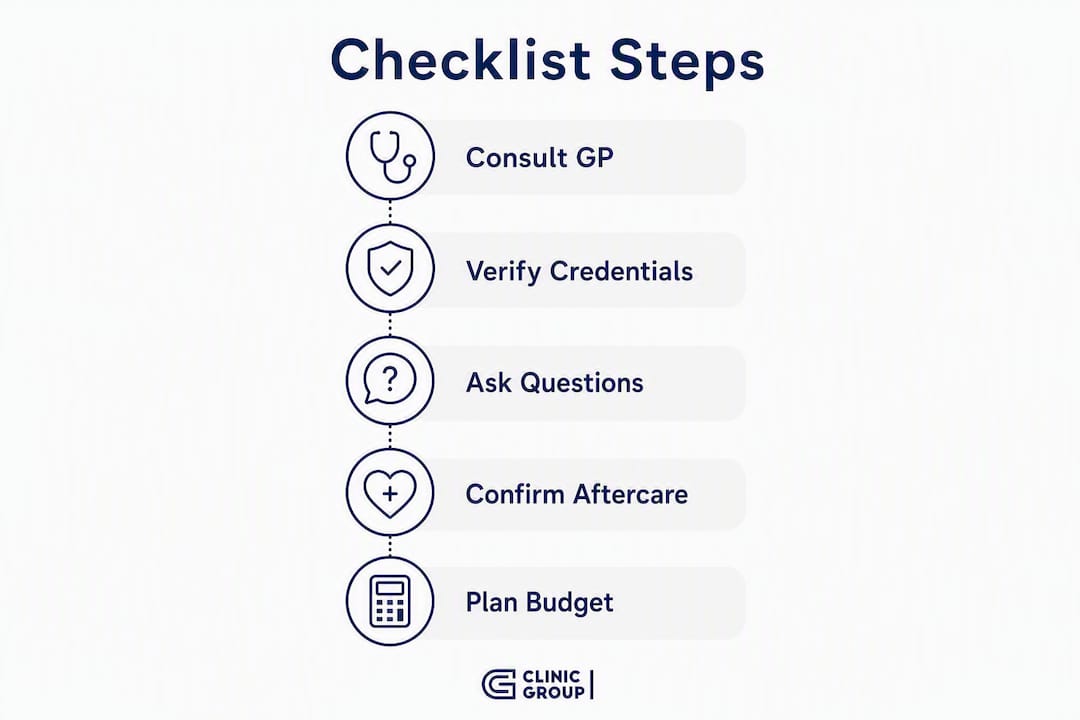
How to find trusted specialists: your step-by-step checklist
Following a clear sequence reduces risk considerably. Work through these steps before committing to any clinic or paying any deposit.
-
Speak to your UK GP, dentist, or relevant specialist first. NHS guidance recommends a fitness-to-travel review before booking any elective procedure abroad. Your GP can flag long-term conditions that affect surgical risk and provide a second opinion on whether the treatment is appropriate.
-
Define the exact procedure you need. Vague requests lead to vague quotes. Know the specific treatment name (for example, FUE hair transplant, dental implant with crown, rhinoplasty) before approaching any clinic.
-
Request the full name and registration number of the performing clinician. Not the clinic director. Not “our senior surgeon.” The specific person who will operate on you. Get this in writing before any payment.
-
Verify credentials with the destination regulator. Cross-check the clinician’s registration number against the destination country’s ministry of health or medical council. Do not rely on the clinic’s own website or social media profiles.
-
Check the facility licence and inspection status. Ask for the clinic’s operating licence number and confirm it with the relevant national authority.
-
Review independent patient feedback. Look beyond the clinic’s own testimonials. Check independent platforms and why patient reviews matter when assessing overseas providers. Treat volume of followers or influencer endorsements as non-clinical indicators.
-
Request a written treatment plan, itemised quote, and complication policy before transferring any funds. A reputable clinic provides these without hesitation.
-
Confirm the aftercare and emergency pathway in writing. Who do you contact if something goes wrong after you return to the UK? This must be documented.
Pro Tip: If a clinic pressures you to pay a deposit quickly or cannot name the operating surgeon in writing, treat that as a serious warning sign and walk away.
What to verify: credentials, registrations, and red flags
Knowing how to choose specialists means going beyond a polished website. The verification flow below applies whether you are considering cosmetic surgery, dental implants, a hair transplant, or anti-ageing treatment.
Verification flow:
- Clinician’s full name and job title
- Registration number with the destination country’s medical or dental council
- Specialist qualifications and the institution that awarded them
- Membership of recognised specialist societies (for example, board certification in plastic surgery)
- Facility licence number and most recent inspection date
Official government guidance is clear: verify registration numbers and qualifications directly with the regulator, not through the clinic. For UK patients, the General Medical Council (GMC) provides a useful benchmark for what a verifiable registration record looks like; apply the same standard to the destination country’s equivalent body.
Medical tourism carries higher risks than domestic care because the sector is poorly regulated internationally. Accreditation is helpful but not definitive; individual clinician verification always takes priority over a clinic’s marketing credentials.

Red flags to watch for:
| Red flag | Why it matters |
|---|---|
| Clinic refuses to name the operating surgeon | You cannot verify credentials you do not have |
| Bait-and-switch to a junior clinician | A documented risk: senior surgeon marketed, junior assigned in theatre |
| No written aftercare or complication policy | Leaves you without recourse if problems arise post-return |
| Package-holiday bundling with no clinical detail | Prioritises sales over individual patient safety |
| Pressure to pay a deposit immediately | Reputable clinics allow time for due diligence |
For a structured approach to researching clinic credentials before you travel, Clinicgroup’s guidance covers the specific checks that matter most.
Vital questions to ask the clinic and surgeon before you pay
These questions apply to every treatment category, from dental veneers to liposuction. Ask them before any financial commitment.
- Will the surgeon I consult with be the one performing the procedure?
- What are this clinic’s specific success and complication rates for this operation?
- Who manages my care if complications arise after I return to the UK?
- Can you provide the surgeon’s full name, registration number, and specialist qualifications in writing?
- Who is the anaesthetist, and what are their credentials?
- What does the written aftercare plan include, and how long does clinical follow-up last?
- What is your documented policy if a revision is required?
For dental patients, specific pre-travel questions for your dentist cover implant protocols, sterilisation standards, and warranty terms in detail.
You can adapt the message below to request written answers from any clinic:
Pro Tip: If answers arrive verbally but the clinic declines to confirm them in writing, that is a high-risk provider. Reputable clinics document everything.
Aftercare, complications, and continuity of care when you return to the UK
Insist on a written aftercare plan and a clear emergency pathway before booking. This is non-negotiable.
Documents to obtain before you travel home:
- Complete operative notes in English
- Copies of all pre-op and post-op imaging
- Implant or device serial numbers (where applicable)
- Written follow-up instructions and recovery milestones
- Direct contact details for the responsible overseas clinician
UK clinicians and professional bodies stress that surgeons may be unavailable once you return home. Documented handover to your UK GP is the safeguard. Clinics that proactively supply comprehensive medical reports in English and support communication with UK GPs materially reduce continuity-of-care risks.
Insurance:
- Standard travel insurance typically excludes elective procedures. Specialist medical travel insurance that names the planned procedure and covers emergency repatriation is usually required.
- Confirm that any clinic guarantee is transferable and enforceable from the UK.
If complications arise after returning:
- Minor concerns: contact your GP and present the clinic’s medical report.
- Urgent concerns: call NHS 111.
- Emergencies: attend A&E and disclose the overseas treatment immediately.
For a full breakdown of what good aftercare services look like for medical tourists, Clinicgroup’s guidance covers the documentation and follow-up standards to expect.
Budgeting and timeline: what to plan for
Treatment abroad involves more than the headline procedure fee. Budget for every component.
| Cost component | Notes |
|---|---|
| Treatment fee | Confirm what is included: surgeon, anaesthesia, theatre, hospital stay |
| Pre-op tests | Blood work, imaging, fitness assessments |
| Travel and accommodation | Flights, partner hotel, local transfers |
| Specialist medical travel insurance | Must name the procedure and cover repatriation |
| Contingency fund | Set aside a reserve for complications, revisions, or extended stay |
Typical planning timeline:
- Weeks 1–4: Research, UK GP consultation, remote clinic enquiries
- Weeks 5–8: Remote consultations, credential verification, written quotes
- Weeks 9–10: Pre-op tests, insurance arranged, travel booked
- Day of travel: Surgery and initial monitored recovery
- Post-op: Minimum recovery period abroad before flying; follow-up with UK GP on return
Always request written refund and cancellation terms before paying a deposit. Confirm what happens financially if the procedure is postponed for medical reasons.
How Clinicgroup helps UK patients find verified specialists
Clinicgroup matches patients with verified clinics and named specialists, supports travel logistics, and coordinates aftercare so patients have a documented continuity-of-care plan from day one.
- Verified directory: Clinics are independently checked for clinician registration, facility licensing, and European-standard protocols before being listed.
- Named specialists: Patients receive the name and credentials of the clinician assigned to their case, not a generic “senior surgeon” promise.
- Pre-booking support: Clinicgroup facilitates remote consultations and second-opinion requests before any commitment is made.
- Travel and accommodation: Partner hotels and transfer logistics are coordinated alongside the clinical booking.
- Aftercare coordination: Post-procedure follow-up is documented, and communication with UK GPs is supported.
The international treatment booking process guide explains each stage in detail, from initial enquiry through to post-op follow-up.
Key takeaways
Verified clinician credentials, a written aftercare plan, and specialist medical travel insurance are the three non-negotiable pillars of safe treatment abroad.
| Point | Details |
|---|---|
| Start with your UK GP | Get a fitness-to-travel review and second opinion before approaching any overseas clinic. |
| Verify the named surgeon | Confirm the operating clinician’s registration number directly with the destination country’s regulator. |
| Insist on written aftercare | Obtain operative notes, follow-up instructions, and an emergency contact in English before travelling home. |
| Arrange specialist insurance | Standard travel policies exclude elective procedures; obtain cover that names the procedure and includes repatriation. |
| Clinicgroup verified directory | Clinicgroup pre-checks clinician registration, facility licensing, and aftercare protocols for every listed clinic. |
The patient-first principle matters more than the price
The most common mistake patients make when seeking treatment abroad is treating the headline price as the primary filter. A lower fee means nothing if the operating surgeon cannot be named, the aftercare plan is verbal, or the clinic’s registration cannot be verified. The patients who experience the best outcomes are those who ask the hardest questions before booking, not after.
Clinicgroup’s approach is built on that principle. Every clinic in the network has been checked for clinician credentials, facility licensing, and documented patient-support processes. Patients receive the name of their specialist upfront, a written treatment plan, and coordinated aftercare that keeps their UK GP informed. The goal is not simply to connect patients with affordable care; it is to make sure that care is genuinely safe and verifiable.
Clinicgroup’s verified directory: your next step
For patients who want the reassurance of pre-verified clinics and named specialists, Clinicgroup offers a straightforward starting point. The directory covers dental treatments, hair transplants, plastic surgery, and anti-ageing therapies across verified clinics in Albania and Dubai. Every listing includes pre-checked clinician credentials, transparent pricing, and coordinated travel and aftercare support. Submit an initial enquiry through the Clinicgroup platform to receive a written treatment plan, a named specialist, and a remote consultation before committing to anything.
This article provides general information for patients considering treatment abroad. It is not a substitute for professional medical advice. Always confirm current regulations and your individual suitability with a qualified clinician.
Useful sources
- NHS: Going abroad for medical treatment — supports the recommendation to speak to your GP and arrange specialist insurance.
- NHS: Treatment abroad checklist — covers GP consultation, credential checks, and pre-booking questions.
- Travel Aware: Surgery abroad, cut out the risk — primary source for verification steps, red flags, and insurance guidance.
- GOV.UK: Government works with TikTok on treatment abroad safety — background on social media risks and package-surgery warnings.
- GOV.UK: Medical emergencies and hospitalisation abroad — guidance on consular support and emergency contacts.
- TravelHealthPro (NaTHNaC): Medical tourism factsheet — independent assessment of medical tourism risks and accreditation limitations.
- Fit for Travel: Questions to ask before travelling for medical treatment — NHS Scotland checklist of pre-booking clinical questions.
- All Health and Care UK: Treatment abroad checklist — covers bait-and-switch risks, written confirmation requirements, and continuity of care.
FAQ
Should I speak to my GP before booking treatment abroad?
Yes. NHS guidance recommends a GP consultation to assess fitness to travel and highlight any conditions that could affect surgical risk.
How do I verify a surgeon’s credentials for treatment abroad?
Request the surgeon’s full name and registration number, then check those details directly with the destination country’s ministry of health or medical council, not through the clinic’s own website.
Does standard travel insurance cover treatment abroad?
Standard travel insurance typically excludes elective procedures. Specialist medical travel insurance that names the planned procedure and includes emergency repatriation cover is required.
What is the bait-and-switch risk when booking surgery abroad?
Some clinics market a senior surgeon but assign a junior clinician in theatre. Insist on written confirmation naming the operating surgeon and verify their registration number independently before paying any deposit.
How does Clinicgroup verify the clinics and specialists it lists?
Clinicgroup independently checks clinician registration, facility licensing, and European-standard protocols for every clinic in its directory, and provides patients with the named specialist and a written treatment plan before booking.