TL;DR:
- Medical tourism in Europe offers genuine opportunities but involves risks if clinic quality verification is neglected. Patients must assess factors such as facility accreditation, individual clinician experience, and comprehensive aftercare arrangements beyond surface-level markers. A structured validation process, including independent database checks and direct documentation requests, ensures safer and more informed treatment choices abroad.
Imagine you have booked a cosmetic procedure at a clinic in Eastern Europe, attracted by the lower price and glossy website photos. You arrive to find the surgeon’s credentials are unavailable for inspection, the aftercare plan is vague, and returning home leaves you uncertain about who to contact if something goes wrong. This scenario plays out more often than most people realise. Medical tourism across Europe is growing rapidly, and whilst the opportunities are genuine, so are the risks of choosing the wrong provider. This guide gives you a structured, proven approach to verify clinic quality before you commit.
Table of Contents
- Understand what clinic quality really means
- Essential tools and requirements for quality verification
- Step-by-step verification: How to check clinic quality
- Beyond checklists: Information sharing, aftercare, and what to ask next
- Why a checklist isn’t enough: The real-world secrets of clinic quality verification
- Finding trusted clinics for your next treatment
- Frequently asked questions
Key Takeaways
| Point | Details |
|---|---|
| Multi-step verification matters | True clinic quality checking combines facility accreditation, provider credentials, and aftercare planning, not just badges or lists. |
| Use official search tools | Check accreditations directly in official JCI or CQC databases rather than relying on clinic websites alone. |
| Aftercare is crucial | Always clarify post-treatment care and escalation protocols before travelling for any medical procedure. |
| Patient reviews need context | Treat patient reviews as one data point and cross-reference with objective quality assessments to avoid selection bias. |
Understand what clinic quality really means
With a clearer sense of what’s at stake, let’s clarify what true clinic quality looks like from the patient’s perspective.
Many patients associate quality with a clean reception area, modern equipment, or a professional-looking website. These things matter, but they are nowhere near sufficient. Genuine clinic quality is multi-dimensional, covering everything from how a facility is governed to whether your individual surgeon has performed your specific procedure hundreds of times.
For cosmetic, dental, and wellness treatments, quality breaks down into several distinct layers:
- Facility accreditation: Independent verification that the physical site meets safety, hygiene, and operational standards.
- Individual provider competency: The qualifications, training, and practical experience of the surgeon, dentist, or clinician who will actually treat you.
- Procedure-specific track record: How many times the provider has performed your exact treatment, and what their complication rates look like.
- Aftercare continuity: Whether structured follow-up is built into your treatment plan, including what happens if you return home and experience complications.
- Outcome monitoring: Whether the clinic tracks and reports patient outcomes systematically, not just anecdotally.
As the NHS advises, clinic quality must include verifying provider training, procedure experience, complications, and aftercare in addition to facility-level accreditation. This distinction is critical. Patients often focus on whether a clinic holds a quality badge and overlook whether the individual practitioner is appropriately qualified.
Facility-level accreditation, such as Joint Commission International (JCI) certification, evaluates the organisation as a whole. However, as JCI itself notes, accreditation surveys focus on overall facility safety, not individual provider competence or aftercare continuity. A facility can pass an accreditation survey whilst employing clinicians at different levels of experience for your specific procedure.
Understanding clinic accreditation basics is the first step, but it should be paired with equal scrutiny of the clinician and the medical tourist aftercare arrangements. True quality is the full picture, not just one part of it.
“Quality is not just about the building. It is about who is doing your procedure, what experience they have, and what support you will receive afterwards.” This is the standard every patient should apply.
Essential tools and requirements for quality verification
Now that you know what to look for, assemble your verification toolkit before making clinic enquiries.
Knowing what to check is only useful if you have the right tools and resources to actually do it. Before you contact a clinic or request a quote, gather the following.
Official accreditation and licensing databases:
- Joint Commission International (JCI): Use the Find Accredited Organisations tool to confirm whether a facility holds current JCI accreditation and to check the expiry date.
- Care Quality Commission (CQC): For UK-based private clinics, the CQC publishes inspection reports and ratings that show compliance at specific dates.
- National health authority registers: Each European country maintains its own register of licensed healthcare facilities. In Turkey, for instance, the Ministry of Health operates a public register. In Germany, each Länder (state) holds its own.
- Professional body registers: For dentistry, check the national dental association. For surgery, verify membership with the relevant surgical college or specialist register.
Documents to request directly from the clinic:
- Proof of the treating clinician’s qualifications and registration number.
- Professional indemnity or malpractice insurance details.
- A written aftercare plan, including who to contact post-procedure.
- Documentation of how many times the clinician has performed your specific treatment.
- Any patient outcome data or audit results the clinic publishes.
Patient review platforms: Use Trustpilot, Google Reviews, and treatment-specific forums with caution. Look for patterns rather than individual comments. The NHS recommends verifying registration, provider training and insurance, and reviewing quality ratings online for any clinic in England. Apply the same logic internationally.
The table below summarises your core verification toolkit:
| Source or tool | What it checks | Who issues it |
|---|---|---|
| JCI accreditation search | Facility-level safety and quality | Joint Commission International |
| CQC provider reports | UK facility compliance and inspection findings | Care Quality Commission (UK) |
| National health authority register | Legal registration of facility in country | Country-specific health ministry |
| Professional body register | Individual clinician’s licence and qualifications | Relevant national professional body |
| Clinic’s own documentation | Provider credentials, insurance, aftercare plan | The clinic itself (verify independently) |
| Patient review platforms | Patient experience, communication, aftercare signals | Patients (use critically, not in isolation) |
You can use our clinic directory to start identifying pre-vetted options, and our guide on comparing clinic features explains how to assess what you find.
Pro Tip: Always cross-reference the clinic’s formal legal name (not just its trading name) against accreditation databases, and check the date on which the accreditation was last confirmed. Accreditation badges on websites are not automatically updated when certification lapses.
Step-by-step verification: How to check clinic quality
After collecting your tools and documents, follow this exact process to check any clinic’s claims and credentials.
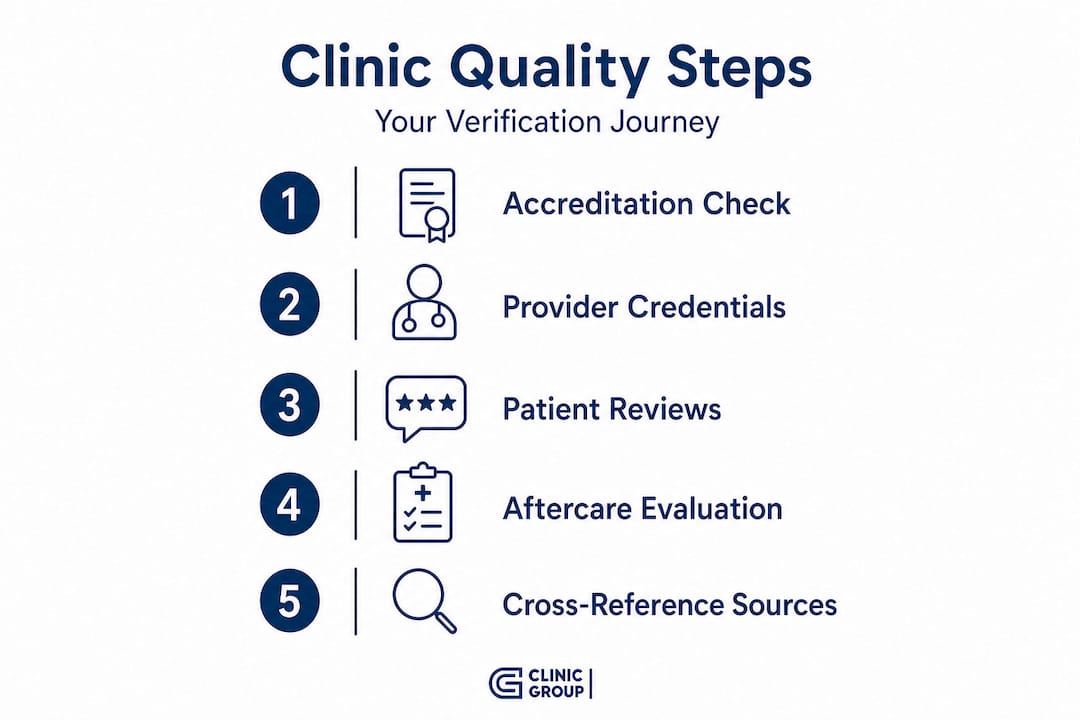
A structured approach removes guesswork and ensures you do not skip critical steps under pressure or excitement. Follow this numbered workflow for every clinic you are seriously considering.
-
Verify legal registration. Confirm the clinic is legally registered as a healthcare provider in the country where it operates. Request the official registration number and cross-check it against the national health authority’s public register.
-
Check facility-level accreditation. Use the JCI public search or the relevant national equivalent to confirm current accreditation status. Note the accreditation expiry date. As JCI confirms, JCI-accredited organisations are evaluated by surveyors for quality and safety and are listed in their public search tool, giving you a direct way to confirm claims.
-
Verify individual provider credentials. Ask for the treating clinician’s full name, registration number, and the professional body with which they are registered. Look up that registration number independently on the professional body’s official website.
-
Ask about procedure-specific experience. Request the number of times the clinician has performed your exact procedure in the last 12 months. For higher-risk treatments such as rhinoplasty, full-mouth dental rehabilitation, or liposuction, ask about their complication rate and how complications are managed.
-
Examine the aftercare plan in writing. A reliable clinic will provide a written aftercare protocol before you arrive. This should include emergency contact details, information on what symptoms require attention, and how they will communicate with your GP or local specialist if needed.
-
Run a robust European verification workflow. As the NHS outlines, a sound process covers local legal registration, facility-level accreditation, provider credentials, procedure and complication history, and patient experience signals together.
-
Review CQC reports if applicable. For UK patients considering domestic private clinics, CQC reports show directly whether facilities met regulations at each inspection date, providing a clear, risk-based signal for shortlisting.
The comparison below shows how the main verification methods stack up:
| Verification method | What it confirms | Limitation |
|---|---|---|
| JCI accreditation search | Facility meets international safety standards | Does not assess individual clinician competency |
| CQC provider report | UK facility met regulations at inspection | UK-focused; point-in-time snapshot only |
| National professional register | Clinician is licensed and registered | Does not confirm procedure-specific experience |
| Direct document request | Specific credentials, insurance, aftercare plan | Relies on clinic being transparent and honest |
| Patient reviews | Patterns in experience and aftercare responsiveness | Subjective; can be manipulated |
For further guidance on arranging safe consultations abroad, or if you are specifically looking at dentistry, our guides on quality dental treatment abroad and dental travel risks and benefits go deeper into treatment-specific considerations.
Pro Tip: When requesting accreditation confirmation, ask the clinic to supply the official entity name and legal address as they appear on the certificate. Then search for exactly those details in the JCI or relevant database. Some clinics display accreditation that applies to a parent organisation, not the specific branch you are visiting.
Beyond checklists: Information sharing, aftercare, and what to ask next
Even after passing your checklist, there is one more crucial layer: what happens after your procedure and how clinics handle follow-up and information sharing.
The quality of a clinic is ultimately tested not just in the operating theatre but in the weeks and months that follow your treatment. Many patients discover problems only after they return home, at which point communicating with an overseas provider becomes complicated. Proactively asking the right questions before you travel can prevent these situations.
NHS England highlights how information requests from private providers help evaluate and improve quality and safety, showing the value of openness in outcome sharing. A clinic that is willing to coordinate with your GP or local specialist, share treatment records, and report outcomes is operating at a higher standard than one that does not.
When speaking with a clinic before booking, ask the following directly:
- Who is responsible for my care if I experience complications after returning home?
- Will you send my treatment records and operative notes to my GP or local specialist?
- What is your process for tracking patient outcomes at 3, 6, and 12 months post-treatment?
- Is there a dedicated aftercare coordinator I can contact from abroad?
- What costs, if any, are associated with follow-up consultations or revision procedures?
The last question is particularly important. As patient review data suggests, third-party quality seals may miss aftercare costs or communication problems, and these should be addressed proactively in your plan. A clinic that holds an impressive accreditation may still leave patients uncertain about who covers the cost of post-operative complications or how follow-up care is coordinated across borders.
Understanding your aftercare responsibilities is just as important as understanding the procedure itself. The best clinics are transparent about all of this in advance.
“Clear, written aftercare plans and a willingness to share information with your home healthcare provider are among the most reliable signals of a genuinely high-quality clinic.”
Why a checklist isn’t enough: The real-world secrets of clinic quality verification
Checklists are a strong foundation. But experienced patients and healthcare advisors will tell you that even a perfectly completed checklist can leave gaps. Here is the reality: some clinics actively manage their public image in ways that a standard verification process will not catch.
Accreditation dates can lapse quietly. A clinic’s website may display a JCI badge from a certification that expired two years ago. Without checking the actual database entry, you would have no way of knowing. Similarly, clinics sometimes display the accreditation of a hospital group of which they are technically part, without that specific branch having been independently assessed. Always check the specific site you intend to visit, not the parent organisation.
There is also the question of staff turnover. A clinic may have earned its accreditation partly on the strength of a highly experienced lead surgeon who has since moved on. The accreditation remains, but the expertise that helped earn it does not. This is why verifying individual provider credentials, not just facility status, matters so much.
Redundancy is your best protection. Cross-reference at least two independent sources for every claim. If a clinic says their lead dentist trained at a particular institution, verify that claim with the institution or the professional body, not just by taking the clinic’s word. Watch for subtle red flags: reluctance to provide registration numbers, vague answers about complication rates, or aftercare plans that consist of a single phone number with no written protocol.
More on clinic accreditation explains how the accreditation process works in practice, and why the human and contextual elements are often the decisive factors in safe treatment abroad. Combine official verification with personal judgement, and you will be in a much stronger position than the majority of medical tourists who rely on price and photographs alone.
Finding trusted clinics for your next treatment
For readers ready to put these verification strategies into action, here is where to start with confidence.

Clinic Group connects patients across Europe and the Middle East with verified, accredited healthcare providers offering cosmetic surgery, dental treatments, hair transplants, and wellness programmes. Every clinic in the network has been assessed for transparency, provider qualifications, and aftercare arrangements, aligning directly with the best practices covered throughout this guide. You can see available treatments and filter by procedure, location, and clinic features, or browse the trusted clinic network to compare options side by side. Our team is also available to assist with personalised guidance, travel support, and arranging second opinions, making the process straightforward and reassuring from first enquiry to full recovery.
Frequently asked questions
How do I know if a clinic’s international accreditation is valid?
Use the JCI public search to confirm facility accreditation, checking both the clinic’s formal legal name and the current accreditation status, including its expiry date.
What is the difference between CQC and JCI accreditation?
CQC inspects and reports on UK facilities, focusing on regulatory compliance, whilst JCI accredits international hospitals based on patient safety and quality standards assessed by independent surveyors.
Does a clinic’s presence on a list guarantee my safety?
No. The NHS emphasises that patients must verify individual provider competency, procedure experience, and aftercare arrangements, as list appearances and quality badges are not a complete guarantee of safe or appropriate care.
What questions should I ask about aftercare with overseas treatment?
Ask who is responsible for follow-up after you return home, what happens if complications arise, and how your treatment records will be shared with your local healthcare provider. Both NHS guidance and patient review evidence consistently point to unclear aftercare responsibilities as one of the most common sources of problems for overseas patients.