Why get medical treatment in Europe: a UK patient’s guide
UK residents choose medical treatment in Europe for three core reasons: shorter waiting times than the NHS, lower costs than UK private care, and access to treatments that face eligibility restrictions at home. For many patients, the decision is not impulsive. It reflects genuine pressure from NHS waiting lists, the high cost of going private domestically, and a growing awareness that high-quality care is available across Europe at transparent, competitive prices. Before you travel, though, there are rules, responsibilities, and practical steps worth understanding clearly.
Key points at a glance:
- The Global Health Insurance Card (GHIC) and its predecessor the EHIC cover urgent or emergency care in Europe, not planned elective procedures.
- NHS-funded treatment abroad requires prior authorisation and specific clinical criteria to be met.
- Elective treatments such as dental implants, cosmetic surgery, and hair transplants are almost always self-funded.
- Total costs must include travel, accommodation, specialist fees, aftercare, and medical travel insurance.
- Patient due diligence is essential: medical tourism is unregulated for UK patients, with no universal vetting of overseas providers.
- Clinicgroup connects UK patients with verified, board-certified clinics across Europe, with full journey support from consultation through to aftercare.
What types of medical treatment can you access in Europe?
The range of treatments available to UK patients across Europe is broader than many people expect. What began as a market dominated by cosmetic surgery now covers dentistry, orthopaedics, fertility care, diagnostics, and wellness therapies.
Common treatment categories include:
- Dental treatments: Implants, veneers, crowns, bridges, and full-mouth restoration. UK patients frequently travel for dental implants and cosmetic dentistry because private dental costs at home can be considerably higher.
- Orthopaedic surgery: Hip and knee replacements are among the most requested procedures, particularly where NHS waiting times have become difficult to tolerate.
- Fertility and reproductive medicine: Eligibility rules, donor availability, and funded treatment cycles vary between countries, making Europe attractive for patients who have exhausted NHS options.
- Plastic and cosmetic surgery: Rhinoplasty, liposuction, breast augmentation, and blepharoplasty are all widely available through verified European clinics.
- Hair transplants: FUE and DHI techniques are performed to high standards at specialist clinics, often at a fraction of UK private prices.
- Diagnostics and second opinions: MRI scans, CT scans, blood panels, and specialist consultations can be arranged faster abroad, with results transferable to UK clinicians.
- Non-surgical aesthetics and wellness: Botox, fillers, PRP, microneedling, IV therapy, and anti-aging programmes are available through accredited clinics across Europe.
How do costs and payment work for UK patients?
Cost is one of the most cited reasons UK patients seek treatment in Europe, but the full financial picture is more complex than the headline price suggests. European countries such as Poland and Lithuania generally have lower labour costs, property expenses, and operational overheads than UK private clinics, which is why comparable procedures can be offered at lower prices without any reduction in clinical standards.

For most elective treatments, patients self-fund entirely. The GHIC and EHIC cover only urgent or emergency care, not planned procedures. NHS-funded treatment abroad is possible but requires prior authorisation and must meet strict clinical criteria, including proof that the NHS cannot provide the treatment within a medically justifiable timeframe.
The true total cost of treatment abroad includes:
- Specialist and surgical fees
- Pre-operative diagnostics and consultations
- Travel and accommodation (including a companion if needed)
- Recovery stays, which may extend beyond the initial estimate
- Specialist medical travel insurance, as standard travel policies typically exclude planned procedures
- Potential UK follow-up costs if your NHS GP or private provider needs to continue care
The lowest headline price often omits several of these items. Patients who budget only for the procedure itself can find that complications, extended recovery, or UK aftercare add considerably to the final figure.
What are the NHS authorisation rules for treatment abroad?
UK residents retain a legal right to NHS-funded treatment in the EU if the NHS cannot provide it within a medically justifiable timeframe, under the terms of the Trade and Cooperation Agreement. However, following Brexit, the EU Directive route that previously allowed patients to seek treatment without prior authorisation ended. Today, anyone travelling to the EU for NHS-funded care must obtain formal approval in advance.
The authorisation process works as follows:
- Apply to NHS England (or the relevant devolved health board in Scotland or Wales) for prior authorisation before travelling.
- Demonstrate that the treatment is medically necessary and that the NHS cannot provide it without undue delay.
- Treatment must be sought from a public, not private, healthcare provider in the destination country.
- If authorisation is granted, the NHS covers costs directly at the rate applicable in that country; the patient typically pays nothing.
Despite this right, most UK patients remain unaware of the authorisation route and self-fund treatment instead. Many UK residents travelled to EU countries for medical care without applying for NHS authorisation, with only a small minority making formal applications for NHS-funded treatment in the EU. For elective, non-clinical treatments such as cosmetic surgery or dental veneers, NHS funding is not available regardless, and self-funding is the only route.
How do you choose the right country and clinic in Europe?
Choosing where to be treated is as important as choosing what treatment to have. The country, the clinic, and the individual specialist all affect your outcome, your recovery, and your experience.
Practical factors to assess:
- Accreditation and certification: Verify that the clinic holds recognised accreditation and that your surgeon or specialist is board-certified in their field. Clinicgroup works only with verified providers who meet defined standards.
- Transparent pricing: Reputable clinics provide itemised quotes that cover all stages of treatment, not just the procedure itself. Avoid any provider that cannot explain exactly what is and is not included.
- Language and communication: English-speaking patient coordinators are standard at established medical tourism clinics. Clinicgroup provides dedicated support throughout, so you are never navigating a foreign healthcare system alone.
- Treatment packages: Look for clinics that offer coordinated pathways covering consultation, diagnostics, surgery, and aftercare as a planned sequence rather than isolated appointments.
- Reviews and independent verification: Patient reviews are a useful signal, but they should be read critically. How reviews shape clinic selection matters, particularly when distinguishing genuine patient feedback from marketing content.
- Recovery infrastructure: Confirm that the clinic or its partner network can support you during recovery, including access to follow-up appointments and emergency care if needed.
Popular destinations for UK patients include Albania, Poland, Lithuania, Hungary, and Spain, each with particular strengths depending on the treatment category.
What does the patient journey abroad actually involve?
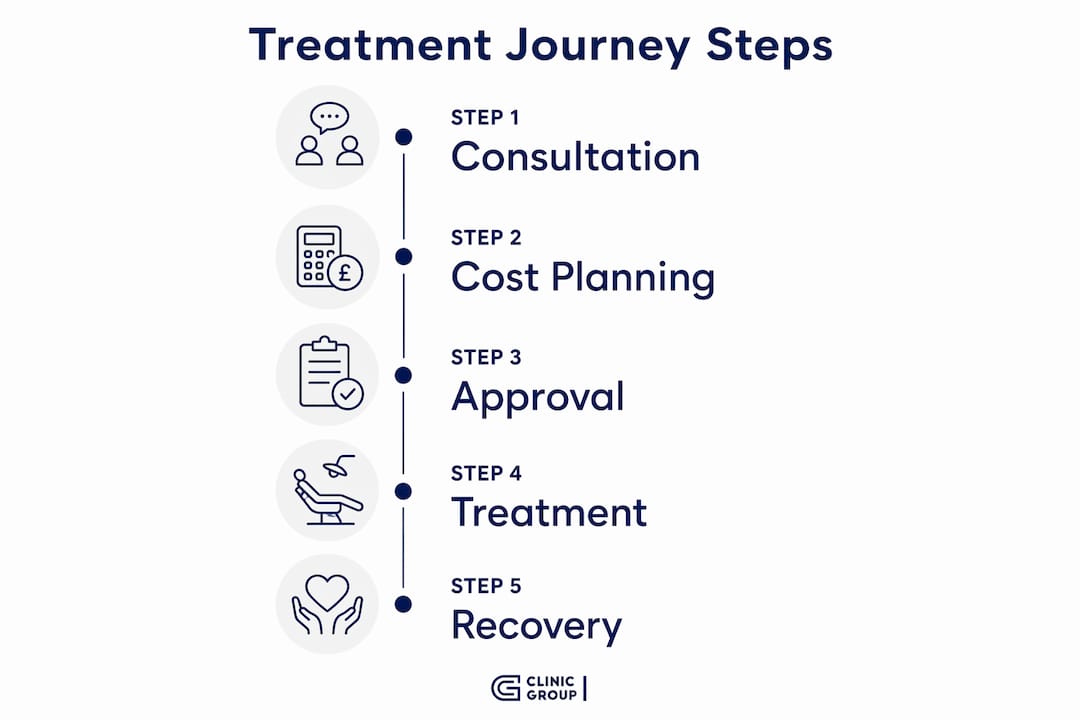
Planning a medical trip abroad involves more than booking a flight and a clinic appointment. A well-organised patient journey covers every stage from initial consultation to post-treatment follow-up.
- Pre-travel consultations: Most reputable clinics conduct a detailed remote consultation before you travel, reviewing your medical history, imaging, and suitability for the procedure.
- Travel and accommodation: Clinicgroup arranges partner hotel stays close to the clinic, so patients are not navigating unfamiliar cities while recovering.
- Recovery timelines: Flying too soon after surgery carries a real risk of deep vein thrombosis (DVT). Post-operative travel timing must be built into the plan, with sufficient rest abroad before the return journey.
- Insurance and contingencies: Specialist medical travel insurance should be arranged before departure. Standard travel policies rarely cover planned procedures or complications arising from them.
- Aftercare and continuity: Clinicgroup’s patient support team remains available after you return home, coordinating with UK clinicians where needed and providing guidance on recovery milestones.
Pro Tip: Book your return flight with flexibility. Recovery from surgical procedures often takes longer than expected, and changing a fixed-date ticket at short notice can be both stressful and expensive. Build at least two to three additional days into your stay as a buffer.
How does European medical care compare with other regions?
European healthcare systems consistently rank among the highest in the world for clinical outcomes, patient safety, and regulatory standards. Countries within the European Economic Area operate under frameworks that govern medical training, facility inspection, and pharmaceutical standards, providing a level of oversight that is broadly comparable to the UK’s own regulatory environment.
Compared with medical tourism destinations in Asia or Latin America, European clinics offer shorter travel times from the UK, fewer time-zone disruptions during recovery, and greater ease of communication. For patients who need follow-up care after returning home, proximity matters. A clinic in Albania or Poland is a short-haul flight away; complications or questions can be addressed without a 12-hour journey.
That said, standards vary within Europe just as they do anywhere else. Accreditation status, surgeon experience, and facility quality differ between individual clinics, not just between countries. Choosing a verified provider through a platform like Clinicgroup removes much of that uncertainty.
What are typical treatment timelines and waiting periods in Europe?
Waiting times are one of the clearest practical advantages of seeking care in Europe. 11% of UK patients wait over a year for specialist appointments, while European countries generally offer considerably shorter waits for the same procedures.
For elective treatments arranged through a medical tourism platform, the timeline from initial consultation to procedure is typically a matter of weeks rather than months. Dental implant treatment, for example, follows a staged process: the implant is placed on the first visit, and the crown is fitted after a healing period of several weeks, requiring a second trip. Cosmetic surgery and hair transplants are usually completed in a single visit, with recovery managed on-site before the patient travels home.
Orthopaedic procedures such as hip or knee replacement require more careful planning around physiotherapy and follow-up imaging, but the overall timeline from enquiry to completed recovery is still often faster than the equivalent NHS pathway for non-urgent cases.
How do insurance and reimbursement work in European healthcare?
Insurance and reimbursement rules depend entirely on whether your treatment is NHS-funded, privately self-funded, or covered by a personal health insurance policy.
For NHS-funded treatment abroad via the prior authorisation route, the NHS pays the destination country’s health authority directly at the local tariff. The patient pays nothing, provided the authorisation was granted before treatment began and the care was received at a public provider.
For self-funded elective treatment, reimbursement from the NHS is not available. Patients should check whether their private health insurance policy covers treatment abroad, as many UK policies exclude planned overseas procedures entirely. Specialist medical travel insurance is the appropriate product for most medical tourists, covering complications, extended stays, repatriation, and cancellation.
The GHIC covers emergency and medically necessary care at public providers in EEA countries on the same basis as a local resident. It does not reimburse elective treatment costs, and it is not a substitute for travel or medical insurance.
What are the risks, and how do you verify a European provider’s credentials?
The risks of treatment abroad are real and should be assessed honestly before any decision is made. Medical tourism for UK patients is unregulated, meaning there is no automatic vetting of overseas clinics by a UK authority. Patients carry the responsibility for checking provider credentials themselves.
Key risks to consider:
- Regulatory differences: Inspection regimes and clinical standards vary between countries. A clinic that looks professional online may not hold the accreditations it implies.
- Continuity of care: UK dentists and GPs may be unwilling to continue treatment plans started abroad, particularly for complex dental or surgical cases.
- Legal recourse: If something goes wrong, pursuing a complaint or compensation claim against an overseas provider is significantly more difficult than doing so within the UK.
- Travel-related complications: DVT, wound infections, and delayed healing are all more difficult to manage when you are far from the treating clinic.
To verify a European provider’s credentials:
- Confirm the clinic holds recognised international accreditation (such as Joint Commission International or equivalent national body certification).
- Check that the treating specialist’s qualifications are verifiable through the relevant national medical register.
- Request itemised treatment plans and written consent documentation before committing.
- Use a trusted platform such as Clinicgroup, which pre-vets all partner clinics and specialists before listing them.
Clinicgroup’s network covers dental treatments, cosmetic surgery, hair transplants, and wellness therapies across verified clinics in Albania and Poland. Every patient receives a dedicated coordinator, transparent pricing, and full aftercare support.
Ready to explore your options? Clinicgroup’s patient team can match you with a verified clinic, provide a transparent quote, and support you from first consultation to full recovery. Visit Clinicgroup treatments to get started.
Key takeaways
European medical treatment offers UK patients faster access, lower costs, and broader choice, but safe outcomes depend on choosing verified providers, understanding authorisation rules, and planning the full patient journey carefully.
| Point | Details |
|---|---|
| GHIC and EHIC cover emergencies only | Neither card covers planned elective procedures; self-funding or NHS prior authorisation is required for those. |
| NHS authorisation is available but little-used | Only 301 patients applied for NHS-funded EU treatment in 2021, despite an estimated 152,000 travelling for care. |
| Total cost exceeds the headline price | Travel, accommodation, insurance, aftercare, and potential UK follow-up must all be factored into the budget. |
| Waiting times drive most decisions | 11% of UK patients wait over a year for specialist appointments; European clinics typically offer far shorter waits. |
| Provider verification is the patient’s responsibility | Medical tourism is unregulated for UK patients; using a vetted platform like Clinicgroup reduces that risk significantly. |
FAQ
Do British citizens get free healthcare in Europe?
British citizens can access necessary state healthcare in EEA countries using a GHIC or EHIC, which covers emergency and medically necessary treatment at public providers on the same basis as a local resident. Planned elective treatments are not covered and must be either self-funded or approved in advance by the NHS.
Which country is best for medical treatment in Europe?
The best country depends on the treatment. Albania, Poland, Lithuania, and Hungary are popular with UK patients for dentistry, cosmetic surgery, and orthopaedics, offering lower costs and short travel times. Clinicgroup operates verified clinics in Albania, covering dentistry, hair transplants, plastic surgery, and wellness.
Is healthcare better in France or the UK?
France and the UK both deliver high standards of care, but through different systems. France operates an insurance-based model with generally shorter waiting times for specialist care, while the NHS is residence-based and free at the point of use. For planned elective procedures, French private clinics can offer faster access, though costs for self-funding patients are higher than in Eastern European destinations.
Can the NHS fund my treatment abroad?
Yes, in specific circumstances. Under the Trade and Cooperation Agreement, the NHS can fund treatment in the EU if it cannot provide that care within a medically justifiable timeframe, provided you obtain prior authorisation before travelling and receive treatment at a public provider. Cosmetic and elective procedures do not qualify for NHS funding regardless of location.