TL;DR:
- Medical tourism accreditation is a formal evaluation process that confirms healthcare providers meet industry standards for safety and quality. It signals adherence to rigorous protocols but does not guarantee treatment success, making independent verification essential for safe travel decisions. Patients should verify both clinical and coordination accreditation from recognized bodies like JCI, MSQH, or Temos to ensure comprehensive quality assurance.
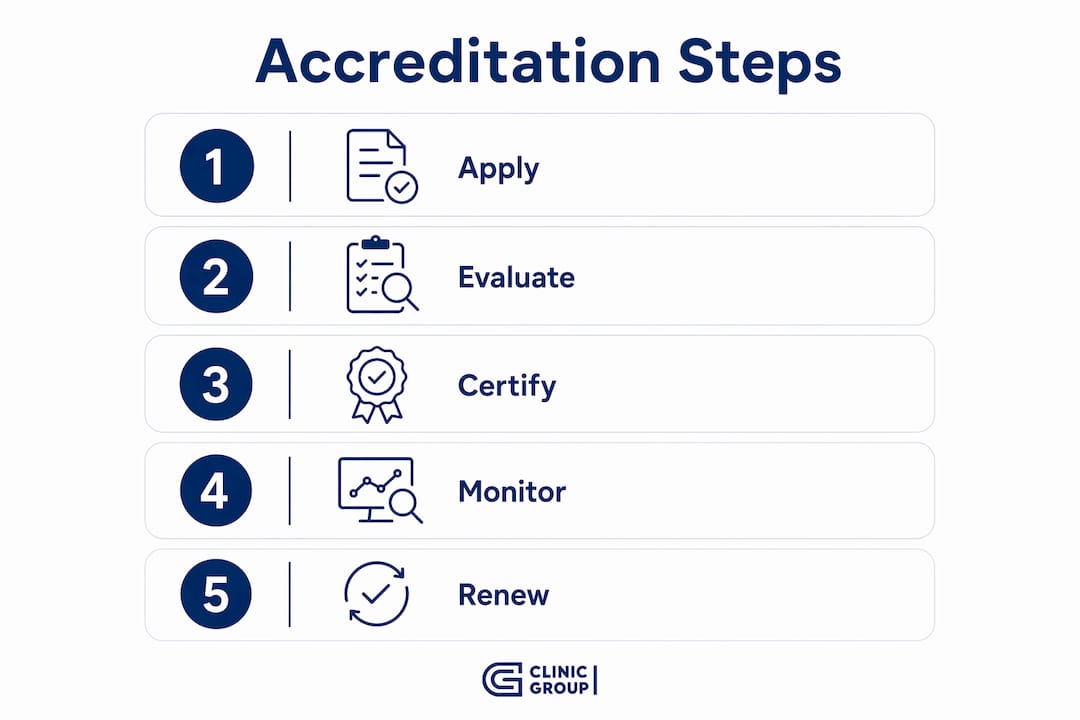
Medical tourism accreditation is a formal, external evaluation process through which an independent body assesses whether a healthcare facility or medical travel coordination service meets defined standards for patient safety and quality of care. The CDC defines accreditation as a review of safety and quality systems, not a guarantee of treatment outcomes. For patients considering treatment abroad, understanding this distinction is the foundation of safe decision-making. Recognised bodies such as Joint Commission International and Temos International set the benchmark for what accredited care looks like across borders. This guide explains what accreditation covers, who provides it, and how to verify it before you travel.
What is medical tourism accreditation and why does it matter?
Medical tourism accreditation is the recognised industry term for a structured quality assurance process applied to international healthcare providers and the agencies that coordinate patient travel. It confirms that a facility or service operates within a defined framework of safety, ethics, and quality management. Crucially, accreditation signals adherence to standards rather than a promise that your treatment will succeed.

For patients travelling from the UK or Europe to receive dental implants, hair transplants, or cosmetic surgery abroad, accreditation provides a meaningful layer of assurance. It tells you that an independent body has reviewed the clinic’s processes, staff qualifications, hygiene protocols, and patient safety systems. Without it, you are relying entirely on marketing claims and self-reported quality, which vary enormously across different countries and providers.
The importance of medical tourism accreditation has grown significantly as the global medical travel market has expanded. Countries such as Malaysia, Albania, and the UAE now host internationally accredited hospitals and clinics that attract patients from across Europe. Understanding what accreditation means, and what it does not mean, gives you a genuine advantage when comparing providers.
What standards do accreditation programmes assess?
Accreditation programmes assess two distinct categories: clinical facilities and medical travel coordination services. Each has its own criteria, and patients benefit from understanding both.
Clinical facility accreditation typically covers:
- Patient safety systems and incident reporting procedures
- Treatment protocols aligned with international clinical guidelines
- Hygiene, sterilisation, and infection control standards
- Staff qualifications, ongoing training, and professional registration
- Outcome tracking and continuous quality improvement processes
Coordination service accreditation, such as the programme offered by Temos International, focuses on a different set of criteria. Temos requires Total Quality Management, Continuous Quality Improvement systems, and adherence to the World Medical Association Code of Ethics. Their assessment covers the entire patient journey, from initial enquiry through to post-treatment follow-up. This matters because a clinic can be clinically excellent but poorly coordinated, leaving patients without adequate support during travel, recovery, or aftercare.
Medical tourism accreditation programmes help agencies implement structured processes for patient communication, provider screening, travel logistics, and quality management. Completion demonstrates adherence to recognised industry standards. For patients, this means a coordinated experience rather than a fragmented one.
Pro Tip: When speaking to a clinic or facilitator, ask specifically which body has accredited them, what the accreditation covers, and when it was last renewed. A credible provider will answer these questions without hesitation.
Which organisations provide medical tourism accreditation?
The accreditation landscape includes international clinical bodies, government tourism departments, and coordination-specific programmes. Each operates with a different scope, and patients should understand the differences clearly.
| Accreditation body | Type | Scope | Standards assessed |
|---|---|---|---|
| Joint Commission International (JCI) | International clinical | Hospitals and clinical facilities | Patient safety, clinical protocols, staff qualifications, outcomes |
| MSQH (Malaysian Society for Quality in Health) | National clinical | Malaysian hospitals | Clinical quality, patient safety, governance |
| ISQua (International Society for Quality in Health Care) | International meta-accreditor | Accreditation bodies themselves | Standards for accreditors |
| Temos International | Coordination-specific | Medical travel coordinators and facilitators | Quality management, ethics, patient journey logistics |
| Philippine Department of Tourism | Government tourism | Medical tourism facilities | Tourism-related criteria, facility presentation |
Malaysian medical tourism hospitals maintain accreditation from both Joint Commission International and MSQH, reflecting a dual-layer approach to quality assurance that is increasingly common in competitive medical tourism markets. This combination of clinical and national accreditation signals a serious commitment to international patient standards.
The Philippine Department of Tourism awards a Seal of Accreditation as a Medical Tourism Facility following onsite inspections. This seal focuses on tourism-related criteria rather than clinical patient safety. It is a useful indicator of a facility’s readiness to receive international visitors, but it does not replace clinical hospital accreditation. Patients who see this seal should still verify the facility’s clinical credentials separately.
ISQua operates as a meta-accreditor, meaning it accredits the accreditation bodies themselves. When a body like JCI holds ISQua recognition, it confirms that JCI’s own standards and processes meet an internationally agreed benchmark. This adds a further layer of credibility to facilities accredited by ISQua-recognised bodies.
How can patients verify medical tourism accreditation?
Verifying accreditation independently is one of the most practical steps you can take before committing to treatment abroad. The process is straightforward when you know where to look.
- Check the accrediting body’s public directory. Joint Commission International and other international accreditors maintain publicly accessible directories of accredited facilities. Search for the clinic by name and confirm its current status and accreditation scope.
- Contact the clinic directly and request documentation. Ask for a copy of their accreditation certificate, the issuing body’s name, and the renewal date. Reputable clinics provide this without delay.
- Verify the accrediting body itself. Confirm that the body is recognised internationally, ideally by ISQua or a government health authority. An unfamiliar or unverifiable accreditor is a warning sign.
- Distinguish clinical accreditation from tourism seals. A government tourism seal confirms a facility meets visitor-readiness criteria. It does not confirm clinical safety standards. Always verify both separately.
- Research individual clinician credentials. Accreditation alone does not cover specialist physician qualifications or individual outcome data. Ask for the treating clinician’s professional registration, board certification, and experience with your specific procedure.
Reading clinic reviews before travelling adds another layer of insight that accreditation documents cannot provide. Patient feedback often reveals how well a clinic handles communication, complications, and aftercare, all of which matter as much as formal credentials.
Pro Tip: Cross-reference the clinic’s accreditation status on the accrediting body’s website rather than relying solely on the clinic’s own marketing materials. Accreditation certificates can expire or be misrepresented.
Understanding why clinic credentials matter before you travel is the single most effective way to reduce risk and make a confident, informed choice.
What are common misunderstandings about medical tourism accreditation?
Several misconceptions about accreditation lead patients to make poorly informed decisions. Recognising these pitfalls protects you from placing confidence in the wrong signals.
- Confusing tourism seals with clinical accreditation. A government tourism department seal confirms a facility is prepared to receive international visitors. It does not assess clinical safety, treatment protocols, or patient outcomes. These are fundamentally different standards, and patients often conflate the two.
- Assuming accreditation guarantees results. Accreditation confirms that quality systems are in place. It does not guarantee that your surgery, dental treatment, or hair transplant will achieve a specific outcome. The CDC is explicit on this point: accreditation is a benchmark, not an outcome assurance.
- Overlooking facilitator accreditation. Many patients verify the hospital but not the agency coordinating their travel. Coordinator accreditation from Temos covers the quality of the entire patient journey, including communication, logistics, and post-treatment follow-up. A poorly accredited facilitator can undermine an otherwise excellent clinical experience.
- Accepting marketing awards as equivalent to formal accreditation. Industry awards and “best clinic” designations are self-nominated or commercially driven. They carry no independent clinical assessment and should not be treated as equivalent to JCI or Temos accreditation.
- Neglecting to verify individual clinician credentials. A facility can hold full clinical accreditation while employing specialists with varying levels of experience. Always ask for the treating clinician’s board certification and specific procedural experience alongside the facility’s accreditation status.
Clinicgroup addresses these challenges directly by verifying both clinic accreditation and specialist credentials before listing any provider on its platform. Transparent information about quality assurance in clinics is central to how Clinicgroup supports patients in making safe, well-informed choices.
Key takeaways
Medical tourism accreditation is a formal quality benchmark covering both clinical facilities and coordination services, and patients must verify both types independently to make genuinely safe choices abroad.
| Point | Details |
|---|---|
| Accreditation is not an outcome guarantee | It confirms quality systems are in place, not that treatment will succeed. |
| Two types of accreditation matter | Clinical facility accreditation and coordinator accreditation serve different but equally important purposes. |
| Recognised bodies carry more weight | JCI, MSQH, and Temos International are internationally recognised; tourism seals are not clinical equivalents. |
| Verification is the patient’s responsibility | Check accrediting body directories directly and request documented proof from providers. |
| Clinician credentials require separate verification | Facility accreditation does not cover individual specialist qualifications or outcome data. |
Why accreditation is the non-negotiable starting point
From Clinicgroup’s experience working with verified clinics in Albania and Dubai, the single most consistent finding is this: patients who research accreditation before travelling report significantly greater confidence in their care, regardless of the procedure. That is not a coincidence.
What we have observed is that accreditation functions as a filter, not a guarantee. It removes the worst-case scenarios from consideration. A JCI-accredited facility in Tirana or Dubai has been assessed against the same framework as leading hospitals in London or Milan. That matters enormously when you are travelling for a dental implant, rhinoplasty, or hair transplant and your usual GP is not available to advise you.
The area where patients most often fall short is facilitator accreditation. They check the hospital, they read the reviews, and then they book through an unverified agency. The coordination layer is where things go wrong: missed appointments, unclear aftercare instructions, no support when complications arise. Temos-accredited coordinators are required to have Continuous Quality Improvement systems in place and to work with CQI-accredited providers. That requirement exists precisely because the coordination layer is where patient safety is most vulnerable.
Our honest view is that accreditation should be the starting point of your research, not a box you tick at the end. Verify the facility, verify the coordinator, and then verify the clinician. All three layers matter. Clinicgroup builds this verification into every clinic listing so that patients do not have to start from scratch.
— Clinicgroup
Explore verified, accredited treatment options with Clinicgroup
Clinicgroup connects patients from the UK and Europe with verified clinics and board-certified specialists in Albania and Dubai. Every clinic listed on the platform has been assessed for accreditation status, specialist credentials, and patient care standards before being made available to patients. Transparent pricing, European-standard facilities, and full journey support, including travel logistics, partner accommodation, and aftercare coordination, are included as standard. Whether you are considering dental implants, a hair transplant, or cosmetic surgery, you can explore your treatment options safely through Clinicgroup’s expert team. Speak to a patient coordinator today to begin your consultation.
FAQ
What is medical tourism accreditation in simple terms?
Medical tourism accreditation is a formal assessment by an independent body confirming that a healthcare facility or travel coordination service meets defined standards for patient safety and quality. It is a quality benchmark, not a guarantee of treatment outcomes.
Which accreditation bodies are most recognised for international hospitals?
Joint Commission International, the Malaysian Society for Quality in Health, and ISQua are among the most widely recognised accreditation bodies for international healthcare facilities. Facilities accredited by these organisations have been assessed against rigorous, internationally agreed standards.
Does accreditation guarantee my treatment will be successful?
No. Accreditation confirms that quality and safety systems are in place within a facility, but it does not guarantee individual treatment results. Patients should also verify clinician credentials and review outcome data separately.
What is the difference between a tourism seal and clinical accreditation?
A tourism seal, such as those issued by government tourism departments, confirms a facility meets visitor-readiness and hospitality criteria. Clinical accreditation, issued by bodies like JCI or MSQH, assesses patient safety protocols, treatment standards, and clinical governance. They are not interchangeable.
How do I verify a clinic’s accreditation before travelling?
Check the accrediting body’s public directory directly, such as the JCI website, and search for the clinic by name. Request a copy of the accreditation certificate from the clinic and confirm the issuing body is internationally recognised. Never rely solely on a clinic’s own marketing materials for accreditation claims.