TL;DR:
- Digital dentistry uses computer technologies to improve diagnosis, treatment planning, and restoration fabrication. It enhances accuracy, patient comfort, and communication through tools like intraoral scanners, CBCT imaging, CAD/CAM, and 3D printing. The field is evolving with wider adoption of digital workflows and emerging AI applications that support clinical decision-making.
Digital dentistry is the use of computer-based technologies to improve every stage of dental care, from diagnosis and treatment planning through to the physical fabrication of restorations. It replaces traditional analogue methods, such as physical impressions and hand-crafted prosthetics, with digital tools that are faster, more accurate, and far more comfortable for patients. The College of General Dentistry formally recognised digital workflows in its 2025 clinical standards, setting aspirational goals for full digital integration across UK practices. Technologies including intraoral scanners, cone beam computed tomography (CBCT) imaging, CAD/CAM systems, and 3D printing now form the backbone of modern dental care in the UK and across Europe. Understanding what digital dentistry involves helps you make informed decisions about your treatment, whether you receive care at home or abroad.
What is digital dentistry and which technologies does it use?
Digital dentistry integrates four core technologies into a connected clinical workflow. Each one addresses a different stage of care, and together they replace the fragmented, manual processes that have defined dentistry for decades.
- Intraoral scanners capture a precise 3D map of your teeth and gums in minutes. They eliminate the need for traditional impression trays filled with putty, which many patients find uncomfortable or triggering for a gag reflex.
- CBCT imaging produces three-dimensional X-rays of the jaw, teeth, and surrounding bone. This level of detail is particularly valuable for implant planning, where the position of nerves and bone density are critical.
- CAD/CAM systems (Computer-Aided Design and Computer-Aided Manufacturing) take the digital scan and use it to design and mill a restoration, such as a crown or veneer, directly from a ceramic block. CAD/CAM milling often completes a restoration within a single appointment, with milling taking under 30 minutes.
- 3D printing produces surgical guides, temporary crowns, orthodontic models, and custom appliances with a level of consistency that manual fabrication cannot replicate.
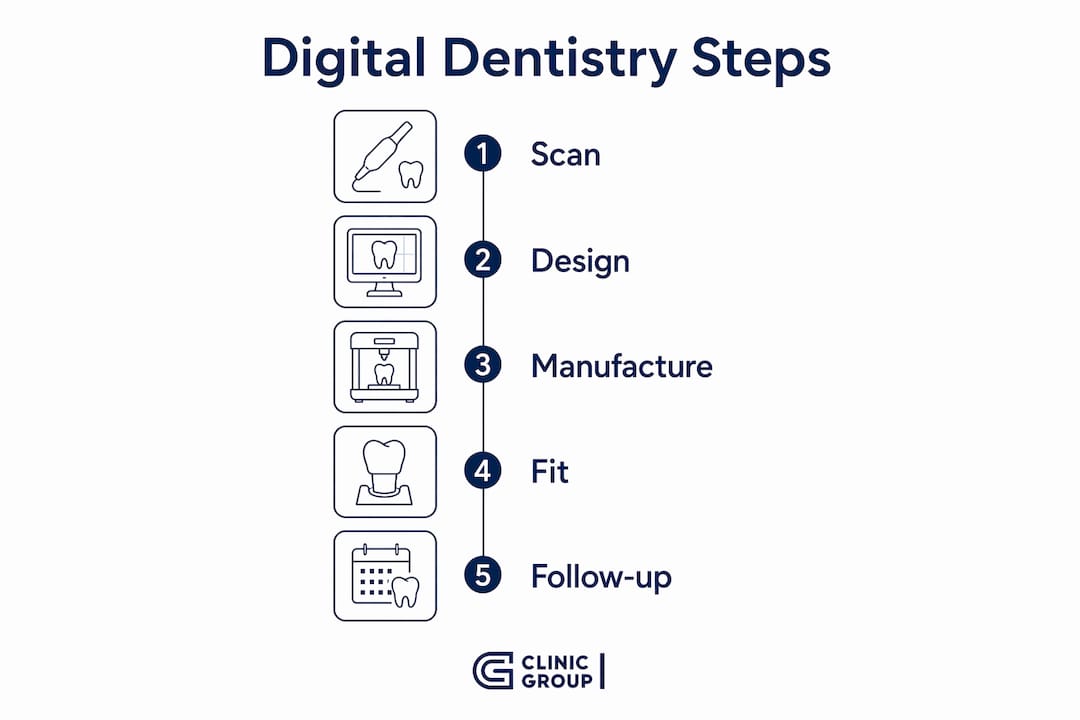
These technologies do not operate in isolation. A scan feeds into a CAD/CAM design, which informs a 3D-printed surgical guide, which supports a CBCT-planned implant placement. The result is a fully connected digital workflow rather than a series of disconnected steps.
Pro Tip: Intraoral scanners can do far more than take a one-off impression. When used at every check-up, they create a time-series record of your oral health, allowing your dentist to detect subtle changes in tooth wear or gum recession that would be invisible on a standard 2D X-ray.
What are the benefits of digital dentistry for patients?
The clinical and experiential benefits of digital dental technology are well established, and they affect patients at every stage of treatment.
- Greater accuracy, fewer adjustments. Digital impressions remove the human error inherent in mixing and setting traditional impression materials. Digital scanning accuracy reduces the need for repeat visits and adjustment appointments, saving patients time and inconvenience.
- No more uncomfortable impressions. Traditional impression trays cause discomfort and anxiety for many patients. Intraoral scanners replace them entirely, making the process quicker and far more tolerable.
- Faster treatment. CAD/CAM technology means a crown or inlay can be designed, milled, and fitted in a single visit. Patients avoid the temporary restoration stage and the second appointment that traditional lab-based work requires.
- Better preventive care. Routine digital scanning creates a longitudinal record of your oral health. Recall rates improve significantly when patients are engaged through digital tools, rising from around 40% to near 87% in practices that adopt full digital ecosystems.
- Clearer communication. 3D visualisations allow patients to see their own teeth in detail, making it far easier to understand a diagnosis or proposed treatment.
“Digital dentistry’s greatest value lies in patient communication and education, not just the technology itself. When patients can see their own oral health in three dimensions, they engage with their care in a fundamentally different way.”
The shift from analogue to digital is not simply about speed or convenience. It changes the nature of the relationship between patient and clinician, making care more transparent and collaborative.
How does digital dentistry change patient communication?
The most underappreciated benefit of digital dental technology is what it does for the conversation between patient and dentist. Traditional explanations relied on mirrors, verbal descriptions, and flat 2D images that rarely conveyed the full picture. Digital tools change this entirely.
3D colour scans allow patients to see their own teeth on a screen in real time. Conditions like enamel attrition, gum recession, or early decay become visible and understandable in a way that a mirror held at an angle never achieves. Patients who can see a problem are far more likely to accept the recommended treatment.
The benefits for communication extend across the entire care pathway:
- Patients receive a visual record of their oral health at every visit, not just a verbal summary.
- Changes over time become visible through side-by-side scan comparisons, which builds trust in the clinical assessment.
- Treatment options can be shown visually before any work begins, supporting genuine shared decision-making.
- Digital records are easily shared with specialists or second-opinion providers, removing the need to repeat diagnostic steps.
The College of General Dentistry’s 2025 standards explicitly link digital workflows to patient-centred care, recognising that technology serves the clinical relationship rather than replacing it.
Pro Tip: Ask your dentist to show you your intraoral scan on screen during your appointment. If they use a TRIOS or equivalent scanner, you can see your teeth in 3D within seconds of the scan completing. This is one of the most effective ways to understand your own oral health.
What does the future of digital dentistry look like?
The current standard digital workflow centres on high-quality 3D scanning and CAD/CAM fabrication. Artificial intelligence and robotics are entering the field, but their clinical role in the UK remains limited and carefully scrutinised.
The General Dental Council published a review in 2025 confirming that AI in UK dentistry is still emerging, with significant gaps in UK-specific clinical guidelines and a lack of large-scale trials supporting routine use. This does not mean AI is without promise. Caries detection algorithms, implant planning software, and automated radiograph analysis are all active areas of development. The honest picture is that these tools supplement clinical judgement rather than replace it.
Several trends are shaping the near-term direction of digital dentistry practices:
- Wider scanner adoption. Major providers in the UK have deployed over 650 TRIOS scanners to standardise patient experience across their networks. Adoption is growing, though only 8–12% of UK dentists currently use CAD/CAM widely, indicating the field is still in an early adoption phase.
- Full digital ecosystems. Forward-thinking practices are connecting scanning, imaging, design, and patient records into a single platform, reducing administrative errors and improving continuity of care.
- TimeLapse scanning. Advanced scanning systems now monitor subtle oral changes over months or years, enabling earlier clinical intervention that manual records cannot match.
- Staff training requirements. The College of General Dentistry’s 2025 standards include requirements for team training in digital tools, recognising that technology is only as effective as the clinician using it.
The role of technology in dental clinics is evolving steadily rather than dramatically. Patients who choose digitally equipped practices today benefit from the most clinically validated tools available, while the next generation of AI-assisted diagnostics continues to mature.
Key takeaways
Digital dentistry is defined by the integration of intraoral scanning, CBCT imaging, CAD/CAM fabrication, and 3D printing into a connected clinical workflow that improves accuracy, patient comfort, and treatment communication.
| Point | Details |
|---|---|
| Core technologies | Intraoral scanners, CBCT imaging, CAD/CAM systems, and 3D printing work together as a connected workflow. |
| Speed of treatment | CAD/CAM milling completes restorations in under 30 minutes, often within a single appointment. |
| Patient recall improvement | Practices using full digital ecosystems report recall rates rising from around 40% to near 87%. |
| Communication benefit | 3D colour scans allow patients to see their own oral health, increasing treatment acceptance and trust. |
| AI adoption status | AI applications are emerging in UK dentistry but lack comprehensive clinical guidelines for routine use. |
Digital dentistry: what it means in practice
The conversation around digital dentistry tends to focus on the technology itself. Scanners, milling machines, and AI algorithms make for compelling headlines. What gets less attention is the human outcome those tools produce.
From working with patients across multiple countries, the most consistent finding is this: patients who see their own teeth in 3D engage with their care differently. They ask better questions. They understand why a treatment is recommended. They follow through. That shift in engagement is not a side effect of digital dentistry. It is arguably its most important clinical outcome.
The underuse of intraoral scanning as a monitoring tool is a genuine missed opportunity in many practices. A scanner used once to take an impression and then put away is a fraction of what the technology offers. Used at every appointment, it becomes a longitudinal health record that catches problems early and gives patients a reason to return. The dental terminology around digital tools can feel technical, but the underlying principle is straightforward: better information leads to better decisions, for patients and clinicians alike.
The College of General Dentistry’s recognition of digital workflows in its 2025 standards is significant not because it mandates specific tools, but because it frames digital dentistry as an expression of core professional values: accuracy, transparency, and patient-centred care. That framing matters. Technology that serves those values is worth adopting. Technology adopted for its own sake rarely improves outcomes.
— Clinic
Clinicgroup and advanced dental care abroad
Clinicgroup connects patients from the UK and across Europe with verified dental clinics in Albania and Dubai that use digital dentistry technologies as standard. Partner clinics offer intraoral scanning, CBCT imaging, and CAD/CAM fabrication for treatments including dental implants, crowns, and veneers, delivered by board-certified specialists working to European clinical standards. Patients benefit from transparent pricing that is significantly lower than equivalent UK costs, without compromising on the quality of care or the technology used to deliver it. Clinicgroup also coordinates travel logistics, partner hotel accommodation, and aftercare support, so the practical side of treatment abroad is handled from the start. For patients who want to understand their full range of options, the Clinicgroup treatments directory provides a clear overview of everything available.
FAQ
What is digital dentistry in simple terms?
Digital dentistry is the use of computer-based tools, including 3D scanners, CBCT imaging, and CAD/CAM systems, to diagnose, plan, and deliver dental treatment more accurately and comfortably than traditional methods allow.
What is CAD/CAM dentistry?
CAD/CAM dentistry uses computer-aided design and computer-aided manufacturing to create dental restorations such as crowns and veneers. The process takes a digital scan of your teeth and mills a restoration from a ceramic block, often within a single appointment.
How does digital dentistry improve patient comfort?
Digital scanning eliminates traditional impression materials, which many patients find uncomfortable or anxiety-inducing. Intraoral scanners capture a full 3D image of the mouth quickly and without physical discomfort.
Is AI widely used in UK dental practices?
AI applications in UK dentistry are still emerging. The General Dental Council confirmed in 2025 that comprehensive clinical guidelines for routine AI use in dental care do not yet exist, though research and development in this area is active.
Does digital dentistry cost more than traditional dentistry?
Digital dentistry can reduce overall costs by cutting the number of appointments needed and minimising errors that require correction. Clinics abroad, including those in Clinicgroup’s network, offer digitally equipped care at prices considerably below typical UK rates.