TL;DR:
- A medical concierge manages every aspect of a patient’s healthcare, from appointments to travel logistics. They provide personalized support, ensuring faster access to specialists and seamless coordination of treatment abroad. This service enhances outcomes, reduces administrative burdens, and offers continuity of care for international patients.
A medical concierge is a dedicated healthcare professional who coordinates every aspect of a patient’s medical experience, from booking specialist appointments to managing travel logistics for treatment abroad. The role sits between a personal health adviser and a care coordinator, offering a level of personalised support that standard NHS or private GP services do not provide. For patients exploring medical tourism in destinations such as Albania or Dubai, a medical concierge removes the guesswork from finding verified clinics, navigating foreign healthcare systems, and arranging aftercare. This guide explains exactly how the service works, what benefits it delivers, and how to choose the right concierge support for your needs.
What is a medical concierge and what do they do?
A medical concierge is defined as a personalised healthcare coordinator who manages access to medical services on behalf of a patient, typically outside the constraints of a standard insurance or NHS model. The industry term used interchangeably is concierge medicine, though the concierge role itself extends well beyond a single physician relationship to cover the full patient journey.

Medical concierge services include appointment booking, insurance paperwork assistance, expedited diagnostics access, specialist referrals, and often 24/7 direct access to physicians. That breadth of support is what separates a concierge from a standard GP receptionist or patient administrator. A concierge does not simply pass on a phone number. They actively manage the process from start to finish.
For patients considering treatment abroad, the role takes on additional dimensions. A medical concierge will identify accredited clinics, verify specialist credentials, coordinate travel and accommodation, and remain available throughout recovery. Clinicgroup operates on exactly this model, connecting patients from the UK and Europe with verified clinics across Albania and Dubai.
How does medical concierge work in practice?
The process follows a clear sequence, though the exact steps vary depending on whether the service is offered through a membership model or on a per-treatment basis.
-
Initial consultation. The concierge conducts a detailed intake conversation to understand your health history, treatment goals, budget, and preferred destinations. This is not a five-minute triage call. Concierge appointments typically last 30–60 minutes, compared with the 15 minutes standard in traditional primary care.
-
Personalised care planning. Based on the consultation, the concierge creates a tailored plan. This includes shortlisting clinics, identifying the right specialists, and mapping out a realistic timeline for diagnostics, treatment, and recovery.
-
Appointment and logistics coordination. The concierge books all appointments, arranges transfers, and liaises with partner hotels or recovery facilities. For international patients, this step removes the most stressful element of treatment abroad.
-
Insurance and paperwork navigation. Concierge services handle pre-authorisation requests, insurance correspondence, and documentation requirements. Patients should note that concierge fees do not replace standard health insurance. The concierge coordinates with insurers but does not substitute for coverage.
-
Ongoing communication and aftercare. Throughout the treatment journey, the concierge remains a single point of contact. After treatment, they coordinate follow-up consultations and recovery support, whether in the destination country or back home.
Communication typically happens via phone, email, or a dedicated patient portal, with many services offering round-the-clock availability for urgent queries.
Pro Tip: Ask any prospective concierge service whether they offer post-treatment follow-up as standard or as an add-on. Aftercare coordination is where the real value of a concierge becomes clear, particularly for patients returning home after surgery abroad.
What are the key advantages of using a medical concierge for medical tourism?
The benefits of a medical concierge are most visible when patients are navigating unfamiliar healthcare systems, language barriers, or complex treatment pathways across borders.
-
Faster access to specialists. Traditional NHS pathways can involve waits of weeks or months for specialist referrals. Concierge care delivers same-day or next-day appointments, compared with the 20–26 day average wait for new patients in traditional care settings. For patients with time-sensitive treatment needs, this difference is significant.
-
Improved health outcomes. Concierge care is associated with 60% fewer ER visits and 30% fewer hospitalisations compared with traditional models. Preventive screening completion rates exceed 90%, against 50–60% in standard care. These figures reflect the impact of proactive, coordinated attention rather than reactive treatment.
-
Trusted clinic matching. A concierge verifies clinic accreditation, checks specialist qualifications, and matches patients to providers based on their specific needs. Patients do not need to rely on online reviews alone. Understanding medical tourism accreditation is one part of this process, and a good concierge handles it on your behalf.
-
Reduced administrative burden. Insurance pre-authorisation, referral letters, diagnostic reports, and travel documentation are all managed centrally. Patients focus on their health rather than paperwork.
-
Continuity of care. A concierge maintains a complete record of your treatment history and coordinates between your home GP, the treating clinic abroad, and any follow-up specialists. This continuity reduces the risk of miscommunication or gaps in care.
-
Peace of mind. Knowing that a qualified professional is overseeing every stage of your treatment journey reduces anxiety considerably. Cleveland Clinic notes that concierge medicine allows physicians to practise thoughtfully rather than rushing through high patient volumes, and patients feel that difference directly.
How does a medical concierge differ from traditional healthcare support?
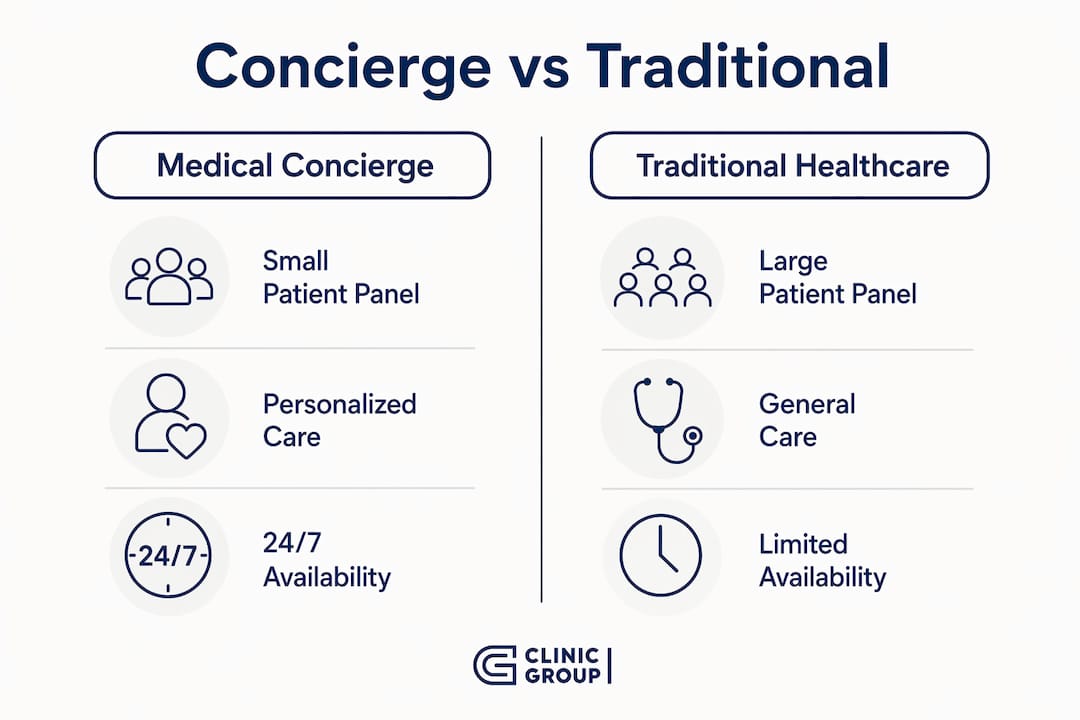
The distinction between a medical concierge and other healthcare roles is often misunderstood. The table below clarifies the key differences.
| Feature | Medical concierge | Traditional GP / NHS | Insurance representative |
|---|---|---|---|
| Patient panel size | 100–600 patients | 2,500+ patients | Not applicable |
| Appointment wait time | Same day or next day | 20–26 days (new patients) | Not applicable |
| Appointment length | 30–60 minutes | 10–15 minutes | Varies |
| Service scope | End-to-end care coordination | Diagnosis and referral | Claims and coverage |
| International support | Yes, including travel and logistics | No | Limited |
| Insurance role | Coordinates with insurers | Refers to specialists | Manages claims directly |
Concierge physicians maintain patient panels of 100–600 individuals, compared with 2,500 or more in traditional practices. That smaller panel is what makes extended consultations and rapid availability possible. The structural difference is not cosmetic. It changes the entire nature of the patient relationship.
A GP diagnoses and refers. An insurance representative manages claims. A medical concierge does neither of those things exclusively. Instead, they coordinate across all parties to ensure the patient receives the right care, in the right place, at the right time.
Pro Tip: When comparing concierge services, ask specifically about their patient-to-coordinator ratio. A lower ratio means more dedicated attention and faster responses when you need them most.
How to choose and work effectively with a medical concierge
Selecting the right concierge service requires more than reading a website. These are the questions and checks that matter most.
-
Verify credentials and experience. Ask whether the concierge team includes qualified healthcare professionals, such as registered nurses or doctors, rather than administrative staff alone. Experience with medical tourism specifically is a distinct advantage.
-
Clarify the service scope. Some concierge services cover primary care only. Others, like Clinicgroup, extend to full treatment journeys abroad including clinic matching, travel arrangements, and aftercare. Confirm exactly what is included before committing.
-
Ask about clinic verification processes. A reliable concierge will explain how they vet the clinics they recommend. Look for references to accreditation bodies, board-certified specialists, and transparent pricing. Learning how to schedule appointments abroad gives you a useful baseline for comparison.
-
Understand the fee structure. Some services charge a flat membership fee. Others charge per treatment journey. Neither model is inherently better, but you should understand what you are paying for and whether it includes aftercare coordination.
-
Communicate your preferences clearly. Tell your concierge your preferred treatment destinations, budget range, recovery timeline, and any concerns about the procedure. The more context they have, the more accurately they can match you to the right clinic and specialist.
-
Stay engaged throughout the process. A concierge works best as a collaborative relationship. Review the care plan they produce, ask questions, and flag any changes to your health or circumstances promptly.
For patients considering treatments such as dental implants, hair transplants, or cosmetic procedures abroad, a personalised medical package often forms the foundation of the concierge’s planning process.
Key takeaways
A medical concierge is the most effective way to access specialist care faster, reduce administrative burden, and maintain continuity of care throughout an international treatment journey.
| Point | Details |
|---|---|
| Core definition | A medical concierge coordinates all aspects of a patient’s healthcare journey, from appointments to aftercare. |
| Speed of access | Concierge care delivers same-day or next-day appointments versus 20–26 day waits in traditional settings. |
| Health outcomes | Patients in concierge models experience 60% fewer ER visits and 30% fewer hospitalisations. |
| Key distinction | Concierge physicians manage panels of 100–600 patients, enabling longer consultations and stronger relationships. |
| Insurance clarity | Concierge fees do not replace health insurance. The concierge coordinates with insurers but does not substitute for coverage. |
Clinicgroup’s view on medical concierge services
The demand for medical concierge support has grown considerably as more patients from the UK and Europe choose to access treatment abroad. What we observe consistently is that the patients who have the best experiences are those who arrive with a clear plan, a verified clinic, and a single point of contact managing the details. Those without that support often face avoidable stress, delays, and uncertainty.
The concierge model is not a luxury reserved for a small group of patients. NerdWallet describes it well: concierge care is a tool for gaining accessibility and thoughtful attention, not a premium product for the few. That framing matters. When a patient from Birmingham is considering a dental implant procedure in Tirana or a hair transplant in Dubai, the complexity of coordinating that journey is real. A concierge removes that complexity.
What we find particularly valuable is the continuity element. Patients do not just need help booking a flight and a clinic appointment. They need someone who understands their full health picture, communicates with the treating team, and follows up once they are home. That is the standard we hold ourselves to at Clinicgroup, and it is the standard worth demanding from any concierge service you consider.
The future of medical tourism will be shaped by how well patients are supported before, during, and after treatment. Concierge services that integrate telehealth, virtual consultations, and chronic disease management will become the norm rather than the exception. Patients who understand this now are better placed to make confident, informed decisions about their care.
— Clinic
How Clinicgroup supports your treatment journey abroad
Clinicgroup provides dedicated concierge-level support for patients seeking treatment across Europe and the Middle East. From the first consultation to post-treatment follow-up, the team handles clinic matching, travel logistics, partner hotel arrangements, and aftercare coordination. Treatments covered include dental implants, crowns, veneers, FUE and DHI hair transplants, rhinoplasty, liposuction, breast augmentation, Botox, fillers, PRP, IV therapy, and wellness check-ups. Every clinic in the Clinicgroup network is verified, with board-certified specialists and transparent pricing. Patients from the UK and Europe consistently report significant savings compared with home-country costs, without compromising on quality or safety. Explore the full range of available treatments and take the first step towards a confident, well-supported healthcare journey abroad.
FAQ
What is a medical concierge in simple terms?
A medical concierge is a healthcare coordinator who manages appointments, specialist referrals, insurance paperwork, and travel logistics on behalf of a patient. The role is designed to give patients faster, more personalised access to medical care.
How does a medical concierge differ from a GP?
A GP diagnoses conditions and issues referrals within a standard patient panel of 2,500 or more. A medical concierge manages a much smaller group of patients, typically 100–600, and coordinates the full care journey rather than focusing on diagnosis alone.
Do I still need health insurance if I use a medical concierge?
Yes. Concierge fees cover enhanced coordination and access but do not replace health insurance. You still need insurance for hospitalisations, surgeries, and emergency services. A concierge helps you navigate and coordinate with your insurer.
Is a medical concierge worth it for medical tourism?
For patients travelling abroad for treatment, a medical concierge reduces risk, saves time, and provides a single point of contact across the entire journey. The coordination of clinic verification, travel, and aftercare alone justifies the service for most international patients.
What treatments can a medical concierge help arrange abroad?
A medical concierge can coordinate access to a wide range of treatments, including dental implants, hair transplants, cosmetic surgery, non-surgical aesthetics, anti-aging therapies, and wellness programmes. Clinicgroup supports all of these across verified clinics in Albania and Dubai.