TL;DR:
- India now offers high-quality, accredited healthcare procedures at a fraction of Western Europe’s cost, with advanced technology and rigorous standards. European patients benefit from transparent care, digital planning, and trusted clinics that prioritize safety, accreditation, and comprehensive aftercare planning. Proper research, documentation, and setting realistic expectations are crucial to ensure safe, successful medical tourism experiences in India.
Procedures that once cost European patients a small fortune are now available in India at a fraction of the price, and the quality standards at accredited clinics are genuinely matching those found across Western Europe. The old assumption that affordable care abroad means compromised outcomes no longer holds. India’s dental and cosmetic tourism sector has matured significantly, driven by advanced technology, rigorous accreditation, and a growing pipeline of internationally trained specialists. This guide will walk you through everything you need to know about planning a safe, reliable, and genuinely cost-effective healthcare trip to India.
Table of Contents
- Why choose India for healthcare tourism?
- What treatments and clinics are available?
- Understanding the patient journey: process, timelines and what to expect
- Risks, documentation and how to ensure safety
- Our perspective: the truth about healthcare tourism in India for Europeans
- Take the next step with trusted clinics
- Frequently asked questions
Key Takeaways
| Point | Details |
|---|---|
| Accredited clinics matter | Choose NABH or JCI clinics for international safety and care standards. |
| Full documentation | Always secure your medical documentation, visa, and written warranty before you fly. |
| Plan follow-up care | Arrange realistic timelines and telemedicine follow-up to ensure safe recovery at home. |
| Balance cost with value | India offers advanced care at lower costs, but value is more than just price. |
Why choose India for healthcare tourism?
India has rapidly moved from being seen as simply a “cheap” destination to one that competes on genuine value. The distinction matters enormously for European patients who have grown cautious about quality. Cost savings are real and significant. Dental implants that cost £2,500 to £3,500 each in the United Kingdom can be completed in India for £500 to £900, including high-grade titanium components and ceramic crowns. Cosmetic procedures such as rhinoplasty or liposuction can run 60 to 75 per cent cheaper than equivalent UK private rates.
What has changed is the substance behind those savings. As India’s cost and care advantage demonstrates, leading clinics now use advanced digital planning tools, CBCT (cone beam computed tomography) scanning, and peer-reviewed treatment protocols that align with global benchmarks. Government investment in the e-Medical Visa system and digital health integration through Ayushman Bharat has made administrative processes considerably smoother for international patients.
Accreditation is the clearest quality signal to look for. NABH (National Accreditation Board for Hospitals and Healthcare Providers) and JCI (Joint Commission International) certification indicate that a clinic meets strict protocols on sterilisation, patient records, emergency procedures, and staff training. These are not rubber-stamp credentials. Both bodies carry out rigorous on-site inspections, and JCI in particular is recognised worldwide as a gold standard.
“The shift in Indian medical tourism is not just about price. It is about technology adoption, outcomes tracking, and transparent governance. The best Indian clinics are not playing catch-up; they are competing at the front of the field.” — Healthcare industry commentary, The Hindu BusinessLine
Here is a quick summary of the core reasons European patients are choosing India:
- Cost savings: 50 to 75 per cent lower than Western European private rates
- Quality assurance: NABH and JCI accreditation frameworks
- Technology: Digital smile design, CBCT scanning, robotic-assisted surgery
- Patient infrastructure: International patient desks, English-speaking coordinators
- Government support: e-Medical Visa, streamlined entry processes
You can browse common treatments in India to understand the full range of procedures available before planning your trip. For a broader perspective on the advantages of seeking care overseas, the benefits of treatment abroad are well worth reviewing.
| Factor | India (accredited clinic) | Western Europe (private) |
|---|---|---|
| Dental implant (per tooth) | £500 to £900 | £2,500 to £3,500 |
| Full mouth rehabilitation | £4,000 to £7,000 | £20,000 to £35,000 |
| Rhinoplasty | £2,000 to £4,000 | £7,000 to £12,000 |
| Recovery support | Included in package | Often additional cost |
| English-speaking staff | Standard at accredited clinics | Standard |
What treatments and clinics are available?
With an understanding of the benefits, European patients next want to know what exactly is on offer in India. The range of procedures is broad and continues to expand as Indian specialists increasingly train in Europe, North America, and Australia before returning home.

Dental treatments are the most commonly sought after. These include single and multiple dental implants, porcelain veneers, full-arch rehabilitation using All-on-4 or All-on-6 implant systems, professional teeth whitening, and orthodontic work including invisible aligners. Cosmetic surgery is equally well represented, with rhinoplasty, blepharoplasty (eyelid surgery), breast augmentation, liposuction, and tummy tuck procedures all available at internationally accredited facilities.
When it comes to choosing where to go, city selection matters. According to a 2026 guide for international dental patients, the best cities for dental tourism are Delhi, Mumbai, Bangalore, and Chandigarh. Each has a concentration of NABH and JCI accredited facilities with dedicated international patient services. Delhi and Mumbai offer the most direct international flight connections from Europe, which is a practical consideration when planning treatment across multiple visits.
| Clinic type | Accreditation | International patient desk | Technology standard | Best for |
|---|---|---|---|---|
| Accredited (NABH/JCI) | Yes | Yes | CBCT, digital planning | Complex, multi-stage work |
| Mid-tier specialist clinic | Sometimes | Partial | Standard digital | Single procedures |
| General dental/cosmetic clinic | Rarely | No | Basic | Routine treatments only |
How do you evaluate and select the right clinic? Follow these steps:
- Verify accreditation independently. Check the NABH or JCI online databases directly rather than relying solely on the clinic’s own claims.
- Request sample case records. Reputable clinics will share before-and-after case studies and outcome data without hesitation.
- Assess the consultation process. A credible clinic will insist on a virtual pre-consultation before accepting you as a patient.
- Ask about materials and suppliers. Confirm that implants, prosthetics, and other components come from internationally recognised manufacturers.
- Review patient testimonials independently. Look beyond the clinic’s own website to third-party platforms and verified review sources.
Pro Tip: Always prioritise clinics that provide written documentation of their accreditation status and are willing to share case outcome data. A reluctance to share this information is a reliable warning sign.
Reviewing trusted clinics in India through a verified platform removes much of the risk from this process. You can also find specific guidance on identifying safe dental clinics for treatment abroad, which covers the key criteria in detail. For a comprehensive walkthrough of what the steps to safe dental tourism look like in practice, particularly for implants, this external resource is well worth your time.
Understanding the patient journey: process, timelines and what to expect
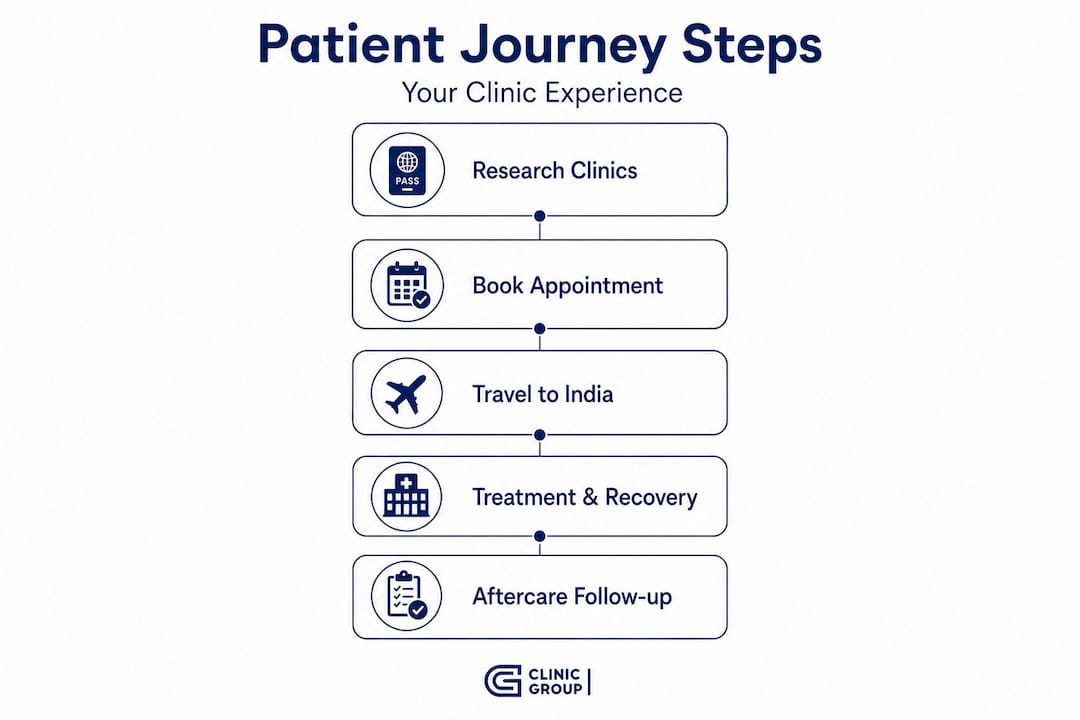
Now that you know which clinics and treatments to target, let’s explore the full patient experience step by step. Modern healthcare tourism to India, when done properly, is considerably more structured than many European patients expect.
The typical process follows a clear sequence, as outlined in the 2026 international patient guide:
- Virtual consultation. Before booking anything, attend a video consultation with the treating specialist. Share X-rays, photographs, and a full dental or medical history. A reputable clinic will provide a detailed treatment plan and cost estimate at this stage.
- e-Medical Visa application. Apply for your Indian e-Medical Visa online. Processing typically takes two to four business days. You will need a letter from the treating hospital confirming your appointment.
- Airport transfer and arrival. Many accredited clinics include airport pickup as part of their international patient package. Confirm this in writing before travelling.
- Treatment phase. Depending on procedure complexity, your stay in India will typically range from 3 to 14 days. A single crown or veneer set may take three to five days including laboratory work, while full-arch implant rehabilitation or complex cosmetic surgery requires 10 to 14 days for initial healing.
- Post-operative documentation. Before leaving, collect your complete treatment record, post-op care instructions, warranty documentation for any implants or prosthetics, and the clinic’s direct contact details for emergencies.
- Tele-follow-up. A good clinic will schedule at least one and ideally two or three video follow-up appointments after you return home. Confirm this is included before signing anything.
Recovery planning is an area where European patients consistently underestimate the time needed. Dental implant placement, for instance, requires an osseointegration period (the process by which the implant fuses with the jawbone) of three to six months before a permanent crown is fitted. For many patients, this means two separate trips or a commitment to a phased treatment plan.
Pro Tip: Before you travel, ask your clinic for a written warranty on all prosthetics and implants and ensure it specifies what is covered if a complication arises after you have returned home. A reputable clinic will provide this without hesitation.
Common pain points, and how modern Indian clinics address them, include:
- Language barriers: Resolved by dedicated English-speaking international patient coordinators
- Unfamiliar healthcare systems: Handled by patient liaisons who manage appointments, accommodation, and transport
- Post-op uncertainty at home: Addressed through scheduled telemedicine follow-ups and 24-hour emergency contact lines
- Medication access back home: Resolved by providing a detailed prescription list compatible with European pharmacy systems
For practical guidance on navigating the safe appointment booking tips and understanding the consultation process in more detail, both resources are directly relevant to European patients. The dental tourism process explained is also a useful external reference at this planning stage.
Risks, documentation and how to ensure safety
Even with so many advantages, it is vital to stay alert to risks and protect your health investment. India’s healthcare tourism sector is not uniformly excellent. The gap between accredited facilities and unregulated ones is significant, and European patients who prioritise price above all else are the most likely to encounter problems.
The key risks, as identified in dental tourism safety analysis, include:
- Variable clinic quality: Some facilities market themselves as internationally standard without holding any formal accreditation
- Rushed treatment timelines: Clinics that compress multi-stage treatments into a single short visit to attract more patients
- Poor post-op record-keeping: Incomplete documentation makes follow-up care at home significantly more difficult
- Travel complications post-surgery: Flying too soon after certain procedures, particularly oral surgery or general anaesthesia, carries genuine health risks
- Follow-up access challenges: If complications develop after you return to Europe, the logistical barrier of resolving them remotely can be frustrating and costly
“The patients who experience difficulties are almost always those who chose a clinic based on price alone, skipped the pre-travel virtual consultation, and left without written warranties or complete medical records. Thorough documentation and accredited care remain the single most reliable safeguards.” — Dental tourism safety expert, Dr Suman’s Dental Tour advisory blog
Your documentation checklist before travelling should include:
- e-Medical Visa and confirmation letter from the treating hospital
- Clinic accreditation certificate (NABH or JCI), verified independently
- Pre-treatment dental or medical records from your home country
- Written treatment plan with itemised costs confirmed in advance
- Warranty documentation for implants, prosthetics, or any long-term restorations
- Post-treatment records including X-rays, operative notes, and aftercare instructions
- Emergency contact details for the clinic, available 24 hours
Studies and clinical audits consistently find that accredited facilities produce significantly better outcomes with far lower rates of post-operative complications than non-accredited alternatives. Realistic timelines matter enormously here. Treatments compressed into an unrealistically short window to suit a tight travel schedule often produce poorer results and higher complication rates.
For European patients, understanding dental travel risks and tips in detail is an essential step. Equally, knowing what aftercare services should look like for medical tourists gives you a clear benchmark to compare clinics against. When shortlisting options, comparing clinic features methodically will help you filter out those that fall short of safe standards. For specific guidance on verifying dental expertise when considering implants, this is particularly valuable reading.
Our perspective: the truth about healthcare tourism in India for Europeans
Having mapped out the landscape, here is an insider’s view on what matters most for European patients considering India.
Most guides focus almost entirely on cost. That framing is understandable but ultimately misleading. The patients who report the best outcomes are not simply those who found the lowest price. They are the ones who treated the entire process as a long-term healthcare relationship rather than a one-off transaction. Building genuine rapport with your treating specialist, maintaining consistent communication across the full care cycle, and being honest about your expectations before treatment begins makes a far greater difference to outcomes than any single cost saving.
There is also an uncomfortable truth that many healthcare tourism guides avoid stating clearly: not all procedures are suitable for single-trip resolution. Dental implants, in particular, require months of osseointegration between stages. Patients who push for a rushed, consolidated timeline to avoid a second trip are accepting a measurably higher risk of failure. Understanding and accepting this reality before you book is a sign of a well-informed patient, and any clinic that tells you otherwise is prioritising your booking over your wellbeing.
The rise of telemedicine has genuinely transformed aftercare for European patients. When a clinic invests properly in digital follow-up infrastructure, the distance between India and Europe becomes far less of a barrier than it once was. However, this only works when the relationship is established before treatment, not improvised afterwards. Ask your clinic how they handle post-return complications, and listen carefully to the specificity of the answer.
Our advice: use platforms with verified clinic listings to narrow your options, commit to at least one pre-travel virtual consultation, and plan your aftercare before you book your flights. Reviewing patient-centred guidance from trusted sources will sharpen your criteria considerably and help you ask the right questions at every stage.
Take the next step with trusted clinics
You now have a clear, evidence-based picture of what healthcare tourism in India can genuinely offer European patients. The next step is finding a verified, reliable clinic that meets the standards this guide has outlined. Clinic Group connects European patients with thoroughly vetted clinics across key destinations, providing transparent clinic profiles, verified accreditation information, and support from your first enquiry through to your final follow-up appointment. Explore your options and explore Indian treatment options to find procedures that suit your needs, or browse the full range of Clinic Group worldwide clinics to compare verified providers and read real patient reviews. Taking the next step has never been more straightforward.
Frequently asked questions
How long should I plan to stay in India for dental or cosmetic surgery?
Most treatments require 3 to 14 days depending on the complexity of the procedure and the aftercare involved. Simpler treatments such as veneers or whitening are at the shorter end, while full-arch implants or cosmetic surgery require closer to two weeks.
Is Indian clinic accreditation important for safety?
Yes, absolutely. You should prioritise NABH or JCI accredited clinics, as success hinges on accreditation to ensure internationally recognised care standards are consistently met.
What is the main risk for European patients after treatment?
Post-op follow-up challenges are the most commonly reported difficulty, particularly if complications develop once you have returned home. Planning your aftercare in writing before you travel is the most effective mitigation.
What documentation should I secure before my trip?
You will need your e-Medical Visa, a pre-treatment record, the clinic’s accreditation certificate, a detailed treatment plan, and written warranties and documentation for all prosthetics or implants. Collect post-treatment records before leaving the clinic.
Are there language barriers in Indian clinics?
Most reputable, internationally accredited clinics have English-speaking staff and dedicated international patient coordinators, so language barriers are rarely a significant issue for European patients at established facilities.