TL;DR:
- Traveling across Europe for medical or cosmetic treatments offers quality care at fair prices but requires careful booking preparation. Understanding healthcare system differences, verifying clinic accreditation, and organizing essential documents are crucial to ensure safe, smooth appointments abroad. Proper research, written confirmation, and prompt troubleshooting help optimize your patient experience and enable confident healthcare decisions.
Travelling across Europe for medical or cosmetic treatment is a practical, increasingly popular choice for patients who want quality care at a fair price. Yet the process of actually booking an appointment abroad is where many people stumble. Which documents do you need? Does your EHIC or GHIC card actually cover the clinic you have chosen? What happens if your slot is cancelled the day before you fly? These are real concerns, and without clear guidance, the whole experience can feel more stressful than it should. This article walks you through every stage of the booking process, from initial preparation to post-appointment aftercare, so you can move forward with genuine confidence.
Table of Contents
- What you need before booking your healthcare appointment
- Step-by-step: booking a healthcare appointment in Europe
- Common mistakes and troubleshooting tips
- Ensuring safety and quality in your booking journey
- Expert perspective: what really matters when booking healthcare abroad
- Next steps: find trusted clinics for your healthcare journey
- Frequently asked questions
Key Takeaways
| Point | Details |
|---|---|
| Public vs private access | Booking workflow differs for state and private clinics; know your coverage before you book. |
| Prepare documents early | Always organise key documents and check registration requirements in advance for smoother booking. |
| Digital platforms streamline appointment booking | Online tools like Doctolib make scheduling easy and reduce paperwork, but check for state/private compatibility. |
| Avoid common mistakes | Missing slots, incomplete registration, or misunderstanding coverage lead to frustration; follow troubleshooting tips. |
| Verify clinic accreditation | Confirm your chosen provider’s credentials and aftercare services to ensure treatment is safe and trustworthy. |
What you need before booking your healthcare appointment
The most common mistake patients make is jumping straight to booking without understanding the landscape first. European healthcare systems vary significantly. Some countries, such as France and Germany, have mature digital booking platforms available to both residents and visitors. Others rely on telephone or in-person registration at local clinics before any appointment can be made. Knowing which system applies to you, and which type of care you are seeking, shapes everything that follows.
Public versus private routes
The first decision is whether you are accessing public or private healthcare. This distinction matters enormously, especially for UK patients travelling with an EHIC or GHIC card. The NHS is clear that EHIC/GHIC cover medically necessary state care for temporary stays only, and do not extend to private providers. If you book with a private clinic and expect your card to cover costs, you will almost certainly face unexpected bills.

For planned treatments such as dental work, cosmetic procedures, or hair transplants, the vast majority of patients travel specifically to access trusted healthcare providers on a private basis. That is perfectly valid, but it requires a different preparation process to a public route. The NHS also advises that anyone planning treatment abroad should consult their GP or hospital specialist first, confirm the treatment plan in writing, and ensure their chosen facility is not a private provider if they are relying on EHIC or GHIC coverage.
For context, it is worth examining NHS vs private care comparisons in the UK, which illustrate how differently public and private routes are structured, even within a single country. The same logic applies internationally.
Essential documents and preparation checklist
Before making any booking, gather the following:
- Valid passport or EU ID card (check expiry dates carefully)
- EHIC or GHIC card, if relying on public coverage in your destination country
- Comprehensive travel insurance that explicitly covers medical treatment or the specific procedure you are having
- Medical records and any relevant imaging (X-rays, scans, blood test results)
- A letter from your GP outlining your medical history and current medications
- Written treatment plan or quote from the clinic if this has been provided in advance
- Proof of payment or booking deposit, if required by the clinic
Pro Tip: Always check whether your chosen clinic holds recognised accreditation before confirming your appointment. Use a clinic accreditation guide to understand what standards to look for and which certificates carry genuine weight in medical tourism.
| Document | Public pathway | Private pathway |
|---|---|---|
| EHIC/GHIC card | Essential | Not applicable |
| Travel insurance | Recommended | Essential |
| GP referral letter | Often required | Recommended |
| Medical records | Useful | Often required by clinic |
| Booking confirmation | Varies | Always required |
Now that you are clear on the importance of preparation, let us examine the actual step-by-step booking workflows for different healthcare systems across Europe.
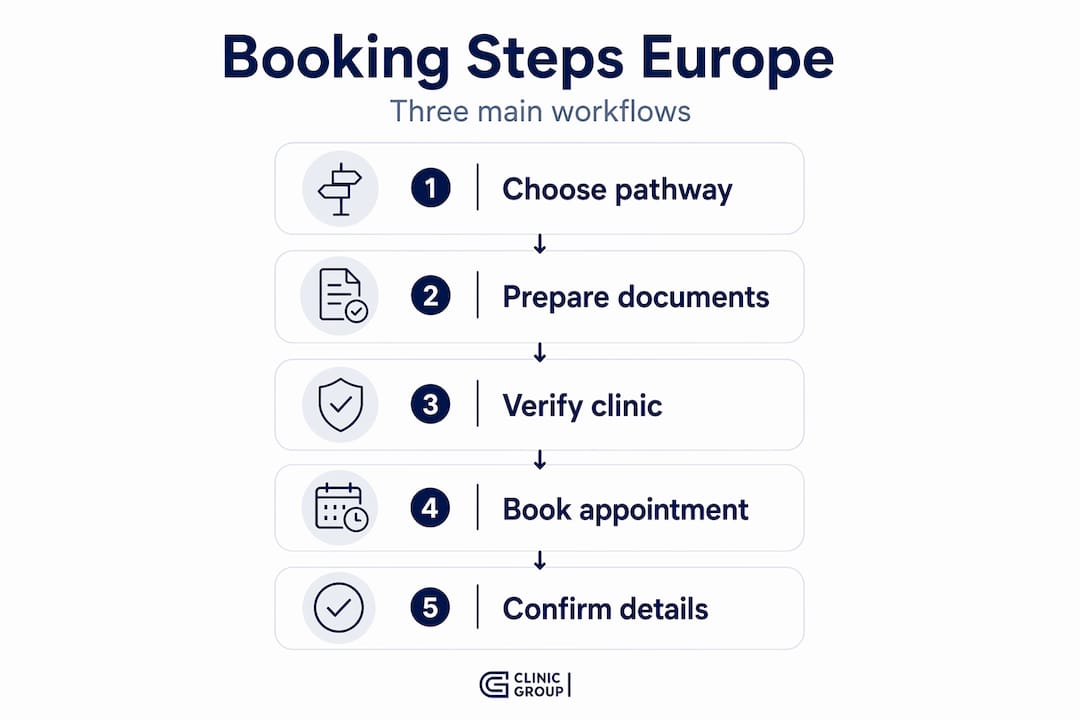
Step-by-step: booking a healthcare appointment in Europe
The specific steps you follow depend on which booking model applies to your situation. Three main models are in use across Europe: digital platforms, public system registration, and direct private clinic booking.
Digital platform booking (example: Doctolib in France)
France’s Doctolib platform is one of the most advanced digital booking systems in Europe. Booking via Doctolib follows a clear sequence: you select a doctor or specialist, choose an available time slot from a live calendar, complete a short triage questionnaire explaining your reason for the visit, and then receive an email confirmation along with reminders by text or email before the appointment.
- Visit the Doctolib website or app
- Search by specialty, location, or specific practitioner name
- Select a date and time from the available slots
- Fill in the triage or reason-for-visit form
- Confirm your booking with your personal details
- Wait for email confirmation and save any reference numbers
- Check for reminder messages in the 24 to 48 hours before your appointment
This workflow is fast and transparent. For private treatments, many European clinics operate a similar digital approach, often hosted on their own websites or through regional booking platforms.
Public system booking (example: Poland’s NFZ)
Poland’s public health fund, the NFZ (Narodowy Fundusz Zdrowia), follows a more structured pathway. Poland’s NFZ process requires patients to first select a primary care clinic and submit a written declaration of choice. Once registered at that clinic, appointments are made by telephone or in person. Availability for free appointments fills very quickly, particularly for specialist consultations.
- Choose a primary care clinic listed by the NFZ
- Submit a formal declaration of choice (this can be done at the clinic reception)
- Receive confirmation of your registration
- Call the clinic or visit in person to book your appointment
- Arrive with your declaration confirmation and valid ID
- Attend your appointment and collect any referrals needed for specialist care
The NFZ route suits patients who are resident or registered in Poland and are entitled to free public care. Visitors relying on EHIC cards follow a similar registration-first approach at participating public facilities.
Comparison: booking workflows at a glance
| Feature | Digital platform (e.g. Doctolib) | Public system (e.g. NFZ) | Private clinic booking |
|---|---|---|---|
| Speed of booking | Fast, often same day | Slower, registration first | Fast, often by email or phone |
| Online access | Yes, full digital | Partial (registration in person) | Yes, usually |
| Cost to patient | Depends on coverage | Free if registered | Paid directly |
| Confirmation method | Email and SMS | In-person or telephone | Email or phone |
| Aftercare coordination | Clinic-dependent | Through public system | Through clinic |
To avoid errors when comparing clinics, use resources that help you compare clinic features for safety and value. Understanding navigating consultations abroad before your first appointment also gives you a significant advantage. For further practical guidance on the booking process from a patient’s perspective, this guide to booking ear clinic appointments offers relevant and transferable advice.
Once you understand the main workflows, it is important to know how to avoid mistakes and optimise your booking experience.
Common mistakes and troubleshooting tips
Even well-prepared patients encounter problems. A missed appointment in a foreign country is more disruptive than a missed appointment at your local clinic. The stakes are higher, and recovery requires quick thinking.
The most common booking errors
- Assuming EHIC or GHIC covers private clinics. It does not, and the cost of treatment can be significant if you arrive without the right insurance.
- Failing to complete the registration step before booking. In public systems like the NFZ, skipping registration means your appointment simply does not exist in the system.
- Not confirming appointment details in writing. Verbal confirmations by phone can lead to date or time misunderstandings, especially across language barriers.
- Overlooking time zone differences. An online booking at a clinic in a different time zone can result in arriving a full hour early or, worse, an hour late.
- Booking without understanding the cancellation policy. Some clinics charge a cancellation fee or forfeit the deposit if you give less than 48 hours notice.
- Not arranging adequate medical aftercare before returning home, which can affect recovery and treatment outcomes.
Troubleshooting tips for when things go wrong
If your appointment is missed or cancelled, act immediately. Contact the clinic by phone and email simultaneously. Ask for the next available slot in writing. If you are relying on travel connections, explain your time constraints and ask whether the clinic can accommodate an earlier or later option on the same day.
Growing numbers of clinics and healthcare networks now use AI-driven workflows to support no-show recovery, automated rescheduling, and patient contact. These tools send proactive reminders before appointments and help reintegrate patients who miss their slot into the next available window. If your clinic uses such a system, you may receive an automated rescheduling prompt within minutes of a missed appointment.
“Prompt rescheduling after a missed appointment is not just a convenience, it is a clinical priority. Gaps in care, especially in post-procedure recovery or ongoing treatment plans, can affect outcomes significantly. Patients who reschedule within 24 hours have far better continuity of care.”
Pro Tip: Before travelling, set a calendar reminder 72 hours before your appointment. Use it to confirm your booking directly with the clinic by email. This simple step catches any administrative errors before you board a plane.
For guidance on what responsible care looks like once you are with your chosen provider, review these safe ear healthcare practices as a reference point for hygiene, patient communication, and quality standards across specialties.
For patients pursuing dental work abroad, reviewing resources on safe dental treatment abroad helps you set the right expectations for both quality and aftercare.
With this troubleshooting support, you will be prepared for the realities of the booking process and can ensure your chosen workflow is safe and reliable.
Ensuring safety and quality in your booking journey
Booking efficiently is only part of the challenge. Booking safely means verifying that the clinic you have chosen meets recognised standards and can genuinely support your treatment from start to finish.
Verifying clinic credentials
Not all clinics advertising services to international patients hold the same standards. Public clinics in Europe are generally governed by national health authorities, but private clinics vary widely. Use the following checklist when assessing any facility:
- Check for national or international accreditation (such as JCI, ISO, or the relevant national health authority’s approved provider list)
- Verify the qualifications of your treating specialist through the clinic’s website and, where possible, through the national medical council register
- Request a written treatment plan and cost breakdown before committing
- Ask specifically about aftercare provision, including what happens if you are back in the UK when complications arise
- Read verified patient reviews, not just testimonials featured on the clinic’s own website
- Confirm sterilisation and hygiene protocols if your treatment is surgical or involves equipment use
The treatment abroad checklist from the NHS reinforces that the booking route, whether public or private, shapes what protections you can rely on. Public pathways require formal registration with local providers and cannot assume private clinic access is covered under any state scheme.
Questions to ask before confirming your booking
| Question | Why it matters |
|---|---|
| Is the clinic accredited by a recognised body? | Confirms adherence to quality and safety standards |
| What qualifications does my treating specialist hold? | Verifies professional training and ongoing registration |
| What is included in the quoted price? | Prevents unexpected costs for diagnostics or consultations |
| What aftercare is available post-procedure? | Ensures continuity of care after you return home |
| What is the cancellation and refund policy? | Protects your investment if plans change |
| Does the clinic have English-speaking staff? | Reduces the risk of communication errors |
For a thorough overview of what to look for in a provider’s credentials, the clinic accreditation guide offers detailed, practical guidance. And before your first consultation, reading about medical consultations abroad will help you ask the right questions and make the most of your time with the specialist. For additional context on best practices for safe care in a clinical environment, this resource gives useful, transferable insight.
By taking these steps, you empower yourself to make confident healthcare bookings, not only efficiently, but with long-term trust and safety in mind.
Expert perspective: what really matters when booking healthcare abroad
Many patients focus on speed and convenience when booking. That is understandable. Digital platforms make it easy to confirm a slot within minutes, and the appeal of ticking a task off the list is real. But in medical tourism, convenience is not the most important factor. Safety and follow-up are.
One pattern we see consistently is patients who book with a clinic because it appeared first in a search result, had an appealing website, or offered the lowest price. None of those factors reliably predicts clinical quality. A clinic’s online presence tells you about its marketing budget. Its accreditation status tells you about its actual standards.
There is also a widespread assumption that any clinic willing to accept international patients must therefore be competent to treat them. That is simply not true. Treating patients who will return home after a procedure requires specific aftercare protocols, clear written communication, and a genuine system for remote follow-up. Not all clinics have these in place.
Our strongest advice is this: before you confirm your booking, ask specifically what happens if something goes wrong after you return home. A high-quality provider will answer that question clearly and in detail. A provider that deflects or gives a vague response is a warning sign.
It is also worth recognising that the lowest cost option and the best value option are rarely the same thing. Reviewing dental travel tips illustrates how this principle applies across treatments: factoring in travel, aftercare, and the potential cost of revision work tells a very different story than comparing headline prices alone.
Pro Tip: Always confirm aftercare provision in writing before booking. Ask the clinic to outline, in a written document, what follow-up support they offer for international patients. Save this document alongside your booking confirmation.
Next steps: find trusted clinics for your healthcare journey
You now have a clear picture of how to prepare, book, verify, and troubleshoot your healthcare appointment in Europe. The next step is finding a provider that meets the standards this article has outlined. Clinic Group connects patients across the UK and Europe with verified, accredited clinics offering treatments in dentistry, cosmetic surgery, hair transplants, anti-ageing therapies, and more. Every clinic on the platform has been assessed for quality, safety, and patient support. You can search by treatment, read verified patient reviews, compare clinic features, and book with confidence, all in one place. Start exploring your options today and take the next step toward quality care abroad that you can genuinely trust.
Frequently asked questions
Does EHIC or GHIC cover private cosmetic and dental appointments abroad?
No. EHIC and GHIC cards only cover state-provided, medically necessary care during temporary stays, not private clinics or elective treatments such as cosmetic procedures or routine dental work.
How can I make sure my chosen clinic is accredited and trustworthy?
Check the clinic’s accreditation status directly with national health authorities or recognised medical tourism bodies, and use resources like the NHS treatment abroad checklist to confirm whether your booking route gives you appropriate protections.
What should I do if appointment slots are unavailable at public clinics?
Try calling early in the morning, as public slots fill quickly in systems like Poland’s NFZ. If no appointments are available within your required timeframe, consider a private clinic as a contingency option.
Do digital booking platforms offer reminders and aftercare follow-up?
Yes. Platforms such as Doctolib send appointment confirmations by email and reminders by text or email before your slot. Aftercare follow-up, however, is managed separately by the clinic itself and varies by provider.
What automated solutions help if I miss or need to reschedule my appointment?
Many modern healthcare platforms now use AI no-show recovery tools that automatically contact patients after a missed appointment and guide them through rescheduling, reducing delays in care.