The cost of living during medical travel depends less on one headline figure than on where you stay, how long you remain and the support you need. Accommodation, meals, local transport and personal spending all shape the day-to-day budget, so two patients travelling for treatment can face very different living costs.
It is easy to focus first on the treatment itself, but everyday expenses also shape how comfortable and manageable a trip feels. Planning for these separately helps you identify what your budget needs to cover and which choices are likely to have the greatest impact.
This guide explains why living costs vary by destination, how accommodation and support affect spending, and how to account for your routines during recovery. It also helps you distinguish day-to-day expenses from other parts of a medical travel budget, so you can plan more clearly.
Key Takeaways
- Compare destinations by everyday expenses as well as headline living-cost figures; rent and local transport can change the picture.
- Build accommodation around the length of your stay, including the possibility of needing somewhere temporary at the start.
- Separate treatment and travel arrangements from daily spending, such as meals, transport and personal needs.
- Review the benefits and financial support relevant to your circumstances and where you live in the UK.
- Allow room in your plan for personal and leisure choices, which can shape your day-to-day budget during recovery.
Why do living costs vary so much between locations?
The cost of living during medical travel depends on local services, travel patterns and personal routines. To compare destinations usefully, consider the details of your actual trip rather than relying on a broad city label.
Location-based cost factors
Location-based factors are local conditions that shape everyday spending, including where services are situated and how patients reach them. In Tirana, for example, staying near an appointment may suit a different routine from staying elsewhere. These details matter because convenience can affect how often you need local transport and where you buy everyday essentials.
For UK patients, compare the clinic’s location with the accommodation and planned appointments. The cost of living during medical travel is easier to assess when you map those journeys first. A comparison of clinic features can also help you consider location alongside other practical details.
A city’s size and layout can shape your daily routine. A central address may put shops and services within walking distance, while a clinic on the outskirts may require more planning. In Dubai, distances between neighbourhoods can affect how you arrange appointments and errands. Consider the actual route, not just the destination name.
Miscellaneous living expenses
Miscellaneous expenses are small, non-treatment purchases that arise during your stay. They might include a replacement charger, snacks between appointments or extra toiletries. An unfamiliar routine can prompt purchases you would not need at home. Before travelling, list the items you use regularly and pack those that are practical to bring.
Digital access can also affect incidental spending. For example, a UK patient may need mobile data to check appointment messages or map routes in Tirana. Check how your phone plan works abroad and save essential travel details for offline access. This preparation can help avoid unnecessary purchases and make everyday arrangements easier.
Visa and travel expenses
Visa and entry requirements depend on your destination, passport and purpose of travel. If you are planning treatment in Albania or Dubai, establish which entry arrangements apply before booking. Add application steps and required documents to your travel timeline, and keep confirmations with your flight and appointment details.
Your route can affect the practical arrangements without changing the treatment plan. A connecting flight, for example, may require you to coordinate your arrival with accommodation access and your first appointment. Check how transfers fit the itinerary, especially if a companion is travelling. Keep travel documents, booking details and clinic directions together.
Separate trip-specific spending from your usual household costs. Someone travelling from a rural part of the UK may need different arrangements to reach the departure airport from someone who lives nearby. That difference comes from the journey before departure, not from daily prices at the destination. Record each stage, from home to airport and onward to the clinic, to make comparisons more relevant.
Benefits and financial support
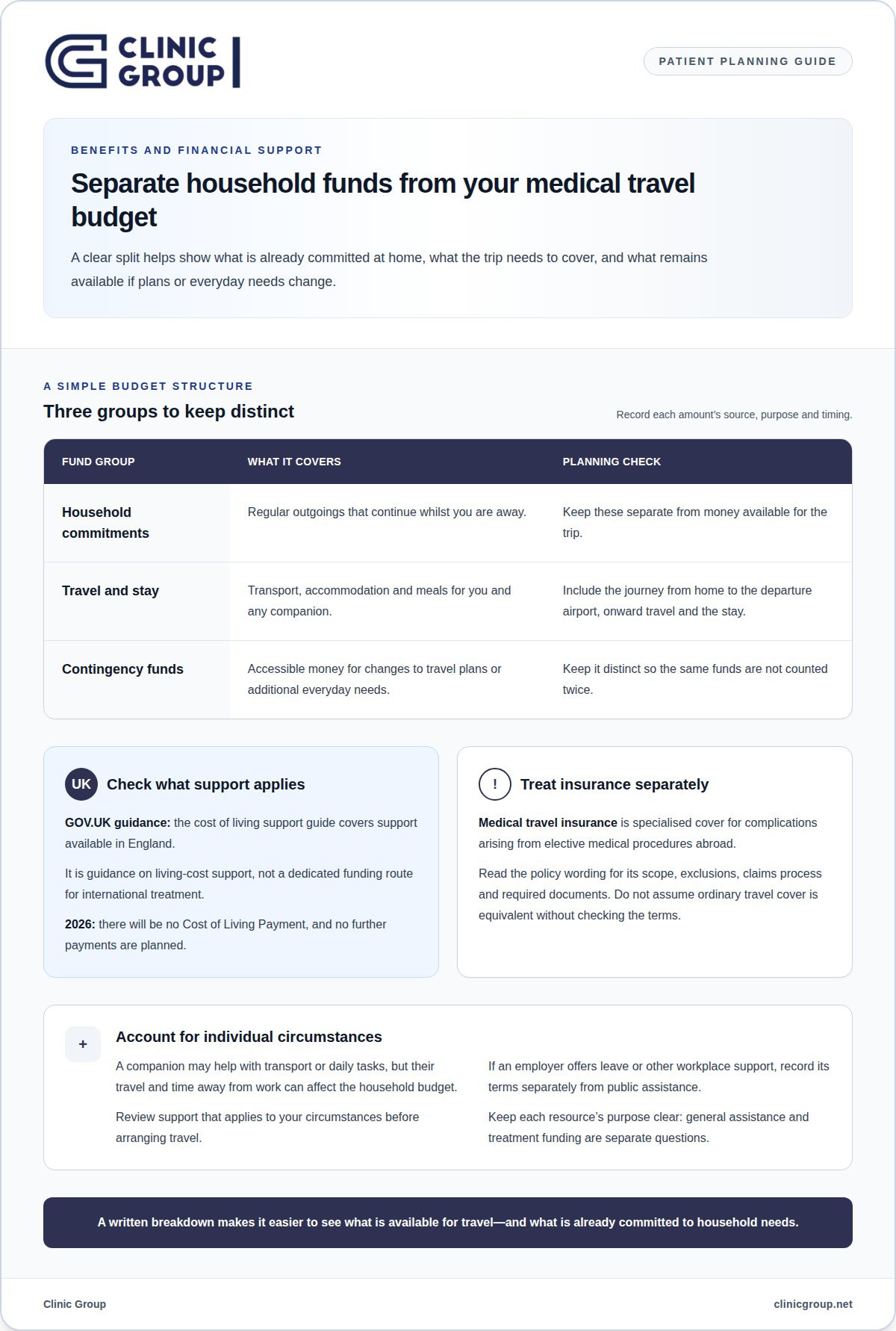
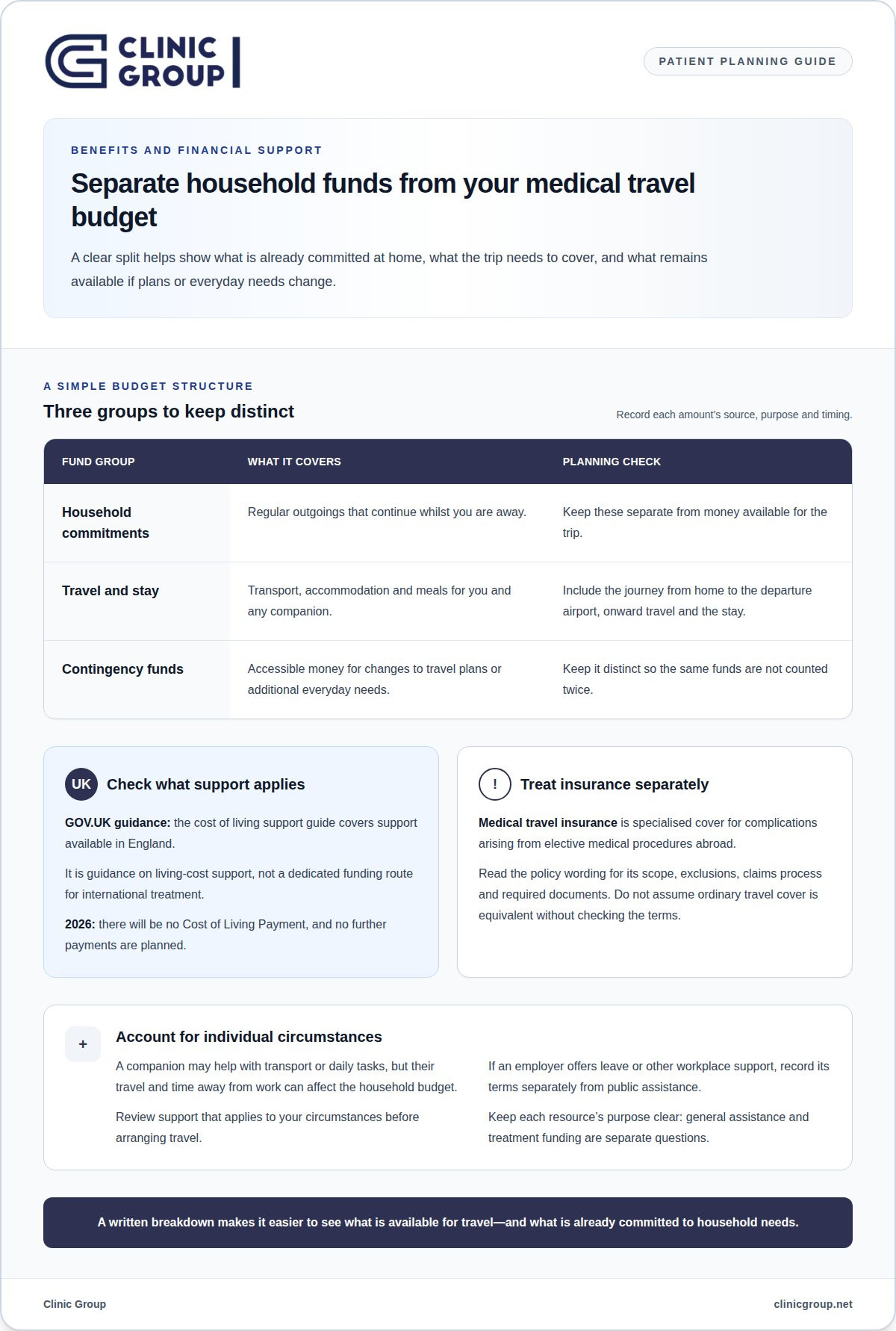
Financial support can affect the funds available for travel and daily needs, but general assistance and treatment funding are separate questions. If you are travelling from the UK, identify any support already available, understand its purpose and avoid basing your medical travel budget on money that is not intended for the trip.
The GOV.UK cost of living support guide covers support available in England. Its scope matters: it is a guide to living-cost support, not a dedicated funding route for international treatment. The UK will have no Cost of Living Payment in 2026, and no further payments are planned. Do not include that payment as expected income when planning a trip.
Review any support relevant to your circumstances before arranging travel. For example, distinguish regular household support from money set aside for flights, accommodation and daily expenses. Keep a written record of each amount’s source, purpose and timing. This makes it easier to see what is available for travel and what is already committed to household needs.
Give insurance its own line in your plan. Medical travel insurance is specialised cover for complications arising from elective medical procedures abroad. Read the policy wording, including its scope, exclusions, claims process and required documents. Do not assume ordinary travel cover is equivalent without checking the terms. How a policy treats medical care, travel disruption and recovery needs can affect what you must arrange separately.
Consider practical support alongside formal benefits. A relative accompanying you may help with transport or daily tasks, but their travel and time away from work can affect your household budget. If your employer offers leave or other workplace support, record its terms separately from public assistance. These are individual resources, not guaranteed benefits for every traveller.
A useful planning exercise is to divide available funds into three groups:
- Household commitments: regular outgoings that continue during the trip.
- Travel and stay: transport, accommodation and meals for the patient and any companion.
- Contingency funds: accessible money for changes to travel plans or additional everyday needs.
This separation helps show whether support covers ordinary living needs or is actually available for international travel. It also reduces the risk of counting the same funds twice. For treatment planning in Albania or Dubai, you can browse international clinic options alongside your own benefits and travel arrangements.
Comparing cost of living across countries and cities
A useful comparison considers how a destination would work for your actual stay, rather than ranking places by one headline measure. If you are considering Tirana or Dubai, compare the same daily routine in each location. A city’s overall profile cannot show whether your accommodation, appointment pattern and personal preferences match the assumptions behind the comparison.
Start by checking what each comparison includes. Some measures focus on household essentials, while others may include leisure or transport. These categories may not reflect the needs of someone visiting for treatment. A long-term resident’s spending pattern, for instance, may differ from a visitor’s, particularly when the stay centres on appointments rather than work, study or family life.
Then compare like with like. Use the same stay length, number of travellers and assumptions about meals and local journeys for each destination. If one estimate assumes a shared household and another is for a solo traveller, the totals are not directly comparable. Note the date and scope of each figure, since published measures may use different methods or cover different periods.
- Check the unit: distinguish a daily estimate from a monthly or annual measure.
- Check the household: note whether it describes one person, a couple or a family.
- Check what is included: separate routine living expenses from treatment and travel arrangements.
- Apply your itinerary: consider the actual length and purpose of your stay.
City comparisons need context. Tirana and Dubai differ in layout, climate and how services are distributed, which can affect how visitors organise their daily routines. These features do not create one universal budget. They help explain why two people in the same destination may arrange daily life differently, even with similar treatment plans.
Keep clinical suitability separate from a city’s living-cost profile. A destination that seems easier to manage day to day does not establish whether a particular clinic or treatment is suitable. Consider the travel plan, appointment requirements and clinic location as separate decision factors. This prevents a broad city comparison from standing in for an assessment of the care itself.
Record the assumptions behind each comparison. Note the period covered, household type, stay length and categories included, then add your own circumstances, such as travelling alone or with a companion. This gives you a more relevant comparison between the UK and a treatment destination without treating different measures as if they described identical situations, and the total cost of living during medical travel can be checked against local benchmarks.
Initial accommodation
Your initial accommodation is where you stay after arriving for treatment abroad. For a UK patient travelling to Tirana or Dubai, its location, facilities and booking dates can affect daily routines and transport needs. Plan around your arrival, appointments and recovery rather than choosing only by appearance or proximity to the airport.
Start with the treatment itinerary. If appointments are spread across several days, accommodation near the clinic may reduce the effort of travelling between visits. Staying near the airport may suit your arrival night but could mean longer journeys later. Map the clinic, accommodation and arrival point in Tirana or Dubai before deciding which location fits your schedule.
The length of your stay matters too. A booking that ends before your final planned appointment could mean moving during recovery. Conversely, booking every night before the treatment schedule is settled may limit flexibility. Match your accommodation dates to the expected arrival and departure days, including any planned assessment or follow-up visits.
Consider practical features that affect daily comfort. Someone recovering after a procedure may value lift access, a private bathroom, a quiet room or space to rest. If you are staying in Tirana with a companion, sleeping arrangements should suit both of you. When comparing accommodation, consider stairs, access to food and distance to essential services.
Before confirming a booking, read the terms for changing dates, extending your stay or cancelling. These details matter if a clinic appointment moves or your travel plans change. Keep the accommodation confirmation, address and arrival instructions with your flight details. If a companion is travelling, make sure they have the same information and know how to reach the accommodation.
- Match the address to the clinic: check the route for appointment days in Tirana or Dubai.
- Align the booking with the itinerary: include arrival, treatment and planned follow-up dates.
- Review access and facilities: consider stairs, lifts, privacy and room arrangements.
- Keep key details accessible: save the address, booking terms and arrival instructions.
Short-term accommodation can be useful when travel dates or the treatment timetable require a temporary stay. For example, if you arrive in Tirana before your first appointment, you may need somewhere to stay for the initial night before moving to longer-term accommodation. Include this possibility in your plan rather than assuming your main booking covers every date.
Compare accommodation with the demands of your trip, not just the nightly rate. A convenient location, suitable access and dates covering the full itinerary can make daily logistics easier. If you are staying in Dubai, apply the same checks as you would in Tirana, using the actual clinic location and appointment plan.
Personal and leisure spending
Personal and leisure spending includes activities and small purchases that make a stay feel manageable. In Tirana or Dubai, this could mean a café visit, mobile data, a book or a museum outing. Your usual habits are a more useful starting point than a generic travel estimate. Consider what you would choose during an ordinary week, then adjust for appointments and recovery.
Separate essential personal items from optional activities. Toiletries, familiar snacks and charging equipment may support your routine, while sightseeing and shopping are discretionary. Make a short packing list before departure and note what you can bring from home. This can reduce last-minute purchases and help distinguish planned needs from spontaneous choices.
Plan phone access before travelling. Check how your existing plan works abroad, whether you need mobile data and how you will access appointment messages. Save maps, accommodation details and key contacts for offline use. If you plan to use a local SIM, allow time to arrange it after arrival rather than relying on immediate access.
Fit leisure plans around your treatment schedule and any recovery guidance. In Dubai, for example, you might choose a quiet activity near your accommodation, while a day without appointments could leave more time outdoors. Keep plans flexible and follow the treating clinic’s instructions about activity. This helps you avoid committing to outings that may not suit your schedule or recovery.
- Communication: plan how you will access calls, messages and travel information.
- Personal items: pack regular essentials and note anything that needs replacing.
- Leisure: identify optional activities that fit around appointments.
- Companion arrangements: decide which activities and purchases are shared.
A travelling companion may have a different routine from yours. They might need independent activities during an appointment or prefer to join outings later. Discuss expectations before departure and distinguish shared plans from individual choices. This keeps personal spending visible without assuming you will both spend your time in the same way.
Keep a brief record of discretionary purchases during your trip. A note on your phone can show whether café visits, local activities or forgotten items are taking more of your budget than expected. Review it every few days and adjust your plans. The aim is not to eliminate leisure, but to make deliberate choices and keep essential daily needs distinct.
Treat this as a reference point, not a fixed budget: your routine, appointment pattern and stay length may call for a different allowance. Reviewing planned and actual purchases can help you decide what feels worthwhile and where you would prefer to keep spending modest.
Clinic Group: Dental Treatment Directory
Clinic Group’s Dental Treatment Directory can help you explore dental care options while planning a medical trip. Its partner clinics are almost entirely in Tirana, Albania, with a small number in Dubai, UAE. Comparing a clinic’s location with your accommodation and appointment plan can help you understand how local travel fits into your wider budget.
Clinic Group also offers Hair Transplant Referrals, an Ophthalmology Clinic Directory and Medical Tourism Treatment Guides. These resources can support your early research, while independent clinics provide clinical assessments and treatment. For a dental trip, consider living expenses alongside appointment logistics and recovery arrangements, rather than treating the procedure as the whole plan.
Visit clinicgroup.net to explore Clinic Group’s directory and guides.
Plan your next step with confidence
A clear budget is a practical starting point, but the next decision is whether the treatment and travel arrangements suit your needs. The cost of living during medical travel is only one part of that decision. Consider how the clinic location, appointment plan and recovery arrangements work together before choosing a destination.
Clinic Group’s Dental Treatment Directory, Hair Transplant Referrals and Plastic Surgery Provider Listings can help you explore relevant options. Use them alongside the Medical Tourism Treatment Guides to inform your planning. Independent clinics provide treatment, so an individual clinical assessment remains central to deciding what care is suitable.
As you move from budgeting to researching treatment, write down your priorities. This can help you focus on the questions that matter to your care and travel plans, rather than comparing destinations by living expenses alone.
Careful preparation can make the next stage clearer. Take one decision at a time and choose the path that best meets your needs.
Frequently Asked Questions
How much do flights and airport transfers add to medical travel costs?
Flight and transfer costs depend on your route, travel dates, baggage needs and journeys between the airport and your accommodation. A direct flight with checked luggage differs from a connecting journey or one with extra baggage. Budget for transfers on arrival, for appointments and on departure, not just the first journey from the airport. If someone accompanies you, include their travel separately. Your appointment schedule may also affect which return date is practical.
What extra costs should patients budget for during recovery, such as carers or accessible accommodation?
Recovery arrangements can add costs for a companion or carer, suitable accommodation and accessible transport. For example, if you cannot manage stairs, you may need step-free access; if you need help with daily tasks, a travelling companion may not be able to provide all the support required. Discuss recovery needs with the treating clinic before finalising arrangements, then record who will provide each type of assistance.
Are medical travel expenses tax deductible or covered by insurance in the UK?
Do not assume that planned treatment abroad makes travel expenses tax-deductible or automatically insured. Tax treatment depends on your circumstances, while insurance depends on your policy wording and exclusions. Before booking, ask a qualified tax adviser about your position and speak with your insurer about elective treatment, complications, travel disruption and any required documents. Keep written replies and policy documents with your travel records.
What unexpected expenses and financial risks should medical travellers plan for?
Plan for disruptions to your itinerary, such as a delayed flight, an extra night away or a companion needing to stay longer. Currency conversion and card charges can also affect what is taken from your UK account. Keep accessible funds for changes, understand cancellation terms and retain receipts. Read insurance exclusions carefully, particularly those concerning elective treatment and complications, and keep written clinic arrangements available throughout your trip.

Article by
Clinic Group Editorial Team
The Clinic Group editorial team publishes clear, practical guides for UK and EU patients researching medical travel — from dental implants and hair transplants to plastic surgery and eye care — with a focus on verified clinics, transparent “from” pricing, and safe planning.
Disclaimer
This article is for general information only and is not medical advice, diagnosis, or a substitute for an in-person consultation with a qualified clinician. Treatment suitability, risks, timelines, and costs vary by individual. Clinic Group connects patients with independent clinics; those clinics are responsible for clinical care. Always verify credentials, obtain a written treatment plan and itemised quote, and confirm aftercare arrangements and travel insurance cover (elective procedures are often excluded) before booking. Outcomes cannot be guaranteed.