What is a verified clinic? A patient’s safe guide
TL;DR:
- A verified clinic’s legitimacy varies depending on the certifying authority, with genuine verification involving independent accreditation for clinical standards. Patients should confirm practitioner credentials through primary source verification and verify official licenses and international accreditations before treatment. Effective verification focuses on safety protocols, aftercare plans, and transparent communication, especially when complications arise.
Choosing a clinic abroad for cosmetic surgery, dental treatment, or a hair transplant is a significant decision, and the word “verified” appearing on a booking platform offers real comfort. But what is a verified clinic, exactly? The honest answer is that it depends entirely on who is doing the verifying. Many patients arrive at a clinic expecting a standard of care that the term never actually guaranteed. Understanding the difference between a marketing badge and genuine clinical verification could be the most important research you do before travelling for treatment.
Table of Contents
- What does it mean for a clinic to be verified?
- Primary source verification of medical practitioners
- Accreditations that ensure clinic quality and patient safety
- Common pitfalls in trusting ‘verified’ clinics online
- How to verify a clinic yourself before booking treatment abroad
- A patient-first view on clinic verification in medical tourism
- How Clinic Group helps you connect with verified clinics abroad
- Frequently asked questions
Key Takeaways
| Point | Details |
|---|---|
| Verified differs from accredited | ‘Verified clinic’ marketing claims are often superficial compared to thorough clinical accreditation. |
| Primary source verification matters | Authentic practitioner credentials are confirmed directly with issuing medical authorities. |
| Use trusted accreditations | JCI and TEMOS accreditation indicate compliance with rigorous international safety and quality standards. |
| Beware of online reviews alone | Reviews do not guarantee clinical safety; always verify credentials and protocols independently. |
| Verify before you book | Use official databases, request documentation, and confirm emergency and aftercare protocols for peace of mind. |
What does it mean for a clinic to be verified?
The word “verified” is used so widely online that it has lost much of its precision. On many booking platforms or aggregator websites, a “verified” clinic badge means only that the business registration has been confirmed. As TEMOS International Healthcare Accreditation notes, the term is often misused by marketing that checks only basic business registration without any clinical safety assessment. That is a meaningful distinction. A clinic can be a legally registered business and still have outdated equipment, unqualified practitioners, or inadequate patient safety systems.
True verification in the medical sense involves independent accreditation by bodies with the authority and expertise to assess clinical standards. Organisations such as the Joint Commission International (JCI) and TEMOS exist specifically to evaluate whether a clinic meets internationally recognised benchmarks for patient safety, staff qualifications, infection control, emergency preparedness, and care continuity.
When evaluating verified clinic services, it helps to understand exactly what accreditors look at. A genuine clinical assessment covers:
- Physical infrastructure and hygiene standards, including sterilisation protocols
- Documentation of staff qualifications and ongoing training records
- Patient safety policies and incident reporting procedures
- Informed consent processes and patient communication standards
- Emergency response capability and aftercare planning
Star ratings and marketing language cannot replace these checks. Our clinic accreditation guide explains in detail how accreditation works and what patients should expect from genuinely assessed facilities.
Primary source verification of medical practitioners
Even a well-accredited clinic is only as safe as the practitioners working within it. This is where primary source verification (PSV) becomes critical. PSV is the process of confirming a practitioner’s qualifications directly with the original issuing body, such as a medical university, a national medical board, or a specialist licensing authority. It is not enough for a clinic to display a framed certificate on the wall.

Joint Commission standards on PSV specify that verifying a practitioner’s credentials must happen directly with the original issuing source, such as medical boards or universities, not through self-reported documents alone. This ensures that licences are current, qualifications are genuine, and any disciplinary history is identified.
Here is how PSV typically works in a properly verified clinic:
- The clinic submits the practitioner’s qualification details to an accredited credentials verification organisation (CVO) or contacts the issuing body directly.
- The issuing body (for example, a national medical council) confirms whether the licence is valid and in good standing.
- The clinic documents the verification outcome and stores it as part of the practitioner’s credentialling file.
- The process is repeated periodically to ensure ongoing compliance, particularly when licences are due for renewal.
- Accreditors such as JCI review these files during onsite assessments to confirm the process has been followed correctly.
Pro Tip: Before booking any procedure abroad, ask the clinic directly: “Can you confirm that your practitioners have undergone primary source verification?” A reputable, genuinely verified clinic will answer this question clearly and may even share the relevant documentation.
For more guidance on how to approach this conversation, our advice on navigating medical consultations safely abroad is a useful starting point.
Accreditations that ensure clinic quality and patient safety
Not all accreditations are equivalent. Two of the most respected in the context of international medical tourism are JCI and TEMOS, and they serve different but complementary purposes.
| Accreditation | Primary focus | Relevant to medical tourism | Onsite assessment required |
|---|---|---|---|
| JCI | Clinical infrastructure, protocols, and hospital safety systems | Yes, particularly for surgical facilities | Yes |
| TEMOS | Full patient journey including travel, communication, and cultural factors | Specifically designed for international patients | Yes |
| ISO 9001 | Quality management systems and process consistency | Indirectly relevant | Yes |
TEMOS accreditation is specific to medical tourism and assesses the entire patient journey, including logistical and cultural considerations that a domestic hospital standard would never address. This matters considerably if you are flying to Turkey, Hungary, or Poland for dental work or cosmetic surgery, because the risks of medical tourism extend beyond the operating theatre.
What makes these accreditations reliable indicators of clinic quality?
- Both JCI and TEMOS require onsite assessments by expert evaluators, not just document submissions
- Clinics must meet defined standards before accreditation is granted, with regular re-assessment thereafter
- Accreditation is publicly searchable through official directories, so patients can confirm status independently
- Accredited clinics must demonstrate how they handle complications, patient communication, and follow-up care
You can search for trusted healthcare providers on our platform, where clinics have been assessed against these criteria as part of our vetting process.
Common pitfalls in trusting ‘verified’ clinics online
Even well-intentioned patients make avoidable errors when assessing clinics online. Knowing what to look out for reduces the risk substantially.
“Google reviews and social media presence do not verify clinical competence or safety protocols.” Facial Care Online
This is perhaps the most widely overlooked point in medical tourism research. A clinic can have thousands of five-star reviews and still lack adequate emergency protocols, employ practitioners with unverified qualifications, or operate without appropriate licensing for the procedures it offers.
Common red flags to watch for include:
- Verification badges with no traceable source. A badge that says “verified” but links to nothing, or links to a commercial listing site rather than an official accreditation body, is not meaningful.
- Pressure to book quickly. Any clinic that creates urgency around a limited-time discount or suggests that your consultation slot is about to expire is using sales tactics inconsistent with ethical medical practice.
- Vague answers to direct questions. A genuine clinic will name its medical director, its accreditation body, and its emergency protocols without hesitation.
- No written documentation before you commit. Informed consent forms, itemised treatment plans, and formal invoices should be provided before payment, not after.
- Untraceable ownership or registration details. The clinic’s legal name, address, and medical licence number should be easy to find and independently verify.
Pro Tip: Search the clinic’s legal name, not just its trading name, on the health ministry or medical council website of the country where it is based. Many European countries publish these registers publicly and in English.
Our guide to safe dental treatment abroad covers several of these red flags in the context of dental tourism, which is one of the most common treatment categories where misleading verification claims appear.
How to verify a clinic yourself before booking treatment abroad
You do not need to rely solely on a platform’s assurance. There are concrete steps you can take personally to confirm whether a clinic meets the criteria for clinic verification before committing to any procedure.
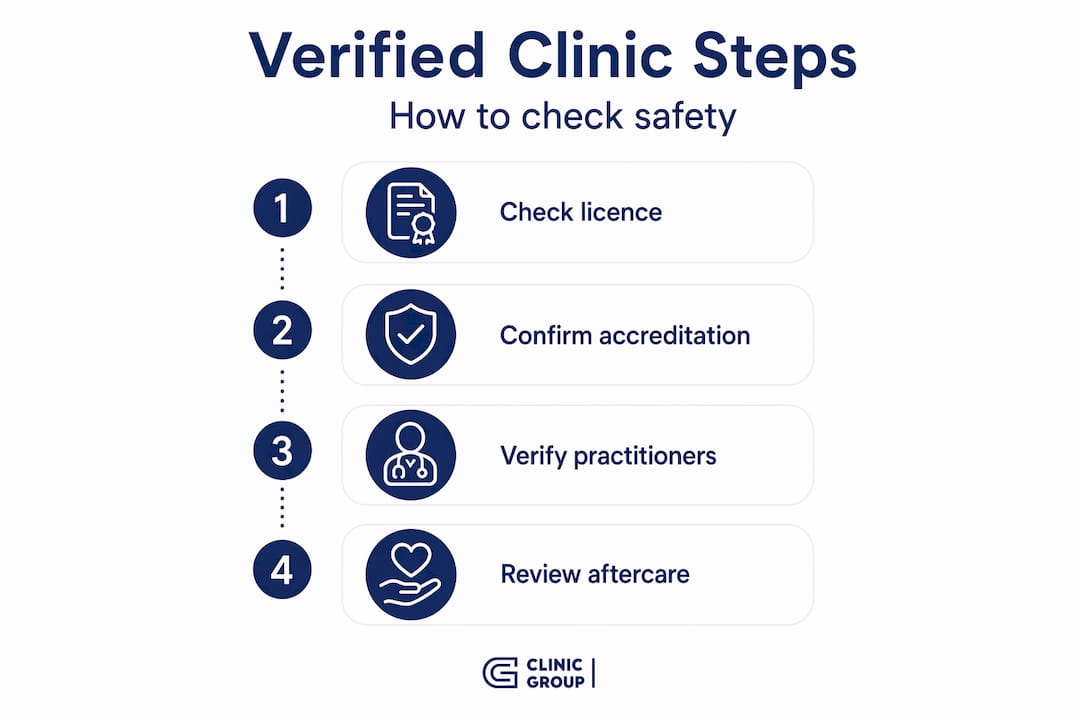
- Search official health ministry portals. Most European countries publish searchable registers of licensed medical facilities. Look for the clinic’s legal name and confirm its licence is current and valid for the specific treatments it offers.
- Verify the medical director and key practitioners. Use the national medical board or specialist registry of the country concerned. Confirm that named surgeons or dentists hold current licences in good standing.
- Cross-reference international accreditations. Both JCI and TEMOS publish online directories of their accredited facilities. If a clinic claims to be accredited, you can confirm it in under two minutes.
- Request key documentation proactively. Ask for informed consent forms, the clinic’s emergency and complication management protocol, and a formal itemised quote on official letterhead before any payment is made.
- Use a structured comparison when assessing multiple clinics. A simple checklist applied consistently to each clinic helps you compare objectively rather than being swayed by website design or testimonial videos.
As national health licences and international accreditation listings confirm, official data sources are the most reliable way to confirm a clinic’s legitimacy. No amount of positive press or polished branding substitutes for a current, searchable licence.
| Verification step | Where to check | Time required |
|---|---|---|
| Legal registration and licence | National health ministry portal | 5 to 10 minutes |
| Practitioner credentials | National medical council or board | 5 to 15 minutes |
| International accreditation | JCI or TEMOS official directory | 2 to 5 minutes |
| Aftercare and emergency protocols | Direct request to clinic | 1 to 2 business days |
| Formal quote and consent documents | Direct request to clinic | 1 to 2 business days |
Our clinic accreditation guide includes additional details on what each verification step reveals and how to interpret what you find.
A patient-first view on clinic verification in medical tourism
There is something important that most verification checklists miss. Verification is not purely about confirming a licence number or spotting an accreditation logo. It is about what happens when something goes wrong.
Complications are rare in well-managed clinics, but they do occur. The difference between a genuinely verified clinic and one that simply presents well online becomes clearest in those moments. Does the clinic have a named complication management protocol? Is there a written plan that tells you, the patient, exactly who to contact, in what timeframe, and through what channel, if you experience a problem at home after returning from treatment abroad? Can they tell you the name of the surgeon who will handle a follow-up if needed?
In our experience working across European and Middle Eastern markets, the clinics that handle complications with transparency and speed are almost always the same clinics that scored well on formal verification criteria before anything went wrong. That is not coincidence. Genuine institutional commitment to patient safety shows up consistently, in documentation, in communication, and in aftercare.
Patients often focus heavily on outcomes and before-and-after photographs when researching clinics. These are useful, but they only tell you what the clinic wants you to see. The more revealing question is: how does this clinic communicate when things are difficult? Ask a prospective clinic a challenging question about complications or aftercare. The quality and transparency of the response will tell you more than any badge or testimonial.
Understanding the importance of aftercare services for medical tourists is central to making a truly informed choice. A clinic that takes verified, documented aftercare seriously is one that takes the full scope of patient welfare seriously.
How Clinic Group helps you connect with verified clinics abroad
Clinic Group was built specifically to address the gap between marketing claims and genuine clinical verification. Every clinic within our network is assessed against legal licensing requirements and international accreditation standards before being listed. We prioritise facilities where practitioners are board-certified, where patient care protocols are clearly documented, and where aftercare is structured rather than an afterthought.
When you use Clinic Group, you benefit from personalised clinic matching based on your specific treatment needs, support with travel and accommodation planning through our partner hotel arrangements, and continuous communication throughout your journey. We provide transparent, itemised pricing so there are no surprises when you arrive. Our platform allows you to explore the full range of treatments we offer, from cosmetic surgery and dental care to hair transplants and regenerative therapies, all within our network of verified clinics. Visit the Clinic Group homepage to start comparing clinics and connect with a patient coordinator who can guide you from your first enquiry through to recovery.
Frequently asked questions
What is the difference between a ‘verified’ clinic and an accredited clinic?
A verified clinic may only have basic business checks confirmed, while an accredited clinic has undergone formal clinical and safety audits conducted by recognised international bodies such as JCI or TEMOS. Accreditation provides a far stronger guarantee of safety and quality.
How can I check if a doctor’s qualifications are authentic?
Ask the clinic for confirmation that primary source verification has been completed, meaning the doctor’s licences and certifications have been directly verified with the issuing medical board or university, not simply self-reported.
Are online reviews reliable indicators of clinic safety?
Online reviews reflect service quality and patient satisfaction, but Google reviews do not prove clinical competence or adherence to safety protocols. Official credentials and accreditations remain the most reliable indicators of clinical safety.
What practical steps can I take to verify a clinic abroad?
Check the clinic and its practitioners on official government health portals, confirm any international accreditations through JCI or TEMOS directories, and request formal documentation including consent forms and aftercare protocols. National licences and accreditation listings provide the most reliable confirmation of a clinic’s legitimacy.