TL;DR:
- Proper preparation and verification of clinic credentials are essential before booking dental treatment abroad.
- Dental procedures, such as implants, often require multiple trips spaced months apart, needing careful planning.
- Remote consultations and clear communication protocols significantly improve patient confidence and post-treatment support.
Many Europeans are sitting on genuinely affordable dental care options but never take the first step because the process of scheduling a consultation abroad feels confusing or even risky. Imagine having a treatment plan ready, knowing costs could be a fraction of what you’d pay locally, but still hesitating because you’re unsure how to begin. This guide removes that uncertainty entirely. You’ll learn exactly what to prepare, how to book, what questions to ask, and how to verify that a clinic is truly safe and reliable before you ever get on a plane.
Table of Contents
- What you need to know before booking a consultation
- Step-by-step: How to schedule your dental consultation
- How to verify clinic credentials and quality standards
- Common mistakes and how to avoid them
- Our perspective: What most guides miss about dental consultations abroad
- Connect with reliable clinics for your consultation
- Frequently asked questions
Key Takeaways
| Point | Details |
|---|---|
| Prepare documents early | Having all your paperwork and records ready before contacting clinics speeds up the process. |
| Check accreditations | Always confirm the clinic’s quality credentials such as JCI, ISO, or EU regulations compliance. |
| Plan for multiple visits | Certain procedures, especially implants, require more than one trip to the clinic. |
| Remote support is key | Choose clinics offering remote consultations or aftercare to handle complications with minimal travel. |
| Avoid common pitfalls | Double-check travel, insurance, and communication details to prevent avoidable delays or stress. |
What you need to know before booking a consultation
Having introduced the process, let’s start with what you need before reaching out to a foreign dental provider. Preparation is not just helpful here. It is essential. Walking into the process without the right information or documentation can cause delays, miscommunication, or worse, wasted travel costs.
Personal and medical information you should prepare:
- Full dental and medical history, including any ongoing medications or allergies
- Recent dental X-rays or CBCT scans (cone beam computed tomography, which maps the jaw structure in 3D) if you have them
- A written summary of your current dental concerns or treatment goals
- Photographs of your teeth and gums taken in good lighting, which many clinics request before an initial remote consultation
- Your passport or national identity document for registration purposes
- Travel insurance details, particularly any policy covering medical tourism
Understanding timelines is equally important. For treatments like dental implants, the process typically involves at least two separate trips. As confirmed by dental tourism data, the first stage of implant treatment requires around 3 to 5 days, while the second stage takes place 3 to 6 months later. This is not a single visit procedure, and many patients are surprised when they discover this. Planning your calendar accordingly from the outset will save you significant stress later on.
Clinic accreditation is another factor to get right before you book. Look specifically for clinics holding JCI (Joint Commission International) or ISO certification, or those demonstrating compliance with EU dental regulations. These are not bureaucratic formalities. They signal that a clinic operates to internationally recognised standards of sterilisation, patient safety, and clinical quality.
| Certification | What it signals |
|---|---|
| JCI (Joint Commission International) | Global hospital and clinic safety standard |
| ISO certification | Quality management systems in practice |
| EU regulatory compliance | Adherence to European healthcare standards |
Remote consultations have become a standard first step at many leading clinics. A video call with a specialist, combined with photos and scans you have submitted in advance, allows the clinic to assess your situation accurately before you commit to travel. This also gives you an opportunity to gauge their communication quality, which is a reliable indicator of how they will handle aftercare later.
“Edge cases are worth preparing for: multi-trip implant treatment, complications handled remotely via photos or video, and verified clinic accreditations are all factors that should be confirmed before you commit to a provider.” Dental Tourism in Budapest
Pro Tip: Before submitting documents to any clinic, explore a trusted clinics directory to compare verified providers side by side. This makes it far easier to shortlist clinics that are already confirmed as safe before you invest time in detailed correspondence.
You can also review broader guidance on safe dental treatments abroad to understand what quality care looks like in practice across different countries.
Step-by-step: How to schedule your dental consultation
With your documents together and a clear sense of what to look for, you are ready to move on to scheduling your appointment. The process is more straightforward than most people expect, particularly if you follow a structured approach from the very beginning.

Step 1: Choose your clinic and gather contact details Start with a shortlist of two or three clinics. Check whether they offer an English-speaking patient coordinator, since this will simplify every stage of communication.
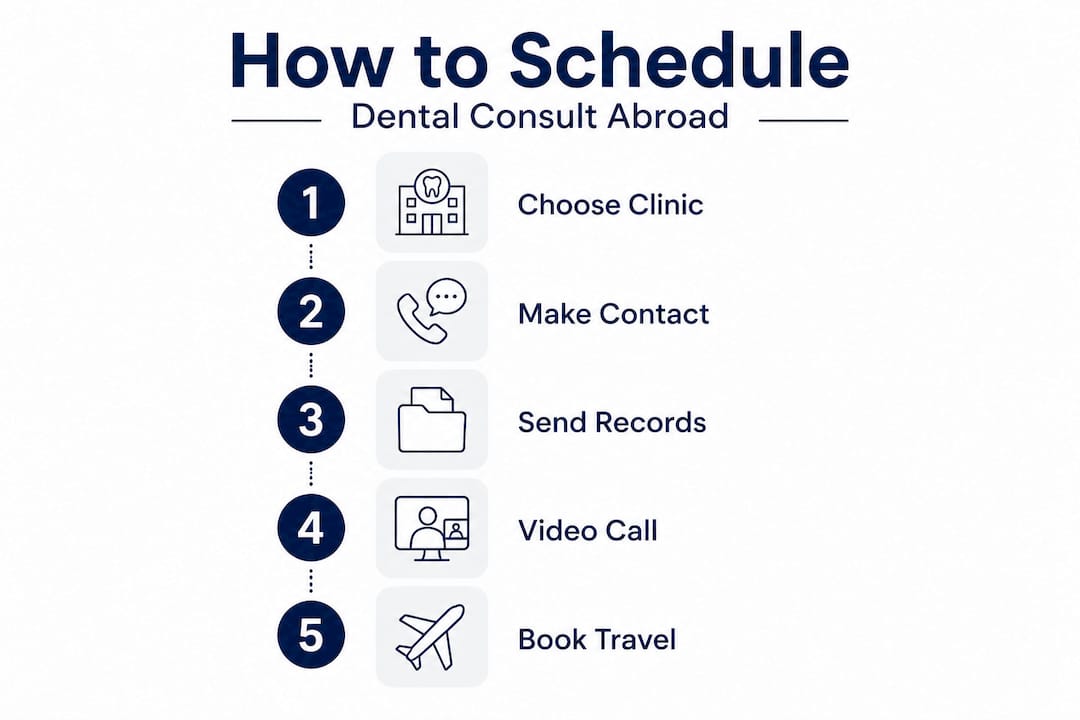
Step 2: Make initial contact Most reputable clinics accept enquiries by email, dedicated contact form, WhatsApp, or telephone. State your treatment interest clearly and mention that you are travelling from abroad. This signals to the clinic that you will need additional coordination support.
Step 3: Submit your documents Send your dental records, recent X-rays, and photos as requested. Clinics will typically respond within 24 to 72 hours with a preliminary assessment and a proposed treatment plan. Some will request further images or scans at this stage.
Step 4: Attend a remote consultation Most clinics now offer a video consultation as standard practice before any in-person visit. This is your opportunity to meet your specialist, discuss your case, ask about costs, and clarify what the in-person visit will involve.
Step 5: Confirm your in-person appointment and travel dates Once you are satisfied with the remote consultation, confirm your preferred dates. For complex treatments like implants, discuss the multi-stage process explicitly: stage one lasts roughly 3 to 5 days, with the second stage scheduled 3 to 6 months later.
Step 6: Arrange travel and accommodation Many clinics can assist with accommodation recommendations near the practice. Some work with partner hotels that offer patient rates. Confirm these details before booking independently.
| Consultation type | Advantages | Considerations |
|---|---|---|
| Remote (video call) | No travel cost, quick initial assessment | Cannot replace full physical examination |
| In-person | Full clinical evaluation, immediate trust building | Requires travel commitment upfront |
Pro Tip: When exploring your range of treatments during the research phase, take note of which procedures require one visit versus multiple. This will help you budget for travel and accommodation accurately from the start.
Understanding how to structure your communication with overseas clinics also helps. Guidance on navigating consultations safely covers key questions to ask and red flags to watch for, making the whole process feel much less uncertain.
How to verify clinic credentials and quality standards
After making initial contact, verifying clinic legitimacy and standards is vital before confirming your consultation. This is a step many first-time dental tourists skip, often because they feel reassured by a professional-looking website or a persuasive first email. A polished web presence is not the same as proven clinical quality.
What to check and where to find it:
- JCI certification: Look for the JCI logo on the clinic’s website and verify it on the official JCI website by searching the clinic name directly
- ISO certification: Ask the clinic to share documentation if it is not publicly listed
- EU regulatory compliance: For clinics in EU member states, request information on how they align with relevant European standards for sterilisation, waste management, and clinical protocols
- Patient reviews: Look beyond Google. Seek reviews on independent medical tourism platforms, and prioritise recent reviews over older ones. A clinic that was excellent three years ago may have changed significantly
- Before-and-after photos: Request case examples relevant to your own procedure, and ask whether these patients can be contacted as references
As industry guidance confirms, verifying clinic accreditations covering JCI, ISO, and EU regulations should happen before you select any provider, not after. Many patients leave this step until they are almost ready to book, by which point they have already invested emotional energy in a particular clinic.
“Accreditation is not a guarantee of perfection, but it is strong evidence that a clinic takes its obligations to patient safety seriously. Clinics that refuse to share accreditation documents or provide vague answers about their credentials should be removed from your shortlist without hesitation.”
Remote complication handling is another quality indicator that many guides overlook entirely. Ask the clinic directly: if you experience a problem after returning home, what is the protocol? Reliable clinics will describe a clear process involving remote assessment via photos or video, and will offer guarantees for corrective work if the original treatment is found to be at fault. Make sure any such guarantee is written into your treatment agreement before you sign anything.
Information on aftercare services for medical tourists is worth reviewing at this stage, as it outlines what good post-treatment support should look like. You should also revisit guidance on safe quality dental care to cross-reference the standards you find at any given clinic against what is considered best practice.
Pro Tip: When using a platform like accredited providers directories, filter specifically for clinics with verified credentials rather than browsing the entire list. This immediately narrows your shortlist to providers that have already passed a quality baseline check.
Common mistakes and how to avoid them
Even with the best preparation, avoidable mistakes can happen. Understanding these in advance helps you sidestep them entirely, saving both money and unnecessary anxiety.
1. Failing to confirm recovery timelines before booking travel Many patients book a short trip without understanding that some procedures require several days of rest before flying. This is particularly relevant for surgical treatments, including implants, bone grafting, and multiple extractions. Always ask your clinic for an explicit recovery-to-travel timeline before you finalise any flights.
2. Overlooking the need for repeat visits As established earlier, dental implants are a two-stage process. Skipping or underplanning for the second visit can result in an incomplete treatment that costs more to resolve at home. Build both trips into your plan from day one.
3. Not securing aftercare or guarantee details in writing A verbal assurance is not a guarantee. Ensure that any promises about post-treatment support, corrective work, or remote follow-up are written clearly into your treatment contract. As dental tourism research shows, complications can often be handled remotely using photos or videos, but only if your chosen clinic formally offers this service with documented protocols.
4. Miscommunication due to language differences Even with English-speaking staff, clinical terminology can lead to misunderstandings. Prepare a written list of questions before your remote consultation, and ask for your treatment plan to be provided in writing in English. Do not proceed based on verbal summaries alone.
5. Leaving documentation to the last minute Clinics need time to review your records and prepare a proper assessment. Submitting your documents the week before travel is not sufficient for complex cases. Aim to submit everything at least three to four weeks before your appointment.
6. Not asking about travel insurance requirements Standard travel policies often exclude medical tourism or dental procedures planned in advance. Specialist policies exist for this purpose and can cover cancellations, emergency extensions, or unexpected complications. Verify your cover before you travel.
Pro Tip: Review consultation safety advice to build a personalised checklist of questions before your first contact with any clinic. Having a structured list ready prevents the kind of gaps that lead to unpleasant surprises later.
Our perspective: What most guides miss about dental consultations abroad
Most guides on dental tourism focus on the logistics. They walk you through steps, mention accreditation checks, and remind you to book early. This is all valid and useful. But the thing these guides consistently underestimate is the emotional dimension of this process, and how significantly it shapes whether a patient has a positive outcome.
Confidence matters. Patients who feel genuinely informed and who trust their chosen clinic tend to communicate better, follow aftercare instructions more carefully, and report higher satisfaction overall. This is not simply about mindset. It is about how a well-chosen clinic treats you throughout the process, from first contact to final follow-up.
The role of secondary communication, by which we mean photos, videos, and remote consultations, is genuinely transformative for international patients. We have seen countless cases where a patient experienced minor post-treatment swelling or sensitivity and panicked, assuming something had gone wrong. When their clinic had a robust remote communication protocol in place, this anxiety resolved quickly. A photo shared with the treating dentist, a video reply, a clear explanation. These interactions, which cost very little to provide, make an enormous difference to patient wellbeing. Understanding real aftercare concerns as they apply to medical tourists clarifies why selecting a clinic with proper remote follow-up is not optional. It is central to the quality of your care.
The real insider knowledge is this: do not judge a clinic primarily on its before-and-after photos or its website design. Judge it on how it communicates when things are not perfectly straightforward. Ask them what happens if your implant site needs reassessment. Ask how they handle patients who have returned home. The clinics that answer these questions with specific, confident, documented processes are the ones worth trusting.
Connect with reliable clinics for your consultation
If you are ready to move from information to action, Clinic Group makes the entire process simpler and far more reassuring. The platform connects patients across Europe with verified, quality-assured dental providers, allowing you to compare clinics, review credentials, and book directly without navigating multiple separate websites or making cold enquiries. Browsing the full catalogue of treatment options allows you to identify exactly the procedure you need and find clinics that specialise in it. When you are ready to take the next step, you can book a consultation directly through the platform, with Clinic Group’s patient support team available to guide you through the process from start to finish. Affordable, reliable dental care abroad is closer than it seems.
Frequently asked questions
How far in advance should I schedule a dental consultation abroad?
Plan at least four to six weeks ahead to secure your preferred dates and allow enough time to gather and submit all required documents before your appointment.
Do I need to visit the clinic more than once for dental implants?
Yes, implants typically require an initial visit of 3 to 5 days followed by a return visit 3 to 6 months later to complete the second stage of the procedure.
How do I check if a foreign dental clinic is properly accredited?
Look for JCI, ISO, and EU certification on the clinic’s website, and verify these credentials directly through the relevant accreditation body’s official records.
What happens if I have complications after treatment abroad?
Many clinics manage minor issues remotely via photos or video calls, and reputable providers will include written guarantees for corrective work in your treatment agreement.
Do I need special travel insurance for dental care abroad?
Standard travel policies often exclude pre-planned dental procedures, so a specialist medical tourism insurance policy is strongly recommended to cover cancellations, emergencies, or any need to extend your stay.