TL;DR:
- Understanding dental terminology helps patients actively participate in their oral health decisions and ask informed questions. Knowing the differences between terms like plaque and tartar or fillings and crowns can influence treatment choices and maintenance routines. Familiarity with standard codes and common conditions enhances communication with dental professionals and insurance processes.
Dental treatment terminology is the specialised vocabulary dental professionals use to describe oral health conditions, procedures, and treatments. Knowing this language matters more than most patients realise. When your dentist mentions “periodontal scaling,” “composite restoration,” or “endodontic therapy,” understanding those phrases helps you ask better questions, compare your options, and make confident decisions about your care. Resources such as Family 1st Dental, Brio Smiles, and MetLife publish patient-facing glossaries precisely because dental jargon creates unnecessary barriers between patients and their treatment plans.
What are the main categories of dental treatment terminology?
Dental procedures are categorised into diagnostic, preventive, restorative, endodontic, and periodontic groups, each serving a distinct clinical role. Knowing which category a procedure falls into tells you a great deal about its purpose before your dentist explains it in full.

Preventive terminology
Preventive dentistry focuses on stopping problems before they start. The terms you will encounter most often include:
- Dental prophylaxis — the clinical term for a routine professional cleaning, typically recommended twice a year to maintain oral health and prevent disease progression.
- Fluoride treatment — a topical application of fluoride to strengthen enamel and reduce cavity risk.
- Dental sealant — a thin protective coating applied to the chewing surfaces of back teeth to seal out bacteria.
- Oral hygiene instruction — formal guidance from a dental hygienist on brushing technique, flossing, and interdental cleaning.
Restorative terminology
Restorative procedures repair or replace damaged tooth structure. Key terms include:
- Composite filling — a tooth-coloured resin used to repair small areas of decay.
- Dental crown — a cap that covers the entire visible portion of a damaged tooth.
- Dental bridge — a fixed prosthetic that spans a gap left by one or more missing teeth, anchored to adjacent natural teeth.
- Denture — a removable appliance replacing multiple missing teeth.
Endodontic and periodontic terminology
Endodontics concerns the inner tooth. A root canal (formally, endodontic therapy) removes infected pulp tissue from inside the tooth root. Periodontics addresses the supporting structures around teeth. Gingivitis describes early gum inflammation, while periodontitis refers to advanced gum disease affecting the bone. Scaling and root planing is the deep-cleaning procedure used to treat periodontitis by removing tartar and bacteria from below the gumline.
Plaque vs. tartar, fillings vs. crowns: what is the difference?
Several pairs of dental terms cause consistent confusion for patients. Clearing up these distinctions before your appointment saves time and reduces anxiety.
| Term A | Term B | Key difference |
|---|---|---|
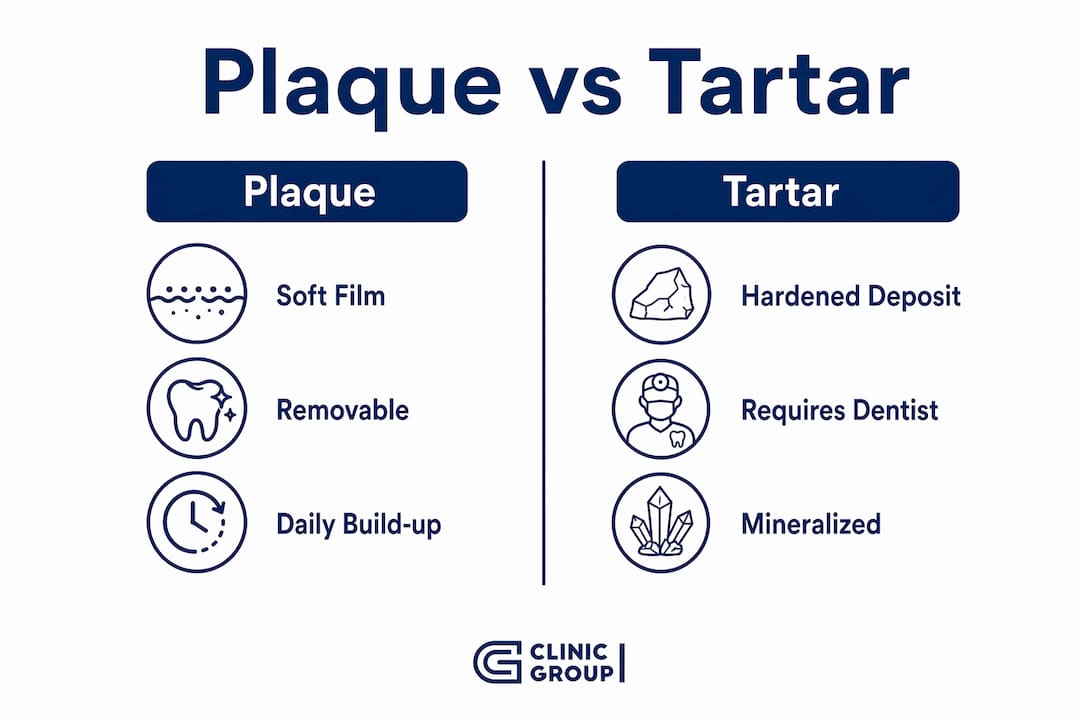
| Plaque | Tartar | Plaque is a soft bacterial film removed by brushing; tartar is hardened plaque removable only by a dental professional. |
| Filling | Crown | A filling repairs a small decayed area; a crown covers the entire tooth for protection after extensive damage. |
| Gingivitis | Periodontitis | Gingivitis is reversible gum inflammation; periodontitis is advanced disease involving bone loss. |
| Dental implant | Denture | An implant is a titanium post anchored in the jawbone; a denture is a removable replacement appliance. |
| Abscess | Cavity | A cavity is a hole caused by decay; an abscess is a pocket of infection, often at the tooth root. |
The plaque and tartar distinction carries a practical consequence. Plaque builds up daily and responds to brushing and flossing. Tartar, once formed, is mineralised and bonded to the tooth surface. No amount of brushing removes it. Only a hygienist using specialised instruments can. This is precisely why regular professional cleanings matter even when your home routine is thorough.
The filling versus crown distinction affects both cost and procedure time. Crowns require more tooth preparation, laboratory fabrication, and usually two appointments. They are the standard recommendation after a root canal because the treated tooth becomes more brittle and needs full coverage for long-term protection.
Pro Tip: Before any appointment, write down the terms your dentist used at the last visit that you did not fully understand. Bring that list and ask for plain-language explanations. Dental professionals actively encourage these questions.
How do standardised codes and terminology affect your treatment plan?
Dental procedures are organised using standardised codes, most notably the Current Dental Terminology (CDT) system. CDT codes help organise dental terminology for treatment planning and billing, linking the clinical name of a procedure to a specific numeric code used by insurers and dental practices alike. That link matters directly to you as a patient.
When you receive a treatment plan or an insurance explanation of benefits, the procedure names and codes should match. If your dentist documents “D2740” (a porcelain crown) but your insurer processes it differently, knowing the terminology lets you identify the discrepancy and query it. Patients who understand this connection are better placed to verify treatment necessity and challenge unexpected charges.
Key points to understand about codes and terminology:
- Each CDT code corresponds to a specific procedure name, so the phrase on your treatment plan and the code on your bill should align.
- Insurers use these codes to determine coverage levels, waiting periods, and annual maximums.
- Internationally, equivalent coding systems exist. Clinics in Albania and Dubai that work with European patients often provide bilingual documentation to support insurance claims back home.
- Asking your dental team to explain each code on your plan before treatment begins is a reasonable and encouraged request.
Understanding dental pricing terminology alongside procedure codes gives you a complete picture of what you are agreeing to, both clinically and financially.
What common dental terms should every patient know?
The following terms cover the procedures and conditions most patients encounter across a lifetime of dental care. Knowing them builds the foundation of your dental vocabulary.
Conditions and diagnostics
- Caries — the clinical term for tooth decay, caused by acid-producing bacteria feeding on sugars.
- Abscess — a bacterial infection forming a pocket of pus, typically at the root tip or in the gum.
- Malocclusion — misalignment of the upper and lower teeth when biting.
- Bruxism — involuntary grinding or clenching of teeth, often during sleep.
- CBCT scan — Cone Beam Computed Tomography, a three-dimensional X-ray used to plan implants and assess bone structure.
Preventive and hygiene procedures
- Scaling and polishing — the two-stage professional cleaning process: scaling removes tartar, polishing smooths the tooth surface.
- Periodontal charting — a systematic measurement of the depth of gum pockets around each tooth to assess gum health.
Restorative and surgical procedures
- Endodontic therapy (root canal) — removal of infected pulp from inside the tooth, followed by sealing of the root canals.
- Osseointegration — the biological process by which a dental implant fuses with the surrounding jawbone. This process typically takes three to six months and determines implant stability.
- Apicoectomy — a minor surgical procedure removing the tip of a tooth root when a root canal alone cannot resolve infection.
- Bone grafting — the addition of bone material to the jaw to support implant placement where natural bone has been lost.
Poor dental hygiene contributes to systemic inflammatory diseases including heart disease and diabetes. That finding reframes routine preventive care as a whole-body health decision, not merely a cosmetic one. Understanding terms like “periodontal maintenance” and “prophylaxis” helps you see why your dentist recommends them with such regularity.
Nearly 50% of American adults suffer from some form of periodontal disease. The figure reflects how commonly gum-related terminology appears in treatment plans, and why understanding words like “scaling,” “root planing,” and “periodontal pocket” is practically useful for a large proportion of patients.
For patients considering treatment abroad, dental implants terminology such as osseointegration, abutment, and implant crown becomes particularly relevant when comparing clinic proposals across different countries.
Key takeaways
Understanding dental treatment terminology is the single most effective way to participate actively in your own oral healthcare decisions.
| Point | Details |
|---|---|
| Terminology is categorised | Dental terms fall into preventive, restorative, endodontic, and periodontic groups, each with distinct clinical purposes. |
| Confused terms carry real consequences | Misunderstanding plaque versus tartar, or fillings versus crowns, affects how you maintain your teeth and what treatment you accept. |
| CDT codes connect language to billing | Knowing procedure names and their codes helps you verify treatment plans and query insurance statements accurately. |
| Oral health links to systemic health | Periodontal disease is linked to heart disease and diabetes, making preventive terminology directly relevant to overall wellbeing. |
| Questions are always appropriate | Dental professionals actively encourage patients to ask for plain-language explanations of any term used during a consultation. |
Why dental jargon anxiety is a solvable problem
Patients often arrive at consultations feeling at a disadvantage. The clinical language moves quickly, the environment feels unfamiliar, and asking for clarification can feel awkward. That experience is understandable, but it is also unnecessary.
Familiarising yourself with key dental terms enables active participation in treatment decisions and makes informed questions possible. In my experience working with patients across multiple countries, the ones who feel most confident are not those with the most dental knowledge. They are the ones who arrived knowing five or six terms well enough to ask precise questions.
Clear understanding of dental terms improves patient confidence and alleviates anxiety related to clinical language. That is not a soft benefit. Patients who understand their treatment plans are more likely to follow through with recommended care, attend follow-up appointments, and report higher satisfaction with outcomes.
The most practical step you can take is to review a reliable oral care terminology guide before any significant dental appointment. Even learning the terms relevant to your specific procedure changes the dynamic of the consultation entirely. You move from passive recipient to informed participant. That shift matters for the quality of care you receive and for your own peace of mind.
— Clinicgroup
How Clinicgroup helps you understand your dental treatment options
Clinicgroup connects patients with verified dental clinics in Albania and Dubai, where board-certified specialists provide European-standard care at transparent prices. Every patient journey includes clinic matching, clear documentation of procedures and costs, travel logistics support, and structured aftercare. When you receive a treatment proposal through Clinicgroup, the terminology in that plan is explained clearly so you understand exactly what each procedure involves before you commit. Explore the full range of dental treatments available through Clinicgroup, from implants and crowns to full smile restorations, and request a consultation with a verified specialist who will answer your questions in plain language.
FAQ
What is dental treatment terminology?
Dental treatment terminology is the specialised vocabulary used by dental professionals to describe oral health conditions, procedures, and treatments. It covers everything from diagnostic terms like “caries” to surgical terms like “osseointegration.”
What is the difference between plaque and tartar?
Plaque is a soft bacterial film that daily brushing removes. Tartar is hardened, mineralised plaque that only a dental professional can remove using specialised instruments during a professional cleaning.
What does CDT stand for in dentistry?
CDT stands for Current Dental Terminology, a standardised coding system that assigns a specific numeric code to each dental procedure. These codes appear on treatment plans and insurance documents to identify and categorise procedures for billing purposes.
What is the difference between a dental implant and a denture?
A dental implant is a titanium post surgically placed into the jawbone, onto which an artificial crown is fixed permanently. A denture is a removable appliance that replaces multiple missing teeth without surgical placement.
How often should I have a professional dental cleaning?
Professional dental cleanings are recommended twice a year for most patients to maintain oral health and prevent the progression of gum disease and decay. Patients with active periodontal disease may require more frequent visits.