TL;DR:
- Medical tourism involves traveling abroad for planned medical procedures to save costs and access unavailable treatments. Choosing accredited clinics, verifying surgeon credentials, and arranging comprehensive aftercare are essential safety measures. Destinations like Albania and Dubai offer high-quality care with significant cost savings for European patients.
Medical tourism means travelling to another country specifically to receive medical treatment. It is not a new concept. In fact, medical tourism spans centuries, with modern growth driven by cost, faster access, and availability of specialist procedures that patients cannot access affordably at home. For UK and European patients, destinations like Albania and Dubai now offer high-quality, accredited care at a fraction of domestic prices. This guide explains exactly what medical tourism involves, what types of treatment are available, how to choose a clinic safely, and what a realistic patient journey looks like.
Table of Contents
- Key takeaways
- What is medical tourism and what types exist
- Risks and considerations in medical tourism
- Popular destinations and typical cost savings
- The patient journey from consultation to aftercare
- How to compare and choose the right clinic
- My perspective on navigating medical tourism safely
- Plan your medical tourism journey with Clinicgroup
- FAQ
Key takeaways
| Point | Details |
|---|---|
| Medical tourism is treatment-focused travel | Patients travel abroad specifically for medical care, not for leisure combined with surgery. |
| Verified clinics and accreditation matter | Choosing an accredited clinic with board-certified specialists is the single most important safety step. |
| Aftercare requires advance planning | Complications often appear weeks after returning home, so coordinating local follow-up care before you travel is critical. |
| Total cost goes beyond procedure price | Travel, accommodation, recovery, and potential complication management all affect your final expenditure. |
| Trusted platforms simplify the process | Platforms like Clinicgroup connect patients with verified clinics and handle logistics, so you focus on recovery. |
What is medical tourism and what types exist
Medical tourism is the practice of leaving your home country to receive planned medical, dental, surgical, or wellness treatment abroad. It differs from emergency care received whilst travelling. Patients who choose medical tourism do so deliberately, researching destinations and clinics in advance, booking appointments, and organising travel around a treatment schedule.
The main categories of medical tourism include:
- Dental treatment: Implants, crowns, veneers, and full-mouth restorations are among the most common procedures. The role of clinics in dental tourism is central, as accredited dental practices offer the equipment and expertise that make complex work safe and predictable.
- Cosmetic and plastic surgery: Rhinoplasty, breast augmentation, liposuction, and facelifts attract large numbers of patients from the UK and Europe.
- Hair transplants: FUE and DHI techniques performed by experienced surgeons abroad offer significant savings over domestic pricing.
- Anti-ageing and wellness: IV therapy, PRP treatments, longevity check-ups, and regenerative therapies are growing in demand.
- Non-surgical aesthetics: Botox, dermal fillers, microneedling, and chemical peels are frequently combined with other treatments during a single trip.
Patients choose medical tourism for several clear reasons. Cost savings top the list. Quicker appointment availability is another factor, particularly relevant for UK patients facing long NHS waiting times. Some procedures, such as certain regenerative therapies or advanced implant techniques, may simply be unavailable or unaffordable at home.
The role of clinics in medical tourism extends beyond performing procedures. Accredited facilities participate in ongoing quality improvement programmes, not just one-off certification. The accreditation process drives quality improvement at verified hospitals and clinics, making active accreditation a reliable indicator of consistent care standards.
Risks and considerations in medical tourism
Medical tourism carries real risks that deserve honest discussion. Understanding them does not mean avoiding treatment abroad. It means planning properly so you can manage them.
One of the most significant concerns is what happens after you return home. Complications appear an average of 30.9 days post-procedure, which is often weeks after a patient has left the destination country. Common issues include severe infections, wound dehiscence, and complications related to anaesthesia or implant materials.
A further complication is that local doctors may refuse to treat foreign surgery complications due to liability concerns. This is not a theoretical risk. It is a documented pattern that leaves some patients in a difficult position when their GP declines to manage a post-operative issue.
Key risks to consider before booking:
- Combined procedures: Patients average 2.34 procedures per trip, and combining multiple surgeries increases complication rates significantly.
- Travel stress on healing tissue: Long flights and changes in environment affect recovery, particularly in the days immediately following surgery.
- Continuity of care gaps: Without a clear plan for follow-up, patients can be left managing complications without adequate medical support.
- Unverified credentials: Clinic marketing does not always reflect actual surgeon qualifications. Patients should verify individual credentials directly.
Pro Tip: Before booking any procedure abroad, contact the relevant national medical board to verify your surgeon’s individual registration and qualifications. Do not rely solely on the clinic’s own promotional materials or facilitator claims.
The American College of Surgeons advises that continuity of care is as important as the procedure itself. Arranging pre-travel agreements with your local GP for postoperative management is strongly recommended.
Popular destinations and typical cost savings
Albania and Dubai are two of the most compelling destinations for European patients in 2026, each offering distinct advantages.
Albania sits within easy reach of the UK and much of Europe, with short flight times and a cost-of-living structure that makes high-quality procedures genuinely affordable. Dubai offers world-class private hospital infrastructure, English-speaking care teams, and regulatory standards aligned with international benchmarks. Both destinations host clinics that adhere to European standards of care.

When comparing total landed cost, the headline procedure price is only one part of the equation. Patients must factor in flights, accommodation, post-operative recovery stays, and the potential cost of managing complications after returning home.
| Destination | Popular treatments | Typical saving vs UK |
|---|---|---|
| Albania | Dental implants, veneers, hair transplants, plastic surgery | 50 to 70% |
| Dubai | Cosmetic surgery, aesthetics, wellness, anti-ageing | 30 to 50% |
| Turkey | Hair transplants, dental work | 60 to 80% |
| Mexico | Plastic surgery, bariatric procedures | 40 to 60% |
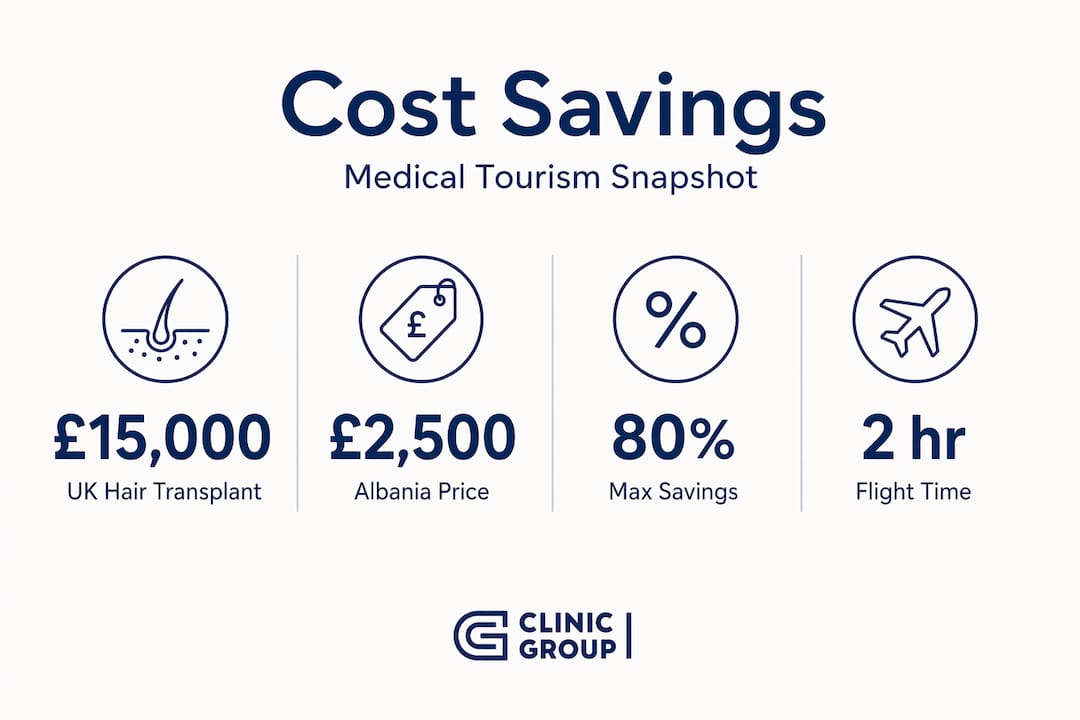
For reference, complex hair transplant procedures costing £15,000 or more in the UK can be completed for between £2,000 and £6,000 in certain destinations. Dental implants that cost upwards of £2,500 per tooth in the UK are frequently available abroad for under £600 per implant, including the crown.
Patients considering dental work abroad should also review guidance on verifying dental clinic credentials before committing to any provider, as standards vary considerably between facilities.
The patient journey from consultation to aftercare
Understanding the full sequence of a medical tourism experience removes a great deal of uncertainty. Here is what a well-managed patient journey looks like.
- Initial enquiry and consultation. The patient contacts a platform like Clinicgroup or reaches out directly to a clinic. A remote consultation is arranged, during which the patient’s medical history, goals, and suitability for treatment are assessed. Clinicgroup’s free consultation process helps patients prepare for these discussions and know what questions to ask.
- Clinic matching and treatment planning. Based on the patient’s needs and budget, a suitable verified clinic is identified. A detailed treatment plan is prepared, including procedure specifics, expected recovery duration, and cost breakdown.
- Travel and accommodation arrangements. Travel logistics, including flights and partner hotel stays close to the clinic, are co-ordinated. Patients receive a clear schedule covering arrival, pre-operative assessments, procedure dates, and departure.
- Treatment and in-clinic care. The procedure is carried out by a board-certified specialist at an accredited facility. Post-operative monitoring begins immediately, and patients receive written aftercare instructions before they leave.
- Return home and follow-up. This stage is where most complications surface. Understanding aftercare services for medical tourists and arranging local follow-up in advance is not optional. It is the step most often skipped and most often regretted.
Pro Tip: Ask your clinic to provide a written aftercare protocol that you can share with your GP before you travel. This gives your local doctor a clear picture of what was done and what to look for, making them far more willing to assist if something goes wrong.
Surgeons and care coordinators are advised to establish clear follow-up care plans and communicate expectations with patients travelling for surgery. Patients who treat this step seriously have measurably better outcomes.
How to compare and choose the right clinic
Choosing a clinic abroad is not simply a matter of finding the lowest price. The criteria you use to evaluate providers will directly affect your safety and the quality of your results.
When you compare medical tourism clinics, these are the factors that matter most:
- Accreditation status: Look for recognised accreditation such as JCI (Joint Commission International) or equivalent national standards. Verify that accreditation is current, not historical.
- Surgeon qualifications: The CDC recommends contacting the surgeon’s national medical board directly rather than relying on facilitator claims. Board certification in the relevant specialty is non-negotiable.
- Patient reviews: Look for verified, independent reviews rather than testimonials hosted on the clinic’s own website. Pay attention to reviews that mention aftercare and complication management, not just the procedure itself.
- Pricing transparency: Reputable clinics provide detailed, itemised cost breakdowns. If a price quote is vague or changes unexpectedly during negotiation, treat that as a warning sign.
- Communication quality: A clinic’s responsiveness before you book tells you a great deal about how it will communicate during and after treatment. Slow, evasive, or inconsistent responses are red flags.
| Feature to check | What to look for |
|---|---|
| Accreditation | Current JCI or equivalent certification |
| Surgeon credentials | Board-certified, verifiable with national medical board |
| Patient reviews | Independent and verified; mention of aftercare quality |
| Pricing | Itemised breakdown with no hidden fees |
| Aftercare support | Written post-operative protocol and follow-up plan |
| Communication | Prompt, clear, and consistent from first contact |
Using one of the best medical tourism platforms simplifies this process considerably. Clinicgroup pre-vets all partner clinics against defined accreditation and safety criteria, so patients are not starting from scratch with every enquiry.
My perspective on navigating medical tourism safely
I’ve worked with patients at different stages of their medical tourism decisions, and the pattern I see most often is this: people spend considerable time researching the procedure and almost no time researching the aftercare.
The honest reality is that the procedure itself is rarely where things go wrong. The risks accumulate in the weeks after a patient boards a flight home. Complications typically emerge around a month post-procedure, and patients who haven’t arranged local follow-up find themselves in a frustrating and sometimes dangerous position.
What I’ve learned from observing many patient journeys is that the patients who do best are those who treat medical tourism as a medical decision first and a travel opportunity second. They ask hard questions before booking. They share their treatment plan with their GP in advance. They build in extra recovery time rather than flying home the day after a procedure.
The appeal of significant cost savings is real and entirely valid. But the patients who achieve the best outcomes are those who spend as much time planning their recovery as they do comparing prices. If a clinic or platform cannot give you a clear, written aftercare plan, that tells you everything you need to know.
— Clinic
Plan your medical tourism journey with Clinicgroup
Clinicgroup connects patients from the UK, Italy, and across Europe with a verified network of accredited clinics in Albania and Dubai. Every clinic in the network is assessed against defined safety and quality standards, and every patient receives personalised support from initial enquiry through to aftercare coordination.
Whether you are exploring dental implants, hair transplants, cosmetic surgery, or wellness programmes, Clinicgroup handles clinic matching, travel logistics, and partner hotel arrangements so your focus remains on recovery. Pricing is transparent and itemised from the outset.
Visit Clinicgroup to request a free consultation, compare verified clinics, and receive a personalised treatment plan tailored to your needs and budget.
FAQ
What is medical tourism in simple terms?
Medical tourism is the practice of travelling to another country specifically to receive planned medical, dental, surgical, or wellness treatment. Patients choose it primarily for cost savings, faster access, and availability of treatments not accessible at home.
Is medical tourism safe?
Medical tourism can be safe when patients choose accredited clinics, verify individual surgeon credentials with the relevant national medical board, and arrange follow-up care before travelling. Risks increase significantly when aftercare is not planned in advance.
What types of treatment are most common in medical tourism?
The most common types include dental implants and veneers, hair transplants, cosmetic surgery such as rhinoplasty and breast augmentation, anti-ageing therapies, and non-surgical aesthetics such as Botox and fillers.
What is medical travel insurance and do I need it?
Medical travel insurance, sometimes called medical tourism insurance, covers costs arising from complications, unexpected hospital stays, or the need to extend your stay abroad for medical reasons. It is strongly advisable for anyone undergoing a surgical procedure abroad.
How do I choose between medical tourism destinations?
Compare destinations based on procedure availability, clinic accreditation standards, total cost including travel and accommodation, and the quality of aftercare support offered. Albania and Dubai are particularly well-regarded options for European patients seeking verified, high-quality care with significant cost savings.