TL;DR:
- Holistic healthcare treats the whole person by addressing physical, emotional, mental, spiritual, and social health dimensions. It combines evidence-based conventional treatments with complementary therapies through shared decision-making, improving outcomes and patient satisfaction. Long-term engagement and lifestyle changes are essential for effective whole-person care.
Holistic healthcare is defined as a whole-person approach to medicine that addresses physical, emotional, mental, spiritual, and social dimensions of health simultaneously, rather than treating symptoms in isolation. Unlike conventional acute care, which typically targets a single complaint, this model focuses on prevention and root causes. The term “integrative medicine” is the recognised clinical standard for this approach, and both terms appear throughout medical literature. Understanding what holistic healthcare means gives you a clearer picture of how modern medicine is shifting, and why more patients across Europe and the UK are actively seeking it out.
What are the main principles of holistic healthcare?
Holistic healthcare is built on five interconnected pillars: physical health, mental and emotional wellbeing, social connection, spiritual health, and environmental factors. No single pillar operates in isolation. A patient managing chronic back pain, for example, may also need support for the anxiety that pain creates, the social withdrawal it causes, and the sedentary lifestyle it reinforces.
The defining feature of integrative medicine is the combination of evidence-based conventional treatments with complementary therapies and lifestyle interventions. This is not a rejection of pharmaceuticals or surgery. It is a recognition that medication alone rarely addresses the full picture of a person’s health.
Shared decision-making sits at the centre of this model. Patients actively collaborate with their providers to build personalised care plans, rather than passively receiving instructions. That shift in dynamic changes the therapeutic relationship entirely, and research consistently links it to better adherence and outcomes.
Core approaches within integrative medicine include:
- Physical care: Nutrition, exercise, physiotherapy, and conventional medical treatment
- Mental and emotional health: Cognitive behavioural therapy, counselling, mindfulness, and stress management
- Behavioural change: Sleep hygiene, smoking cessation, and alcohol reduction programmes
- Spiritual wellbeing: Practices such as meditation, prayer, or spiritual integration that support a patient’s sense of meaning and purpose
- Social support: Community engagement, family involvement, and peer networks
Pro Tip: Many patients assume they must choose between conventional medicine and complementary therapies. The integrative model uses both together. Always tell your GP or specialist about any supplements, herbal remedies, or alternative treatments you are using, as interactions can occur.
What are the key benefits of holistic health?
The benefits of holistic health extend well beyond patient satisfaction, though that matters too. Integrative care models improve patient satisfaction and adherence, reduce polypharmacy, and strengthen therapeutic relationships compared to fragmented conventional care. Polypharmacy, the use of multiple medications simultaneously, is a significant risk for older patients, and reducing it has direct safety implications.

The economic case is equally strong. Adopting a whole-person care model can lead to a 4% decrease in hospital costs, with average savings of £898 per hospital admission compared to conventional care alone. That figure reflects fewer repeat admissions, better self-management, and earlier intervention before conditions escalate.
Beyond cost, the health outcomes are compelling:
- Improved chronic disease management: Conditions such as type 2 diabetes, hypertension, and fibromyalgia respond well to integrative approaches that combine medication with lifestyle change
- Enhanced resilience: Whole-person care builds a patient’s capacity to adapt to health challenges, rather than simply managing crises as they arise
- Disease prevention: By addressing lifestyle factors early, integrative medicine reduces the likelihood of conditions developing in the first place
- Reduced polypharmacy: Coordinated care plans identify unnecessary medications and replace them with targeted interventions
- Stronger patient-provider relationships: Longer, more collaborative consultations produce better communication and greater trust
For patients managing long-term conditions, the shift from reactive to preventive care is particularly significant. Conventional medicine excels at acute intervention. Integrative medicine fills the gap between appointments, keeping patients engaged in their own health between clinical encounters.
How does holistic healthcare work in practice?
Whole-person care is delivered through interdisciplinary teams rather than a single clinician. A typical care model might involve a GP, a nutritionist, a physiotherapist, a psychologist, and a specialist working from a shared care plan. Each professional addresses a different dimension of the patient’s health, but all communicate around a central treatment goal.
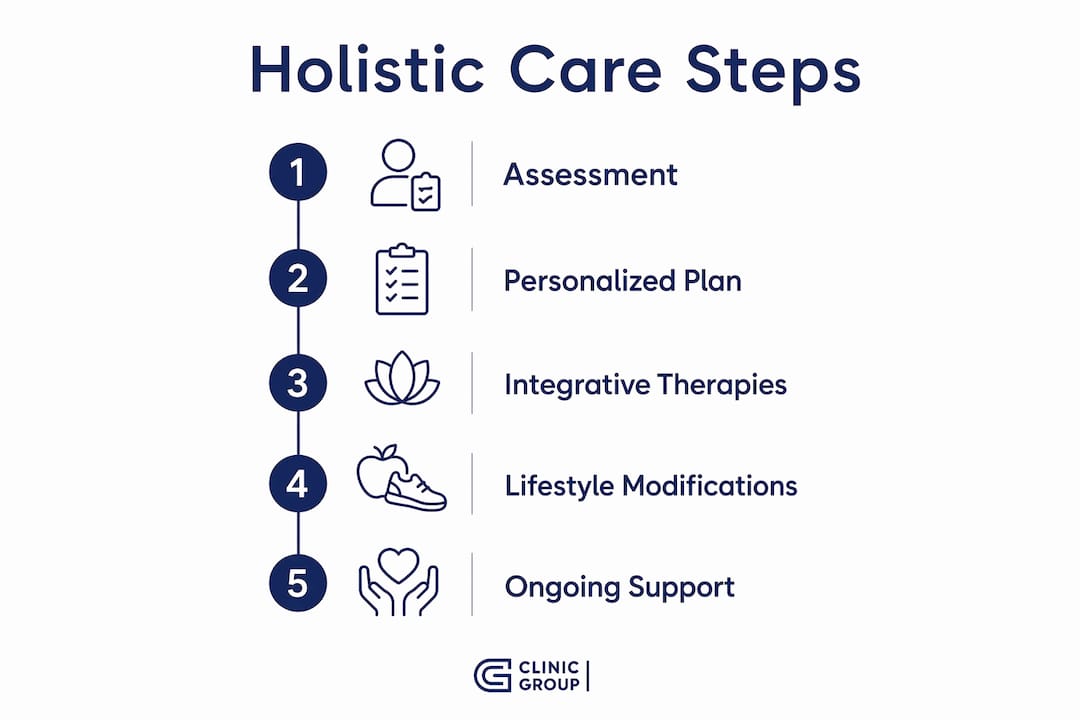
The practical process generally follows these steps:
- Comprehensive assessment: The initial consultation covers medical history, lifestyle, mental health, social circumstances, and the patient’s own health goals. This takes considerably longer than a standard GP appointment.
- Personalised care plan: The interdisciplinary team develops a plan that integrates conventional treatment with complementary therapies and lifestyle modifications.
- Active patient participation: The patient commits to specific lifestyle changes, including dietary adjustments, exercise, and stress management, as core parts of treatment rather than optional extras.
- Ongoing coordination: Patients manage communication between conventional and complementary providers, keeping each practitioner informed about all treatments and supplements being used.
- Regular review: The care plan is reviewed and adjusted based on progress, with outcome measures tracked over time.
Lifestyle modifications are not peripheral to this model. Diet, stress management, and regular physical activity are integral parts of the treatment plan. Clinicgroup’s wellness programme guide outlines how these elements are structured within a coordinated care framework.
Pro Tip: Prepare for a significant time commitment when entering an integrative care model. Initial assessments can take 60–90 minutes, and lifestyle changes require sustained effort over weeks and months. Patients who treat this as a long-term investment, rather than a quick fix, see the strongest results.
What are the common misconceptions about holistic healthcare?
The most persistent misconception is that whole-person care replaces conventional medicine. Current integrative models complement and optimise evidence-based conventional care rather than substituting for it. A patient receiving chemotherapy, for example, might also use acupuncture for nausea management and mindfulness for anxiety. Neither replaces the other.
A second misconception is that all holistic practitioners operate from the same framework. There is substantial conceptual variation in how integrative medicine is defined and implemented across providers, which makes direct comparisons difficult. This heterogeneity is a genuine challenge for the field, not a sign that the approach lacks rigour.
| Misconception | Fact |
|---|---|
| Holistic care replaces conventional medicine | It integrates with conventional treatment; neither replaces the other |
| It is unscientific or purely alternative | Evidence-based therapies form the foundation of integrative models |
| Any practitioner can deliver it | Qualified, board-certified specialists lead integrative care teams |
| Results are immediate | Whole-person care produces gradual, sustained improvements over time |
| It is only for the worried well | Integrative approaches are used for chronic disease, cancer support, and mental health |
Systemic barriers in mainstream healthcare, including lack of standardisation and limited long-term follow-up protocols, do limit broader adoption. That is a structural problem, not a reflection of the model’s effectiveness. Patients seeking integrative care benefit from choosing providers who use validated assessment tools and maintain clear communication across their care team.
Key takeaways
Whole-person care works because it addresses the root causes of ill health across physical, mental, social, spiritual, and environmental dimensions, rather than managing symptoms alone.
| Point | Details |
|---|---|
| Definition of holistic healthcare | Integrative medicine treats the whole person across five health dimensions simultaneously. |
| Core principle | Shared decision-making between patient and provider produces better adherence and outcomes. |
| Economic benefit | Whole-person care models reduce hospital costs by an average of £898 per admission. |
| Patient role | Patients coordinate between providers and commit to lifestyle changes as core treatment. |
| Key misconception | Integrative medicine complements conventional care; it does not replace it. |
Why whole-person care matters more than ever
Working with patients across Europe and the Middle East, I have seen a clear pattern. The patients who achieve the most sustained improvements are not those who receive the most aggressive treatment. They are the ones who understand their own health, engage actively with their care team, and make consistent lifestyle changes between clinical appointments.
The shift from passive recipient to active health partner is not easy. It requires time, self-awareness, and a willingness to address uncomfortable factors, including stress, diet, and social isolation. Most conventional healthcare systems are not designed to support that shift. Appointments are short, follow-up is inconsistent, and the focus remains on acute problems.
What integrative medicine offers is a structure for that longer conversation. The challenge is finding providers who genuinely deliver it, rather than simply labelling their services as “whole-person” without the interdisciplinary infrastructure to back it up. Verified clinics with board-certified specialists and coordinated care teams are not the norm. They are the exception. That is precisely why clinic selection matters so much.
Long-term resilience is the goal that conventional acute-focused models consistently overlook. Patients who build resilience through integrative care handle setbacks differently. They recover faster, manage chronic conditions more effectively, and report higher quality of life. That outcome is worth the investment.
— Clinic
Clinicgroup and access to verified integrative care
Clinicgroup connects patients from the UK, Italy, and across Europe with verified clinics and board-certified specialists in Albania and Dubai, all operating to European standards of care. For patients interested in wellness programmes, anti-ageing therapies, and integrative treatment approaches, the platform handles clinic matching, travel logistics, partner hotel arrangements, and aftercare coordination from a single point of contact. Pricing is transparent, and every clinic in the network undergoes quality assurance review. You can browse the full range of available treatments or search the verified clinic directory to find a provider whose approach aligns with your health goals.
FAQ
What is the definition of holistic healthcare?
Holistic healthcare, also called integrative medicine, is a whole-person approach that addresses physical, mental, emotional, spiritual, and social health simultaneously. It focuses on prevention and root-cause treatment rather than managing symptoms alone.
How does holistic healthcare differ from conventional medicine?
Conventional medicine typically targets a specific condition or symptom. Integrative medicine combines evidence-based conventional treatments with complementary therapies and lifestyle interventions to address the full context of a patient’s health.
What are the main benefits of holistic health?
Key benefits include improved patient satisfaction and adherence, reduced polypharmacy, stronger therapeutic relationships, better chronic disease management, and measurable reductions in hospital costs.
Is holistic healthcare evidence-based?
Yes. Integrative medicine uses evidence-based conventional treatments as its foundation and adds complementary therapies that have clinical support. The approach is not a rejection of science; it is an extension of it.
What should I expect when starting holistic healthcare?
Expect a comprehensive initial assessment covering your medical history, lifestyle, mental health, and personal health goals. You will be asked to commit to lifestyle changes, including diet, exercise, and stress management, as core parts of your treatment plan.