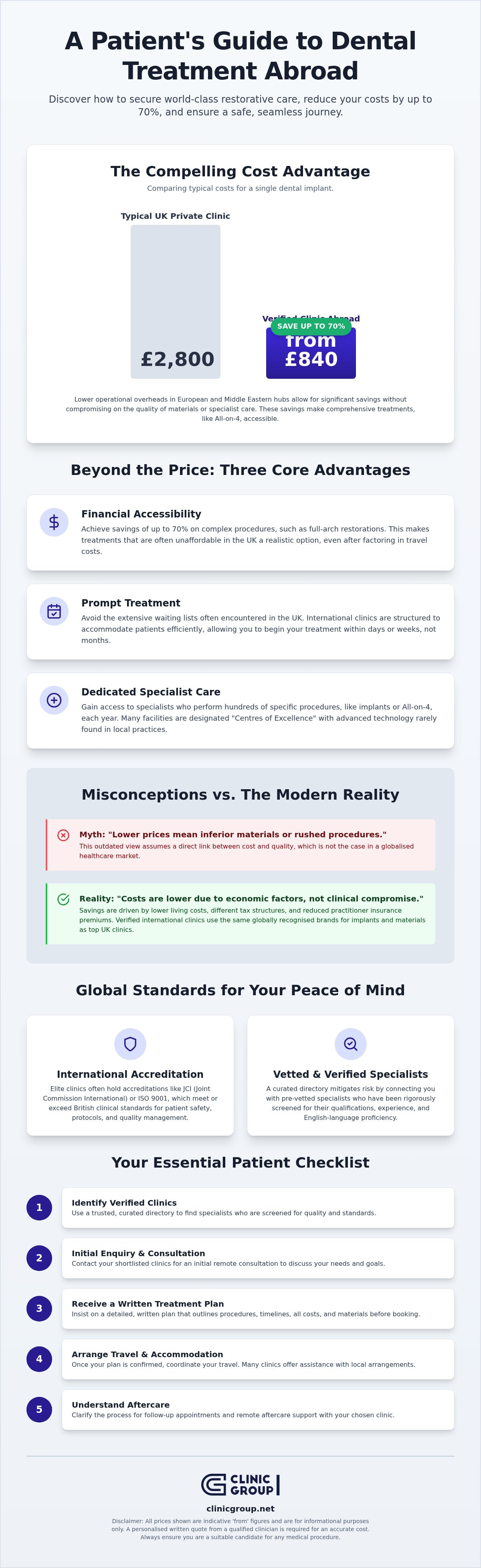
With private dental implant costs in the UK frequently reaching £2,800 per tooth, it's hardly surprising that the global dental tourism market is now valued at nearly £15 billion. You're likely searching for a way to restore your smile without the prohibitive price tag of local private clinics, yet the prospect of dental treatment abroad can feel daunting. It's common to feel a sense of unease regarding international medical standards or the practicalities of coordinating care in a different country.
We understand that your priority is a balance of safety, sophistication, and value. This guide provides the essential framework to help you secure world-class restorative care whilst reducing your total costs by as much as 75%. You'll discover how to identify verified specialists who match UK clinical standards and learn the precise steps to ensure a seamless journey from your initial enquiry to successful aftercare. We will explore the latest 2026 pricing for popular procedures like All-on-4 restorations and provide a curated strategy for selecting clinics that prioritise patient transparency above all else.
Key Takeaways
- Achieve savings of up to 70% on restorative procedures by understanding the primary drivers and efficiencies of the global dentistry market.
- Gain peace of mind by learning to identify international clinics with JCI and ISO 9001 accreditations that mirror or exceed British clinical standards.
- Secure a predictable outcome for your dental treatment abroad by following a structured checklist that prioritises detailed, written treatment plans before you travel.
- Explore why complex restorations, such as the All-on-4 technique, are particularly well-suited for international travel due to their high success rates and significant cost advantages.
- Simplify your search and mitigate risk by leveraging a curated directory of pre-vetted specialists who have been rigorously screened for quality and English-language proficiency.
Understanding Dental Treatment Abroad: The Rise of Global Dentistry
Choosing dental treatment abroad has evolved from a niche alternative into a strategic healthcare decision for thousands of UK patients annually. It represents a shift towards prioritising clinical excellence and financial logic over geographic proximity. This movement is part of a broader historical shift known as The Rise of Global Dentistry, where patients actively seek out jurisdictions that offer the best balance of expertise and value. What was once viewed with hesitation is now a sophisticated, multi-billion pound industry that adheres to rigorous international protocols.
For many, the transition starts with a search for relief from the escalating costs of private care in Britain. The emotional journey usually begins with skepticism, often fuelled by outdated stories of "budget" clinics. As patients research verified providers, that doubt transforms into empowerment. They realise they can access advanced technology and world-class specialists on their own terms, taking control of both their oral health and their financial wellbeing.
Why UK Patients are Choosing International Clinics
The primary catalyst for travelling is the stark contrast in pricing structures. Whilst UK private dental inflation continues to outpace wage growth, European dental hubs maintain competitive rates due to lower operational overheads. Patients often find they can save up to 70% on complex procedures, even after accounting for travel and accommodation costs. This financial accessibility allows for comprehensive treatments that might be unaffordable at home.
Speed of service is another critical factor. UK patients frequently face extensive waiting lists for restorative work; however, international clinics are structured to accommodate patients within days. These facilities often provide a "boutique" level of care, offering personalised attention and comfortable environments that are rarely found in standard high-street practices. Accessing a specialist who performs hundreds of specific implants a year provides a level of reassurance that general practitioners cannot always match.
Common Misconceptions vs. Modern Reality
A persistent myth suggests that lower prices indicate inferior materials or rushed procedures. In reality, the reduced cost of dental treatment abroad is primarily driven by lower living costs, different tax structures for medical providers, and reduced insurance premiums for practitioners in those regions. Many of these facilities are designated as "Dental Centres of Excellence," equipped with 3D imaging, digital smile design, and on-site laboratories that often exceed the capabilities of local UK surgeries.
Dental tourism is a global standard of care where international accreditation and specialist expertise often surpass the options available at a local level. By choosing pre-vetted clinics, patients ensure their journey is defined by clinical precision rather than compromise.
Safety and Regulations: Comparing UK Standards with International Care
While the General Dental Council (GDC) ensures a baseline of safety within the UK, it isn't the only authority capable of enforcing high clinical standards. Many elite international facilities choose to adhere to global benchmarks that provide even more granular oversight of patient care and facility management. Understanding Safety and Regulations: Comparing UK Standards with International Care is essential for any patient who wants to move beyond the assumption that domestic care is inherently superior. When you look at dental treatment abroad through the lens of objective accreditation, the safety gap often disappears entirely.
The Role of International Accreditation
Joint Commission International (JCI) accreditation is widely regarded as the gold standard for global healthcare. When a clinic carries this seal, it means they've met hundreds of rigorous criteria regarding patient safety, surgical protocols, and infection control. Similarly, TEMOS (Trust. Effective Medicine. Optimised Services) is a specialised certification designed specifically for the medical tourism sector. It ensures the facility is equipped to handle the unique needs of international patients, from pre-op consultations to remote aftercare coordination. You'll typically find these logos in the footer of a clinic's website; they're a reliable indicator of a practice that values transparency and external auditing.
Individual Clinician Verification
Beyond the facility, the individual surgeon's credentials are paramount. In popular destinations like Hungary, Poland, and Turkey, dentists must be registered with their respective National Dental Chambers or Ministries of Health. For instance, Turkish dentists must belong to the Turkish Dental Association (TDB) to practice legally. These bodies enforce strict educational requirements, often involving five to six years of intensive university training followed by specialised residency programmes. This level of training often mirrors or exceeds the requirements found in the UK.
It's perfectly acceptable to ask for a clinician's registration number to verify their status independently. Most reputable clinics will provide this information without hesitation, along with proof of professional memberships in organisations like the International Congress of Oral Implantologists (ICOI). If you're feeling overwhelmed by the manual research, using a directory of pre-vetted dental specialists can significantly simplify the process by ensuring these safety checks are already complete. By focusing on these verifiable metrics, you can confidently plan your dental treatment abroad with the same peace of mind you'd expect from a local surgery.
High-Value Procedures: Implants, All-on-4, and Full Restorations
High-value procedures are the primary reason UK patients consider dental treatment abroad. While a simple filling is rarely worth the flight, complex restorative work offers transformative financial and clinical benefits. For those requiring a complete overhaul of their oral health, the "All-on-4" technique has emerged as a gold standard. This procedure involves placing four titanium implants to support a full arch of fixed prosthetic teeth, providing a permanent alternative to traditional dentures. It's an efficient solution for patients with significant tooth loss or failing bridges who seek a stable, life-changing result. Leading international clinics utilise the same premium systems found in top-tier UK practices, such as Straumann and Nobel Biocare. Using these globally recognised brands ensures that the lower price point doesn't compromise the longevity of the restoration or the future availability of compatible components.
Dental Implants Abroad: A Long-Term Solution
The process for a single dental implant is a multi-stage journey that prioritises biological integration. Initially, the specialist performs a thorough 3D scan to assess bone density before surgically inserting the titanium post into the jaw. Following this, a healing period of three to six months is required for osseointegration. This is the critical phase where the bone fuses with the implant to create a stable foundation. Finally, the patient returns for the attachment of the permanent porcelain or zirconia crown. This "two-trip" model is essential for clinical success and long-term durability. UK patients often save thousands on implant-supported bridges, making the total investment significantly more manageable than domestic private quotes. It's a strategic choice for those seeking a permanent fix for missing teeth without the exorbitant UK price tag.
Cosmetic Transformations: Veneers and Smile Makeovers
Smile makeovers often involve a combination of veneers and crowns to achieve a precise aesthetic result. Top European clinics frequently offer a choice between E-max, known for its natural translucency and beauty, and Zirconia, favoured for its exceptional strength in the molar regions. These materials allow clinicians to correct alignment, colour, and shape in a remarkably short timeframe. A full makeover can often be completed in a single week, including custom lab work and final fittings. This speed is possible because many international centres of excellence house their own digital dental laboratories, allowing for rapid adjustments. High-quality veneers typically last between 10 and 15 years when maintained with correct oral hygiene and regular check-ups. When you compare the cost of a full set of veneers abroad to UK prices, the savings often cover the entire holiday and travel expenses.
The Essential Patient Checklist: Planning Your Treatment Journey
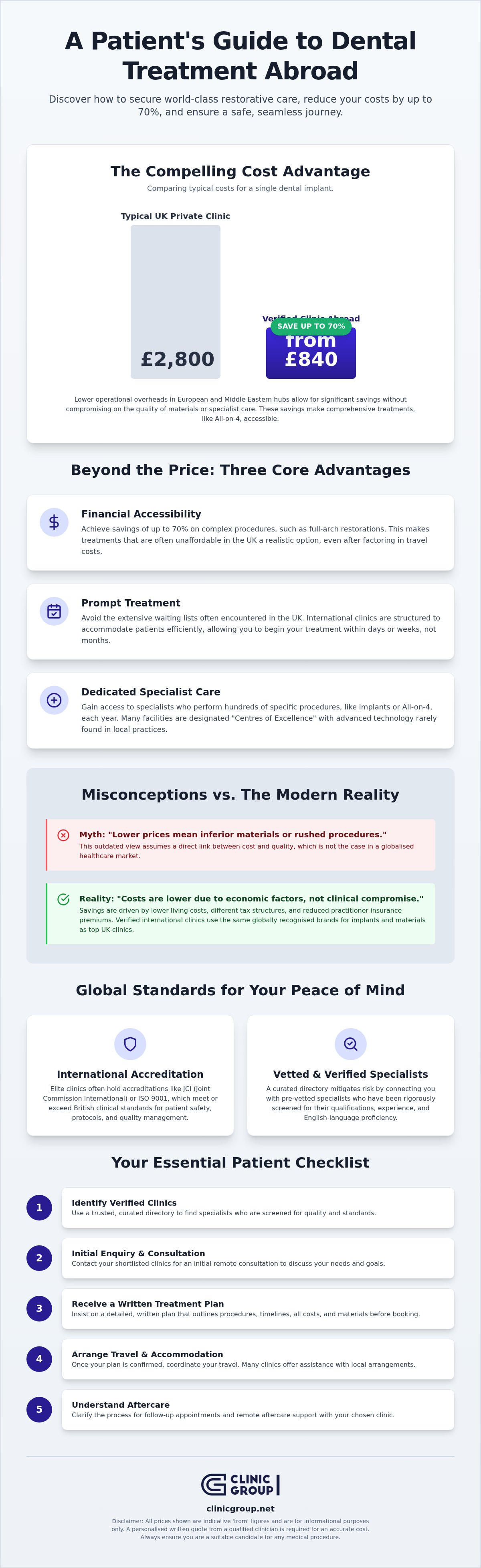
Successful dental treatment abroad is defined by the meticulous planning that occurs before you ever leave the UK. It is a structured process that begins with a remote consultation and concludes with a robust aftercare strategy. The most critical document in this journey is your comprehensive, written treatment plan. This should arrive before you book any flights, detailing every procedure, the total cost in GBP, and the specific timeframe required for your recovery. Without this document, you lack the clinical and financial certainty needed for a professional medical journey.
Logistical support is a hallmark of elite international centres. Many top-tier facilities now offer concierge services that include airport transfers, pre-arranged accommodation near the clinic, and a dedicated patient coordinator. This local support ensures you can focus entirely on your recovery rather than the stresses of travel. Once you return to the UK, coordinating with your local dentist for routine check-ups remains vital to maintain the longevity of your new restorations.
Vetting the Clinic: Questions You Must Ask
Before committing to a provider, you must conduct a thorough interview to ensure their standards align with your expectations. Use the following questions to gauge their transparency and professional accountability:
- What is the clinic’s specific complication rate for the procedure I am undergoing?
- Is there a formal guarantee on the dental work, and exactly what does it cover regarding travel costs if a revision is needed?
- Does the clinical staff speak fluent English to ensure there is no ambiguity regarding my consent or treatment steps?
Logistics and Aftercare: Ensuring a Smooth Experience
Managing your medical records is a priority for long-term health. You should arrange for the digital transfer of your records between the international clinic and your UK GP to ensure your medical history remains cohesive. It is also wise to invest in travel insurance specifically designed for medical tourism; standard policies often exclude complications arising from elective surgery.
Finally, request a "treatment passport" before you depart the clinic. This document should record the exact materials, brand names, and serial numbers of any implants or abutments used. This information is invaluable for any future maintenance performed by other clinicians. To find providers who already meet these rigorous logistical and safety standards, you can browse our directory of verified dental clinics to begin your journey with confidence. By following this structured approach, you ensure your dental treatment abroad is a predictable, high-quality experience.
Navigating the Market: How a Curated Directory Simplifies Choice
Selecting a destination for dental treatment abroad shouldn't feel like a gamble. When you rely on generic search engines, the results are often skewed by the clinics with the largest marketing budgets rather than those with the highest clinical standards. A curated directory like Clinic Group serves as a discerning guide, filtering through the noise to present only those facilities that meet rigorous safety and quality benchmarks. This approach moves the focus away from high-pressure sales tactics and towards an expert-led selection process that prioritises your peace of mind.
Referral services act as a vital bridge, connecting UK patients with the "best of the best" globally. By the time a clinic appears in a curated listing, it has already undergone a comprehensive vetting process. This evaluation includes a review of surgical complication rates, verification of specialist qualifications, and an assessment of English-language proficiency amongst the clinical staff. Using these medical tourism treatment guides allows you to make an objective, informed decision based on facts rather than persuasive advertising. It's a structured way to take control of your healthcare journey whilst ensuring you don't compromise on the quality of your restorative care.
The Value of Verified Provider Listings
A curated directory organises complex clinic data into a standardised format, allowing you to perform an easy, side-by-side comparison of credentials and facilities. This level of organisation is designed specifically for the needs of UK patients who require transparency regarding international standards. It serves as your first line of defence against sub-standard providers, ensuring that every specialist on the platform adheres to the global benchmarks discussed earlier in this guide. This dedicated focus on vetting provides a layer of security that a simple web search cannot replicate, giving you the confidence that your chosen clinic is both established and reputable.
Next Steps: Starting Your Journey with Confidence
Empowerment in healthcare comes from having access to reliable, verified information. Your journey towards a restored smile begins by identifying the specialists who align with your specific clinical needs and aesthetic goals. You can request a detailed referral or a comprehensive treatment guide for your chosen destination to further clarify the logistics of your trip. Taking this methodical approach ensures that your experience is seamless, safe, and financially rewarding. Explore our curated directory of verified dental specialists today to begin your transformation with the support of a trusted facilitator.
Securing Your Future Smile with Confidence
Deciding to pursue dental treatment abroad is a significant step towards reclaiming your oral health and confidence without the financial burden of UK private fees. By prioritising clinics with JCI or ISO accreditations, you ensure that your care meets rigorous global standards for safety and clinical precision. We've explored how complex restorations like All-on-4 implants offer life-changing results whilst providing savings of up to 75% compared to domestic quotes. Success in international dentistry isn't about finding the lowest price; it's about accessing a curated ecosystem of verified excellence.
Taking control of your transformation requires a structured approach and reliable information. Our platform acts as a discerning guide, offering expertly curated listings and comprehensive patient guides designed specifically for UK residents. We focus on transparency and verified credentials so you can focus on your recovery. When you're ready to take the next step, access our verified directory of dental providers abroad to discover a world-class solution tailored to your needs. Your journey to a perfect smile is closer than you think.
Frequently Asked Questions
Is dental treatment abroad safe for UK patients?
Dental treatment abroad is safe when you choose clinics that prioritise international clinical standards over the lowest price. Safety is ensured through adherence to global benchmarks such as JCI accreditation or ISO 9001 certifications. While the General Dental Council in the UK does not oversee international practices, many centres of excellence employ specialists with extensive European training. Clinic Group's curated directory helps you identify providers who have been pre-vetted for their safety protocols and surgical success rates.
How much can I actually save by having dental work abroad?
UK patients typically achieve savings of between 60% and 75% on restorative procedures by travelling to dental hubs like Turkey. For instance, a single dental implant including the crown may cost between £600 and £1,100 abroad, whereas UK private fees often reach £2,800. These significant reductions are possible due to lower operational overheads and living costs in these regions, allowing clinics to offer premium materials at a fraction of the domestic price.
What happens if I have a complication after returning to the UK?
If you experience a complication, your first step should be contacting the treating clinic to invoke your written guarantee. Most reputable international providers offer warranties that cover the cost of revision work at their facility. For immediate emergencies, UK dentists are obliged to provide stabilising care; however, for elective adjustments, you may need to coordinate with a local private dentist who is comfortable working with the specific implant brands recorded in your treatment passport.
Is state funding available for dental treatment abroad in 2026?
State funding for elective dental treatment abroad is virtually non-existent in 2026. Government-backed healthcare programmes typically do not reimburse costs for private restorative or cosmetic procedures, such as implants or veneers, regardless of where they are performed. While some state-funded schemes historically allowed for cross-border healthcare, these are generally reserved for medically necessary treatments that cannot be provided within a reasonable timeframe at home, rather than elective dental tourism.
Do dentists abroad speak English?
Clinics that specialise in medical tourism almost exclusively employ English-speaking staff to ensure clear communication and patient safety. Many senior dentists have completed postgraduate training in the UK or the United States, providing them with a high level of technical and conversational fluency. Additionally, top-tier facilities provide dedicated patient coordinators who act as translators and guides, ensuring that every detail of your treatment plan and consent form is fully understood.
How do I know if a clinic abroad is properly regulated?
Regulation is verified by checking a clinic's mandatory registration with their national health ministry or dental association, such as the Turkish Dental Association. You should also look for voluntary international accreditations like TEMOS, which specifically audits medical tourism standards. Because manual verification is complex, Clinic Group's professional directory is the most efficient way to access clinics that have already proven their regulatory compliance and clinical standing to independent experts.
Which is the best country for dental treatment abroad?
Turkey remains the most popular destination for UK patients seeking significant savings on full-mouth restorations and smile makeovers. For those prioritising shorter travel times, Hungary and Poland offer a long-standing reputation for clinical excellence in complex dental implantology. The ideal choice depends on your specific clinical needs, budget, and the level of aftercare support you require. Clinic Group's dental treatment abroad guides provide objective comparisons to help you select the most suitable region for your care.
How long do I need to stay abroad for dental implants?
The dental implant process usually requires two separate trips to ensure successful osseointegration. The initial visit for the surgical placement of the titanium posts typically lasts between five and seven days. Following a healing period of three to six months, a second trip of approximately seven to ten days is necessary for the final fitting of the permanent crowns. This phased approach is essential for the long-term stability and durability of the restoration.

Article by
Clinic Group Editorial Team
The Clinic Group editorial team publishes clear, practical guides for UK and EU patients researching medical travel — from dental implants and hair transplants to plastic surgery and eye care — with a focus on verified clinics, transparent “from” pricing, and safe planning.
Disclaimer
This article is for general information only and is not medical advice, diagnosis, or a substitute for an in-person consultation with a qualified clinician. Treatment suitability, risks, timelines, and costs vary by individual. Clinic Group connects patients with independent clinics; those clinics are responsible for clinical care. Always verify credentials, obtain a written treatment plan and itemised quote, and confirm aftercare arrangements and travel insurance cover (elective procedures are often excluded) before booking. Outcomes cannot be guaranteed.