TL;DR:
- Medical coordinators facilitate non-clinical aspects of international healthcare, ensuring safety and smooth logistics for patients. They manage documentation, scheduling, travel, language support, and post-operative data transfer, significantly reducing safety risks. Effective coordinators possess high-speed response skills, clinical data handling knowledge, and professional certification to protect patients throughout their treatment journey.
Medical coordinators are defined as patient-facing facilitators who manage the logistical, administrative, and communicative aspects of international healthcare without providing medical treatment themselves. In the medical tourism industry, the role of medical coordinators is central to patient safety. They sit between patients and overseas healthcare providers, ensuring that clinical data, travel arrangements, accreditation checks, and post-operative handoffs all happen correctly. Professional bodies such as the Joint Commission International (JCI) and the Global Healthcare Accreditation (GHA) programme set the quality standards that coordinators help patients navigate. Without this layer of professional support, patients travelling abroad for procedures such as plastic surgery, dental implants, or hair transplants face significant logistical and safety risks.
What are the primary responsibilities of medical coordinators?
Medical coordinators are not treating clinicians. They do not diagnose conditions, prescribe medication, or perform procedures. Their function is to facilitate every non-clinical aspect of a patient’s treatment journey, from the first enquiry through to post-operative follow-up.
The core duties of a medical coordinator cover several distinct areas:
- Medical documentation management. Coordinators collect and organise patient records, imaging files, and referral letters. Accurate documentation is what allows overseas surgeons to provide reliable treatment quotes and surgical plans.
- Appointment and scheduling coordination. They book consultations, pre-operative assessments, and surgical slots, ensuring that timelines align with a patient’s travel window.
- Travel and accommodation logistics. Coordinators arrange flights, transfers, and partner hotel stays. They also manage ground support, including airport collection and transport to and from the clinic.
- Cultural and language support. They bridge communication gaps between patients and clinical teams, particularly where language barriers or cultural expectations could affect informed consent.
- Liaison with third parties. Coordinators liaise with hospital staff, embassies, and insurance providers where relevant, advocating for patients’ needs throughout the process.
- Financial facilitation. They explain costs transparently and help patients understand payment structures, without making clinical recommendations based on price.
Pro Tip: Ask your coordinator to provide a written itinerary covering every appointment, transfer, and contact number before you travel. A well-prepared coordinator will have this ready without prompting.
The medical coordination job description is broader than most patients expect. A coordinator who only books flights is not fulfilling the full scope of the role. Effective coordination touches clinical data, cultural sensitivity, logistics, and financial transparency in equal measure.

How do medical coordinators contribute to patient safety?
Patient safety is the most consequential part of a coordinator’s function. Patients should verify facility accreditation through established registries such as JCI or GHA, and a competent coordinator actively supports this process. Coordinators help patients identify which questions to ask, which documents to request, and which red flags to take seriously.
A key responsibility in this area is credential verification. Coordinators guide patients towards checking surgeon qualifications and hospital accreditation independently, rather than relying solely on a clinic’s own marketing materials. Accreditation through bodies like JCI signals that a facility meets internationally recognised standards for patient safety and clinical governance. Patients can cross-reference this through the medical tourism accreditation guide published by Clinicgroup.
| Safety task | Coordinator’s role | Patient’s responsibility |
|---|---|---|
| Accreditation verification | Guides patient to JCI/GHA registries | Confirms accreditation independently |
| Surgeon credentials | Provides documentation and contact details | Verifies qualifications with licensing bodies |
| Complication insurance | Advises on the need for medical travel cover | Purchases and holds their own policy |
| Post-operative handoff | Prepares clinical data package for home GP | Shares records with home-country physician |
| Communication standards | Ensures informed consent is clearly explained | Asks questions until fully satisfied |
Continuity-of-care planning is another area where coordinators add measurable value. Failure to standardise post-operative data transfer causes delays and genuine risks to patient safety. A coordinator who builds a structured handoff process, including DICOM imaging files and anaesthesia records, protects the patient long after they have returned home.
Pro Tip: Before confirming any booking, ask your coordinator to confirm in writing which accreditation body has certified the clinic and where you can verify this independently. A credible coordinator will welcome the question.
What essential skills must effective medical coordinators have in 2026?
The demands on medical coordinators have grown considerably. Patients arrive better informed, procedures are more complex, and digital communication has raised expectations for speed and accuracy. The following competencies define effective coordination in 2026.
-
High-velocity lead management. Coordinators handle multiple enquiries simultaneously. Responding to a patient within hours, not days, is now a baseline expectation. Slow responses push patients towards less rigorous providers.
-
Clinical data facilitation. Mastering secure clinical data handling and understanding surgeon-specific technical requirements is what separates capable coordinators from average ones. Knowledge of required X-ray formats, CBCT scan specifications, and correct photographic angles reduces errors in surgical quoting and prevents avoidable complications.
-
End-to-end logistics management. A coordinator must manage the full arc of a patient’s trip, from pre-departure preparation through to post-operative transport home. This includes contingency planning for delays, medical emergencies, and itinerary changes.
-
Technical understanding of surgical requirements. Coordinators do not perform surgery, but they must understand enough about each procedure to communicate accurately between patients and clinical teams. A coordinator facilitating a rhinoplasty, for example, needs to know which imaging views the surgeon requires before a remote consultation.
-
Secure digital data handling. Patient records are sensitive. Coordinators must use encrypted communication channels and comply with applicable data protection standards when transferring clinical files internationally.
-
Professional certification. The Certified International Patient Specialist (CIPS) designation, offered through the Medical Tourism Association, is the recognised professional credential in this field. Coordinators holding CIPS certification demonstrate a commitment to international patient care standards that goes beyond on-the-job experience.
Understanding healthcare coordination requirements in depth, including the data formats and clinical knowledge needed for accurate international coordination, is what distinguishes professionals who protect patients from those who merely process bookings.
What challenges and pitfalls should coordinators and providers be aware of?
The medical coordination role carries inherent risks that both coordinators and healthcare providers must manage carefully. Understanding these challenges is not optional. It is a professional responsibility.
- The accountability gap. Facilitators are rarely liable for surgical outcomes. Commercial guarantees offered by facilitators typically cover only re-treatment at the same clinic and do not constitute medical or insurance protection. Patients must hold their own dedicated complication insurance, entirely separate from any facilitator guarantee.
- Commission-driven conflicts of interest. Medical travel facilitators commonly earn commissions from clinics. This creates a structural incentive to recommend providers who pay more, rather than those who are best suited to the patient’s clinical needs. Patients and providers should ask coordinators to disclose their commercial relationships openly.
- Communication failures in post-operative care. Delayed or incomplete transfer of clinical records to home-country GPs is one of the most common causes of compromised follow-up care. A coordinator who does not have a documented handoff protocol is a risk to patient safety.
- Cultural and language barriers. Misunderstandings about consent, recovery expectations, or post-operative instructions can have serious consequences. Coordinators must either speak the patient’s language fluently or work with qualified interpreters.
- Inadequate independent verification. Patients who rely entirely on a coordinator’s recommendations without conducting their own checks are exposed to greater risk. Coordinators should actively encourage independent verification, not discourage it.
“A coordinator’s value is not measured by how smoothly they sell a package. It is measured by how thoroughly they protect the patient when something goes wrong. The best coordinators build systems that function even in difficult circumstances.”
Reviewing the clinic credentials guide before travel helps patients understand exactly what independent verification looks like in practice.
How does the coordinator role integrate with international patient care pathways?
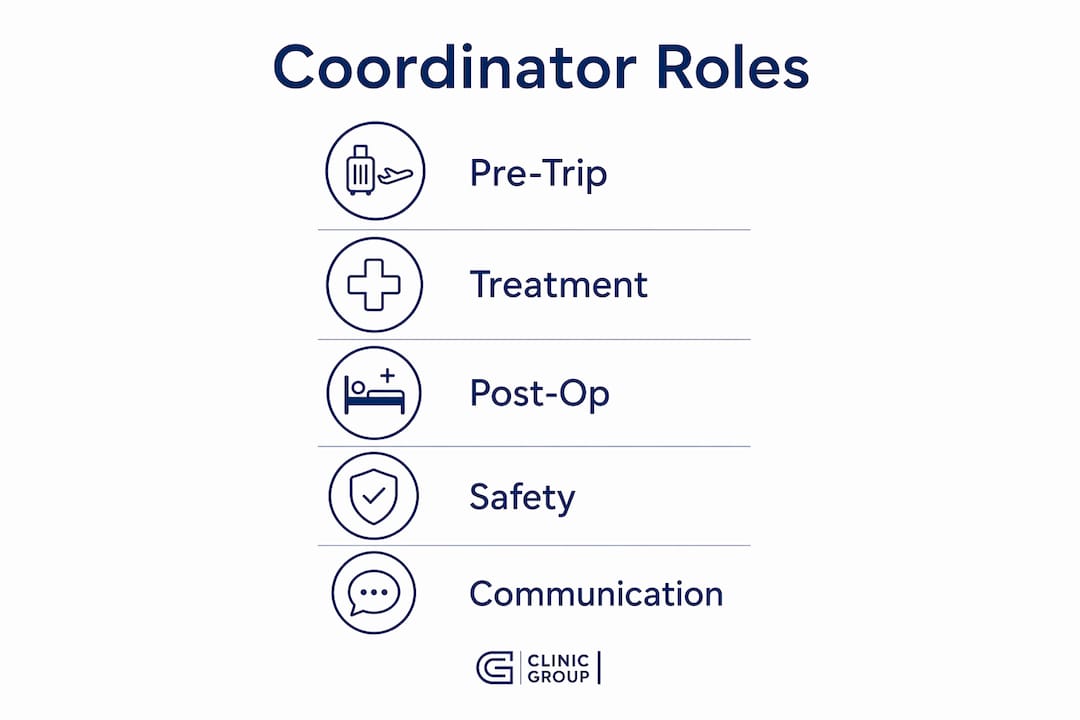
The functions of medical coordinators fit into a structured care pathway that begins at the first enquiry and ends only when the patient’s home-country GP has received a complete clinical handoff. Each stage of this pathway has a defined coordinator function.
Good facilitators improve safety and convenience but do not provide medical oversight. Their value lies in removing friction at every stage of the process, so that patients can focus on recovery rather than administration.
The pre-trip phase involves collecting medical history, sourcing imaging in the correct format, and arranging a remote consultation with the treating surgeon. Coordinators also advise patients to consult a travel medicine specialist before departure, particularly for procedures requiring general anaesthesia.
During the treatment phase, coordinators manage on-the-ground logistics: clinic transfers, interpreter support, accommodation, and daily check-ins. They act as the patient’s primary contact point if questions or concerns arise, escalating clinical issues to the medical team immediately.
The post-operative phase is where coordination most often falls short. Effective coordinators prepare a structured clinical data package, including operative notes, DICOM imaging, and anaesthesia records, and transfer this to the patient’s home GP before discharge. They also schedule follow-up calls at defined intervals to monitor recovery and address concerns early. Patients can use the quality assurance checklist to confirm that their coordinator is meeting these standards at each stage.
Key takeaways
Medical coordinators are the single most important non-clinical factor in determining whether an international patient journey is safe, well-managed, and free from avoidable complications.
| Point | Details |
|---|---|
| Coordinators are not clinicians | They facilitate logistics, documentation, and communication without providing medical treatment. |
| Accreditation verification matters | Coordinators guide patients to JCI and GHA registries, but patients must confirm accreditation independently. |
| The accountability gap is real | Facilitator guarantees do not replace medical travel insurance; patients must hold their own complication cover. |
| Clinical data handoff is critical | Structured transfer of DICOM images and operative notes to home-country GPs prevents post-operative complications. |
| Commission disclosure is non-negotiable | Patients should ask coordinators to disclose clinic referral fees before any booking is confirmed. |
The professionalisation of coordination cannot wait
From where Clinicgroup sits, working daily with patients travelling from the UK and across Europe for surgery, dentistry, and hair restoration, the gap between good coordination and poor coordination is not subtle. It is the difference between a patient who returns home with complete records, a clear recovery plan, and a GP who knows exactly what was done, and a patient who arrives back with a folder of documents in a language they cannot read and no follow-up appointment booked.
The coordinators who perform best in 2026 are not simply organised people with good communication skills. They are professionals who understand DICOM formats, know which questions to ask a surgeon before a remote consultation, and have a documented continuity-of-care protocol that they follow without exception. The Certified International Patient Specialist (CIPS) credential exists precisely because the role demands this level of competence.
What concerns me most is the number of facilitators who still operate on a commission-only model without disclosing this to patients. The conflict of interest is structural, not personal. A coordinator who earns more from one clinic than another cannot be fully objective, regardless of their intentions. Patients deserve transparency, and providers who want to build long-term reputations should demand it from every coordinator in their network.
Technology will continue to raise the bar. Secure data transfer, encrypted patient portals, and digital handoff systems are already standard in the best-performing networks. Coordinators who have not adopted these tools by now are not just behind the curve. They are creating risk.
— Clinic
How Clinicgroup supports coordinated medical travel
Clinicgroup connects patients from the UK and Europe with verified clinics and board-certified specialists in Albania and Dubai. Every patient journey includes clinic matching, travel logistics, partner hotel arrangements, and structured aftercare coordination, with transparent pricing and no hidden fees. For patients considering plastic surgery abroad, Clinicgroup’s network of accredited providers meets European standards of care at a fraction of UK costs. The coordination process covers every stage from initial consultation through to post-operative follow-up, giving patients and their home-country physicians the documentation they need. Contact Clinicgroup to speak with a patient coordinator about your treatment options.
FAQ
What is the role of medical coordinators in medical tourism?
Medical coordinators manage the logistical, administrative, and communicative aspects of a patient’s international treatment journey. They do not provide medical treatment but facilitate safe, well-organised care pathways between patients and overseas healthcare providers.
Are medical coordinators responsible for surgical outcomes?
Coordinators are not liable for surgical outcomes. Patients must hold their own medical travel insurance, as facilitator guarantees typically cover only re-treatment at the same clinic and do not constitute formal medical or insurance protection.
What qualifications should a medical coordinator have?
The Certified International Patient Specialist (CIPS) designation, offered through the Medical Tourism Association, is the recognised professional credential for international patient coordinators. It demonstrates competence in clinical data management, patient advocacy, and international care standards.
How do coordinators help verify clinic accreditation?
Coordinators guide patients to established registries such as JCI and GHA to confirm facility accreditation. Patients should always verify accreditation independently rather than relying solely on documentation provided by the clinic or coordinator.
What should patients ask a coordinator before booking treatment abroad?
Patients should ask coordinators to disclose any commission arrangements with clinics, confirm accreditation details, and provide a written continuity-of-care plan that includes post-operative data transfer to their home-country GP.