TL;DR:
- Medical tourism packages generally bundle treatment, accommodation, and logistics but exclude flights and personal expenses.
- Choosing a reputable provider based on transparent, itemized details and clinic credentials ensures a safer, more predictable experience.
If you are considering treatment abroad, the term “medical package” will come up quickly, and it does not always mean the same thing. In medical tourism, a medical package typically refers to a bundled arrangement covering your procedure, hospital stay, local transfers, and accommodation. In healthcare product contexts, the same phrase points to the physical packaging of devices and pharmaceuticals. This article focuses firmly on medical tourism packages: what they contain, what they leave out, and how to compare them so you make a genuinely informed decision before committing to treatment overseas.
Table of Contents
- Key takeaways
- What is a medical package in healthcare abroad?
- What medical tourism packages typically include
- Package versus self-arranged: weighing the trade-offs
- Medical product packaging: a brief explainer
- How to choose a medical tourism package
- My perspective on medical packages and what patients miss
- How Clinicgroup helps you find the right package
- FAQ
Key takeaways
| Point | Details |
|---|---|
| Packages bundle logistics, not clinical care | A medical tourism package reorganises travel and accommodation alongside treatment, but the clinical quality stays the same. |
| Exclusions are common and costly | International flights, travel insurance, visa fees, and unforeseen complications are routinely excluded from quoted package prices. |
| Itemised lists are non-negotiable | Always request a full breakdown of what is covered before booking to avoid unexpected charges. |
| Product packaging is a separate concept | Medical product packaging refers to sterile barriers protecting devices and pharmaceuticals, not patient service bundles. |
| Verified clinics matter more than price | The value of any package depends on the credentials of the clinic and specialists delivering your care. |
What is a medical package in healthcare abroad?
The definition of medical package depends heavily on context. For patients exploring healthcare abroad, a medical tourism package is a bundled service arrangement sold by a clinic, hospital, or facilitator that combines clinical treatment with some or all of the surrounding logistics. Think of it as a planned schedule of services rather than a single appointment. A dental implant package in Albania, for instance, might include consultations, surgery, post-operative nursing, local airport transfers, and three nights in a partner hotel.
The confusion arises because “medical package” also appears in healthcare product terminology, where it describes the physical packaging of medical devices and pharmaceuticals. This is an entirely different domain.
In regulated healthcare settings, the term covers at least three distinct concepts:
- Medical tourism packages: Bundled clinical and logistical services sold to international patients.
- Medical product packaging: The materials and design used to protect, preserve, and deliver healthcare products safely from manufacture to use, maintaining sterility throughout the supply chain.
- Procedure packs and systems: A procedure pack is a collection of regulated medical devices grouped for use in a specific clinical specialty, while a system refers to components intended to be used together under one name.
For prospective medical tourists, the relevant definition is the first one. The other two are worth knowing about simply to avoid confusion when you encounter the terminology during research.
What medical tourism packages typically include
Understanding the medical package contents before you sign anything is one of the most practical steps you can take. Packages vary between providers and destinations, but there is a common baseline of what reputable providers include.
Typical inclusions:
- The primary procedure itself (surgery, dental treatment, hair transplant, etc.)
- Pre-operative consultations and diagnostic tests
- Hospital or clinic stay, including a room and nursing care
- Anaesthesia and theatre fees where applicable
- Local transfers between the airport, hotel, and clinic
- Partner hotel accommodation for recovery nights
- Some meals during your hospital stay
- Translation or patient coordination services
Common exclusions are where patients are most frequently caught off guard. Many packages exclude international flights, travel insurance, visa fees, and personal expenses as standard. Meals outside hospital are frequently not covered. Crucially, treatment for unforeseen complications or extended stays may fall outside the original quote entirely.
Some packages also exclude follow-up appointments after you return home, which can be significant depending on the procedure. Learning about aftercare services before you book helps you plan for costs that do not appear in the headline price.

Pro Tip: Ask every provider to send you a written, line-by-line breakdown of inclusions. If a provider is reluctant to provide this, treat that as a warning sign rather than a minor inconvenience.
Understanding all-inclusive healthcare is particularly useful here, as many packages use the phrase loosely without it meaning what most patients assume.
Package versus self-arranged: weighing the trade-offs
Choosing a medical tourism package over arranging services independently is not always the obvious choice. Both approaches have genuine merits, and the right option depends on your specific situation.
The importance of medical packages is often framed around cost savings, and this is partly accurate. Clinics negotiate volume rates with hotels and transfer companies, and those savings get passed along in the package price. Locking in a fixed price also protects you if the local currency moves between booking and travel. Logistically, having one point of contact for your entire stay reduces the mental load of coordinating multiple suppliers in an unfamiliar country.
That said, packages reorganise logistics and volume pricing rather than changing clinical quality. The care you receive is the same with or without a package. You are paying for convenience and predictability, not a higher standard of treatment.
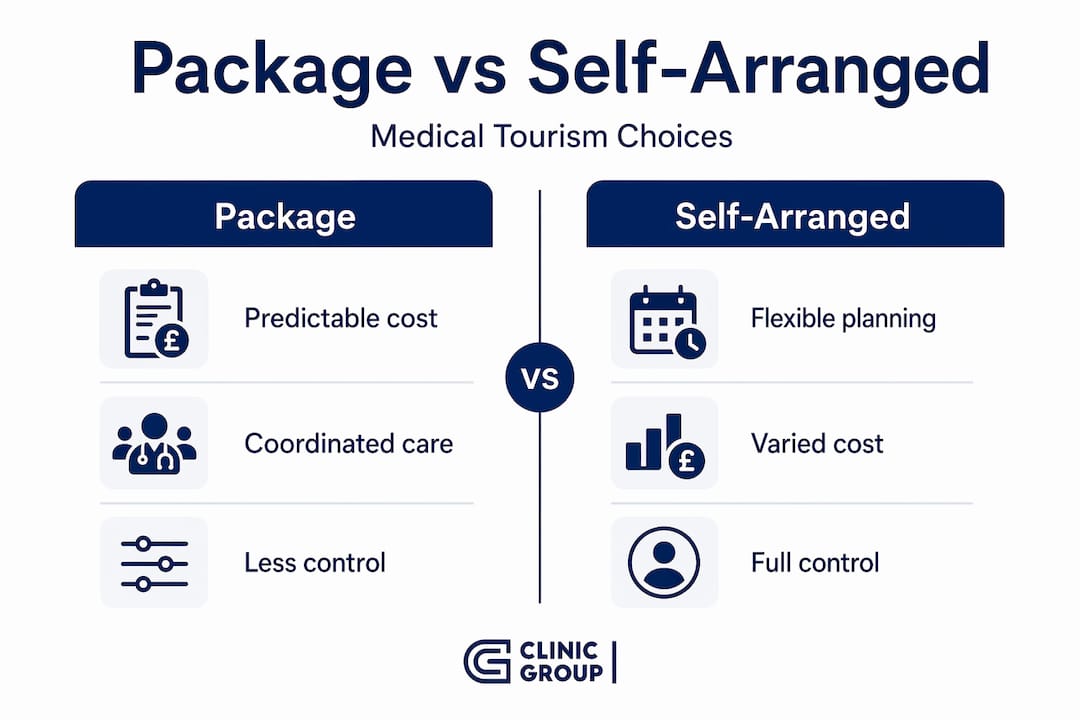
The drawbacks deserve equal attention. If you are staying with family rather than in a hotel, a package that bundles accommodation may cost you more than booking separately. If you need a shorter or longer stay than the package assumes, you may pay for nights you do not use or need to pay extra for nights not covered.
| Factor | Package arrangement | Self-arranged |
|---|---|---|
| Cost predictability | Fixed, upfront price | Variable, dependent on booking timing |
| Logistics effort | Low — one provider manages coordination | High — you coordinate each service separately |
| Flexibility | Limited to package terms | Full control over choices |
| Accommodation fit | Preset partner hotel | Choose your own location and budget |
| Currency risk | Locked in at booking rate | Exposed to exchange rate changes |
| Aftercare coordination | Often included in package | Must arrange independently |
Pro Tip: Calculate the total cost of a package by adding in your flights, visa, and insurance before comparing it to an itemised self-arranged alternative. The gap is sometimes smaller than it first appears.
Medical product packaging: a brief explainer
While this article is primarily for patients planning treatment abroad, a basic grasp of medical product packaging is useful. It helps you ask informed questions about the standards clinics uphold and understand why device safety is taken seriously.
Medical packaging refers to the design and materials used to protect and preserve healthcare products from the point of manufacture through to clinical use. Its purpose extends well beyond simple wrapping. There are three levels of packaging used across the healthcare supply chain:
- Primary packaging comes into direct contact with the device or pharmaceutical. It forms the sterile barrier that prevents contamination before use.
- Secondary packaging groups and protects primary packages during storage and distribution. This is typically the outer box or carton you would see in a clinical setting.
- Tertiary packaging covers bulk transport, usually pallets or crates used for logistics between manufacturers and distributors.
Within this system, the sterile barrier is the most critical component for patient safety. A sterile barrier system is defined as the minimum packaging configuration that ensures a microbial barrier and allows aseptic presentation of a device at the point of use. For terminally sterilised devices, sterile barrier maintenance is a core part of the device’s safety case, not an optional refinement.
For patients, this context matters when evaluating clinics abroad. A clinic meeting European standards will use devices whose packaging integrity has been validated. Asking whether a clinic uses CE-marked devices is a straightforward way to confirm this.
How to choose a medical tourism package
Once you understand the types of medical packages and what they contain, the practical work of choosing one becomes more manageable. The following steps reflect what experienced medical tourists and patient facilitators consistently recommend.
- Request an itemised breakdown without exception. Detailed package lists covering surgery, diagnostic tests, nursing fees, and aftercare allow you to make a fair cost comparison and avoid surprise charges.
- Check clinic credentials and patient reviews. Understanding why clinic reviews matter helps you identify reputable providers from less reliable ones. Board certification and accreditation details should be publicly available.
- Clarify aftercare terms explicitly. Ask whether aftercare appointments are included in the package or billed separately, and what happens if you need a follow-up after returning home.
- Confirm what you must arrange independently. Flights, travel insurance, and visas are almost universally excluded. Understanding how to schedule appointments abroad helps you align your travel dates with clinic availability.
- Ask about partner hotel options. Some clinics work with specific hotels near their facilities. Reviewing partner hotel arrangements in advance helps you understand whether the accommodation suits your recovery needs.
- Compare at least three providers. One quote gives you a number. Three quotes give you a market. Do not commit to the first package you receive, regardless of how compelling it appears.
The medical package benefits you actually realise depend almost entirely on the quality of the provider you choose, not the polish of their brochure.
My perspective on medical packages and what patients miss
I have seen a consistent pattern with patients who feel let down by their experience abroad, and it rarely comes down to the clinical treatment itself. It comes down to mismatched expectations about what the package covered.
Many patients read “all-inclusive” and assume that every possible cost is accounted for. In practice, that phrase is not regulated. It can mean different things on different providers’ websites, and the gap between what patients expect and what the fine print delivers is where most disappointment originates.
What I find genuinely valuable in a well-structured package is not the headline savings. It is the coordination. When a clinic takes responsibility for your airport transfer, your hotel check-in, your pre-operative testing schedule, and your discharge, you arrive calmer and better prepared. That matters for recovery.
The clinics I trust most are the ones that are equally forthcoming about what their package does not cover. Transparency about exclusions is a stronger signal of quality than any list of inclusions. If a provider cannot clearly tell you what falls outside the scope of your package, that is the most important thing they have told you.
My advice: treat the package as a starting framework, not a final answer. Request the itemised list, read it carefully, and ask one direct question: “What would I pay for if something unexpected happens during my stay?” The response to that question tells you more than any brochure.
— Clinic
How Clinicgroup helps you find the right package
Clinicgroup connects patients from the UK, Italy, and across Europe with verified clinics in Albania and Dubai, covering treatments from dental implants and hair transplants to plastic surgery and wellness programmes. Every clinic in the network is vetted for credentials, patient outcomes, and transparency of pricing before being listed.
When you use Clinicgroup, you are not simply browsing a directory. The platform helps you compare treatment options, understand what each package genuinely includes, and access support with travel logistics, partner hotel bookings, and aftercare planning. Pricing is displayed clearly so you can assess total costs with confidence.
Whether you are in the early stages of research or ready to book a consultation, Clinicgroup’s platform gives you the tools to move forward with clarity and confidence. Reach out to the patient team for personalised guidance on which package best suits your procedure, timeline, and budget.
FAQ
What does a medical package include?
A medical tourism package typically includes the procedure, hospital or clinic stay, nursing care, local transfers, and accommodation. Exact contents vary by provider, so always request a written itemised list before booking.
Are flights included in medical packages?
Flights are almost always excluded. Most packages expect patients to arrange their own international travel, along with travel insurance and any required visas.
Is a medical package the same as all-inclusive healthcare?
Not necessarily. “All-inclusive” is not a regulated term, and providers use it differently. A package labelled all-inclusive may still exclude flights, personal expenses, and treatment for complications.
What is medical product packaging?
Medical product packaging refers to the materials and design used to protect healthcare products, maintain sterility, and preserve device integrity from manufacture through to clinical use. It is a separate concept from medical tourism service bundles.
How do I compare medical tourism packages fairly?
Request itemised breakdowns from at least three providers, then add your estimated flight, insurance, and visa costs to each total. This gives you a true comparison rather than a comparison of headline prices alone.