TL;DR:
- Albania offers high-quality dental treatments at significantly lower costs than Western Europe.
- Clinics in Albania meet international safety standards with advanced technology and European-trained dentists.
- The entire patient journey includes remote assessments, comprehensive care, and long-term follow-up support.
Thousands of patients from the UK and Italy are quietly discovering that world-class dental care does not have to come with a world-class price tag. Albania has emerged as one of Europe’s most compelling dental tourism destinations, offering treatments that rival Western European standards at a fraction of the cost. With implant success rates of 95 to 98% and warranties stretching up to 15 years, the old assumption that affordable automatically means risky simply does not hold up here. This article unpacks the real advantages, from cost savings and clinical quality to the full patient journey.
Table of Contents
- Why Albania has become a dental tourism hotspot
- Cost savings: How much can you really save?
- Quality and safety: Meeting Western European standards
- The complete patient experience: From arrival to aftercare
- Why the best value isn’t always the cheapest treatment
- Discover your dental treatment options in Albania
- Frequently asked questions
Key Takeaways
| Point | Details |
|---|---|
| Major cost savings | Dental treatments in Albania can save you thousands compared to UK and Italian clinics. |
| High success rates | Procedures in Albania offer 95-98% success rates with warranties up to 15 years. |
| International standards met | Clinics adhere to global quality and hygiene standards, ensuring patient safety. |
| Comprehensive patient journey | From pre-travel planning to aftercare, Albanian clinics support patients every step of the way. |
Why Albania has become a dental tourism hotspot
Albania sits at a genuinely strategic point on the map. For UK patients, direct flights to Tirana from London take roughly two to three hours. For Italian patients, the journey is even shorter, with ferry connections from Bari and Brindisi making Albania one of the most accessible dental destinations in Europe. This geographical convenience removes one of the biggest barriers to seeking treatment abroad: the long-haul journey.
Beyond location, Albania has invested heavily in its healthcare infrastructure over the past decade. Private dental clinics in Tirana, Durrës, and other cities have installed advanced diagnostic equipment including CBCT scanners (Cone Beam Computed Tomography, which produces detailed 3D images of the jaw and teeth), digital smile design software, and CAD/CAM milling machines that produce same-day ceramic crowns. These are not budget shortcuts. They are the same technologies used in leading clinics across Germany, the Netherlands, and the UK.
Albania is also increasingly recognised among medical tourism destinations across Europe, attracting patients who prioritise both quality and transparency. Several clinics have pursued international accreditation and maintain sterilisation protocols that align with ISO standards and EU directives. This formal commitment to quality assurance gives patients a reliable framework to evaluate clinics before booking.
Key reasons why Albania stands out as a dental tourism destination:
- Short travel times from the UK (2 to 3 hours by air) and Italy (under 1 hour by ferry or 1.5 hours by air)
- Rapid growth in internationally accredited private dental clinics
- Investment in modern diagnostic and treatment technology
- English and Italian-speaking dental teams at most major clinics
- Long-term warranties on implants and prosthetics, typically 5 to 15 years
- Implant success rates matching global benchmarks at 95 to 98%
The combination of accessibility, technology, and transparent quality standards has created a destination that patients return to, and recommend to others.
Cost savings: How much can you really save?
Having seen why Albania attracts attention, let’s break down the real cost advantages and what they mean for your wallet. The numbers are striking, and for many patients, they represent the difference between getting treatment done and continuing to delay it.
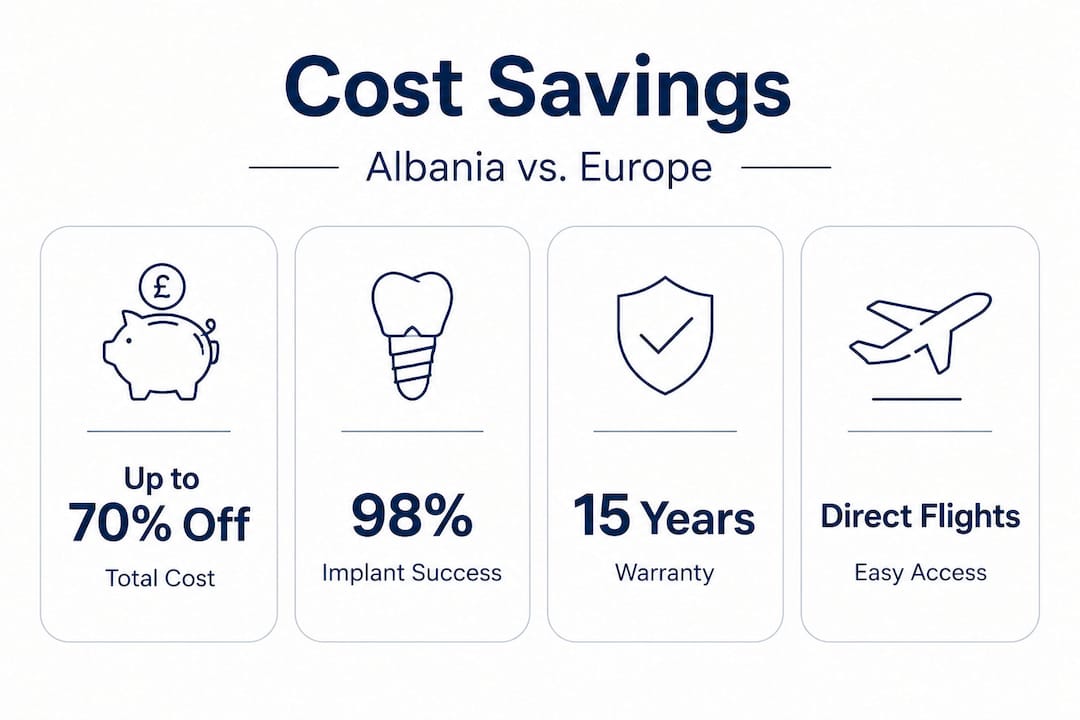
The following table compares typical treatment costs across Albania, the UK, and Italy:
| Treatment | Albania (approx.) | UK (approx.) | Italy (approx.) |
|---|---|---|---|
| Single dental implant | £400 to £600 | £2,000 to £3,000 | £1,500 to £2,500 |
| Porcelain crown | £100 to £180 | £700 to £1,000 | £500 to £900 |
| Porcelain veneer | £150 to £250 | £800 to £1,200 | £600 to £1,000 |
| Full arch (All-on-4) | £3,500 to £6,000 | £15,000 to £25,000 | £12,000 to £20,000 |
| Teeth whitening | £80 to £150 | £300 to £700 | £250 to £600 |
The savings on a single implant alone can cover the entire cost of flights and a comfortable hotel stay in Tirana, with money to spare. For patients requiring multiple implants or a full arch restoration, the financial case becomes even more compelling. A patient needing six implants could save upwards of £12,000 compared to UK prices, even after factoring in travel and accommodation.
It is also worth considering what is included in Albanian treatment packages. Many clinics bundle consultations, X-rays, CBCT scans, the procedure itself, temporary restorations, and follow-up appointments into a single transparent price. In the UK or Italy, each of these elements is typically billed separately, which inflates the total cost significantly.
The dental treatments offered through verified platforms often come with additional value-adds, such as airport transfers, accommodation partnerships, and dedicated patient coordinators who manage the logistics of your visit. These inclusions reduce the stress and hidden costs that can catch first-time dental tourists off guard.
Additional ways the savings extend beyond the dental chair:
- Budget airlines offer frequent routes from London, Manchester, and Rome to Tirana
- Accommodation in Albania is considerably cheaper than in Western Europe
- Many clinics partner with local hotels, offering discounted rates for patients
- Warranties on implants and prosthetics of 5 to 15 years reduce long-term replacement costs
Pro Tip: Ask your chosen clinic whether they offer treatment packages that bundle multiple procedures. If you need both implants and crowns, a combined package can reduce the per-treatment cost further and consolidate your travel into a single trip.
Quality and safety: Meeting Western European standards
Cost is important, but safety and quality are non-negotiable. Let’s look at how Albanian clinics perform on this front, because this is where many patients have the most questions.
The short answer is that leading Albanian dental clinics operate to standards that are directly comparable to those in the UK and Italy. Many dentists practising in Albania trained at European universities, including institutions in Italy, Germany, and Austria. Some hold dual qualifications and maintain professional memberships with international dental associations. This is not a coincidence. Albania’s proximity to Italy has created a long tradition of academic and professional exchange between the two countries.
“Patients travelling to Albania for implants can expect success rates of 95 to 98%, warranties of 5 to 15 years on implants and prosthetics, and structured online follow-up after returning home.” Source: Dental Implants in Albania
For patients considering safe, quality dental treatment abroad, understanding what to look for in a clinic is essential. Here is a step-by-step overview of what to expect before, during, and after treatment at a reputable Albanian clinic:
- Initial consultation and diagnostics: Your clinic will conduct a full oral examination, digital X-rays, and in many cases a CBCT scan to assess bone density and jaw structure before recommending any treatment.
- Treatment planning: A detailed treatment plan is produced, including a cost breakdown, timeline, and the materials to be used. Reputable clinics use internationally recognised implant brands such as Straumann, Nobel Biocare, or Osstem.
- Treatment delivery: Procedures are carried out in sterile environments using single-use instruments where applicable. Sterilisation protocols follow ISO 13485 or equivalent standards.
- In-clinic aftercare: Before you leave, the clinic provides written aftercare instructions, emergency contact details, and a follow-up schedule.
- Post-return support: Most clinics offer structured online consultations and are reachable by video call if any concerns arise after you return home.
The following table summarises key quality indicators at leading Albanian clinics:
| Quality indicator | Standard at leading Albanian clinics |
|---|---|
| Implant success rate | 95 to 98% |
| Implant warranty | 5 to 15 years |
| Sterilisation protocol | ISO 13485 or equivalent |
| Diagnostic technology | CBCT, digital X-ray, intraoral camera |
| Dentist training | European university qualifications |
Pro Tip: Before booking, request the clinic’s accreditation documents, ask which implant brands they use, and look for verified patient reviews on independent platforms. Reviewing dental travel tips from experienced medical travellers will also help you ask the right questions and avoid common pitfalls.
The complete patient experience: From arrival to aftercare
Having addressed quality, it is time to walk through the entire patient experience from start to finish. Knowing what to expect at each stage makes the process far less daunting, particularly for first-time dental tourists.
The journey typically begins online, weeks or even months before you travel. Most clinics accept enquiries by email or through a patient coordinator platform, and will ask you to submit recent dental X-rays or photographs so that a preliminary assessment can be made remotely. This initial step allows the clinic to confirm whether your planned treatment is suitable and to provide a detailed cost estimate before you commit to travel.
Here is how the typical patient journey unfolds:
- Online enquiry and assessment: Submit X-rays and photographs. Receive a preliminary treatment plan and quote within 24 to 48 hours.
- Booking and travel arrangements: Confirm your appointment dates. Many clinics assist with hotel recommendations and airport transfer bookings.
- Arrival and welcome: A patient coordinator meets you at the airport or hotel. They accompany you to the clinic and act as a point of contact throughout your stay.
- Diagnostic appointment: A full in-person assessment is conducted on your first day, confirming or refining the treatment plan.
- Treatment: Depending on the complexity of your case, treatment may take one to five days. Implants require a healing period, so some patients return for a second trip to fit the final crown.
- Pre-departure review: Before you fly home, the dentist conducts a final check, provides written aftercare instructions, and schedules your first online follow-up.
- Online aftercare: Structured follow-up consultations are conducted via video call. Most clinics are also reachable by WhatsApp or email for urgent queries.
Services commonly included for international patients:
- Airport or ferry port transfers on arrival and departure
- Interpreter services for non-English-speaking patients
- Hotel partnership arrangements at negotiated rates
- Emergency contact numbers available 24 hours a day
- Digital copies of all X-rays, scans, and treatment records for your home dentist
Understanding how aftercare services work for medical tourists is particularly important. The continuity of care after you return home is one of the most significant differentiators between a trustworthy clinic and one that is simply chasing short-term revenue. Reputable Albanian clinics build long-term patient relationships, and many of their international patients return for additional treatments or refer family members.
Warranties of 5 to 15 years on implants and prosthetics are a direct expression of this commitment. A clinic that offers a long warranty is confident in its materials, its technique, and its aftercare. That confidence is worth paying attention to.
Why the best value isn’t always the cheapest treatment
With a full view of the patient journey, it is worth reconsidering what “best value” actually means in dental tourism. Many patients approach the search for dental care abroad with a single question: who is cheapest? That is an understandable starting point, but it is rarely the right finishing point.
The real value calculation in dental tourism involves at least four factors working together: the cost of treatment, the quality of materials and technique, the comprehensiveness of aftercare, and the terms of any warranty. A clinic offering implants at half the price of its competitors but using unbranded components and no warranty is not a bargain. It is a risk.
Experienced dental tourists, particularly those who have made more than one trip to Albania, consistently report that the clinics they trust most are not necessarily the cheapest. They are the ones that communicate clearly before, during, and after treatment. They use named implant systems. They provide written warranties. They respond promptly when questions arise post-treatment.
Before booking any dental treatment abroad, it is worth taking the time to compare clinic features carefully. Look beyond the headline price and ask specific questions: What implant brand do you use? What does the warranty cover, and how do I claim it from the UK? What happens if I experience complications after returning home? These questions separate transparent, patient-focused clinics from those that are simply competing on price.
The most satisfied dental tourists are those who treat the process as a considered healthcare decision, not a purchasing transaction. Albania offers genuinely excellent value, but that value is best realised when patients choose wisely rather than cheaply.
Discover your dental treatment options in Albania
If you are ready to explore what Albanian dental care could mean for you, Clinic Group makes the process straightforward and transparent. Our platform connects UK and Italian patients with verified clinics offering a full range of treatments in Albania, from single implants and crowns to full arch restorations and cosmetic veneers. Every clinic in our clinic directory has been reviewed for quality standards, patient support, and aftercare provision, so you can compare options with confidence. Whether you are at the early research stage or ready to book a consultation, our patient coordinators are available to guide you through every step, from choosing the right clinic to arranging travel logistics and follow-up care once you are home.
Frequently asked questions
How long do dental implants last in Albania?
Most Albanian clinics back their implants with warranties of 5 to 15 years, and success rates reach up to 98%, which is consistent with global benchmarks. With proper care and regular check-ups, implants can last considerably longer than the warranty period.
Are Albanian dental clinics safe for international patients?
Leading Albanian dental clinics follow strict international sterilisation and safety protocols, use certified implant brands, and employ dentists trained at European universities. Checking a clinic’s accreditation documents and patient success rates before booking is always recommended.
What is included in the price of dental treatments in Albania?
Many Albanian clinics include consultations, diagnostic scans, the procedure, temporary restorations, and follow-up appointments in a single package price, along with long-term warranties on implants. Always request a full written breakdown before confirming your booking.
Can I get aftercare support once I return home?
Yes. Most reputable Albanian clinics offer structured online follow-up consultations via video call or messaging platforms, allowing you to stay in contact with your treating dentist after you return to the UK or Italy.