TL;DR:
- Choosing the correct destination influences clinical safety, care quality, and total costs in medical tourism.
- Verifying clinic accreditation, surgeon credentials, and proper planning are essential before booking any treatment abroad.
The destination you choose for medical treatment abroad determines your clinical safety, the quality of care you receive, and the true total cost of your trip — not just the headline procedure price. A systematic review of behavioural determinants found that safety expectancy and the quality of doctor interaction predict patient satisfaction more reliably than cost alone. Before you book anything, three checks matter most.
Start here: Confirm the clinic holds verifiable accreditation (JCI or an equivalent national body), and verify your surgeon’s board certification and published credentials, and request a written aftercare and complication plan. Then book a pre-travel consultation at least 4–6 weeks before departure.
- Confirm accreditation status (JCI, ISO 22525, or national equivalent)
- Verify surgeon credentials and published clinical outcomes
- Request a written aftercare plan and complication policy
- Schedule a pre-travel consultation 4–6 weeks before travel
Table of Contents
- How does destination affect clinical safety and quality?
- What should you verify about regulation and accreditation before booking?
- How should you plan travel, logistics and aftercare?
- What are the real costs of medical tourism once you include everything?
- Does destination image bias your choice, and how can you correct for it?
- How do you evaluate a destination and clinic step by step?
- How Clinicgroup supports UK patients choosing a destination
- Key takeaways
- A note from Clinicgroup
- Further reading and authoritative sources
- FAQ
How does destination affect clinical safety and quality?
Safety and perceived trust are stronger drivers of patient satisfaction than cost, and the destination is the single biggest variable shaping both. CDC guidance identifies infection risk, antimicrobial resistance, and the potential for counterfeit or substandard medical devices and medicines as destination-specific hazards that vary considerably between countries.
Surgeon credentials and facility accreditation signal different things. Accreditation certifies that a facility follows documented institutional processes; it does not guarantee individual clinical outcomes. A surgeon’s board certification, published CV, and verifiable licence number speak more directly to the person who will treat you. Both matter, but neither alone is sufficient.
Before booking, verify:
- Infection control protocols and sterilisation standards at the clinic
- Whether devices and implants come from internationally recognised manufacturers
- The surgeon’s board certification and licence number (request these in writing)
- The facility’s accreditation certificate and its expiry date
- Whether the clinic publishes outcome data or anonymised audit results
Pro Tip: Accreditation certificates should name the accrediting body, the specific facility, and a validity period. If a clinic’s website displays a logo without a certificate number or expiry date, ask for the full document. Legitimate accreditation bodies — including JCI and ISO — maintain searchable public registers.
What should you verify about regulation and accreditation before booking?
Accreditation and national regulation reduce risk, but they do not eliminate it. There is no single international standard governing medical travel; regulatory frameworks differ significantly between destinations, and gaps remain even in well-regarded markets.
A reliable clinic accreditation check covers the following:
- Confirm the clinic holds JCI accreditation, ISO 22525 certification, or a recognised national licence — and verify it directly with the issuing body.
- Request the surgeon’s full CV, specialist registration number, and evidence of relevant postgraduate training.
- Ask for a transparent, itemised price breakdown that includes complication management fees and extended-stay costs.
- Request the written aftercare protocol and the clinic’s pathway for managing post-operative complications.
- Ask whether the clinic can share anonymised outcome data or patient satisfaction audit results.
When contacting a clinic remotely, send a structured email that asks for: the accreditation certificate (with number and expiry), the lead surgeon’s registration details, a full written quote, and the aftercare plan. A clinic that responds promptly with complete documentation is demonstrating the transparency that quality care requires. One that deflects or provides only marketing materials warrants caution.
How should you plan travel, logistics and aftercare?
Logistics and aftercare are not separate from clinical safety — they directly determine how complications are managed and how well you recover. CDC guidance recommends delaying air travel for about two weeks following major surgery to reduce thrombosis risk, which means your in-country stay needs to be planned accordingly.

| Stage | Timing | Key action |
|---|---|---|
| Pre-travel consultation | several weeks before departure | Assess health status, vaccinations, destination-specific risks |
| Pre-operative preparation | 1–2 weeks before | Confirm logistics, accommodation, insurance |
| Surgery and initial recovery | — | Stay close to the clinic; confirm emergency access |
| Recommended in-country stay | Varies by procedure | Follow surgeon’s guidance; do not fly before cleared |
| Air travel after major surgery | No earlier than 10–14 days post-op | Per CDC guidance on thrombosis risk |
| Post-return follow-up | Within 1–2 weeks of returning | Arrange review with a UK clinician |
Travel checklist:
- Book medical travel insurance that covers the specific procedure and any complications
- Choose accommodation within easy reach of the clinic
- Confirm local emergency services and hospital access near your accommodation
- Arrange a follow-up appointment with a UK clinician before you travel
- Check visa requirements and entry conditions for your destination well in advance
- Review the political stability and public health environment of the destination country
What are the real costs of medical tourism once you include everything?
The cheapest headline price can mask a significantly higher total cost once travel, complications, and follow-up care are factored in. This is one of the most consistently underestimated factors influencing medical tourism decisions.
Hidden costs that vary by destination include:
- Return flights for follow-up appointments if complications arise
- Extended accommodation if your recovery takes longer than planned
- Revision procedures, which may not be covered by the original quote
- Emergency care costs if the local system charges international patients
- Uninsured follow-up treatment back in the UK
- Translation or interpretation services if the clinic does not provide them
Destination factors also shape cost risk in less obvious ways. Local availability of specific implant brands, the standard length of post-operative stay required by national guidelines, and whether the destination’s health system has reimbursement agreements with UK insurers all affect what you might pay if things do not go to plan.
Practical cost checklist: Request an all-in written quote that specifies what is included if complications arise. Ask explicitly whether revision procedures within a defined period are covered, and confirm what the clinic charges for an extended stay. A transparent pricing breakdown — including complication contingencies — is itself a quality signal, as DOH standards for medical tourism recognise.
Does destination image bias your choice, and how can you correct for it?
Destination image and cultural familiarity strongly influence choice and can override clinical evidence. The NIHR theoretical synthesis on medical tourism decision-making shows that both cognitive judgements about clinical quality and affective feelings about a place shape destination selection — and that UK patients with diaspora ties to a country often weight familiarity above objective indicators.
Common biases to watch for:
- Familiarity bias: choosing a destination because family or friends have been there, regardless of clinical verification
- Bandwagon effect: following recommendations from social networks or treatment-specific online groups without checking credentials
- Tourism appeal: selecting a destination partly for its attractions, then rationalising the clinical choice afterwards
Research on UK outbound medical tourists confirms that informal referrals and social networks guide much of the decision process. The problem is that patients frequently rely on informal sources rather than clinical metrics, and may overestimate what a friend’s positive experience guarantees for their own case.
To counter these biases: triangulate any personal recommendation with independent accreditation checks, seek a second opinion from a clinician who has no financial interest in the destination, and use a structured checklist rather than gut feeling alone.
Pro Tip: A trusted referral from a friend is a useful starting point, not a finishing point. Use it to identify a clinic worth investigating, then apply the same verification steps you would use for any other provider: check the accreditation, request the surgeon’s credentials, and ask for a written quote with complication terms.
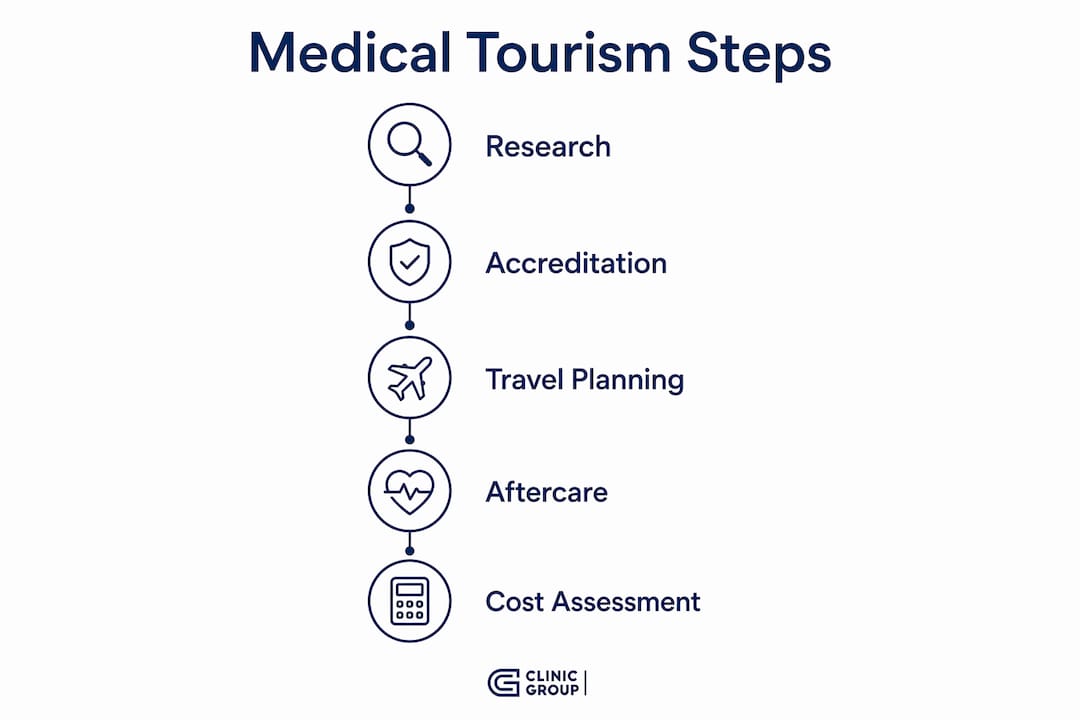
How do you evaluate a destination and clinic step by step?
Follow this sequence to move from high-level destination assessment to clinic and clinician verification before committing to any booking.
- Confirm national regulation and accreditation. Check that the destination country has a functioning health regulatory body and that your target clinic holds verifiable accreditation.
- Verify surgeon credentials and published outcomes. Request the lead surgeon’s board certification, specialist registration, and any published outcome data.
- Request full pricing and complication policy. Ask for an itemised written quote that covers the procedure, extended stay, and complication management.
- Confirm local emergency access and recovery accommodation. Identify the nearest hospital to your accommodation and confirm it accepts international patients.
- Secure travel insurance and plan your UK follow-up. Arrange international travel health insurance that covers the specific procedure, then book a post-return review with a UK clinician before you depart.
Questions to ask the clinic:
- What are your published outcome rates for this procedure?
- Can I see the lead surgeon’s CV and registration number?
- What infection control and sterilisation protocols do you follow?
- Which manufacturers supply your implants or devices?
- What is your written aftercare plan and complication pathway?
Red flags:
- No verifiable accreditation or refusal to share certificate details
- Vague or verbal-only pricing with no written breakdown
- Reluctance to provide the surgeon’s credentials
- Pressure to pay a large deposit via unusual payment channels
- No written aftercare or complication management plan
How Clinicgroup supports UK patients choosing a destination
For UK patients who want the benefits of treatment abroad without navigating verification alone, Clinicgroup connects you with verified clinics and board-certified specialists in Albania and Dubai — destinations where European standards of care apply and costs are substantially lower than in the UK.
Clinicgroup manages the steps that matter most: clinic matching against verified accreditation and credential checks, transparent pricing breakdowns that include aftercare, partner hotel arrangements close to each clinic, and coordination of follow-up care after you return home. Whether you are considering plastic surgery, a hair transplant, or anti-aging treatments, every patient is matched with a specialist whose credentials have been independently confirmed.
The platform is designed to reduce the risks this article describes — not by making clinical guarantees, but by ensuring the verification work is done before you travel. To find out which clinic and destination suits your needs, contact Clinicgroup for a no-obligation consultation and clinic match.
Key takeaways
Destination choice in medical tourism determines clinical safety, care quality, and total cost — not just the procedure price — making structured verification before booking the single most important step.
| Point | Details |
|---|---|
| Safety over price | Safety expectancy and doctor interaction quality predict satisfaction more reliably than cost alone. |
| Accreditation limits | Accreditation certifies institutional processes, not individual outcomes; always verify surgeon credentials separately. |
| Pre-travel timeline | Book a pre-travel consultation 4–6 weeks before departure and plan to stay in-country for an appropriate recovery period after major surgery. |
| Hidden costs | Budget for return flights, extended stays, revision procedures, and UK follow-up — not just the headline quote. |
| Clinicgroup support | Clinicgroup matches UK patients with verified clinics in Albania and Dubai, handling credentials, pricing, logistics, and aftercare. |
A note from Clinicgroup
At Clinicgroup, we work exclusively with board-certified specialists and clinics that meet verifiable accreditation standards. Continuity of care is a priority for us: that means coordinating your pre-travel preparation, your in-country experience, and your post-return follow-up as a connected process rather than three separate events. Transparent outcomes and honest pricing are the baseline we hold every partner clinic to — not an optional extra.
Clinicians who wish to verify our partner network, discuss referral pathways, or explore collaboration are welcome to contact us directly. We do not make clinical guarantees, but we do make a commitment to the verification and coordination processes that reduce avoidable risk for every patient we support.
Further reading and authoritative sources
These sources underpin the guidance in this article and are worth consulting directly when verifying clinics or planning your pre-travel consultation.
- CDC: Medical tourism guidance — covers infection risk, antimicrobial resistance, air travel timing after surgery, and pre-travel consultation recommendations.
- NIHR theoretical synthesis on medical tourism decision-making — explains how destination image and diaspora ties influence UK patients’ choices.
- Systematic review: safety and behavioural determinants in medical tourism — evidence that safety and trust outweigh cost as satisfaction drivers.
- NCBI: Medical tourism and patient behaviours — analysis of how informal networks shape destination and provider selection.
- DOH standard for medical tourism, Abu Dhabi — regulatory framework covering transparent pricing and complication planning as quality signals.
- Frontiers in Public Health: international quality standards for medical travel — proposes OECD/WHO-linked frameworks and identifies current regulatory gaps.
- Networks and medical tourism destination selection (ScienceDirect) — qualitative study of UK outbound medical tourists and the role of referral networks.
- ISO 22525:2020 — Medical tourism service requirements — international standard for facilitators and healthcare providers in medical tourism.
Use these links when verifying clinics, assessing accreditation claims, and preparing questions for your pre-travel consultation.
FAQ
Why does destination matter so much in medical tourism?
Destination determines infection control standards, device and medicine quality, surgeon licensing requirements, and the legal framework protecting you if something goes wrong — factors that vary significantly between countries.
What accreditation should I look for in a medical tourism clinic?
JCI accreditation and ISO 22525 certification are the most widely recognised international standards; always verify the certificate directly with the issuing body rather than relying on a logo on a website.
How far in advance should I plan a medical trip abroad?
Book a pre-travel consultation at least 4–6 weeks before departure, and plan to remain in-country for at least 10–14 days after major surgery before flying home.
How can Clinicgroup help me choose the right destination and clinic?
Clinicgroup matches UK patients with verified, accredited clinics in Albania and Dubai, provides transparent pricing breakdowns, and coordinates travel logistics and aftercare so patients do not need to navigate verification alone.
What hidden costs should I budget for in medical tourism?
Beyond the headline procedure price, budget for return flights if follow-up is needed, extended accommodation, potential revision procedures, and post-return follow-up with a UK clinician.